Where to get help if you have a selfish, absent or abusive mother or father

Practice that makes perfect
Theology that hits the spot

Normally in my 6 PM post I like to write about something related to apologetics, because that’s when people are done with their work and have time to think about the big questions. Today, I want to say something this article about lambs in Scotland, written by Sheila Walsh in the The Stream.

She writes:

I am very fond of sheep. I grew up on the west coast of Scotland with sheep all around me, field after field of white wool and incessant crying when things seemed a little off.

[…]Of all the lessons I have learned from these defenseless, gentle animals, the most profound is the most painful. Every now and then, a ewe will give birth to a lamb and immediately reject it. Sometimes the lamb is rejected because they are one of twins and the mother doesn’t have enough milk or she is old and frankly quite tired of the whole business. They call those lambs, bummer lambs.

Unless the shepherd intervenes, that lamb will die. So the shepherd will take that little lost one into his home and hand feed it from a bottle and keep it warm by the fire. He will wrap it up warm and hold it close enough to hear a heartbeat. When the lamb is strong the shepherd will place it back in the field with the rest of the flock.

“Off you go now, you can do this, I’m right here.”

The most beautiful sight to see is when the shepherd approaches his flock in the morning and calls them out, “Sheep, sheep, sheep!”

The first to run to him are the bummer lambs because they know his voice. It’s not that they are more loved — it’s just that they believe it.

I am so grateful that Christ calls himself the Good Shepherd.

“He calls his own sheep by name and leads them out. After he has gathered his own flock, he walks ahead of them, and they follow him because they know his voice.” (John 10:3-4 NLT)

My older brother and I grew up with a mother who was very much focused on her career and earning and saving money for her retirement. We were both stuck in daycare very early after being born, so that she could go back to work right away. My older brother has shown the ill effects of our parents (especially our mother) not having any plan for us, especially morally and spiritually. He dropped out of college after failing his first year, never had a career. Although he has normal intelligence and mental health, he never could stick in any real job.

Although there were early warning signs when his grades started to drop in Grade 5, my parents never took responsibility to make a plan to solve it. Oh, they would yell and scream at him at report card time, but just for a day or two, and after that, nothing constructive. My brother decided that he could just ride out the flak my parents gave him on report card night, and keep going with his plan of having fun and being popular. My parents just forgot about it until the next report card day, because they did not want to be distracted from their careers, hobbies and retirement planning.

I had the exact same upbringing as my older brother. He actually did pretty well until Grade 5 just like me, but then our paths diverged. From Grade 5 on, his grades deterioriated. He got tired of having to study and he was more interested in the opinions of his peers and conforming to pop culture. In my case, from Grade 5 on, my grades were always high-90s. I remember taking the same classes as he did, in the same high school, with the same teachers. He got a 44 in data processing, I got a 96 with the same teacher and won the award for the entire grade. Every class I went to, the teachers would speak fondly of my older brother – he was a nice guy, very popular with his peers, good at sports, but not a very good student. How was it that I was winning awards when he had scored so poorly. Was I really his brother? How could we be so different?

The difference is that in Grade 5, he got a Gideon’s New Testament and he read it and he didn’t put it into practice, and in Grade 5, I got a Gideon’s New Testament and I read it twice and I did put it into practice. That was the difference. I had the awareness of the moral law (i.e.- wisdom) that allowed me to judge my parents and judge my peers and judge my teachers and stand alone. When you cannot rely on anyone to lead you, judging others is critical. That is what allows you to maintain appropriate boundaries and minimize the influence of friends and family who do not have any plan to grow you. Awareness of the moral law is what allows you to stop trying to please people who do not want what is best for you. On the other hand, God is always willing to give you wisdom, and you can find out all about him because he has left plenty of evidence concerning his existence and character for you to find. It is in knowing God as he really is that you can find your sense of value, purpose and meaning.

For me, Christianity was a simple matter of being willing to go along with what was true, and not insisting having fun or conforming to peer expectations. The essential characteristic of my faith, in contrast to my older brother’s lack of faith, was this – I did not mind being different, so long as I never lost a debate about what was true. My obedience to Christ has never been conditional on things going my way, on being liked, or anything like that. The only thing that mattered was being factually correct. It never bothered me what other people were doing, or what other people expected me to do, so long as as I was acting on what I knew to be true. And God helped me to find out what was true my motivating me to study, and leading me to him with good evidence, and good mentors.

How has this affected me? Well, this is the second thing I wanted to say about the bummer lamb analogy. Since I was a victim of this hands-off, me-first style of parenting, it’s caused me to be extra sensitive about being a good spiritual leader to others in the same predicament.The people I mentor can see it in the way that I treat them the exact opposite of the way that my older brother and I were treated. I care what people read. I care what courses they choose. I care what they eat. I care how they feel. I care about their finances. I care about their plans to serve God. I care about their romantic relationships. I care whether they get recognition for doing good. I care whether their life is going in the right direction. One person I mentored who once considered taking her own life wrote to me when she graduated from a STEM program, and she said this: “I wish you could have been here at my graduation. My parents only paid for this degree. You were the one who got me through it”. We have never met in person, but she is going to continue to make a huge difference for Christ and His Kingdom going forward.

I think when you have been a bummer lamb, you are extra careful to make decisions that will enable you to be a good shepherd to other lambs. Being a good shepherd does not mean being pious, spiritual, mystical, etc. Being a good shepherd does not mean making the lambs feel good about making bad decisions. Being a good shepherd means understanding what God has done to lead you, and then reflecting that love back to others in practical, self-sacrificial actions that solve actual real-world problems for other people who want to know and serve God. If you are about to jump off a cliff, the last thing you need is someone with no wisdom or experience telling you that God is OK with you doing whatever feels good to you. What you need is someone practical and competent to give you good advice, however much that advice may make you feel bad, or block your pursuit of fun.

One of my friends proof-read the draft of this post told me that it made her think of 2 Cor 1:3-5:

Praise be to the God and Father of our Lord Jesus Christ, the Father of compassion and the God of all comfort,

who comforts us in all our troubles, so that we can comfort those in any trouble with the comfort we ourselves receive from God.

For just as we share abundantly in the sufferings of Christ, so also our comfort abounds through Christ.

Nothing else I do in life matters to me as much as taking care of the people I mentor, especially the ones who are lost and lacking guidance and care. I have good health, good education, good career, and great finances. But by far the most important thing I do is following the example of the Shepherd by caring for other lambs.

Three logical prerequisites for biological evolution to work

Hummingbird in flight

Biologist, blogger and super-mom Lindsay has written a post that explains what supporters of Darwinian mechanisms have to prove in order to explain the origin and diversity of life.

Here are the three things that Darwinists must demonstrate:

  1. It is possible to add biological information.
  2. There are more upward steps than downward steps (or at least a way to get more upward steps than downward steps at least some of the time).
  3. There does exist a gradual genetic pathway that can be climbed in tiny, incremental steps.

So first of all, the main two arguments for intelligent design and against naturalism are the origin of life and the Cambrian explosion. Both involve massive infusions of new biological information. So Lindsay is right to focus on whether Darwinism can add new biological information. But I wanted to focus on number three, because I really think that her post is about the burden of proof on Darwinists more than it is about our burden of proof. And we do need to get used to asking Darwinists for the evidence for their view.

Take a look at the detail on number three:

In order for evolution to be true, not only does information have to be added over time, but each successive change must occur in a living organism and it must be conserved by being passed on to offspring. Thus, the change cannot kill the organism or seriously disable it, or the change will not be passed on. This must be the case for EVERY step in the entire evolutionary sequence, no matter how small. At every step you must have a functional organism. Thus, the changes must be gradual enough that the tiny upward steps (if they exist) can achieve each new level without killing or disabling the organism. To use a simplistic analogy, if one tries to change from one word to another by changing one letter at a time (cat to cot to dot to dog, for example), there must, at every step, be an actual word that can be reached by changing one letter. In the Mount Improbable analogy, this means that there can be no upward jumps in the trail. If the maximum possible upward step is 6 inches, then there can be no 6 foot cliffs along the trail, or even 7 inch steps. If ever there is a step which requires more information than unguided evolution can provide, then evolution is falsified in that instance. It cannot account for the change in information if that is the case.

Now I have never seen a gradual genetic pathway from one body plan (phyla) to another body plan (phyla) in any peer-reviewed paper. What I need to see to believe in the ability of Darwinian mechanisms to drive change from one body plan to another is that sequence of changes at the genetic level. And I don’t just need to see the steps, I need to see the probabilities of getting the correct sequence of changes at the genetic level within the time available by chance. That’s what Darwinists assert in their theory – that’s what they need to prove. Talking about how one creature looks like another creature is irrelevant. My car looks like my Dads car, because we drive the same model, but different model years – and both cars are designed.

When people ask our side for evidence for our claims, we are able to produce the evidence to substantiate our claims, e.g. – cosmic fine-tuning factors or protein sequencing probabilities. I would like to see the other side do the same, and not just tell me a story. When I question people in the arts who accept Darwinism, they seem to be terribly disinterested in the details, and just want to jump to the conclusion shared by the smart people without thinking hard about all the steps in between. That’s intellectually lazy. The same thing happens with global warming with the non-scientists – they are more concerned about jumping to the “smart people” position, so you think that they’re smart. They aren’t really interested in hearing both sides, or looking at the evidence. I think people need to take it slow and look at the evidence, instead of deciding what to believe based on how other people perceive them. No need to rush to agreement to build up your self-esteem without doing the hard work first.

If you are looking to understand what the other side has to prove, and in a concise way, read her post.

Harvard Law Review: Ted Cruz is a natural born citizen and is eligible to become President

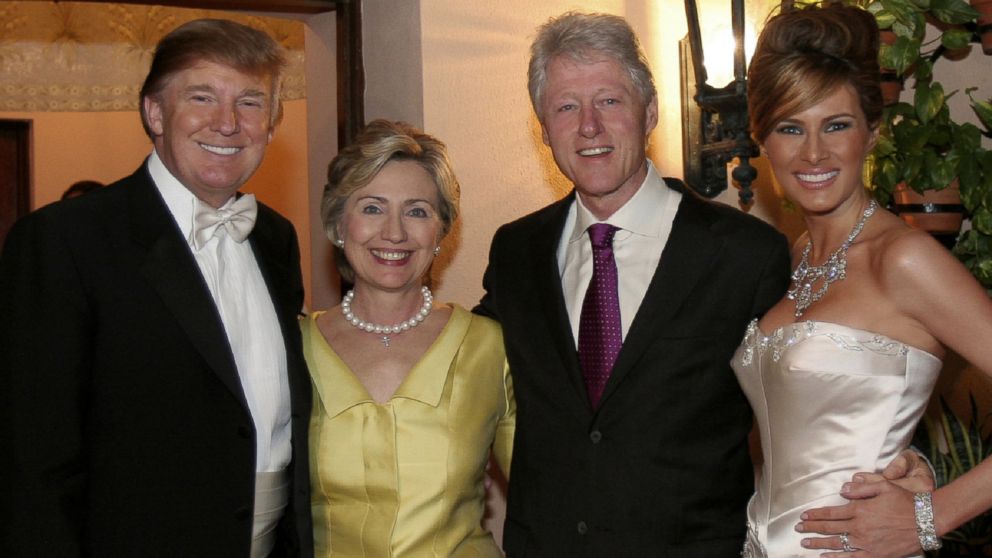
Donald Trump with his buddies, the Clintons - I think that's Trump's third wife on the right
Donald Trump and his third wife pose with his radical leftist Democrat friends

Donald Trump has been questioning whether Ted Cruz is eligible to run for President because he was born in Canada. I thought it might be worth it to look at the circumstances of Cruz’s birth, then get an opinion from some legal experts.

So as far as I can tell, there are 3 people on the planet who think that Cruz is not eligible to run for President. Donald Trump, Rand Paul and Ann Coulter, a famous celebrity comedian who supported Mitt Romney, and now supports Donald Trump. She is very fond of getting attention by saying outrageous things, which she later claims are “jokes”. This week, she wanted to have the Republican governor of South Carolina, Nikki Haley, deported. She later said she was joking.

Ted Cruz’s mother was born in the USA

So, let’s start with the facts:

Eleanor Darragh, mother of Sen. Ted Cruz (R-TX), was born in Delaware on Nov. 23, 1934, establishing her citizenship by birth–and, according to U.S. law, that of her son, even though he was born in Calgary, Alberta, Canada, on Dec. 22, 1970.

You can look at her birth certificate on Breitbart News. This is the thing that all the birthers on Daily Kos and Democratic Underground denied the existence of, until it appeared. There is no doubt that Ted Cruz’s mother is an American citizen, and she met the residency requirements to pass on birthright citizenship to baby Ted.

Ted Cruz’s mother passes the residency requirement to pass on birthright citizenship

Former assistant U.S. attorney, and law professor Andrew McCarthy explains in National Review:

Under the law in effect when Cruz was born in 1970 (i.e., statutes applying to people born between 1952 and 1986), the requirement was that, at the time of birth, the American citizen parent had to have resided in the U.S. for ten years, including five years after the age of fourteen. Cruz’s mother, Eleanor, easily met that requirement: she was in her mid-thirties when Ted was born and had spent most of her life in the U.S., including graduating from Rice University with a math degree that led to employment in Houston as a computer programmer at Shell Oil.

Ted’s mother registered baby Ted with the U.S. Consulate in Calgary. Cruz moved back to the USA when he was 4 years old. Cruz was able to get a U.S. passport to travel abroad in 1986. The U.S. government does not hand out U.S. passports to non-citizens.

A legal opinion from the Harvard Law Review

Now, I didn’t think this topic was worth writing about. It was actually my friend Robb who urged me to do it.

Robb sent me this article from the Harvard Law Review, which is what made me decide to go ahead and write about it.

The article is written by two experts in the law:

Neal Kumar Katyal is an American lawyer and chaired professor of law. He served as Acting Solicitor General of the United States from May 2010[2] until June 2011… Katyal was the Paul and Patricia Saunders Professor of National Security Law at Georgetown University Law Center and the lead counsel for the Guantanamo Bay detainees in the Supreme Court case Hamdan v. Rumsfeld. While serving at the Justice Department, he argued numerous cases before the Supreme Court.

Paul Drew Clement is a former United States Solicitor General and current Georgetown University law professor. He is also an adjunct professor at New York University School of Law. He was nominated by President George W. Bush on March 14, 2005 for the post of Solicitor-General, confirmed by the United States Senate on June 8, 2005, and took the oath of office on June 13. Clement replaced Theodore Olson. Clement resigned on May 14, 2008, effective June 2, 2008, and joined the Georgetown University Law Center as a visiting professor and senior fellow at the Supreme Court Institute.

The article says:

The Constitution directly addresses the minimum qualifications necessary to serve as President. In addition to requiring thirty-five years of age and fourteen years of residency, the Constitution limits the presidency to “a natural born Citizen.” All the sources routinely used to interpret the Constitution confirm that the phrase “natural born Citizen” has a specific meaning: namely, someone who was a U.S. citizen at birth with no need to go through a naturalization proceeding at some later time. And Congress has made equally clear from the time of the framing of the Constitution to the current day that, subject to certain residency requirements on the parents, someone born to a U.S. citizen parent generally becomes a U.S. citizen without regard to whether the birth takes place in Canada, the Canal Zone, or the continental United States.

While some constitutional issues are truly difficult, with framing-era sources either nonexistent or contradictory, here, the relevant materials clearly indicate that a “natural born Citizen” means a citizen from birth with no need to go through naturalization proceedings. The Supreme Court has long recognized that two particularly useful sources in understanding constitutional terms are British common law and enactments of the First Congress. Both confirm that the original meaning of the phrase “natural born Citizen” includes persons born abroad who are citizens from birth based on the citizenship of a parent.

“Natural born” means no naturalization process. Ted Cruz’s mother was a citizen by birth. She meets the residency requirements to pass on birthright citizenship. We have her birth certificate. We also have Ted’s birth certificate with her name on it as his mother. This ends the issue for all the people who are governed by reason and evidence.