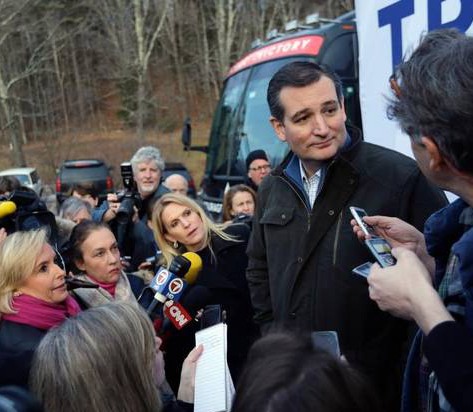
Some of you may be worried that Cruz is “too conservative” to win the general election, because he is indeed very conservative. One area where this is a concern is on the gay-marriage issue.
Is Cruz’s position on the same-sex marriage issue “too conservative” for the general election.
Take a look at how he answers this question:
Transcript:
“I am a constitutionalist and under the Constitution, marriage is a question for the states. That has been the case from the very beginning of this country- that it’s been up to the states. And so if someone wants to change the marriage laws, I don’t think it should be five unelected lawyers down in Washington dictating that. And even if you happen to agree with that particular decision, why would you want to hand over every important public policy issue to five unelected lawyers who aren’t accountable to you, who don’t work for you— instead if you want to change the marriage laws, convince your fellow citizens to change the laws. And by the way, it may end up that–we’ve got 50 states– that the laws in one state may be different than another state and we would expect that. We would expect the people of New York to adopt different laws than perhaps the people of Texas or California and that’s the great thing about a big, diverse country is that we can have different laws that respect different values.”
Part of me is so angry at losing the culture wars that I long for the President to push back against the leftists like a lawless dictator. Of course, that wouldn’t be Constitutional. And Ted Cruz is a Constitutional conservative. That means that he will appoint judges to the Supreme Court who do not make law from the bench, but he’ll leave decisions about controversial issues like the definition of marriage at the state level. That’s not as far as I would go, but it is Constitutional.
Besides, I could never get elected with my crazy top-down pro-marriage view. My conservative dictator view won’t fly in a general election, but Cruz’s Constitutional view will. If he wins and picks justices to reverse Obergefell, then people in red states will pass legislature that they want, people in blue states will pass what they want, and people who don’t want to be bullied by gay activists for disagreeing with redefining marriage will move to red states.
I’m sure I will be able to find a nice red state to live in that has the correct definition of marriage. I’m looking forward to a Cruz victory and no more threats to my religious liberty from the federal government.
Biomimetic refers to human-made processes, substances, devices, or systems that imitate nature. The art and science of designing and building biomimetic apparatus is called biomimetics, and is of special interest to researchers in nanotechnology, robotics, artificial intelligence (AI), the medical industry, and the military.
A snake moves without legs by the scales on its belly gripping the ground. It generates friction at the points needed to move forwards only and prevents its scales from being worn off by too much friction. Researchers of KIT have found a way to transfer this feature to components of movable systems. In this way, durability of hip prostheses, computer hard disks or smartphones might be enhanced.
“Friction and wear are two of the biggest challenges in systems of several individual components,” Christian Greiner of the Institute for Applied Materials says. A solution is found in nature: Snakes, such as the ball python, or lizards, such as the sandfish skink, use friction to move forwards, but can reduce it to a minimum thanks to their scales. Together with Michael Schäfer, Greiner developed a process to transfer the scale structure of reptiles to components of electromechanical systems: With a fiber laser, they milled scales into a steel bolt of 8 mm in diameter.
With the help of two different structures, the materials researchers tested whether the distance of the scales influences friction behavior. In the first structure, the scales overlap and are located very closely to each other, such as the scales on the belly of a ball python. The second structure consists of scales arranged in vertical rows at a larger distance, such as the skin of a sandfish skink. “The distance between the rows in our experiment was the smallest possible distance we could produce with the laser. The structure, hence, does not entirely correspond to that of the sandfish skink,” Greiner says. In the future, however, the researchers plan to produce structures that are closer to the original in nature.
[…]To find out whether scales reduce friction, Greiner and Schäfer fixed the structured surface of the bolts to a rotating plate. The experiments were carried out without and with a lubricant (1 ml of mineral oil). For the experiments with oil as lubricant, the scientists used steel disks. Under dry sliding conditions, sapphire disks were applied. The disk diameter was 50 mm.
Experiments under lubricated conditions revealed that both narrow and wide arrangements of the scales increase friction compared to the unstructured bolt: By the wide scales, friction is increased by a factor of 1.6. The narrow scales increase friction by a factor of 3. In the non-lubricated state, the wide scale structure reduced friction by more than 40 percent, while friction was reduced by 22 percent in case of a narrow scale structure.
The finding that the narrow scale structure increases friction under both lubricated and non-lubricated conditions had not been expected by the researchers: “We assumed that the narrow structure is more effective, as it is closer to nature,” Greiner says.
See the related posts for more examples of humans learning from the engineering designs in nature.
NEXT TO THE UNSTABLE DOLLAR, the biggest deadweight today on the American economy is the horrific federal income tax code. It is past time we junked this incomprehensible, opportunity-killing and corrupting monstrosity and replaced it with a simple flat tax. The returns we, the people, must file by today (even if you file for an extension, you have to pay what you owe Uncle Sam by this date) should be the last time we have to suffer through this ordeal.
More than 40 countries and jurisdictions (such as Hong Kong) have variations of a flat tax, and those systems have worked well.
For those unfamiliar with the concept, a flat tax is a single-rate income tax system that has few or no deductions. You could literally fill out your return on a single sheet of paper or with a few keystrokes on your computer.
The most basic and profound argument for a flat tax is moral.
The IRS estimates we spend 6 billion hours a year filling out tax forms. Experts calculate we spend over $200 billion a year complying with the income tax code.
The nice thing about the flat tax is that you can already see what happens in countries that have adopted it, by looking at the change in GDP growth in the years before the flat tax was adopted compared to the years after the flat tax was adopted.
Here’s a comparison of 3 countries that adopted flat tax rates at different times:
Forget the rhetoric: what happens to GDP growth after enacting a flat tax policy?
As you can see, when people waste less time filling in their taxes, they have more time for productive activities. And don’t let anyone fool you: a productive economy creates more jobs, and builds the resumes of the workers so that they can be resilient to layoffs and other challenges to their peace of mind and security.
So which candidate is going to give us a flat tax, and the economic growth that goes with it?
Ted and Heidi Cruz have a plan to simplify the tax code
The centrist Forbes magazine summarizes Cruz’s flat tax plan:
Ted Cruz claims that his tax plan would supercharge economic growth, boosting GDP by as much as 5% a year for a decade or more. That’s, umm, an ambitious goal to be sure. However, there is actually good reason to believe that he’s right. As long as we’re careful about how we define GDP growth and also as long as we consider all the ways in which his plan will change the economy. This does mean being a little perverse in our assumptions: but also correct in our assumptions.
The basics of the plan are that income taxes will be cut for all. Also, that pretty much all business taxation will be replaced with a 16% flat tax. It is claimed (and Cruz has Art Laffer there claiming it with him) that such a relief from the burdens of taxation will produce an explosion of economic growth. This is not, I feel, entirely believable to put it mildly. While there may well be specific bottlenecks in the taxation system the total take, at 35 to 36% of GDP, isn’t large enough for it to be causing a general lack of economic growth. Not in my opinion at least and in the opinion of vanishingly few economists too.
Conservative economist Stephen Moore says this about the Cruz plan in The American Spectator:
Senator Ted Cruz has a flat tax plan borrowed from a blueprint in a book by Arthur Laffer and me called, Return to Prosperity.
[…]Conservatives should be excited about the Cruz flat tax. It’s what tax filers have been waiting decades for:
First, the Cruz plan would give America the lowest tax rates since the income tax was devised 100 years ago. For this reason, these plan are estimated by the Tax Foundation to grow the economy by a gigantic $2 trillion extra GDP per year after 10 years. That’s exactly the opposite effect of the Hillary and Bernie show plans.
Second, Cruz’s plan eliminates almost all deductions and credits — which is how they get the rate so low. The IRS could be dramatically shrunk in size. Don’t forget, when there are fewer deductions, there are fewer ways to cheat on your taxes. The lower the tax rate, the less incentive to cheat, which means greater voluntary compliance.
Third, because the Cruz plan is “border adjustable,” imports are taxed at the flat rate when they are brought into the U.S., but American products sold abroad are not taxed at all. This would level the global playing field for American manufacturers, tech firms, and drug companies and bring these jobs scampering back to the U.S. Blue collar union workers should love this.
[…]Some conservatives complain that the tax is too efficient and so it will raise too much money.
Moore works for the Heritage Foundation, the number one conservative think tank, which features conservative policy on social, fiscal and foreign policy issues. My favorite think tank.
And famous economist Art Laffer says this: (H/T Dad)
Art Laffer is a speaker for the American Enterprise Institute, which is a champion of the free enterprise system.
Forbes, Moore and Laffer are my three favorite authorities on tax policy and economic growth.
If you are nervous about the economy, you need to vote for Ted Cruz and get this plan enacted. Imagine not having to worry about losing your job, losing work hours, and so on. I would like to get in on a stock market boom so that I can pay off my mortgage faster. If you all join me in voting for Ted Cruz, we can all stop worrying about money for the next 10 years. But we need people to get behind economic policies that work. Steve Forbes, Stephen Moore and Art Laffer are experts in tax policy. We need to listen to the experts, and we need to do what has been proven to work, not what sounds good.
Ted Cruz discussing the plan on CNBC:
This is the United States of America – we are not some third world country that elects a charismatic socialist dictator who attacks job-creating businesses. Our country is founded on limited government, federalism, and low taxes. We need to vote for economic growth and free enterprise. If people want to punish the rich, they should move to Cuba, Venezuela, Argentina and North Korea, and get their income inequality there.