Arthur Brooks: why is the American public shifting from optimism to envy?

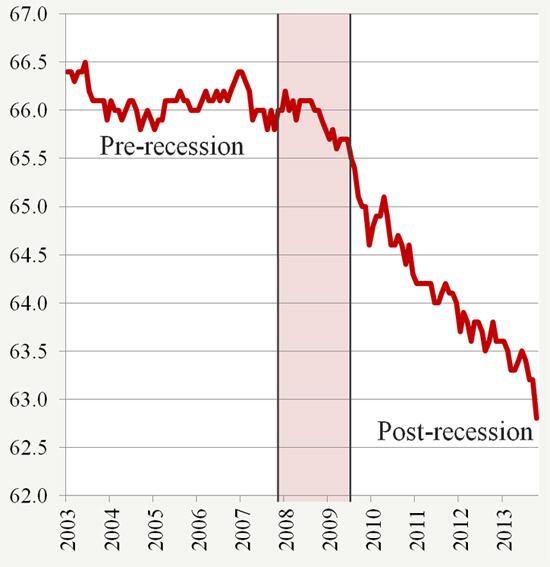
Labor Force Participation down to 62.8%

An editorial by Arthur Brooks appeared today in the leftist New York Times. His topic is the shift from optimism to envy, why it is happening, and whether envy makes us happier than optimism.

Excerpt: (links removed)

The Irish singer Bono once described a difference between America and his native land. “In the United States,” he explained, “you look at the guy that lives in the mansion on the hill, and you think, you know, one day, if I work really hard, I could live in that mansion. In Ireland, people look up at the guy in the mansion on the hill and go, one day, I’m going to get that bastard.”

[…]Unsurprisingly, psychologists have found that envy pushes down life satisfaction and depresses well-being. Envy is positively correlated with depression and neuroticism, and the hostility it breeds may actually make us sick. Recent work suggests that envy can help explain our complicated relationship with social media: it often leads to destructive “social comparison,” which decreases happiness. To understand this, just picture yourself scrolling through your ex’s wedding photos.

My own data analysis confirms a strong link between economic envy and unhappiness. In 2008, Gallup asked a large sample of Americans whether they were “angry that others have more than they deserve.” People who strongly disagreed with that statement — who were not envious, in other words — were almost five times more likely to say they were “very happy” about their lives than people who strongly agreed. Even after I controlled for income, education, age, family status, religion and politics, this pattern persisted.

It’s safe to conclude that a national shift toward envy would be toxic for American culture.

Unfortunately, in the wake of the Great Recession, such a shift may well be underway, given the increasing anxiety about income inequality and rising sympathy for income redistribution. According to data from the General Social Survey, the percentage of Americans who feel strongly that “government ought to reduce the income differences between the rich and the poor” is at its highest since the 1970s. In January, 43 percent of Americans told the Pew Research Center that government should do “a lot” to “reduce the gap between the rich and everyone else.”

Why the shift? The root cause of increasing envy is a belief that opportunity is in decline. According to a 2007 poll on inequality and civic engagement by the Maxwell School of Citizenship and Public Affairs at Syracuse University, just 30 percent of people who believe that everyone has the opportunity to succeed describe income inequality as “a serious problem.” But among people who feel that “only some” Americans have a shot at success, fully 70 percent say inequality is a major concern.

People who believe that hard work brings success do not begrudge others their prosperity. But if the game looks rigged, envy and a desire for redistribution will follow.

This is the direction we’re heading. According to Pew, the percentage of Americans who feel that “most people who want to get ahead” can do so through hard work has dropped by 14 points since about 2000. As recently as 2007, Gallup found that 70 percent were satisfied with their opportunities to get ahead by working hard; only 29 percent were dissatisfied. Today, that gap has shrunk to 54 percent satisfied, and 45 percent dissatisfied. In just a few years, we have gone from seeing our economy as a real meritocracy to viewing it as something closer to a coin flip.

There is a good lesson in this for people who want what is best for the poor. Simply receiving money from others is not going to make poor people happy. What we need to focus on is providing the poorest people with opportunities.

One way to help the poor is by giving poor children a better education. Conservatives support school choice, which takes money away from government and puts it back in the hands of parents, letting them choose the best school for their child. Schools have to produce good outcomes in order to earn the money, just like private businesses have to compete for customers. But Democrats oppose school choice, as when they killed the D.C. voucher program that helped poor black students. Less school choice helps public schools to be insulated from competition, which provides worse outcomes to students, especially poor minority students. If we really cared about poor, minority students, we would put pressure on public schools to compete with private schools. But the Democrats don’t want that, they prefer to give favors to their teacher union allies.

Democrats also want to punish job creators with high taxes and burdensome regulations. Democrats passed Obamacare, which punishes businesses with taxes if they allow part-time workers to work for more than 30 hours a week. Many jobs were lost because of this, and many people are now struggling to pay higher premiums for plans with higher deductibles and co-pays. Obamacare is a nightmare of intrusive regulations, too. Now the Democrats are talking about raising the minimum wage, which is going to put even more pressure on employers to lay off workers, because they can’t afford to pay them more money for the same work. For Democrats, this is all to the good, though. Because if the poor don’t have jobs, or can’t work enough hours, they start to see the economic game as “rigged” and they are more responsive to “envy rhetoric”. They start to look to big government for handouts, rather than trying to prevent the government from taxing and regulating job creators.

What we need to see is that it’s not the Democrats’ objective to help people find jobs. They gain when people become more envious, like in European countries, and start to vote to grow the size and power of government to redistribute wealth. Speeches about income inequality never have the goal of giving people jobs. None of Obama’s policies aim to do that. That’s why he won’t build the Keystone XL pipeline, or boost domestic energy development here at home. Instead, they want to extend unemployment benefits and pass the costs on to the next generation. Their goal is to get you unemployed or on disability or on welfare, so that you will vote for the government to continue to take your neighbor’s money to give it to you. That manufactured envy is what keeps the Democrats in power.

This plan to borrow from young people to buy the votes of old people today works for a while, until the money runs out. But by then, the politicians who put in place the redistribution programs are usually long gone .

Who should you marry?

Painting: “Tristan and Isolde”, by Marc Fishman

Dina found this article in the leftist Washington Post, of all places. The author explains how her husband lovingly helped her to recover from her Caesarian section. He actually had to to carry her to and from the bathroom, very slowly. Until she was better.

She writes:

At the time, I thought: This is why I married this man. Not for his fabulous head of hair or his beautiful, light-brown eyes — though those things were certainly bonuses. But no. It was his gentleness, his thoughtfulness, his loving heart, his caring nature that sealed the deal for me.

As a dating coach who works with singles in their 20s to 50s, I see a lot of people focusing on superficial things that have little to do with a potential partner’s character. I get it — I once obsessed over those things, too.

Most of all, I see how the trap of chemistry can lead people astray. Chemistry is important, but as far as relationships go, it’s only half the equation.

So how do you look for these deeper, more important qualities in the early stages of dating? Some might argue there’s no way to tell in, say, the first several months of dating someone — after all, it is the honeymoon stage — if this is the type of person who will help you onto the toilet during times of trial. I disagree.

Looking back to the early days of dating Dave, all the signs were there. He treated my friends with care and kindness, which showed me he had the ability to be compassionate. The way he scoured the Internet for the perfect gifts for my parents and nephews showed me his thoughtful, generous side. He rubbed my back and wiped my tears after I suffered a heart-wrenching squash match loss, showing me that validating my feelings was important to him (even if I’m the most competitive person alive and it was just a squash match). He listened to me vent after a difficult fallout with a colleague, showing me he was ready and willing to be a part of my support system.

When he stayed up until the early hours of the morning, helping me with Web site issues relating to my coaching business, I knew I’d found someone who would support me in my professional goals as well as physically and emotionally. When he held my hands and said “We’ll figure it out” while I was dealing with a frustrating medical situation, that was probably my biggest clue that he’d be so supportive in that hospital room years down the line.

Singles should keep their eyes open for these signs. They’re more telling than a person’s job, salary, ambition or education; whether he or she is the “right age”; has the perfect body; or can dazzle you with their charm and wit.

Keep your eyes open for the type of person who one day might lovingly help you onto the toilet.

When you are married, the amount of time you spend having fun and feeling thrilled is minuscule. The real problems you face are money problems, sex problems, in-law problems, holiday problems, parenting problems, etc. Most often in marriage hard stuff needs to get done. Compromises need to be made. There is actually very little fun and thrills. If you want to prepare for most of what marriage is about, then it’s best to focus on responsibilities, expectations and obligations. Spouses need each other, and the ability to sense someone else’s needs and to care for them, even when it’s not fun for you, is non-negotiable.

The bottom line for people to understand is that you can’t be a selfish fun-seeking, thrill-seeking, FOMO-traveling hedonist all your life, and then jump into marriage at the last minute. You have to mature and grow your character so that you are ready for the responsibilities, expectations and obligations that marriage requires. If you go through your 20s and 30s always doing what feels good “in the moment”, then don’t expect that any last-second desperate marriage will last. You are are the person who makes all the decisions before you marry. If your repeated pattern of decision making is to do what feels good “in the moment”, then you won’t suddenly be able to turn into a person who is comfortable with doing what marriage requires of you. You have to form your character first so that you are comfortable with what marriage requires of you.

Believe me when I tell you that some women who hate the things I write are now divorced, unemployed and running short of money because they thought that following their heart was the right approach to life. If you’re not practicing how to deny your own self-interest and practicing how to build up the people around you to practice for marriage, then your marriage won’t last. If you push away people who are wiser than you are, so that you can follow your heart, your marriage won’t last. If you think that you have to delay marriage in order to tick off items on a list of impressive, fun things that the feminist culture says are “more important” than marriage, then your marriage won’t last. The prerequisite to a successful marriage is growing up.

William Lane Craig debates Austin Dacey: Does God Exist?

Two tough rams butt heads, and may the best ram win!

Here is the video and summary of a debate between Christian theist William Lane Craig and Austin Dacey at Purdue University in 2004 about the existence of God.

The debaters:

The video: (2 hours)

The video shows the speakers and powerpoint slides of their arguments. Austin Dacey is one of the top atheist debaters, and I would put him second to Peter Millican alone, with Walter Sinnott-Armstrong in third place. This is the debate to show people who are new to apologetics. The debate with Peter Millican is better for advanced students, and that’s no surprise since he teaches at Oxford University and is familiar with all of Dr. Craig’s work. The Craig-Dacey debate is the one that I give to my co-workers.

By the way, you can get the DVDs and CDs for the first Craig-Dacey debate and the second Craig-Dacey debate and the second Craig-Sinnott-Armstrong debate. The Peter Millican debate is not available on DVD, but the link above (Peter Millican) has the video and my summary.

Dr. Dacey’s 5 arguments below are all good arguments that you find in the academic literature. He is also an effective and engaging speaker, This is a great debate to watch!

SUMMARY of the opening speeches:

Dr. Craig’s opening statement:

Dr. Craig will present six reasons why God exists:

  1. (Contingency argument) God is the best explanation of why something exists rather than nothing
  2. (Cosmological argument)  God’s existence is implied by the origin of the universe
  3. (Fine-tuning argument) The fine-tuning of the universe for intelligent life points to a designer of the cosmos
  4. (Moral argument) God is the best explanation for the existence of objective moral values and objective moral duties
  5. (Miracles argument) The historical facts surrounding the life, death and resurrection of Jesus
  6. (Religious experience) God’s existence is directly knowable even apart from arguments

Dr. Dacey’s opening argument:

There are two ways to disprove God’s existence, by showing that the concept of God is self-contradictory, or by showing that certain facts about ourselves and the world are incompatible with what we would expect to be true if God did exist. Dr. Dacey will focus on the second kind of argument.

  1. The hiddenness of God
  2. The success of science in explaining nature without needing a supernatural agency
  3. The dependence of mind on physical processes in the brain
  4. Naturalistic evolution
  5. The existence of gratuitous / pointless evil and suffering

One final point:

One thing that I have to point out is that Dr. Dacey quotes Brian Greene during the debate to counter Dr. Craig’s cosmological argument. Dr. Craig could not respond because he can’t see the context of the quote. However, Dr. Craig had a rematch with Dr. Dacey where was able to read the context of the quote and defuse Dr. Dacey’s objection. This is what he wrote in his August 2005 newsletter after the re-match:

The following week, I was off an another three-day trip, this time to California State University at Fresno. As part of a week of campus outreach the Veritas Forum scheduled a debate on the existence of God between me and Austin Dacey, whom I had debated last spring at Purdue University. In preparation for the rematch I adopted two strategies: (1) Since Dacey had come to the Purdue debate with prepared speeches, I decided to throw him for a loop by offering a different set of arguments for God, so that his canned objections wouldn’t apply. I chose to focus on the cosmological argument, giving four separate arguments for the beginning of the universe, and on the evidence for Jesus’ resurrection. (2) I reviewed our previous debate carefully, preparing critiques of his five atheistic arguments. In the process I found that he had seriously misunderstood or misrepresented a statement by a scientist on the Big Bang; so I brought along the book itself in case Dacey quoted this source again. I figured he might change his arguments just as I was doing; but I wanted to be ready in case he used his old arguments again.

[…]The auditorium was packed that night for the debate, and I later learned that there were overflow rooms, too. To my surprise Dr. Dacey gave the very same case he had presented at Purdue; so he really got clobbered on those arguments. Because he wasn’t prepared for my new arguments, he didn’t even respond to two of my arguments for the beginning of the universe, though he did a credible job responding to the others. I was pleased when he attacked the Big Bang by quoting the same scientist as before, because I then held up the book, specified the page number, and proceeded to quote the context to show what the scientist really meant.

Dr. Craig is always prepared!