Hillary Clinton and her ally, the Human Rights Campaign
This article by Kelsey Harkness appeared in the Daily Signal, and it’s a must-read.
Excerpt:
More than 25 prominent leaders of the national LGBT movement, including elected officials and other influential voices, gathered for the four-day event called the Equality Forum.
The Daily Signal attended several panel discussions featuring speakers such as Janson Wu, executive director of the advocacy group GLAD; James Esseks, director of the lesbian, gay, bisexual, transgender, and AIDS project at the American Civil Liberties Union; and Evan Wolfson, former president of Freedom to Marry, a campaign largely credited with winning the legalization of same-sex marriage.
Looking forward, speakers said, priorities include defeating “anti-LGBT” bills, supporting lesbian, gay, bisexual, and transgender youth through new school policies and curriculum and partnering with outside organizations on minority-driven issues such as gun control and criminal justice reform. They called for Congress to amend the Civil Rights Act to add protections in places of public accommodation, among other changes.
LGBT advocacy groups also are involved in an array of lawsuits they believe could have a major impact, including a Pennsylvania case where a transgender women alleges discrimination by her former employer.
Kelsey has a four point list summarizes the main priorities of the gay rights movement:
The biggest threat LGBT leaders said they’re facing is what they call “anti-LGBT” legislation proposed by conservatives in state and local governments.
After the U.S. Supreme Court ruled on same-sex marriage, many people of faith concluded they needed laws to protect their conscience rights so that they can run businesses, adoption agencies, and charity organizations in accord with their deeply held religious beliefs.
Specifically, these state laws—which advocates call Religious Freedom Restoration Acts (RFRAs) after the 1993 federal law—aim to protect from discrimination or punishment those who believe that marriage is the union of one man and one woman, that sexual relations should be reserved for marriage, and that gender identity is based on biological sex.
Wolfson, who spent decades advocating same-sex marriage, didn’t pay much mind to those concerns.
“Religion is not the reason people are bigots,” he said. “It’s the excuse.”
With more than 200 such measures popping up last year, Equality Forum panelists said they were dealt a major challenge from opponents who they believe are trying to use religion as a reason to discriminate.
“We knew there was going to be a backlash, but the backlash was bigger than I thought it was going to be,” the ACLU’s Esseks said, speaking of the Supreme Court’s same-sex marriage decision. “That’s an enormous onslaught of organized legislative activity coming at us.”
To defeat their opponents, LGBT groups plan to go state by state to strike down religious freedom measures and, instead, implement their own laws on sexual orientation and gender identity. They said they intend to do this until new federal law or court decisions negate that necessity.
“The national conversation around this is night and day different from where it was last fall,” Esseks said, expressing confidence the tide is shifting in their favor. “We finally got over being awkward and shy about talking about restrooms.”
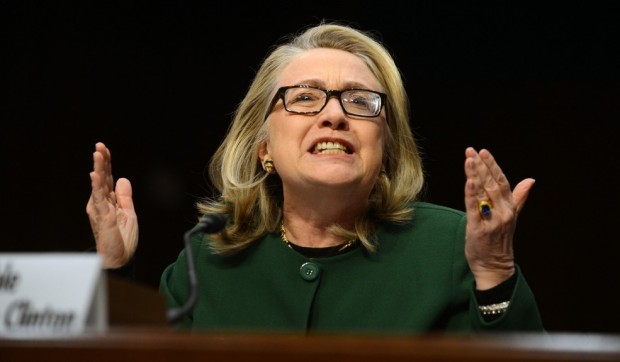
Hillary Clinton has previously said that religious liberty and conscience is no defense to being forced to fund abortions. There’s no reason to think that she has any objection to using the law and the courts to compel Christians and conservatives to celebrate and participate in the agenda of the gay activists.
What difference at this point does national security make? How dare you question the Queen?
There was an interview on Fox News Sunday featuring centrist Chris Wallace and Democrat presidential candidate Hillary Clinton.
Full video:
It was hard work to find any news articles that mentioned the exchanges about Benghazi, her private, unsecure e-mail server and alleged peddling of Secretary of State influence for foreign donations, through the Clinton foundation,
Regarding Benghazi, the Washington Free Beacon noted that Clinton called one of the gold star moms a liar, for contradicting Clinton’s story that the terrorist attack was caused by a YouTube video:
With Benghazi playing a major theme in the attacks against Clinton, Wallace played a video clip from the Republican National Convention (RNC) of Pat Smith blaming Clinton for her son’s death.
“I blame Hillary Clinton. I blame Hillary Clinton personally for the death of my son. That’s personally,” Smith said.
Wallace asked Clinton about Smith’s comments that Clinton lied to her and the other families on the day when the Benghazi victims’ bodies returned to the United States.
“I don’t hold any ill feeling for someone who in that moment may not fully recall everything that was or wasn’t said,” Clinton said.
Wallace played the video of Clinton blaming the attack on YouTube video. She’s not just calling the gold star mom a liar, she’s calling the video of her blaming the video a liar, too.
Breitbart News reported on the questions Wallace asked about the Clinton Foundation:
Wallace, in an exclusive sit-down interview, asked Clinton about allegations first made in Clinton Cash, the book and now film/graphic novel, that Clinton used the multi-billion-dollar charity for international “pay-to-play” deals while she served as Secretary of State. Author and Breitbart News Senior Editor-at-Large Peter Schweizer says that Clinton Foundation donors were on the receiving end of corrupt deals approved by Hillary’s State Department — including the sale of U.S. uranium to Russia and a rare, lucrative mining permit in Haiti.
Clinton retorted that she is “really proud of the Clinton Foundation,” yet not a single speaker at the DNC last week — not even Bill or Chelsea Clinton — mentioned the Foundation or its spinoffs such as the Clinton Global Initiative.
[…]This week, news broke that the IRS is investigating the Clinton Foundation. Earlier this month, FBI Director James Comey would not confirm or deny whether the bureau is investigating the Foundation during congressional testimony. Just days later, The Globe and Mail reported that “The Canadian affiliate of the Clinton Foundation is spending an astounding 78 percent of the money it raises on administrative costs.”
And finally, she got a Four Pinnochios rating from the far-left Washington Post for her comments about her private, unsecure e-mail server – which she used to prevent her employer from reading her e-mails when she was Secretary of State:
The Facts
“Director Comey said my answers were truthful, and what I’ve said is consistent with what I have told the American people, that there were decisions discussed and made to classify retroactively certain of the emails.”
—Hillary Clinton, interview on “Fox News Sunday,” July 31, 2016
Clinton made these remarks after “Fox News Sunday” host Chris Wallace played a video of her saying: “I did not email any classified material to anyone on my email. There is no classified materials. I am confident that I never sent nor received any information that was classified at the time. I had not sent classified material nor received anything marked classified.”
As Wallace put it, “After a long investigation, FBI Director James Comey said none of those things that you told the American public were true.”
After Clinton denied that, Wallace played another video of an exchange between Comey and Rep. Trey Gowdy (R-S.C.), chair of the House Select Committee on Benghazi:
GOWDY: Secretary Clinton said there was nothing marked classified on her emails either sent or received. Was that true?
COMEY: That’s not true.
GOWDY: Secretary Clinton said, “I did not email any classified material to anyone on my email. There is no classified material.” Was that true?
COMEY: There was classified material emailed.
So what’s going on here?
The Facts
Clinton is cherry-picking statements by Comey to preserve her narrative about the unusual setup of a private email server. This allows her to skate past the more disturbing findings of the FBI investigation
[…]The Pinocchio Test
As we have seen repeatedly in Clinton’s explanations of the email controversy,she relies on excessively technical and legalistic answers to explain her actions. While Comey did say there was no evidence she lied to the FBI, that is not the same as saying she told the truth to the American public — which was the point of Wallace’s question. Comey has repeatedly not taken a stand on her public statements.
And although Comey did say many emails were retroactively classified, he also said that there were some emails that were already classified that should not have been sent on an unclassified, private server. That’s the uncomfortable truth that Clinton has trouble admitting.
Her final rating:
Four Pinocchios
It’s a firing offense – unless you’re Hillary Clinton. And when you are dealing with classified information, it’s a treason offense – unless you’re Hillary Clinton.
The Center for Media and Public Affairs (CMPA) at George Mason University is out with a new study on media fact checkers, and unsurprisingly, their results suggest that PolitiFact has it out for Republicans. Dylan Byers at Politico summarized CMPA’s findings:
The fact-checking organization PolitiFact has found Republicans to be less trustworthy than Democrats, according to a new study.
Fifty-two percent of Republican claims reviewed by the Tampa Bay Times fact-checking operation were rated “mostly false,” “false” or “pants on fire,” versus just 24 percent of Democratic statements, according to George Mason University’s Center for Media and Public Affairs. By the same token, 54 percent of Democratic statements were rated as “mostly true” or “true,” compared to just 18 percent of Republican statements.
The CMPA looked at 100 statements — 46 by Democrats, 54 by Republicans — that were fact-checked by PolitiFact between January 20 and May 22.
[…]This is also not the first academic study that concluded PolitiFact might be putting their thumb on the scale when it comes to selecting and evaluating political statements. Last year, during the height of campaign season, the CMPA tallied up PolitiFact ratings. That study also showed PolitiFact tends to be much harder on Republicans:
The study examined 98 election-related statements by the presidential candidates, their surrogates, and campaign ads fact-checked by PolitiFact.com from June 1 to September 11. Major findings:
PolitiFact checked the assertions of Democrats slightly more often than those of Republicans (54% vs. 46% of all statements).
However, PolitiFact rated Democratic statements as “mostly true” or “entirely true” about twice as often as Republican statements — 42% true ratings for Democrats vs. 20% for Republicans.
Conversely, statements by Republicans were rated as entirely false about twice as often as Democratic statements – 29% false ratings for GOP statements vs. 15% false ratings for Democrats. (This includes categories labeled “false” and “pants on fire.”)
Further, the University of Minnesota School of Public Affairs looked at over than 500 PolitiFact stories from January 2010 through January 2011. Their conclusion:
Current and former Republican officeholders have been assigned substantially harsher grades by the news organization than their Democratic counterparts. In total, 74 of the 98 statements by political figures judged ‘false’ or ‘pants on fire’ over the last 13 months were given to Republicans, or 76 percent, compared to just 22 statements for Democrats (22 percent).
In other words, they are cherry-picking statements that are false for Republicans and true for Democrats. But maybe that’s just because Republicans lie more than Democrats right before an election? Maybe, just before an election, Republicans suddenly start to lie uncontrollably while Democrats suddenly start to tell the truth all the time?
Let’s take a look at one famous case and see.
This is from Avik Roy, health care policy expert at Forbes magazine.
2008 PolitiFact before the election: ‘We rate his statement True’
Roy writes: (links removed)
On October 9, 2008, Angie Drobnic Holan of PolitiFact published an article using the site’s “Truth-O-Meter” to evaluate this claim: “Under Barack Obama’s health care proposal, ‘if you’ve got a health care plan that you like, you can keep it.’” The article assures us in its headline that “Obama’s plan expands [the] existing system,” and continues that “Obama is accurately describing his health care plan here…It remains to be seen whether Obama’s plan will actually be able to achieve the cost savings it promises for the health care system. But people who want to keep their current insurance should be able to do that under Obama’s plan. His description of his plan is accurate, and we rate his statement True.”
The 2008 Obama plan, among other things, sought to transform the individual insurance market; it proposed to bar insurers from charging different premiums to the healthy and the sick, and to require them to offer plans to all comers, regardless of prior health status. According to PolitiFact, however, there was no need to worry that these provisions would be disruptive to existing health plans.
As per PolitiFact’s usual M.O., Holan didn’t seek out any skeptical health-policy experts to suss out the veracity of Senator Obama’s signature claim. Instead, its sources included Jonathan Cohn, a passionate Obamacare supporter at The New Republic, and various interviews and statements of Mr. Obama. Holan simply took the “keep your plan” promise at face value, dismissing as dishonest anyone who dared suggest that Obama’s claim would be impossible to keep. “His opponents have attacked his plan as ‘government-run’ health care,” she wrote, the scare-quotes around “government-run” being visible to all.
PolitiFact’s pronouncements about Obamacare were widely repeated by pro-Obama reporters and pundits, and had a meaningful impact on the outcome of the election. Indeed, in 2009, PolitiFact won the Pulitzer Prize for its coverage of the 2008 campaign.
Here’s the screen capture from 2008:
Politifact caught with its pants on fire
2013 PolitiFact after the election: ‘We rate his statement Pants On Fire’
Roy writes: (links removed)
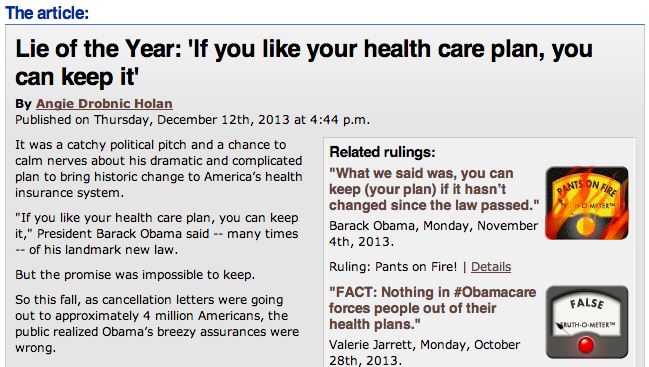
On December 12, [2013] the self-appointed guardians of truth and justice at PolitiFact named President Obama’s infamous promise—that “if you like your health care plan, you can keep it”—its 2013 “Lie of the Year.”
[…]So that brings us back to the fall of 2013. As Obamacare’s battle station became operational, and tens of millions of health plans became illegal, PolitiFact was caught with its flaming pants down. Louis Jacobson rapped Valerie Jarrett for tweeting that “nothing in Obamacare forces people out of their health plans”—a claim Jacobson rated as “False,” even though PolitiFact had rated it as “True” and “Half True” before.
On November 4, Jacobson rated as “Pants on Fire” the President’s new claim that “what we said was, you can keep [your plan] if it hasn’t changed since the law passed.” Both pieces were edited by Angie Drobnic Holan, who had initially granted PolitiFact’s seal of approval to Senator Obama’s 2008 promise. Holan delivered the coup de grâce, declaring as PolitiFact’s “Lie of the Year” the “keep your plan” promise.
“The promise was impossible to keep,” says Holan in her December piece. Now she tells us! But none of the key facts that made that promise “impossible” in 2008 had changed by 2013. The President’s plan had always required major disruption of the health insurance market; the Obamacare bill contained the key elements of that plan; the Obamacare law did as well. The only thing that had changed was the actual first-hand accounts of millions of Americans who were losing their plans now that Obamacare was live.
And the screen capture from 2013:
Politifact says: we were just kidding! Kidding!
So when Politifact rates a statement by a Democrat as true, what they really mean is that it’s pants-on-fire-false, but it’s election time so they don’t say that.
The Tampa Bay Times. Politifact. It’s a catchy name, isn’t? It’s telling us the Facts about Politics.
I think this case demonstrates how people on the political left allow their emotions to overturn objective reality. You can keep your doctor. You can keep your health plan. Benghazi was caused by a Youtube video. The e-mails and e-mail backups of all the IRS employees were lost. The Department of Justice did not target Associated Press journalists. The assault weapons were not gun-walked to Mexican drug cartels. They will believe anything that makes them feel superior and noble, even when faced with evidence that clearly falsifies their beliefs.