J. Warner Wallace: is the idea that you should only evangelize your friends Biblical?

Ratio Christi event at Ohio State University featuring Frank Turek

A recent post from the Please Convince Me blog analyzed whether it is normal for Christians to only evangelize their friends.

Excerpt:

We typically only share our faith with people we know, so it’s shouldn’t surprise us that these are the people who come to know something about our faith! But does it have to be this way, and more importantly, is this approach consistent with what the New Testament teaches?

In order to answer this question, we needn’t go further than the words of Jesus. During His earthly ministry, Jesus commissioned seventy-two of His followers to travel from town to town, announcing, “The Kingdom of God has come near” (Luke 10:9). Were these disciples told to engage only people they already knew? Hardly. In fact, Jesus warned these budding evangelists that they would be in unknown, often dangerous territory; He told the group they would be “lambs in the midst of wolves” (Luke 10:3). Later, after the Resurrection, Jesus commissioned His apostles with a more sweeping directive: “You shall be My witnesses both in Jerusalem, and in all Judea and Samaria, and even to the remotest part of the earth” (Acts 1:8). It’s clear that the expansive geographic parameters described by Jesus would require the apostles to move quickly beyond the limits of their friends and acquaintances.

And that’s exactly what the apostles proceeded to do. Paul repeatedly entered unfamiliar synagogues to announce the Good News to Jews who were strangers to Paul (i.e. Acts 13:13-42 and Acts 18:4-5), and he frequently evangelized “on the streets” from town to town to Jewish and Gentile groups he did not know (i.e. Acts 13:44-52 and Acts 17:16-21). In fact, there are very few examples of friendship evangelism on the pages of Scripture.

I gently reminded the students that they needed to see strict friendship evangelism for what it truly is: a natural, fallen, human response to the fear of discomfort and worldly judgment. Most of us are more concerned with how we will be perceived (and the discomfort we might feel) than our godly responsibility to share the Gospel.  Jesus has a message for us: Get over it. Get comfortable with discomfort. The more we talk about Jesus and reflect His nature and mission, the more likely the world will hate us (John 15:18-16:14). The more we stand up for the truth, the more likely the world will put us in a tough spot (Matthew 10:17-23). And the more we are ostracized by the fallen world around us, the more joy we ought to feel to have been given the opportunity to stand up for something more than our own immediate personal comfort (Luke 6:22-23).

See, I think the problem is that Christians, when they evangelize, are not equipped to do anything more than talk about their personal experiences and preferences when it comes to evangelism. The problem is that asserting that your experience/preference is better than someone else’s experience/preference is uncomfortable. Especially if their preference makes them happy and makes them act nicely. That’s why evangelizing people is so intimidating for us – because we’re never telling people about facts that are true or false out there in the real world. It’s not controversial to tell someone that their belief about the world out there is wrong. That’s why I prefer to talk about public, testable data – like whether the universe began, or how to make a protein, or where the Cambrian animals came from. That’s just like discussing anything else.

The publication of the new Darwin’s Doubt book that was on the New York Times non-fiction bestseller list is a good example of something to talk about safely. Although I might intimidated about trying to talk about feelings, sinfulness and religious experiences with people, I don’t mind talking about science with people. It’s much easier to talk about facts and evidence that about my personal experiences. People understand that and they aren’t intimidated by it, because they feel that they can disagree with factual claims and participate in the discussion.

For example, if I am talking to a Hindu, I’ll show him the papers that argue against the oscillating universe model which is part of the Hindu religion. I don’t even have to mention Hinduism, Christianity or religion. And then he has to come back to me on that factual claim. But it’s a lot easier for me to tell him he’s wrong about facts than to tell him he’s wrong about religious preference claims. Think about it – you disagree with strangers and acquaintances all the time about facts, and you’re not scared of that. I tell people they’re wrong about computer science stuff every day. Why is it any different to tell them that they’re wrong about facts that happen to be related to the claims of different religions? It’s the same thing! That’s why it’s so important to speak about facts with strangers. It’s normal. It’s not weird. It’s easy to say “You need to get your facts straight, because not knowing the facts is causing you to commit to the wrong religion”. That’s doable. Even with strangers.


Study: women who attend church regularly are healthier, and live longer

Church is good for you

CNS News reports on a new Harvard study that was published in JAMA Internal Medicine.

It says:

A new study by the Harvard T.H. Chan School of Public Health and published online in JAMA Internal Medicine found that women who attended religious services more than once a week were more than 30% less likely to die during a 16-year-follow-up than women who never attended.

The study also found that compared with women who never attended religious services, women who attended more than once per week had a decreased risk of both cardiovascular mortality (27%) and cancer mortality (21%).

“Our results suggest that there may be something important about religious service attendance beyond solitary spirituality,” said Tyler VanderWeele, professor of epidemiology at Harvard Chan School and senior author of the study. “Part of the benefit seems to be that attending religious services increases social support, discourages smoking, decreases depression, and helps people develop a more optimistic or hopeful outlook on life.”

[…]Most of the women in the study were Protestant or Catholic. The baseline age of the participants was 60 years or older – and “therefore the study cannot be generalized to men or young adults.”

Now, note: this is not an apologetics argument, it’s just something interesting to get a discussion started. Obviously, we don’t believe things just because they make us happier or healthier. I would raise this to get a discussion started about whether a secular life that suppresses questions of meaning and purpose can really be satisfying at all. My goal is truth, though. Not life enhancement. We have to keep the focus on truth.

Study: women who have fewer premarital sex partners have lower risk of divorce

Man helping a woman with proper handgun marksmanship

Consider this article from Family Studies that talks about how the number of pre-marital sex partners that a woman has increases her risk of divorce.

It says:

American sexual behavior is much different than it used to be. Today, most Americans think premarital sex is okay, and will have three or more sexual partners before marrying. What, if anything, does premarital sex have to do with marital stability?

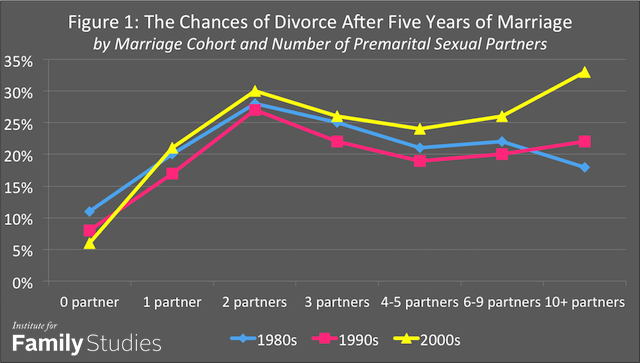
This research brief shows that the relationship between divorce and the number of sexual partners women have prior to marriage is complex. I explore this relationship using data from the three most recent waves of the National Survey of Family Growth (NSFG) collected in 2002, 2006-2010, and 2011-2013. For women marrying since the start of the new millennium:

  • Women with 10 or more partners were the most likely to divorce, but this only became true in recent years;
  • Women with 3-9 partners were less likely to divorce than women with 2 partners; and,
  • Women with 0-1 partners were the least likely to divorce.

Earlier research found that having multiple sex partners prior to marriage could lead to less happy marriages, and often increased the odds of divorce.

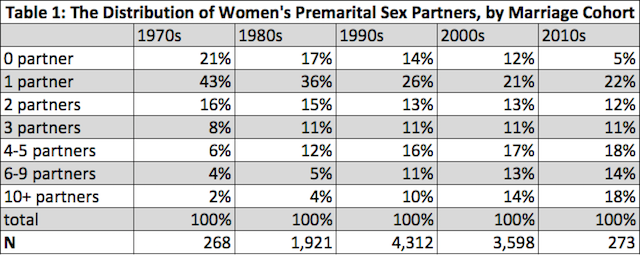
[…]Even more noteworthy has been the decline in the proportion of women who get married having had only one sex partner (in most cases, their future husbands). Forty-three percent of women had just one premarital sex partner in the 1970s.

[…]By the 2010s, only 5 percent of new brides were virgins. At the other end of the distribution, the number of future wives who had ten or more sex partners increased from 2 percent in the 1970s to 14 percent in the 2000s, and then to 18 percent in the 2010s. Overall, American women are far more likely to have had multiple premarital sex partners in recent years (unfortunately, the NSFG doesn’t have full data on men’s premarital sexual behavior, and in any event they recall their own marital histories less reliably than do women).

Here’s the change:

Women have freely chosen to dismiss the Bible and the moral law

And the problem with this, of course, is that more premarital sex partners means a higher risk of divorce:

Even one non-husband premarital sex partner raises risk of divorce

Why is the 2-partner number so high?

In most cases, a woman’s two premarital sex partners include her future husband and one other man. That second sex partner is first-hand proof of a sexual alternative to one’s husband. These sexual experiences convince women that sex outside of wedlock is indeed a possibility. The man involved was likely to have become a partner in the course of a serious relationship—women inclined to hook up will have had more than two premarital partners—thereby emphasizing the seriousness of the alternative.

The Christian Post had an article about some recent numbers from the Centers for Disease Control about virgins.

Excerpt:

A new Centers for Disease Control study examines teenage health behaviors in connection to their self-reported sexual activity and shows those who remain abstinent are much healthier on many fronts than their sexually active peers.

The report, titled “Sexual Identity, Sexual Contacts, and Health-Related Behaviors Among Students in Grades 9-12, United States and Selected Sites,” showcased the results from a 2015 survey that monitored several categories of health-related behaviors like tobacco usage, drug and alcohol use, sexual habits, unhealthy dietary behaviors, and behaviors that contribute to unintentional injuries and violence.

The report concludes “that students who had no sexual contact have a much lower prevalance of most health-risk behaviors compared with students” who had sexual contact.

The article quotes Dr. Jennifer Roback Morse, who I have featured on this blog many times:

In a Monday interview with The Christian Post, Jennifer Roback Morse, founder and president of the Ruth Institute, said, “this study is remarkable because it asks questions and reports the answers, rather than avoiding questions or assuming answers.”

As Glenn Stanton noted last week in The Federalist, the results from those questions and answers are remarkable.

With regard to smoking, teenage virgins are 3,300 percent less likely to smoke daily than their peers who are sexually involved with someone of the opposite sex, Stanton computed from the report’s data. Teen virgins are 9,500 percent less likely to smoke daily than their peers who are sexually involved with someone of the same sex or in a bisexual relationship, he added. Chaste young people are also extremely less likely to use indoor tanning beds, binge drink, smoke marijuana, ride in cars as passengers with a drunk driver, and get into physical fights than their sexually active peers. Abstinent youth are also more likely to get a solid eight hours of sleep every night and eat breakfast daily.

[…]The CDC report also included findings from 25 state surveys, and 19 large, urban school district surveys conducted among students in grades 9–12 which took place between December of 2014 and September of 2015.

Now, many pro traditional marriage people will tell young men “feminism and the sexual revolution change nothing about a woman’s suitability for marriage, so go out there and get married to these women anyway”. In my experience, no one is telling women NOT to follow their hearts, and explaining to them the harm that they do by allowing their feelings to determine who they will engage in relationships.

I would like to see women make better decisions with men before they marry, rather than be influenced by their peers and culture to give themselves to men who are not marriage-minded. Maybe a little skepticism should be shown to “follow your heart”? Women need to understand what they are losing when they choose to have premarital sex.

In my group of friends, the men are aware of the Biblical prohibition on premarital sex. My friends know about the research on marriage, and what it takes to make a marriage work. We don’t follow our hearts, because we do what we know will work to achieve the results we want. We don’t listen to the culture, and we don’t listen to radical feminists. Men generally take an engineering approach to marriage – we want to know what the best practices and tradeoffs are, and then we plan and act to succeed.