

Category Archives: Polemics

Is Sam Harris successful at rationally grounding objective moral values and duties?

I have a key that will unlock a puzzling mystery

I just wanted to put out a few snips from this layperson-level article on the Reasonable Faith web site. The article is about atheist scholar Sam Harris, and his attempt to provide a basis for morality on atheism.

Here’s the Harris project:

The question then is, what is the best foundation for the existence of objective moral values and duties? What grounds them? What makes certain actions good or evil, right or wrong? Traditionally, God has been the highest Good (summum bonum) and His commandments constitutive of our moral duties. But if God does not exist, what foundation remains for objective moral values and duties?

Dr. Craig is able to show why Harris’ attempt to ground the objective moral value of humans in “human flourishing” fails, by using the law of identity to show that Harris’ rule doesn’t account for the possibility that those who do evil could possibly flourish and be happy. If Harris is right that objective morality is identical to human flourishing, then it cannot even be possible that this be the case. This can be a bit confusing to non-philosophers, though, so I’ll focus on Dr. Craig’s argument against Harris’ attempt to ground objective moral duties.

Dr. Craig writes:

That takes us to a second question: Does atheism provide a sound foundation for objective moral duties? Duty has to do with moral obligation and prohibition, what I ought or ought not to do. Here reviewers of The Moral Landscape have been merciless in pounding Harris’ attempt to provide a naturalistic account of moral obligation. Two problems stand out.

First: Natural science tells us only what is, not what ought to be, the case. As philosopher Jerry Fodor has written, “Science is about facts, not norms; it might tell us how we are, but it wouldn’t tell us what is wrong with how we are.” In particular it cannot tell us that we have a moral obligation to take actions that are conducive to human flourishing.

So if there is no God, what foundation remains for objective moral duties? On the naturalistic view, human beings are just animals, and animals have no moral obligations to one another. When a lion kills a zebra, it kills the zebra, but it does not murder the zebra. When a great white shark forcibly copulates with a female, it forcibly copulates with her but it does not rape her — for there is no moral dimension to these actions. They are neither prohibited nor obligatory.

So if God does not exist, why think we have any moral obligations to do anything? Who or what imposes these moral duties on us? Where do they come from? It is hard to see why they would be anything more than a subjective impression ingrained into us by societal and parental conditioning.

So we might feel morally obligated to do something, maybe what our herd expects of us in this time and place we live in. But on atheism those feelings are arbitrary. After all, societies have evolved where feelings of obligation are felt by people to perform suicide bombings against civilians. On atheism, those feelings are as valid and grounded as any other “duties” because they emerge from the same process in other times and places. Obligations change between time and place – they are not objectively real. But that means that our moral duties are not objective, they are arbitrary – if atheism is true. The same “socio-biological evolution” is generating opposite moral duties in different times and places. This is not “objective”.

And the second objection is even more lethal:

Second: “ought” implies “can.” A person is not morally responsible for an action he is unable to avoid. For example, if somebody shoves you into another person, you are not to blame for bumping into this person. You had no choice. But Harris believes that all of our actions are causally determined and that there is no free will. Harris rejects not only libertarian accounts of freedom but also compatibilistic accounts of freedom. But if there is no free will, no one is morally responsible for anything. In the end, Harris admits this, though it’s tucked away in his endnotes. Moral responsibility, he says, “is a social construct,” not an objective reality: “in neuroscientific terms no person is more or less responsible than any other” for the actions they perform. His thoroughgoing determinism spells the end of any hope or possibility of objective moral duties on his worldview because we have no control over what we do.

Harris recognizes that “determinism really does threaten free will and responsibility as we intuitively understand them.” But not to worry! “The illusion of free will is itself an illusion.” The point, I take it, is that we do not really have the illusion of free will. Not only is such a claim patently false phenomenologically, as any of us can attest, but it is also irrelevant. The fact remains that whether we experience the illusion of free will or not, on Harris’ view we are thoroughly determined in all that we think and do and can therefore have no moral responsibilities.

On Harris’ view, human beings are computers made out of meat. But if you cannot freely make moral choices, then you cannot choose to perform moral duties or not. What is amazing to me is why he wants to deny free will in the first place. He is surely very well aware of his own experience of free will, and his own consciousness, for that matter. Before we even start to look at scientific evidences against atheism like the origin of the universe, the cosmic fine-tuning, the origin of life, the Cambrian explosion, etc. we already have evidence within ourselves that naturalism is false.

Just in passing, my friend Micah sent me this article about Sam Harris’ academic credentials. Although Harris has a PhD in neuroscience, the underlying reality is a bit more complicated. When I watched him debate William Lane Craig, he seemed to be ignorant of simple problems with his utilitarian moral views, and his inability to ground libertarian free will. The problems with utilitarianism have been known for hundreds of years. You can watch the debate yourself and see if you think he was prepared or not.

What is the root cause of multiple-victim public shootings?

A family praying and reading the Bible

The New York Times is reporting that the shooter was fatherless:

Mr. Cruz had no criminal history before the shootings, according to state law enforcement records. But his childhood was certainly troubled.

He spent much of it in a subdivision called Pine Tree Estates, on a lush, narrow street dotted with tropical plants and the occasional driveway basketball hoop. Mr. Cruz and his brother, Zachary, had been adopted, and were raised largely by their mother, Lynda Cruz, especially after their father, Roger P. Cruz, died suddenly in 2004 at the age of 67. Ms. Cruz died in November, and people who knew Nikolas said he had taken the loss hard.

This doesn’t surprise me, because we’ve known for decades that fatherlessness is associated in higher rates of criminal behavior in boys.

Let’s take a closer look at some recent active shooters, and see if we can find out what they have in common. And then we can decide whether the people who complain the most about gun violence are willing to do anything about the root cause of gun violence.

Let’s start with this article from The Stream, which looks at 3 mass murderers:

Dylann Roof: The killer of nine people in a Charleston, South Carolina church grew up in painful circumstances. His parents divorced when he was small. His father divorced his first wife after a few years of marriage. And he reportedly was abusive of his second wife, Dylann’s step-mother.

According to the Associated Press, “Court documents and nearly two dozen interviews show Roof’s early childhood was troubled and confused as well, as he grew up in an unstable, broken home amid allegations of marital abuse and infidelity.”

Stephen Paddock: The man who slaughtered 58 concert-goers in Las Vegas was the son of a top criminal.

Paddock’s father was named Benjamin. He “was on the FBI’s Top Ten Most Wanted list in the 1970s for robbing banks and was described as psychopathic in an arrest warrant. According to the warrant, the suspect’s father carried a firearm and was considered ‘armed and dangerous.’”

Benjamin Paddock was arrested and put in prison. But “six months after his sentencing, he escaped and robbed a bank in San Francisco before being recaptured in Oregon.”

[…]Adam Lanza: The son of divorce, the Sandy Hook Elementary School killer struggled with mental health issues for years.

Lanza’s parents divorced in 2009 after 28 years of marriage. Adam, then 17, was experiencing severe mental and emotional illnesses.

Three case studies are fine, but is this the general rule among active shooters?

The Federalist takes a look:

As University of Virginia Professor Brad Wilcox pointed out back in 2013: “From shootings at MIT (i.e., the Tsarnaev brothers) to the University of Central Florida to the Ronald E. McNair Discovery Learning Academy in Decatur, Ga., nearly every shooting over the last year in Wikipedia’s ‘list of U.S. school attacks’ involved a young man whose parents divorced or never married in the first place.” His observation is largely ignored.

In contrast, conversations about black-on-black violence often raise the link between broken households (or fatherless homes) and juvenile delinquency. But when the conversation turns to mass shootings, we seem to forget that link altogether.

[…]On CNN’s list of the “27 Deadliest Mass Shootings In U.S. History,” seven of those shootings were committed by young (under 30) males since 2005. Of the seven, only one—Virginia Tech shooter Seung-Hui Cho (who had been mentally unstable since childhood)—was raised by his biological father throughout childhood.

So what are some of the factors that lead to young men who have mental illness, anger issues, etc.?

Daycare

For one thing, young children’s brains don’t develop if they don’t have their mothers at home for the first 2 years at least, and the study I linked to said 3 years. Mothers are essential, during this time, for developing the parts of the brain that allow empathy and self-control. Unfortunately, keeping the mom home during the crucial early years is rare, because feminism requires that she work in order to be like a man.

No-fault divorce

I also recently blogged about how easy it is to initiate divorce just because you are unhappy. Well, when parents divorce for no good reason, (after having chosen a spouse poorly), that has a very bad effect on the children. Although the divorce rate is dropping, that’s because fewer people are marrying – they’re cohabitating instead. The alternative to marriage, cohabitation, is far more unstable than marriage. Either way, children lose out from the decreased stability of their parent’s union. The notion of lifelong commitment regardless of happiness is gone. Now we treat relationships as entertainment instead of enterprise.

So what should we do?

Well, to fix the daycare, we could give tax breaks to promote stay at home mothers. In the two countries where that was tried (UK and Canada), it was opposed by the political left. The UK wanted to give tax breaks ONLY to working mothers, not to stay at home mothers. And Canada did not want to extend income splitting to cover stay at home moms. Why not? Because when women work, the state gets more money, and the children adopt the values of the state in the government-run public schools. So, there is a solution to daycare’s bad influence on children, but the left opposes it.

And, to fix no-fault divorce, we could repeal no-fault divorce laws. Unfortunately no-fault divorce laws are strongly supported by powerful left-wing groups: trial lawyers and radical feminists. But they are also supported by women who don’t want to think too hard about who they are “in love” with. I was once told by a divorced mother of four whose husband cheated on her that she would never dream of marrying without no-fault divorce. Another childless divorced woman whose ex-husband cheated on her (she suspects) told me that it is impossible to tell whether a man is faithful or not through courtship and interviews. So long as women see marriage as something to be entered into on feelings, and exited lightly, children will be raised fatherless. It doesn’t help that we are subsidizing single motherhood with welfare and divorce courts that typically reward the the partner who initiates divorce (usually the woman). We could repeal no-fault divorce and single mother welfare, but again, the left opposes both of these things.

Leftist policies create the gun violence problem

As I’ve discussed before, the common denominator in all violent crime is that the violent criminal is male, and grew up without a father. The left pretends to be concerned with this, but they are not willing to address the root causes of the problem. They want more daycare, and they want it taxpayer-funded. They want universal pre-K, and they want it taxpayer-funded. They want to keep no-fault divorce, because it’s just too much work for women to make wise choices in how they make sexual choices and who they marry. And they want more and more welfare for single mothers, because women who have babies before they have husbands should be rewarded by taxpayers who made better decisions. People on the left want to subsidize fatherlessness, in short. And whatever you subsidize, you get more of.

Fatherlessness is the root cause of crime and mass murders, and the left doesn’t care about solving the real problem. It’s ironic that the left looks to government to solve the problem that government has actually created, by destroying marriage and the family unit.

How did Obama’s plan to let government run student loans work out?

Obama nationalized student loan administration in 2010

I’m a free-market capitalist, so I believe that economic decision-making is best done by the people it concerns, not the people in government. If it is a decision that affects the family, let the family decide. If it’s a decision that affects the business, let the business owner decide. Obama has a different view – he thinks that government should make all of the decisions, even though government earns none of the money.

Here is an article in Investor’s Business Daily about his policy of letting the government take over student loan decision-making.

Excerpt:

A report from the Department of Education notes that the net cost of the federal government’s direct loan program is quickly heading into the red. This program, mind you, was supposed to be a moneymaker for the government, as students paid back federal loans with interest.

But as it turns out, borrowers have been flocking toward various loan forgiveness programs, by which the government will lose money, erasing gains from other loans. The report shows that the direct loan program went from a $25 billion surplus in 2012 to less than $5 billion by 2015.

A separate report says that this program ran a $36 billion deficit last year, up from $8.4 billion in 2016.

This is not how this federal loan program was supposed to work when President Obama launched it eight years ago.

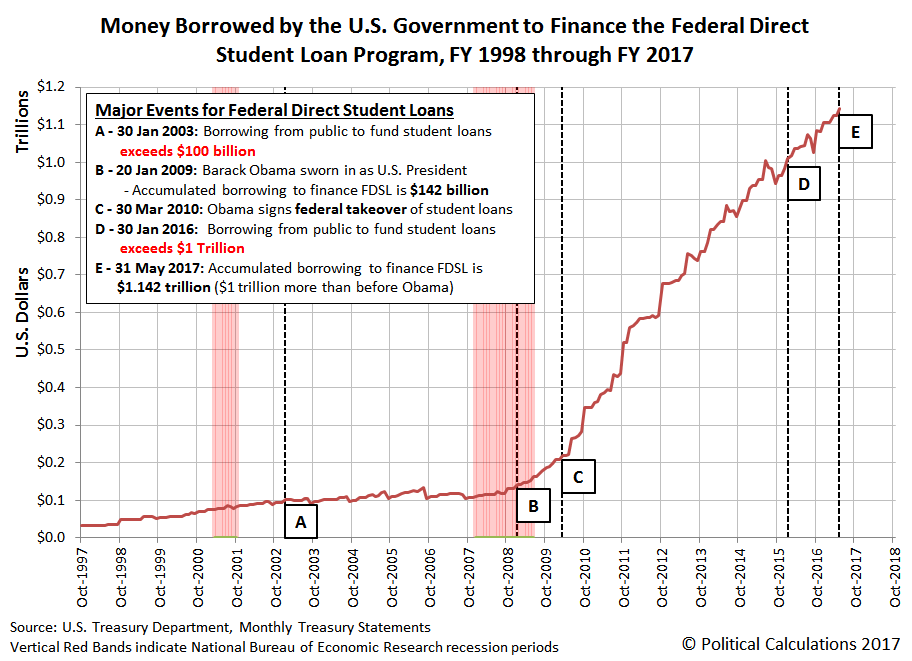
In 2010, President Obama effectively nationalized student lending by cutting banks — which had been offering government-backed loans to students — out of the equation and having the government make the loans itself.

“By cutting out the middleman, we’ll save the American taxpayers $68 billion in the coming years,” Obama said when he signed this change into law. “That’s real money.”

As a result, federal student loan debt shot up from $154.9 billion in 2009 to $1.1 trillion by the end of 2017.

As everyone knows, under Obama’s big government leadership, the national debt skyrocketed from $10 trillion to $20 trillion in only 8 years. Obama ran up as much debt in his 8 years as ALL the other presidents, combined. Why? It’s simple. Because government isn’t as careful with other people’s money as people are careful with their own money. People make better decisions than government because they care about the money more – they earned it. The right people to solve an economic problem are the people in the families, and the people at the local bank branches nearby. When government takes over economic decision-making, they use other people’s money to buy the votes of people who make poor decisions.

We shouldn’t be allowing students to take 4-year vacations at taxpayer expense, so that they can learn English or Women’s Studies and then stick taxpayers with the bill. Some of those taxpayers had to study hard things like engineering and pay their own way. Some of those taxpayers had to get jobs in the trades as electricians and plumbers to pay for the bad decisions of these spoiled brats. Student loan administration should not be something for big government to control. When government decides who gets loans, students feel no pressure to study subjects and get credentials that will allow them to pay back what they borrowed. I want the banks to make the lending decisions and loan out their own money, so that they can deny people who are studying nonsense that won’t get a return.

That’s why we should never have elected a big-government liberal to be president. They make a lot of promises about how great they are with money, but it never works out. Big government is never the answer to problems that are outside of what the Constitution describes as the boundaries of government.

(Image Source)