Category Archives: Polemics

Luke Barnes discusses the fine-tuning of the fine structure constant

Fine-tuning of the strong nuclear force and the fine structure constant

Here is an article from The New Atlantis written by cosmologist Luke Barnes about one specific example of cosmic fine-tuning. (H/T Uncommon Descent via J. Warner Wallace tweet)

Excerpt:

Today, our deepest understanding of the laws of nature is summarized in a set of equations. Using these equations, we can make very precise calculations of the most elementary physical phenomena, calculations that are confirmed by experimental evidence. But to make these predictions, we have to plug in some numbers that cannot themselves be calculated but are derived from measurements of some of the most basic features of the physical universe. These numbers specify such crucial quantities as the masses of fundamental particles and the strengths of their mutual interactions. After extensive experiments under all manner of conditions, physicists have found that these numbers appear not to change in different times and places, so they are called the fundamental constants of nature.

These constants represent the edge of our knowledge. Richard Feynman called one of them — the fine-structure constant, which characterizes the amount of electromagnetic force between charged elementary particles like electrons — “one of the greatest damn mysteries of physics: a magic number that comes to us with no understanding by man.”

[…]A universe that has just small tweaks in the fundamental constants might not have any of the chemical bonds that give us molecules, so say farewell to DNA, and also to rocks, water, and planets. Other tweaks could make the formation of stars or even atoms impossible. And with some values for the physical constants, the universe would have flickered out of existence in a fraction of a second. That the constants are all arranged in what is, mathematically speaking, the very improbable combination that makes our grand, complex, life-bearing universe possible is what physicists mean when they talk about the “fine-tuning” of the universe for life.

Atheists, both rank-and-file and expert, almost universally misunderstand the fine-tuning argument. They imagine that if the constants and quantities specified at the origin of the universe were different, then humans would just have green skin, or maybe forehead ridges, or pointy ears. Atheists tend to get their view of science from science fiction in novels or television or movies. Just this week I was talking to an agnostic woman (who since reverted to atheism) and brought up the fine-tuning argument. And she said “well, maybe if the initial constants and quantities were different, then we would have evolved differently”. No, the whole point is that life of any conceivable kind becomes impossible if the constants and quantities are altered higher or lower. Even slightly. It’s not that you have green skin, pointy ears, and forehead ridges. It’s that you have a universe that recollapses into a hot fireball, or contains only hydrogen, or does not form stars and planets at all.

I got the impression that she hadn’t read anything about the fine-tuning from peer-reviewed scientific publications, but had just read popular responses to it from atheists with degrees in English and drama and philosophy. If you want to understand a scientific argument, then you have to go to the scientific publications, and read the science. Here is an excellent start, from two astrophysicists, and published by Cambridge University Press.

So what does the scientific evidence actually show?

Barnes explains:

The strong nuclear force, for example, is the glue that holds protons and neutrons together in the nuclei of atoms. If, in a hypothetical universe, it is too weak, then nuclei are not stable and the periodic table disappears again. If it is too strong, then the intense heat of the early universe could convert all hydrogen into helium — meaning that there could be no water, and that 99.97 percent of the 24 million carbon compounds we have discovered would be impossible, too. And, as the chart to the right shows, the forces, like the masses, must be in the right balance. If the electromagnetic force, which is responsible for the attraction and repulsion of charged particles, is too strong or too weak compared to the strong nuclear force, anything from stars to chemical compounds would be impossible.

Stars are particularly finicky when it comes to fundamental constants. If the masses of the fundamental particles are not extremely small, then stars burn out very quickly. Stars in our universe also have the remarkable ability to produce both carbon and oxygen, two of the most important elements to biology. But, a change of just a few percent in the up and down quarks’ masses, or in the forces that hold atoms together, is enough to upset this ability — stars would make either carbon or oxygen, but not both.

It’s very important that theists are well-equipped to explain how individual cases of fine-tuning work. We need to know what you lose if you alter these constants and quantities even slightly. You can read about some more examples in this previous post.

The Economist: marriage is still the best place for children

Marriage and family
Marriage and family

I stopped reading The Economist when they endorsed the socialist failure Barack Obama, who doubled the national debt to $20 trillion in only 8 years. However, even a stopped clock is right twice a day. And here is one of those times.

Excerpt:

However, there is one big reason to worry about the quality and longevity of people’s intimate bonds. It is that relationships often produce children, and children are profoundly affected by how their parents get on.

You could make enough confetti for a summer of weddings with all the academic papers that show how much children gain from being brought up in stable, loving families, and how much they suffer when those families break down. Culture and customs make little difference. In Japan, four-fifths of single-parent households emerge when couples divorce—a much higher share than in the West, where people usually slip into single parenthood without marrying. Japanese children living with only one parent nonetheless perform significantly worse in school tests, just as children from single-parent families do in Europe and America. In poorer countries, family breakdown can kill. According to one recent estimate, the chance that an African child will die before turning five is about 25-30 per 1,000 for those born into stable families, but 35-40 per 1,000 for the children of single, divorced or widowed parents.

Marriage is not always good for children. They do not benefit when a parent marries somebody who is not their mother or father, and seem to suffer if the parent they live with cycles through several relationships. What they seem to need most is for their biological parents to stick together. And one strong claim that can be made for marriage is that it appears to glue parents together more tightly than any other arrangement.

This part is key, especially for those millennials who think that cohabitating before marrying makes the marriage more secure:

Analysis of one large American data set by Kathryn Edin and Laura Tach, two sociologists, shows that 27% of marriages broke down within nine years of a child being born. By contrast, among couples who were merely cohabiting when a child appeared, 53% separated within nine years—and most of the remaining 47% were married by that point. Among couples who were dating but not living together when the child was born, 81% had split up.

Again, this pattern runs across national and cultural borders. Cohabiting couples behave a bit more like married couples in countries where giving birth outside marriage is very common, such as Estonia and Norway. But they seldom attain the same level of stickiness as married couples, even after controlling for the mother’s level of education.

Cohabitation doesn’t work, because it’s basically saying that I’m going to try the other person and see if I like the other person, and that sex is required to know if I like the other person. It doesn’t really matter that you know the other person really well, because you can always get out of cohabitation just by leaving. Marriage says that I’m going to commit to the other person for life, through thick and thin. Here, both people tend to do a more thorough job of selecting their partner, perhaps even consulting fathers for advice. Why? Because getting out of a marriage is a lot harder to do, and more expensive.

In the past, I’ve blogged about some factors that can make your marriage pretty much divorce proof: things like chastity, not spending too much on the wedding, age of the man and woman at marriage, education levels of each spouse, number of people attending the wedding ceremony, isolation from other divorced people, church attendance, and so on. The truth is that you can engineer a marriage that’s practically divorce proof. But if you insist on spontaneity and following your heart, then you aren’t going to care what studies say works best. A stable marriage takes preparation, and that means making pro-marriage choices all throughout your life before your marriage, instead of doing what feels right to you in the moment. What feels good in the moment is almost never the right choice if your goal is a stable marriage.

How the WMAP satellite confirmed nucleosynthesis predictions and falsified atheism

Christianity and the progress of science

Prior to certain scientific discoveries, most people thought that the universe had always been here, and no need to ask who or what may have caused it. But today, that’s all changed. Today, the standard model of the origin of the universe is that all the matter and energy in the universe came into being in an event scientists call “The Big Bang”. At the creation event, space and time themselves began to exist, and there is no material reality that preceded them.

So a couple of quotes to show that.

An initial cosmological singularity… forms a past temporal extremity to the universe. We cannot continue physical reasoning, or even the concept of spacetime, through such an extremity… On this view the big bang represents the creation event; the creation not only of all the matter and energy in the universe, but also of spacetime itself.

Source: P. C. W. Davies, “Spacetime Singularities in Cosmology,” in The Study of Time III, ed. J. T. Fraser (Berlin: Springer Verlag ).

And another quote:

[A]lmost everyone now believes that the universe, and time itself, had a beginning at the big bang.

Source: Stephen Hawking and Roger Penrose, The Nature of Space and Time, The Isaac Newton Institute Series of Lectures (Princeton, N. J.: Princeton University Press, 1996), p. 20.

So, there are several scientific discoveries that led scientists to accept the creation event, and one of the most interesting and famous is the discovery of how elements heavier than hydrogen were formed.

Nucleosynthesis: forming heavier elements by fusion

Here’s the history of how that discovery happened, from the National Aeronautics and Space Administration (NASA) web site:

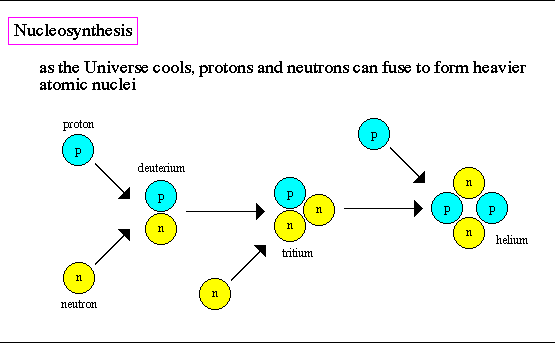
The term nucleosynthesis refers to the formation of heavier elements, atomic nuclei with many protons and neutrons, from the fusion of lighter elements. The Big Bang theory predicts that the early universe was a very hot place. One second after the Big Bang, the temperature of the universe was roughly 10 billion degrees and was filled with a sea of neutrons, protons, electrons, anti-electrons (positrons), photons and neutrinos. As the universe cooled, the neutrons either decayed into protons and electrons or combined with protons to make deuterium (an isotope of hydrogen). During the first three minutes of the universe, most of the deuterium combined to make helium. Trace amounts of lithium were also produced at this time. This process of light element formation in the early universe is called “Big Bang nucleosynthesis” (BBN).

The creation hypothesis predicts that there will be specific amounts of these light elements formed as the universe cools down. Do the predictions match with observations?

Yes they do:

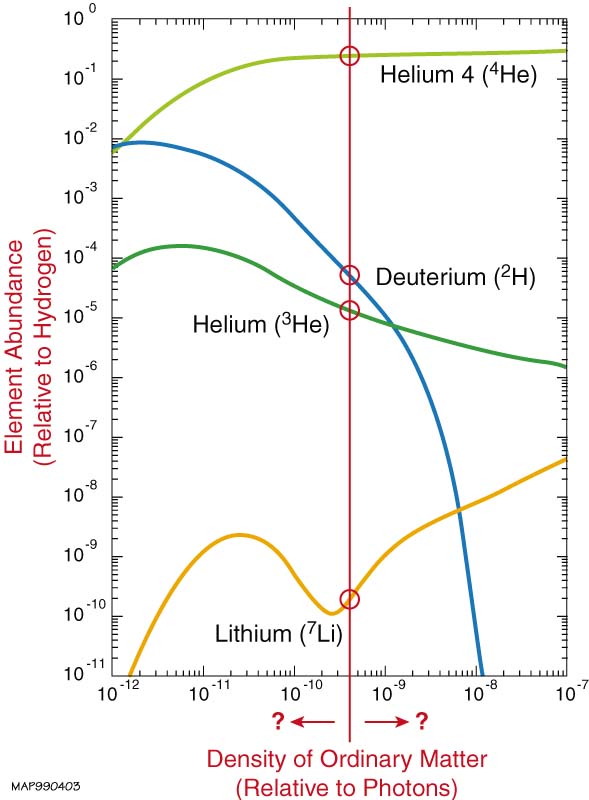
The predicted abundance of deuterium, helium and lithium depends on the density of ordinary matter in the early universe, as shown in the figure at left. These results indicate that the yield of helium is relatively insensitive to the abundance of ordinary matter, above a certain threshold. We generically expect about 24% of the ordinary matter in the universe to be helium produced in the Big Bang. This is in very good agreement with observations and is another major triumph for the Big Bang theory.

Moreover, WMAP satellite measurements of mass density agree with our observations of these light element abundances.

Here are the observations from the WMAP satellite:

Scientific observations match predictions

And here is how those WMAP measurements confirm the Big Bang creation event:

However, the Big Bang model can be tested further. Given a precise measurement of the abundance of ordinary matter, the predicted abundances of the other light elements becomes highly constrained. The WMAP satellite is able to directly measure the ordinary matter density and finds a value of 4.6% (±0.2%), indicated by the vertical red line in the graph. This leads to predicted abundances shown by the circles in the graph, which are in good agreement with observed abundances. This is an important and detailed test of nucleosynthesis and is further evidence in support of the Big Bang theory. 

“An important and detailed test”.

For completeness, we should learn how elements heavier than these light elements are formed:

Elements heavier than lithium are all synthesized in stars. During the late stages of stellar evolution, massive stars burn helium to carbon, oxygen, silicon, sulfur, and iron. Elements heavier than iron are produced in two ways: in the outer envelopes of super-giant stars and in the explosion of a supernovae. All carbon-based life on Earth is literally composed of stardust.

That’s a wonderful thing to tell a young lady when you are on a date: “your body is made of stardust”. In fact, as I have argued before, this star formation, which creates the elements necessary for intelligent life, can only be built if the fundamental constants and quantities in the universe are finely-tuned.

Now, you would think that atheists would be happy to find observations that confirm the origin of the universe out of nothing, but they are not. Actually, they are in denial.

Here’s a statement from the Secular Humanist Manifesto, which explains what atheists believe about the universe:

Religious humanists regard the universe as self-existing and not created.

For a couple of examples of how atheistic scientists respond to the evidence for a cosmic beginning, you can check out this post, where we get responses from cosmologist Lawrence Krauss, and physical chemist Peter Atkins.

You cannot have the creation of the universe be true AND a self-existing, eternal universe ALSO be true. Someone has to be wrong. Either the science is wrong, or the atheist manifesto is wrong. I know where I stand.

Positive arguments for Christian theism