Category Archives: Polemics

If you find a discrepancy in the Bible, does that mean Jesus didn’t exist?

Even if we don’t know whether there was one angel or two angels at Jesus’ tomb, we can still know things about whether God exists and whether Jesus rose from the dead.

First, we can know that the universe was created and designed because of reliable, experimental evidence that the universe came into being and is finely-tuned for life. And second, we can know that Jesus was buried, that his tomb was found empty, that a variety of people had experiences of him appearing to them after his death, and that the Christian movement had an early belief that he was resurrected from the dead. We know those core things like we know anything – because we have good evidence. Other things that are more peripheral may not be as supported by evidence. We can remain agnostic about those peripheral things, but that agnosticism about peripheral things doesn’t undermine the things that we know.

William Lane Craig answered a question related to this problem for a person who accepted the minimal facts case for the resurrection but then though that someone this case couldn’t work unless he accepted inerrancy as well.

Here’s the question:

After re-evaluating my Christian faith and pruning it for two years, I can’t shake what seem like two disparate conclusions. One is that the evidence for Jesus resurrection is impecable. But the other is that there seem to be some very awkward realities about the composition of scripture (like errors or authors claiming to write by another name). Yet, the authors of the New Testament, including Jesus, seem to use Scripture in a way that assumes it is word for word from God.

While inductive logic is used to arrive at a strong historical case for the resurrection of Jesus, inductive logic can also be used to arrive at a strong case for many of the peculiaraties about Scripture previously mentioned.

It seems that the approach which many apologists take at this point is that, having established the authority of Jesus by the resurrection, if the argument being raised against scripture contradicts an opinion expressed by Jesus in the Gospels, then the argument for a contradiction must have no possible harmonizations for it to really stick. But I don’t see how this is fair to say, since (1) it seems unfair to use inductive logic to evidence Jesus’ resurrection but then not use it for criticisms against the Bible and (2) an inductive argument can be strong despite what Jesus as recorded in the Gospels says, especially since we cannot assume the precision with which many of the saying were recorded. And (3), anybody can cook up a harmonization of some verse that is possible but not plausible, which I am sure you have seen first hand many times.

Yet, holding these two positions in tension tends to be corrosive to my faith and ultimately leads to a certain bitterness against God for allowing the biblical writers to play fast-and-loose with his words and for not providing a clarity that brings more certainty about what is from him and what isn’t. Any help you can give to relieve this tension would be greatly appreciated.

Now Dr. Craig has a long response on his Reasonable Faith web site, but I just want to quote you this:

But secondly, suppose you’ve done all that and are still convinced that Scripture is not inerrant.  Does that mean that the deity and resurrection of Christ go down the drain?  No, not all.  […]As you recognize, we have a very strong case for the resurrection of Jesus.  That case in no way depends on the Bible’s being inerrant.  This became very clear to me during my doctoral studies in Munich with Wolfhart Pannenberg.  Pannenberg had rocked German theology by maintaining that a sound historical case can be made for the resurrection of Jesus.  Yet he also believed that the Gospel resurrection appearances stories are so legendary that they have scarcely a historical kernel in them!  He did not even trust the Markan account of the discovery of the empty tomb.  Rather his argument was founded on the early pre-Pauline tradition about the appearances in I Corinthians 15.3-5 and on the consideration that a movement based on the resurrection of dead man would have been impossible in Jerusalem in the face of a tomb containing his corpse.

Evangelicals sometimes give lip service to the claim that the Gospels are historically reliable, even when examined by the canons of ordinary historical research; but I wonder if they really believe this.  It really is true that a solid, persuasive case for Jesus’ resurrection can be made without any assumption of the Gospels’ inerrancy.

By contrast, the case for Jesus’ belief that the Old Testament Scriptures are inerrant is much weaker.  I think there’s no doubt that (5) is the premiss that would have to go if biblical inerrancy were to be abandoned.  We should have to re-think our doctrine of inspiration in that case, but we needn’t give up belief in God or in Jesus, as Bart Ehrman did.  Ehrman had, it seems to me, a flawed theological system of beliefs as a Christian.  It seems that at the center of his web of theological beliefs was biblical inerrancy, and everything else, like the beliefs in the deity of Christ and in his resurrection, depended on that. Once the center was gone, the whole web soon collapsed.  But when you think about it, such a structure is deeply flawed.  At the center of our web of beliefs ought to be some core belief like the belief that God exists, with the deity and resurrection of Christ somewhere near the center.  The doctrine of inspiration of Scripture will be somewhere further out and inerrancy even farther toward the periphery as a corollary of inspiration.  If inerrancy goes, the web will feel the reverberations of that loss, as we adjust our doctrine of inspiration accordingly, but the web will not collapse because belief in God and Christ and his resurrection and so on don’t depend upon the doctrine of biblical inerrancy.

We have mainstream scientific evidence for God’s existence, and a mainstream historical evidence for a minimal facts case for the resurrection. None of that evidence depends on inerrancy being true.

So can we please just accept what can be known from experimental science and standard historical methods, and work our lives around that, and not nitpick about peripheral issues so much? I am inerrantist, and so is Dr. Craig. But you don’t have to be in order to accept that the mainstream evidence that shows that universe was created and fine-tuned, and that Jesus was raised bodily from the dead. Don’t let “one angel vs two angels “stop you from accepting things we can know. You can just stay agnostic about the things you think we don’t know.

What makes a planet suitable for supporting complex life?

The Circumstellar Habitable Zone (CHZ)

What do you need in order to have a planet that supports complex life? First, you need liquid water at the surface of the planet. But there is only a narrow range of temperatures that can support liquid water. It turns out that the size of the star that your planet orbits around has a lot to do with whether you get liquid water or not. A heavy, metal-rich star allows you to have a habitable planet far enough from the star so  the planet can support liquid water on the planet’s surface while still being able to spin on its axis. The zone where a planet can have liquid water at the surface is called the circumstellar habitable zone (CHZ). A metal-rich star like our Sun is very massive, which moves the habitable zone out further away from the star. If our star were smaller, we would have to orbit much closer to the star in order to have liquid water at the surface. Unfortunately, if you go too close to the star, then your planet becomes tidally locked, like the moon is tidally locked to Earth. Tidally locked planets are inhospitable to life.

Circumstellar Habitable Zone

Here, watch a clip from The Privileged Planet: (Clip 4 of 12, full playlist here)

But there’s more.

The Galactic Habitable Zone (GHZ)

So, where do you get the heavy elements you need for your heavy metal-rich star?

You have to get the heavy elements for your star from supernova explosions – explosions that occur when certain types of stars die. That’s where heavy elements come from. But you can’t be TOO CLOSE to the dying stars, because you will get hit by nasty radiation and explosions. So to get the heavy elements from the dying stars, your solar system needs to be in the galactic habitable zone (GHZ) – the zone where you can pickup the heavy elements you need but not get hit by radiation and explosions. The GHZ lies between the spiral arms of a spiral galaxy. Not only do you have to be in between the arms of the spiral galaxy, but you also cannot be too close to the center of the galaxy. The center of the galaxy is too dense and you will get hit with massive radiation that will break down your life chemistry. But you also can’t be too far from the center, because you won’t get enough heavy elements because there are fewer dying stars the further out you go. You need to be in between the spiral arms, a medium distance from the center of the galaxy.

Like this:

Galactic Habitable Zone
Galactic Habitable Zone and Solar Habitable Zone

Here, watch a clip from The Privileged Planet: (Clip 10 of 12, full playlist here)

The GHZ is based on a discovery made by astronomer Guillermo Gonzalez, which made the front cover of Scientific American in 2001. That’s right, the cover of Scientific American. I actually stole the image above of the GHZ and CHZ (aka solar habitable zone) from his Scientific American article (linked above).

These are just a few of the things you need in order to get a planet that supports life.

Here are a few of the more well-known ones:

  • a solar system with a single massive Sun than can serve as a long-lived, stable source of energy
  • a terrestrial planet (non-gaseous)
  • the planet must be the right distance from the sun in order to preserve liquid water at the surface – if it’s too close, the water is burnt off in a runaway greenhouse effect, if it’s too far, the water is permanently frozen in a runaway glaciation
  • the solar system must be placed at the right place in the galaxy – not too near dangerous radiation, but close enough to other stars to be able to absorb heavy elements after neighboring stars die
  • a moon of sufficient mass to stabilize the tilt of the planet’s rotation
  • plate tectonics
  • an oxygen-rich atmosphere
  • a sweeper planet to deflect comets, etc.
  • planetary neighbors must have non-eccentric orbits

By the way, you can watch a lecture with Guillermo Gonzalez explaining his ideas further. This lecture was delivered at UC Davis in 2007. That link has a link to the playlist of the lecture, a bio of the speaker, and a summary of all the topics he discussed in the lecture. An excellent place to learn the requirements for a suitable habitat for life.

Sean Carroll debates William Lane Craig on cosmology and God’s existence

Carroll was as good of a speaker as Craig in terms of style. Very easy to listen to, very quick on his feet, very civil. There was no clear winner on style.

It was difficult to assess the truth value of scientific points being made, especially for the layperson. I explained a few of them in my posts earlier this week, but I think laypeople might struggle with them if they are hearing about these things for the first time.

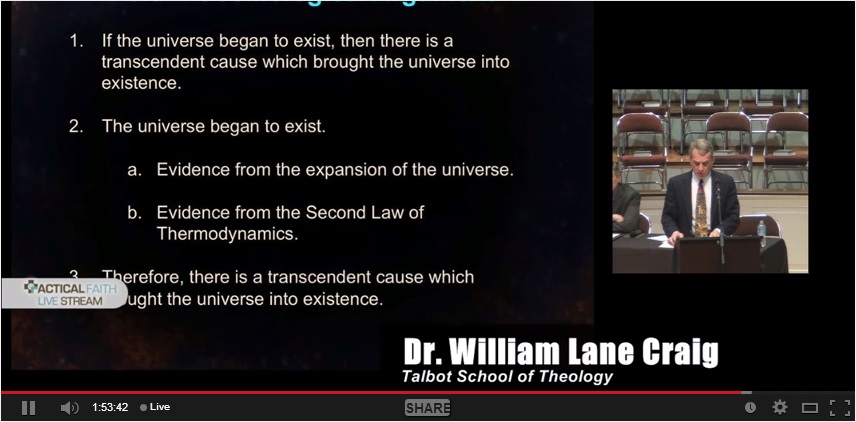
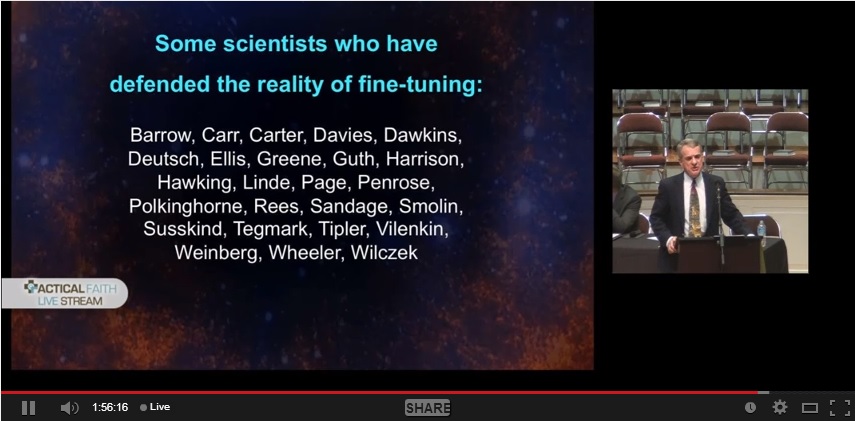
A couple of Craig’s slides: (click for larger images)

Slide 1 of 2:

Dr. Craig slide #1 of 2

Slide 2 of 2:

Dr. Craig slide #2 of 2

Quick summary: (this is not complete, because I couldn’t get everything they were saying noted)

Dr. Craig defended two arguments: 1) the kalam cosmological argument and the fine-tuning argument.

Dr. Craig supported the origin of the universe with 1) the expansion of the universe and 2) the second law of thermodynamics.

Dr. Craig said that the BGV theorem supports a beginning for the universe.

Dr. Craig said that the consensus of scientists did not accept Carroll’s naturalistic cosmology, quoting Stephen Hawking in support.

Dr. Craig said that multiverse models fall victim to the Boltzmann brain problem, where we should observe Boltzmann brains coming into existence and then phasing out again far more probably than embodied minds. But we observe embodied minds, and no Boltzmann brains.

Dr. Carroll said that science cannot study metaphysical questions.

Dr. Carroll said that science is about making models that may or may not be consistent with the experimental data.

Dr. Carroll said that the BGV theorem does not support a beginning for the universe.

Dr. Carroll proposed 17 alternative cosmologies, but did not provide a shred of scientific evidence for any of them, the way that Craig did for the standard model.

Dr. Carroll refuted Dr. Craig’s citation of Stephen Hawking, and Craig yielded the point.

Dr. Carroll speculated that science might progress to the point where the fine-tuning can be explained without an intelligent cause, and he gave an example of where that happened (inflation).

Dr. Craig argued that all 17 of the models suggested by Carroll either conflicted with evidence, had serious problems or did require a beginning.

Dr. Craig argued that Carroll’s own model required a beginning.

Dr. Craig argued that Carroll’s own model fell victim to the Boltzmann brain problem.

Dr. Craig argued that Carroll’s own model violated the second law of thermodynamics.

Dr. Craig re-stated his point that the baby universe spawning in Carroll’s model was speculative and incomplete, and cited Christopher Weaver’s work.

Dr. Carroll denied that things that pop into being out of nothing require a transcendent cause.

Dr. Carroll reiterated that science can only make naturalistic models, and that he did not have to answer questions about ultimate causes.

Dr. Carroll showed a photo of Alan Guth expressing his opinion that the universe is “probably” eternal. No evidence was given for this assertion.

Dr. Carroll said that the fine-tuning was not done in an optimal way, because one fine-tuned value was lower than it needed to be, and it should be exactly what it needed to be if God did it.

Dr. Carroll said that a finely-tuned universe is more probably in naturalism than in theism, because God can do anything he wants and doesn’t need a fine-tuned universe.

Dr. Carroll said he would stop defending his model now, and would instead defend Aguirre-Gratton.

Dr. Craig gave three reasons why the universe popping into being out of nothing requires a transcendent cause.

First, he said that nothing cannot cause anything to happen, because nothing is nothing.

Second, he said that if things pop into being out of nothing, then why don’t we see it happening all the time with other things.

Third, he said that we have no reason to dismiss the causal principle, especially when it is the basis of scientific inquiry and has been so fruitful in the progress of science.

Dr. Craig reiterated that baby universes in Carroll’s model would be dominated by Boltzmann brains, and we don’t observe that.

Dr. Craig said that even on the quantum gravity models that Carroll mentioned, there would still be a beginning.

Dr. Carroll said that Craig mustn’t say “popped into being” but instead that “there was a first moment of time”.

Dr. Carroll said that his model does indeed violate the second law of thermodynamics “YES!”.

At this point Carroll stopped talking about the topic of the debate and started expressing personal opinions about religion. It’s funny how often atheists do this in debates.

Dr. Carroll said that most theists don’t believe in God because of cosmology, but because of community and feelings.

Dr. Carroll said that science had learned a lot in the last 2000 years, so theism was false.

Dr. Carroll said that most philosophers don’t think that God exists, so theism was false.

Dr. Carroll said microscopes and telescopes were absent 2000 years ago, so theism was false.

Dr. Carroll said that religion should be about community and feelings, not about what is true.

Conclusion:

My conclusion was that Carroll lost because he is just satisfied to throw theories out and not to argue that they are true by citing evidence. Carroll never seemed to be interested in finding out what is true, but instead he just wanted to tell a story that didn’t include God, and assert that by Occam’s Razor, his story was a better explanation. I am not impressed with theoretical speculations, although the layperson might be. I kept waiting for him to respond to Craig’s points about how his model was falsified by experimental evidence and observations, e.g. – the Boltzmann brains or the baby universe generation, and he never cited the evidence I wanted him to cite. Craig did have some evidence for his views, but he could have been stronger in making his case. He could have shown the e-mail from Vilenkin that stated that he had understood the BGV theorem, and was using it correctly, for example.

For me the winning side comes down to evidence. The standard model is the standard model because of scientific evidence. Until that evidence is overturned, then speculative models are of no interest to anyone who is evidence-driven. Speculations are not science. A philosophical presupposition of metaphysical naturalism is not science.

The nice thing is that Robin Collins, one of Craig’s respondents, went deep into the science of the fine-tuning, especially on one of my favorite data points, the cosmic microwave background radiation. The paper he presented is now posted on his web site (H/T Christian Apologetics Alliance). I posted about the CMBR before in my post about particle physicist Michael Strauss lecture on cosmology and fine-tuning at Stanford University and the his more recent lecture at the University of Texas. Note that Strauss is an experimental physicist, not a theoretical physicist like Carroll.

Here’s another review of the debate by Randy Everist of Possible Worlds blog. He explains the back-and-forth over Boltzmann brains and the BGV theorem in more detail.