
Category Archives: News

William Lane Craig’s secret weapon is his amazing wife Jan

My favorite painting: "Godspeed" by Edmund Blair Leighton, 1900
My favorite painting: “Godspeed” by Edmund Blair Leighton, 1900

I’m re-posting this classic post because it was mentioned in the latest episode of the Reasonable Faith podcast.

I want to draw your attention to a talk on “Vision in Life” given by Dr. William Lane Craig. Dr. Craig is the ablest defender of the Christian faith operating today. He has done formal academic debates with all of the best known atheists on major university campuses in front of thousands of university students.

It turns out that he owes a lot of his success to his amazing wife Jan.

The MP3 file is here. (32 minutes)

This talk was Dr. Craig’s chapel address to Biola University students.

About 11 minutes into the talk, Bill describes what happened after he finished his Bachelor’s degree at Wheaton:

And so I joined the staff of Campus Crusade for Christ for 2 years, and was assigned to Northern Illinois University. And that was where I met my wife Jan. She was a graduate of the University of North Dakota where she had come to faith in Christ. And she had a similar vision for her life of evangelism and discipleship.

And as we worked at NIU together, she with gals and I with the guys, leading students to Christ and discipling them to walk with the Lord, we fell in love. And we decided that we would be more effective if we joined forces and became a team.

So their reason for getting together was because they thought that they would be more effective in evangelism and discipleship if they worked as a team.

It is at this point in the talk where Bill begins to explain just how Jan molded him into the lean, mean debating machine that travels the world striking terror into the hearts of atheists.

Bill’s first story about Jan occurs early after their marriage while he is working on his first Masters degree at Trinity:

And it was also at that time that I began to see what an invaluable asset the Lord had given me in Jan. I remember I came home from classes one day, and found her at the kitchen table with all the catalogs and schedules and papers spread out in front of her and she said, “look! I’ve figured out how you can get two Masters degrees at the same time that it would normally take to get one! All you have to do is take overloads every semester, go to all full-time summer school and do all these other things, and you can do two MAs in the time it takes to do one!”

And I thought, whoa! Are you sure you really want to make the commitment it takes to do this kind of thing? And she said, “Yeah! Go for it!” And it was then I began to see that God had given me a very special woman who was my supporter – my cheerleader – and who really believed in me. And as long as she believed in me, that gave me the confidence to dream bigger dreams, and to take on challenges that I had never thought of before.

In an article on his web site, he talks about how Jan encouraged him to do his first Ph.D:

As graduation from Trinity neared, Jan and I were sitting one evening at the supper table in our little campus apartment, talking about what to do after graduation. Neither of us had any clear leading or inclination of what we should do next.

So Jan said to me, “Well, if money were no object, what would you really like to do next?”

I replied, “If money were no object, what I’d really like to do is go to England and do a doctorate under John Hick.”

“Who’s he?” she asked.

“Oh, he’s this famous British philosopher who’s written extensively on arguments for the existence of God,” I explained. “If I could study with him, I could develop a cosmological argument for God’s existence.”

But it hardly seemed a realistic idea.

The next evening at supper Jan handed me a slip of paper with John Hick’s address on it. “I went to the library today and found out that he’s at the University of Birmingham in England,” she said. “Why don’t you write him a letter and ask him if you can do a doctoral thesis under him on the cosmological argument?”

What a woman! So I did, and to our amazement and delight Professor Hick wrote back saying he’d be very pleased to supervise my doctoral work on that subject. So it was an open door!

And in the same article, he explains how Jan encouraged him to get his second Ph.D:

As Jan and I neared the completion of my doctoral studies in Birmingham, our future path was again unclear to us. I had sent out a number of applications for teaching positions in philosophy at American universities but had received no bites. We didn’t know what to do.

I remember it like yesterday. We were sitting at the supper table in our little house outside Birmingham, and Jan suddenly said to me, “Well, if money were no object, what would you really like to do next?”

I laughed because I remembered how the Lord had used her question to guide us in the past. I had no trouble answering the question. “If money were no object, what I’d really like to do is go to Germany and study under Wolfhart Pannenberg.”

“Who’s he?”

“Oh, he’s this famous German theologian who’s defended the resurrection of Christ historically,” I explained. “If I could study with him, I could develop a historical apologetic for the resurrection of Jesus.”

Our conversation drifted to other subjects, but Jan later told me that my remark had just lit a fire under her. The next day while I was at the university, she slipped away to the library and began to research grants-in-aid for study at German universities. Most of the leads proved to be defunct or otherwise inapplicable to our situation. But there were two grants she found that were possibilities. You can imagine how surprised I was when she sprung them on me!

Both of these Ph.D experiences are also described in the talk. And the talk concludes as follows:

I am so thankful to be married to a woman who is tremendously resourceful, tremendously talented and energetic, who could have pursued an independent career in any number of areas, but instead, she has chose to wed her aspirations to mine, and to make it her goal to make me the most effective person I can be, for Christ. And she has been like my right arm in ministry over these many years. And it is a tremendous privilege to be a team with a person like that.

And you young men, I would encourage you, if you marry, to find a gal who shares your vision, not some independent vision, but who is interested in aligning herself with you, and pursuing together a common vision and goal that will draw you [together], so that you will avoid the growing separateness that so often creeps into marriages.

And now you know the rest of Bill’s story. The person you marry will have an enormous influence on the impact you will have for Christ and his Kingdom. It is up to you to decide whether that influence is going to be positive or negative, by deciding if you will marry, and if you do marry, by deciding whom you will marry.

You may also be interested in this talk given by William Lane Craig, entitled “Healthy Relationships” (National Faculty Leadership Conf. 2008) (audio here) In that talk, he offers advice to Christians who want to have a marriage that is consistent with their Christian faith.
Trump takes action on unemployment, healthcare, environment, refugees, adoption

I have a Canadian friend named McKenzie who sometimes reviews my blog post drafts. She usually says the same two things: 1) this post should be one third as long as it is, and 2) don’t tell me any more about why Democrats are bad, tell me why Republicans are good. So, in this post, I will tell you 5 reasons why Republicans are good, all from news stories about events from the last week alone.

Let’s start with healthcare. I’ve been bashing Elizabeth Warren on healthcare for a couple of posts. What are the Republicans going to do about healthcare?

Here’s Daily Signal:

The White House is making a strong push against Democrats’ “Medicare for All” proposal, laying out a “Health Care for You” agenda to boost competition and transparency, lower prescription prices, and produce greater affordability in health-related costs.

[…]The White House also has touted $6 billion spent over two years to target opioid addiction. This has contributed to a decrease in opioid deaths for the first time in almost two decades, officials say.

[…]Prescription prices are declining to levels not seen since the 1960s, according to the White House.

The Trump administration reduced approval times for medicines regulated by the Food and Drug Administration. Trump signed into law Right-to-Try legislation to allow critically ill patients to access potentially lifesaving medicines that haven’t yet been fully approved by the FDA.

Trump also signed a $1 billion increase in funding for researching Alzheimer’s disease and launched the End HIV/AIDS in America Initiative to stop transmission of the AIDS virus in the nation by 2030.

The president last year signed the VA MISSION Act, which reforms existing programs in the Department of Veterans Affairs to provide more care for veterans in the communities where they live, with the aim of minimizing travel. The measure includes paying for veterans to get medical care outside VA facilities and also established walk-in community clinics for veterans.

Are Republicans doing anything to earn the votes of black Americans in 2020?

Breitbart reports:

The unemployment rate for African Americans fell to 5.4 percent in October, the lowest level on record.
This is the third consecutive month of record-low unemployment. September’s 5.5 percent matched the record set in August.

The unemployment rate for black men hit a record low of 5.1 percent, down three-tenths from the month prior. That was lower than the previous record low of 5.2 set in December 1973.

OK, I have white Democrat co-workers who think that this is proof of Trump’s racism. Not kidding. But I think it’s good.

But what about restrictions on energy production? We don’t want to end up with blackouts like those Democrats in California, do we?

The Daily Signal reports:

The Environmental Protection Agency will propose easing rules on disposal of coal ash, the residue from burning coal, to make it less likely the federal government would shutter a coal-fired utility plant, in an announcement set for Monday.

The move is part of what has been a larger deregulation push by the Trump administration to roll back strict Obama-era regulations that the industry viewed as the previous administration’s “war on coal,” that pushed to shut down many coal-fired power plants.

[…]Coal ash is frequently recycled, and used as material for wallboard and concrete. Thus, according to the EPA, the rule could provide more resources for building the nation’s highways and for agricultural purposes. Coal ash reuse also conserves natural resources and provides viable alternatives to disposal, the agency contends.

“This demonstrates our support for reuse of coal ash,” Wright said.

More than 500 units at approximately 260 coal-fired facilities may be impacted by Monday’s proposed rule, according to the EPA.

More coal means lower energy costs, and recycling coal by-products to build and repair highways sounds good.

But what about life issues? What is Trump doing about abortion?

The Daily Signal reports:

Under a proposed new rule from the Department of Health and Human Services announced Friday, the federal government no longer will withhold federal grant money from faith-based adoption providers that won’t compromise their views on same-sex marriage.

[…]The proposed HHS rule clarifies that the federal government won’t discriminate against charitable organizations that don’t handle adoptions for same-sex couples when it comes to allocating federal grants. The proposed rule clarifies all federal nondiscrimination laws enacted by Congress will be enforced in awarding grants. Sexual orientation and gender identity are not currently covered under nondiscrimination laws enacted by Congress.

OK, it’s hard to deny that more adoption means less abortions. It certainly won’t hurt to make it easier for adoption agencies to place unwanted children in loving homes.

OK, fine, but what about the refugees? There is a crime epidemic going on in Europe, because they keep welcoming in low-skilled non-English-speakers into their country, without checking them properly for risk factors.

Daily Wire reports:

President Donald Trump announced on Friday that the administration was restricting the intake of refugees into the United States to the lowest-level on record under the current refugee system.

In a memo to Secretary of State Mike Pompeo, Trump announced that he was setting the refugee cap at 18,000 refugees for Fiscal Year 2020 — 12,000 lower than Trump’s cap for Fiscal Year 2019, and “the lowest number since the modern refugee system was created nearly 40 years ago,” The Washington Times reported.

The Trump administration reportedly considered going even lower when they first entertained the idea over the summer, cutting the number all the way down to nearly zero.

I remember when Obama wanted the cap set to 110,000 refugees. But he didn’t want them to live in his mansion or pay with him with his own money. He wanted them to live next to your children’s school, and pay for them with your money. So compassionate! Refugees are a problem for private voluntary charities, not for government, paid for by taxpayers who can barely make ends meet already.

Well, so I guess we do have reasons for wanting to elect Republicans in 2020! If you agree, then share the post! We can’t ALWAYS be relying on attacking Democrats to reach the people in the middle who decide elections. We have to tell them what Republicans will do that is different from what Democrats will do.

How will Elizabeth Warren pay for her $52 trillion government-run health care plan?

So, in yesterday’s post, we talked about our current budget of $4 trillion dollars, our $3 trillion of revenues, our $1 trillion annual budget deficit, and our $23 trillion in accumulated national debt. We also talked about how Elizabeth Warren’s health care plan would add $5.2 trillion to our annual budget, and how we only get about $2 trillion in revenue if we take almost everything the wealthiest taxpayers earn.

Warren likes to talk about how her plan will reduce health care costs. She thinks that government workers (think of the DMV and the post office) will be more efficient about increasing quality and reducing costs than the private sector (think of Apple and Amazon) is. Is she correct?

Let’s take a look at this article from Reason:

Warren and her defenders will likely try to shift the discussion back to total costs, but that’s just a way of repeating the dodge that has dogged her campaign for much of the year. Warren will no doubt claim that costs would go down under her plan, but there are reasons to doubt this, including an analysis from health care economist Kenneth Thorpe finding that under a Sanders-style plan, more than 70 percent of people who currently have private insurance would see costs increase, as well as an Urban Institute analysis projecting that single-payer plans would raise national health care spending by $7 trillion over a decade.

There isn’t any magic in Warren’s plan that would lover the costs to the point where the middle class would not have to pay for her spending:

Indeed, much of Warren’s plan is based on unlikely, and at times outright fantastical, assumptions about what sort of additional revenue could be raised, what health care costs could be contained, and what might be politically feasible. Among other things, she proposes raising $400 billion by passing comprehensive immigration reform, which, given the politics of immigration policy, is only a little more realistic than planning to pay off your mortgage by winning the lottery. The Washington Examiner‘s Philip Klein has published a useful roundup of Warren’s less plausible ideas; the takeaway is that even if Warren somehow managed to raise the enormous amounts of tax she proposes, it probably would still not be anywhere close to enough to finance her plan. (More on this in a future post.)

In some ways, Warren’s plan amounts to a list of technically sophisticated magic asterisks. It is as much an attempt to obscure the economic and political feasibility of passing and implementing a single-payer health care plan as a good-faith attempt to describe what it would practically require.

Yet in another way, it reveals something about both Warren and the economic reality of single-payer: Despite running a campaign based on wonky academic credentials and detail-oriented policy chops, Warren has, until now, repeatedly refused to directly answer questions about precisely how she would finance Medicare for All and whether she would foist new taxes on the middle class. Turns out she didn’t dodge the question because the answer was complex or hard to explain. She dodged it because the answer was so simple it could be expressed in a single word: yes.

So, let’s just state the obvious. We’re talking about a person who pretended to be an Indian in order to get into Harvard, and who lied about being fired from her teaching job for being pregnant. If we’re looking at her education, we don’t find any evidence that she understands health care policy, or even basic economics. If we’re looking at her work experience, there’s no evidence there that she was ever able to produce results in health care administration. There are people who have been able to reform health care in a way that reduces costs, reduces taxes, improves quality of care, and covers more people. But not Elizabeth Warren.

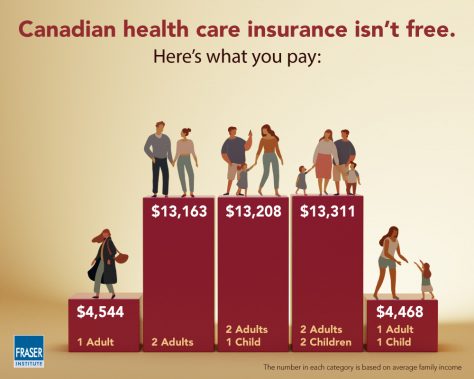
Price of healthcare per Canadian household (Source: Fraser Institute)

Price of healthcare per Canadian household (Source: Fraser Institute)

What about Canada?

I think it’s worth remembering how much government-run health care costs in countries that have adopted “Medicare for All” plans.

I found two interesting studies from Canada’s Angus Reid Institute describing single payer health care in Canada. I’m very interested in find out what things are like in countries that have true government-run health care. A typical Canadian family pays $13,000+ per year per household for healthcare, or about $585,000 over their working lives. What are they getting for all that money?

Here is the first Angus Reid article:

The study finds more than 2 million Canadians aged 55 and older face significant barriers when accessing the health care system in their province, such as being unable to find a family doctor or experiencing lengthy wait-times for surgery, diagnostic tests, or specialist visits.

Moreover, most Canadians in this age group have at least some difficulty getting the care they want or need in a timely manner.

The study focuses on the health care experiences of older Canadians, as well as their assessments of the quality of care they receive.

According to the article, 31% of respondents (aged 55 and older) rated access to the government’s healthcare system as “easy”. 48% had “moderate” problems with access, and 21% had “major” problems with access.

The second Angus Reid article explains:

This second part of the study finds one-in-six Canadians (17%) in the 55-plus age group – a figure that represents upwards of 1.8 million people – say that they or someone else in their household have taken prescription drugs in a way other than prescribed because of cost.

One-in-ten (10%) have decided to simply not fill a prescription because it was too expensive, and a similar number (9%) have decided not to renew one for the same reason. One-in-eight (12%) have taken steps to stretch their prescriptions, such as cutting pills or skipping doses.

Some 17 per cent of Canadians 55 and older have done at least one of these things, and that proportion rises among those who have greater difficulty accessing other aspects of the health care system.

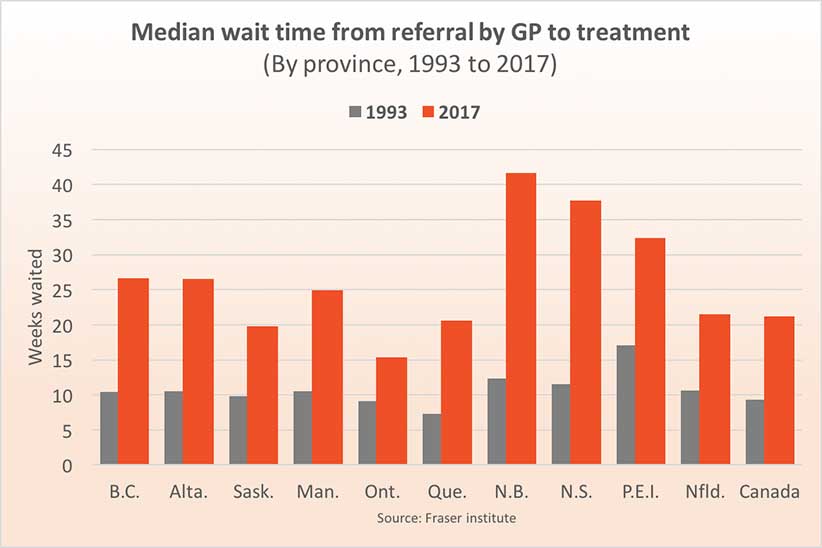
In a previous blog post, I reported on how Canadians have to wait in order to see their GP doctor. If that doctor refers them to a specialist, then they have to wait to see the specialist. And if that specialist schedules surgery, then they have to wait for their surgery appointment. The delays can easily go from weeks to months and even years. The MEDIAN delay from GP referral to treatment is 19.5 weeks.

Wait times in weeks (Source: Maclean's magazine)
Wait times in weeks (Source: Maclean’s magazine)

Also, the Canadian system does NOT cover prescription drugs.

Please share this article and yesterday’s because we have an election coming up, and votes need to know the facts.