Category Archives: News

Is the Bible’s definition of faith opposed to logic and evidence?

Bible study that hits the spot
Theology that hits the spot

Probably the biggest misconception that I encounter when defending the faith is the mistaken notion of what faith is. Today we are going to get to the bottom of what the Bible says faith is, once and for all. This post will be useful to Christians and atheists, alike.

What is faith according to the Bible?

I am going to reference this article from apologist Greg Koukl of Stand to Reason in my explanation.

Koukl cites three Biblical examples to support the idea that faith is not blind leap-of-faith wishing, but is based on evidence.

  1. Moses went out into the wilderness and he had that first encounter with the burning bush, and God gave him the directive to go back to Egypt and let his people go. Moses said, Yeah, right. What’s going to happen when they say, why should we believe you, Moses?God said, See that staff? Throw it down.Moses threw it down and it turned into a serpent.God said, See that serpent? Pick it up.And he picked it up and it turned back into a staff.God said, Now you take that and do that before the Jewish people and you do that before Pharaoh. And you do this number with the hail, and the frogs, and turning the Nile River into blood. You put the sun out. You do a bunch of other tricks to get their attention.And then comes this phrase: “So that they might know that there is a God in Israel.”
  2. [I]n Mark 2 you see Jesus preaching in a house, and you know the story where they take the roof off and let the paralytic down through the roof. Jesus said, “Your sins are forgiven.” And people get bugged because how can anyone forgive sins but God alone?Jesus understood what they were thinking and He said this: What’s harder to say, your sins are forgiven, or to rise, take up your pallet and go home?Now, I’ll tell you what would be harder for me to say : Arise, take up your pallet and go home. I can walk into any Bible study and say your sins are forgiven and nobody is going to know if I know what I am talking about or not. But if I lay hands on somebody in a wheelchair and I say, Take up your wheelchair and go home, and they sit there, I look pretty dumb because everyone knows nothing happened.But Jesus adds this. He says, “In order that you may know that the Son of Man has the power and authority to forgive sins, I say to you, arise, take up your pallet and go home.” And he got up and he got out. Notice the phrase “In order that you may know”. Same message, right?
  3. Move over to the Book of Acts. First sermon after Pentecost. Peter was up in front of this massive crowd. He was talking about the resurrection to which he was an eyewitness. He talked about fulfilled prophecy. He talked about the miraculous tongues and the miraculous manifestation of being able to speak in a language you don’t know. Do you think this is physical evidence to those people? I think so. Pretty powerful.Peter tells them, These men are not drunk as it seems, but rather this is a fulfillment of prophecy. David spoke of this. Jesus got out of the grave, and we saw him, and we proclaim this to you.Do you know how he ends his sermon? It’s really great. Acts 2:36. I’ve been a Christian 20 years and I didn’t see this until about a year ago. This is for all of those who think that if you can know it for sure, you can’t exercise faith in it. Here is what Peter said. Acts 2:36, “Therefore let all the house of Israel know for certain that God has made him both Lord and Christ, Messiah, this Jesus whom you crucified.” There it is again. “Know for certain.”

What is faith according to Bible-based theologians?

I am going to reference this article from theologian C. Michael Patton of Parchment and Pen in my explanation.

Patton explains that according to Reformation (conservative, Bible-based) theologians, faith has 3 parts:

  1. notitia – This is the basic informational foundation of our faith. It is best expressed by the word content. Faith, according to the Reformers must have content. You cannot have faith in nothing. There must be some referential propositional truth to which the faith points. The proposition “Christ rose from the grave,” for example, is a necessary information base that Christians must have.
  2. assensus – This is the assent or confidence that we have that the notitia is correct… This involves evidence which leads to the conviction of the truthfulness of the proposition… This involves intellectual assent and persuasion based upon critical thought… assensus… says, “I am persuaded to believe that Christ rose from the grave.”
  3. fiducia – This is the “resting” in the information based upon a conviction of its truthfulness. Fiducia is best expressed by the English word “trust.”… Fiducia is the personal subjective act of the will to take the final step. It is important to note that while fiducia goes beyond or transcends the intellect, it is built upon its foundation.

So, Biblical faith is really trust. Trust(3) can only occur after intellectual assent(2), based on evidence and thought. Intellectual assent(2) can only occur after the propositional information(1) is known.

The church today accepts 1 and 3, but denies 2. I call this “fideism” or “blind faith”. Ironically, activist atheists, (the New Atheists), also believe that faith is blind. The postmodern “emergent church” denies 1 and 2. A person could accept 1 and 2 but deny 3 by not re-prioritizing their life based on what they know to be true.

How do beliefs form, according to Christian philosophers?

I am going to reference a portion of chapter 3 of J.P. Moreland’s “Love Your God With All Your Mind” (i.e. – LYGWYM).

J.P. Moreland explains how beliefs form and how you can change them.

  1. Today, people are inclined to think that the sincerity and fervency of one’s beliefs are more important than the content… Nothing could be further from the truth… As far as reality is concerned, what matters is not whether I like a belief or how sincere I am in believing it but whether or not the belief is true. I am responsible for what I believe and, I might add, for what I refuse to believe because the content of what I do or do not believe makes a tremendous difference to what I become and how I act.
  2. A belief’s strength is the degree to which you are convinced the belief is true. As you gain ,evidence and support for a belief, its strength grows for you… The more certain you are of a belief… the more you rely on it as a basis for action.

But the most important point of the article is that your beliefs are not under the control of your will.

…Scripture holds us responsible for our beliefs since it commands us to embrace certain beliefs and warns us of the consequences of accepting other beliefs. On the other hand, experience teaches us that we cannot choose or change our beliefs by direct effort.

For example, if someone offered you $10,000 to believe right now that a pink elephant was sitting next to you, you could not really choose to believe this… If I want to change my beliefs about something, I can embark on a course of study in which I choose to think regularly about certain things, read certain pieces of evidence and argument, and try to find problems with evidence raised against the belief in question.

…by choosing to undertake a course of study… I can put myself in a position to undergo a change in… my beliefs… And… my character and behavior… will be transformed by these belief changes.

I think definition of faith is important, because atheists seemed to want to substitute their own definition of faith as blind belief for this Biblical definition, but there is no evidence for their view that faith is belief without evidence. I think this might be another case of projection by atheists. Blind faith is how they arrive at their views, so they are trying to push it onto us. But the Bible is clearly opposed to it.

Positive arguments for Christian theism

Is the definition of atheism “a lack of belief in God”?

I have a key that will unlock a puzzling mystery

First, let’s see check with the Stanford University Encyclopedia of Philosophy:

‘Atheism’ means the negation of theism, the denial of the existence of God.

Stanford University is one of the top 5 universities in the United States, so that’s a solid definition. To be an atheist is to be a person who makes the claim that, as a matter of FACT, there is no intelligent agent who created the universe. Atheists think that there is no God, and theists think that there is a God. Both claims are objective claims about the way the world is out there, and so both sides must furnish forth arguments and evidence as to how they are able to know what they are each claiming.

Philosopher William Lane Craig has some thoughts on atheism, atheists and lacking belief in God in this reply to a questioner.

Question:

In my discussions with atheists, they  are using the term that they “lack belief in God”. They claim that this is different from not believing in God or from saying that God does not exist. I’m not sure how to respond to this. It seems to me that its a silly word-play and is logically the same as saying that you do not believe in God.
What would be a good response to this?
Thank you for your time,

Steven

And here is Dr. Craig’s full response:

Your atheist friends are right that there is an important logical difference between believing that there is no God and not believing that there is a God.  Compare my saying, “I believe that there is no gold on Mars” with my saying “I do not believe that there is gold on Mars.”   If I have no opinion on the matter, then I do not believe that there is gold on Mars, and I do not believe that there is no gold on Mars.  There’s a difference between saying, “I do not believe (p)” and “I believe (not-p).”   Logically where you place the negation makes a world of difference.

But where your atheist friends err is in claiming that atheism involves only not believing that there is a God rather than believing that there is no God.

There’s a history behind this.  Certain atheists in the mid-twentieth century were promoting the so-called “presumption of atheism.” At face value, this would appear to be the claim that in the absence of evidence for the existence of God, we should presume that God does not exist.  Atheism is a sort of default position, and the theist bears a special burden of proof with regard to his belief that God exists.

So understood, such an alleged presumption is clearly mistaken.  For the assertion that “There is no God” is just as much a claim to knowledge as is the assertion that “There is a God.”  Therefore, the former assertion requires justification just as the latter does.  It is the agnostic who makes no knowledge claim at all with respect to God’s existence.  He confesses that he doesn’t know whether there is a God or whether there is no God.

But when you look more closely at how protagonists of the presumption of atheism used the term “atheist,” you discover that they were defining the word in a non-standard way, synonymous with “non-theist.”  So understood the term would encompass agnostics and traditional atheists, along with those who think the question meaningless (verificationists).  As Antony Flew confesses,

the word ‘atheist’ has in the present context to be construed in an unusual way.  Nowadays it is normally taken to mean someone who explicitly denies the existence . . . of God . . . But here it has to be understood not positively but negatively, with the originally Greek prefix ‘a-’ being read in this same way in ‘atheist’ as it customarily is in . . . words as ‘amoral’ . . . . In this interpretation an atheist becomes not someone who positively asserts the non-existence of God, but someone who is simply not a theist. (A Companion to Philosophy of Religion, ed. Philip Quinn and Charles Taliaferro [Oxford:  Blackwell, 1997], s.v. “The Presumption of Atheism,” by Antony Flew)

Such a re-definition of the word “atheist” trivializes the claim of the presumption of atheism, for on this definition, atheism ceases to be a view.  It is merely a psychological state which is shared by people who hold various views or no view at all.  On this re-definition, even babies, who hold no opinion at all on the matter, count as atheists!  In fact, our cat Muff counts as an atheist on this definition, since she has (to my knowledge) no belief in God.

One would still require justification in order to know either that God exists or that He does not exist, which is the question we’re really interested in.

So why, you might wonder, would atheists be anxious to so trivialize their position?  Here I agree with you that a deceptive game is being played by many atheists.  If atheism is taken to be a view, namely the view that there is no God, then atheists must shoulder their share of the burden of proof to support this view.  But many atheists admit freely that they cannot sustain such a burden of proof.  So they try to shirk their epistemic responsibility by re-defining atheism so that it is no longer a view but just a psychological condition which as such makes no assertions.  They are really closet agnostics who want to claim the mantle of atheism without shouldering its responsibilities.

This is disingenuous and still leaves us asking, “So is there a God or not?”

So there you have it. We are interested in what both sides know and what reasons and evidence they have to justify their claim to know. We are interested in talking to people who make claims about objective reality, not about themselves, and who then go on to give reasons and evidence to support their claims about objective reality. There are atheists out there that do make an objective claim that God does not exist, and then support that claim with arguments and evidence. Those are good atheists, and we should engage in rational conversations with them. But clearly there are some atheists who are not like that. How should we deal with these “subjective atheists”?

Dealing with subjective atheists

How should theists respond to people who just want to talk about their psychological state? Well, my advice is to avoid them. They are approaching religion irrationally and non-cognitively – like the person who enters a physics class and says “I lack a belief in the gravitational force!”.  When you engage in serious discussions with people about God’s existence, you only care about what people know and what they can show to be true. We don’t care about a person’s psychology.

Dealing with persistent subjective atheists

What happens when you explain all of that to a subjective atheist who continues to insist that you listen to them repeat over and over “I lack a belief in God, I lack a belief in God”? What if you tell them to make the claim that God does not exist, and then support it with arguments and evidence, but instead they keep leaving comments on your blog telling you again and again about their subjective state of mind: “I lack a belief in cupcakes! I lack a belief in icebergs!” What if they keep e-mailing you and threatening to expose you on Twitter for refusing to listen to them, or denounce you via skywriting: “Wintery Knight won’t listen to me! I lack a belief in crickets!”. I think at this point you have to give up and stop talking to such a person.

And that’s why I moderate and filter comments on this blog. There are uneducated people out there with access to the Internet who want attention, but I am not obligated to give it to them. And neither are you. We are not obligated to listen to abusive people who don’t know what they are talking about. I do post comments from objective atheists who make factual claims about the objective world, and who support those claims with arguments and evidence. I am not obligated to post comments from people who refuse to make objective claims or who refuse to support objective claims with arguments and evidence. And I’m not obligated to engage in discussions with them, either.

Related posts

Facebook censors admit that they suppress Republican content to help Democrat Party

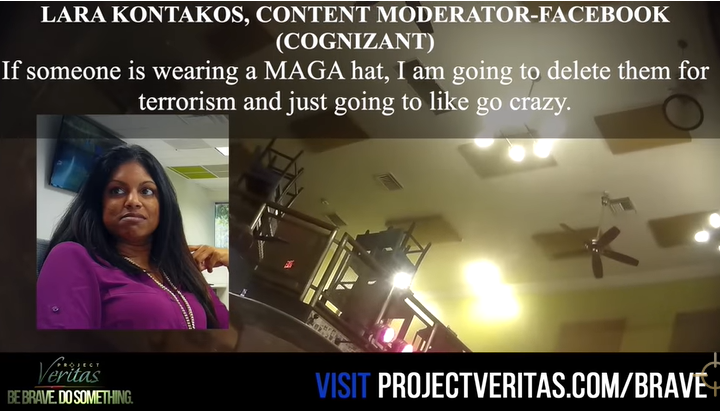
Facebook content moderator explains how she censors Republican content as "terrorism"
Facebook content moderator explains that Republican content is “terrorism”

Project Veritas meets with members of the secular left and get them to talk on camera about how they discriminate against conservatives in order to help Democrats win elections. In this post, we’ll look at their latest sting of Facebook, and review some of Facebook’s censorship of Christians (e.g. – Seth Gruber, Franklin Graham) and conservatives (e.g. – Live Action, PragerU).

Life News reported on the new Project Veritas video:

The Civic Harassment Queue was a list of all the posts that had been flagged for violations of the Community Guidelines. McElroy said, “So, for 75 to 80 percent of the posts to be targeting Republicans and conservatives, you can say it was a bot. But somebody had to design that algorithm. So really, somebody at Facebook.”

[…]An unnamed moderator said that it’s “common sense” to delete posts that have #MAGA in them.

One journalist asked, “If you see a conservative post you just get rid of it, right?” The unnamed moderator responded, saying, “Yes! I don’t give no f*cks, I’ll delete it.”

Another content moderator said:

 “Facebook shadowbans. Facebook is notorious for it, they say they don’t but, it’s clear that people’s content don’t come because it’s been de-filtered off the queue.”

Someone asked on camera, “How many of you are like, take your own stance and say we’re just deleting whatever, all the Trump posts?” An unnamed moderator said, “There are probably like 16 of us.”

A service delivery manager was reportedly caught on camera saying, “Gotta get the Cheeto (Trump) out of office.”

[…]He took screenshots of a memo saying that a poster which showed President Donald Trump’s head being cut off would not be flagged as hate speech. A meme that showed a cartoon of Elmer Fudd shooting at former Democratic presidential candidate Beto O’Rourke was allegedly flagged as hate speech.

In another screenshot, one memo read, “CNN host Don Lemon recently said ‘white men are the biggest terror threat in this country.’ This is implying that white men are terrorists and so would typically violate (HS Tier 1-2 1:6 dehumanizing speech). As this is a newsworthy event, FB’s content policy team is allowing a exception for this content on the platform.”

The video from Project Veritas features about a dozen content moderators (censors) from Facebook, admitting that they deliberately censor Republican content. My favorite is the woman who says that anything pro-Trump is “terrorism”.

Here’s the full video released by Project Veritas, which features conversations with a dozen Facebook content moderators.

Previously, I’ve blogged about other cases of Facebook censoring Christians and conservatives.

Live Action reported:

In yet another apparent attempt to silence pro-lifers, Facebook has removed a post created by Seth Gruber of Life Training Insitute. Gruber had interviewed abortion survivor Melissa Ohden and was sharing information about the interview on his personal Facebook page when he was sent a warning message from the social media giant — and his post was removed.

Fox News reports on another case of Facebook censoring conservatives:

Four Republican senators blasted Facebook for ‘censorship’ over the tech giant’s recent fact check of pro-life organization Live Action.

In a letter today to CEO Mark Zuckerberg, Senators Josh Hawley of Missouri, Ted Cruz of Texas, Kevin Cramer of North Dakota and Mike Braun of Indiana condemn the company’s “pattern of censorship” and demand that it issue a correction, remove any restrictions placed on Live Action and its founder Lila Rose, as well as submit to a “meaningful” external audit.

The Washington Times reports:

The Rev. Franklin Graham was kicked off Facebook for defending North Carolina’s “bathroom bill,” which the social-media giant’s review team decided was hate speech.

Facebook acknowledged over the weekend it had banned the prominent evangelist over transgender issues… But Mr. Graham was having none of it Sunday, calling the move “a personal attack towards me” and an example of the censorship that Silicon Valley has in store for Christians and/or conservatives.

And this one from the Daily Caller:

Facebook is censoring PragerU videos for violating its speech codes that prohibit so-called “hate speech” and shadow banning its posts, PragerU wrote on Twitter Friday.

“We’re being heavily censored on @Facebook. Our last 9 posts are reaching 0 of our 3 million followers. At least two videos were deleted last night for ‘hate speech’ including our recent video with @ConservativeMillen,” PragerU tweeted.

And then there is the previous Project Veritas sting of Facebook, where it emerged that official company documents said that efforts to censor Republicans was important to do, especially in an election year. That makes it clear that Facebook’s intention is to get the Democrat Party elected.

The previous investigation found this:

Project Veritas has obtained and published documents and presentation materials from a former Facebook insider. This information describes how Facebook engineers plan and go about policing political speech. Screenshots from a Facebook workstation show the specific technical actions taken against political figures, as well as “[e]xisting strategies” taken to combat political speech.

[…]According to the insider, the documents revealed a routine suppression of the distribution of conservative Facebook pages. The technical action she repeatedly saw, and for which Project Veritas was provided documentation, was labeled ActionDeboostLiveDistribution.

Said the insider, “I would see [this term] appear on several different conservative pages. I first noticed it with an account that I can’t remember, but I remember once I started looking at it, I also saw it on Mike Cernovich’s page, saw it on Steven Crowder’s page, as well as the Daily Caller’s page.”

[…]The insider says that unlike many actions that Facebook content moderators can take against pages, the “deboost” action, which appears to occur algorithmically, does not notify the page’s owner.

[…]Upon further review, the insider says she did not notice the tag on any left-wing pages.

Everything that hurts the Democrats is “terrorism” and has to be “de-boosted”, especially “in an election year”.

It’s easy for Big Tech executives to go to Washington and lie about whether their companies are censoring or not, but the evidence speaks for itself. We should be investigating them right now, while we still have the Senate and time before the election. Wake up Republicans! Investigate them and hold them accountable.