Science Daily reports on a new paper published in the prestigious peer-reviewed journal Nature.
Excerpt:
A team led by the University of Colorado Boulder has discovered an invisible shield some 7,200 miles above Earth that blocks so-called “killer electrons,” which whip around the planet at near-light speed and have been known to threaten astronauts, fry satellites and degrade space systems during intense solar storms.
The barrier to the particle motion was discovered in the Van Allen radiation belts, two doughnut-shaped rings above Earth that are filled with high-energy electrons and protons, said Distinguished Professor Daniel Baker, director of CU-Boulder’s Laboratory for Atmospheric and Space Physics (LASP). Held in place by Earth’s magnetic field, the Van Allen radiation belts periodically swell and shrink in response to incoming energy disturbances from the sun.
As the first significant discovery of the space age, the Van Allen radiation belts were detected in 1958 by Professor James Van Allen and his team at the University of Iowa and were found to be composed of an inner and outer belt extending up to 25,000 miles above Earth’s surface. In 2013, Baker — who received his doctorate under Van Allen — led a team that used the twin Van Allen Probes launched by NASA in 2012 to discover a third, transient “storage ring” between the inner and outer Van Allen radiation belts that seems to come and go with the intensity of space weather.
The latest mystery revolves around an “extremely sharp” boundary at the inner edge of the outer belt at roughly 7,200 miles in altitude that appears to block the ultrafast electrons from breeching the shield and moving deeper towards Earth’s atmosphere.
“It’s almost like theses electrons are running into a glass wall in space,” said Baker, the study’s lead author. “Somewhat like the shields created by force fields on Star Trek that were used to repel alien weapons, we are seeing an invisible shield blocking these electrons. It’s an extremely puzzling phenomenon.”
A paper on the subject was published in the Nov. 27 issue of Nature.
Something for us to be thankful for on Thanksgiving Day.
When you argue for theism from science, you typically use arguments like these:
the origin of the universe from nothing (the Big Bang)
the fine-tuning of cosmic constants and quantities
the origin of the first living cell
the sudden origin of animal phyla in the Cambrian explosion
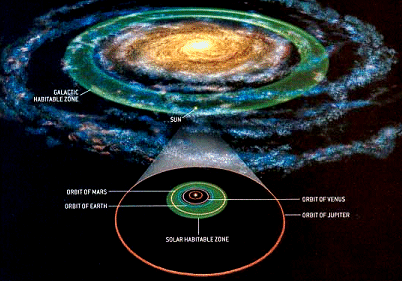
the fine-tuning of the galaxy for complex, embodied mind
the fine-tuning of the solar system for complex, embodied mind
the fine-tuning of the planet (and moon) for complex, embodied mind
This is a peer-reviewed article from Science, one of the most prestigious peer-reviewed journals. It speaks to the fine-tuning of the galaxy for life.
The article says:
Of the estimated 100 billion galaxies in the observable universe, only one in 10 can support complex life like that on Earth, a pair of astrophysicists argues. Everywhere else, stellar explosions known as gamma ray bursts would regularly wipe out any life forms more elaborate than microbes. The detonations also kept the universe lifeless for billions of years after the big bang, the researchers say.
[…]Astrophysicists once thought gamma ray bursts would be most common in regions of galaxies where stars are forming rapidly from gas clouds. But recent data show that the picture is more complex: Long bursts occur mainly in star-forming regions with relatively low levels of elements heavier than hydrogen and helium—low in “metallicity,” in astronomers’ jargon.
Using the average metallicity and the rough distribution of stars in our Milky Way galaxy, Piran and Jimenez estimate the rates for long and short bursts across the galaxy. They find that the more-energetic long bursts are the real killers and that the chance Earth has been exposed to a lethal blast in the past billion years is about 50%. Some astrophysicists have suggested a gamma ray burst may have caused the Ordovician extinction, a global cataclysm about 450 million years ago that wiped out 80% of Earth’s species, Piran notes.
The researchers then estimate how badly a planet would get fried in different parts of the galaxy. The sheer density of stars in the middle of the galaxy ensures that planets within about 6500 light-years of the galactic center have a greater than 95% chance of having suffered a lethal gamma ray blast in the last billion years, they find. Generally, they conclude, life is possible only in the outer regions of large galaxies. (Our own solar system is about 27,000 light-years from the center.)
Things are even bleaker in other galaxies, the researchers report. Compared with the Milky Way, most galaxies are small and low in metallicity. As a result, 90% of them should have too many long gamma ray bursts to sustain life, they argue. What’s more, for about 5 billion years after the big bang, all galaxies were like that, so long gamma ray bursts would have made life impossible anywhere.
But are 90% of the galaxies barren? That may be going too far, Thomas says. The radiation exposures Piran and Jimenez talk about would do great damage, but they likely wouldn’t snuff out every microbe, he contends. “Completely wiping out life?” he says. “Maybe not.” But Piran says the real issue is the existence of life with the potential for intelligence. “It’s almost certain that bacteria and lower forms of life could survive such an event,” he acknowledges. “But [for more complex life] it would be like hitting a reset button. You’d have to start over from scratch.”
The analysis could have practical implications for the search for life on other planets, Piran says. For decades, scientists with the SETI Institute in Mountain View, California, have used radio telescopes to search for signals from intelligent life on planets around distant stars. But SETI researchers are looking mostly toward the center of the Milky Way, where the stars are more abundant, Piran says. That’s precisely where gamma ray bursts may make intelligent life impossible, he says: “We are saying maybe you should look in the exact opposite direction.”
You need to be able to pick up enough heavy elements from surrounding supernovae to make a metal-rich star, but you have to be far enough away from other stars to avoid getting blasted with gamma rays. The metal-rich star is needed to be able to support the circumstellar habitable zone, which is the zone where liquid water exists on the planet’s surface.
It’s important to understand that this factor in the study just a few of the things you need in order to get a planet that supports life. The more factors you add, the more unexpected complex, embodied life of any kind becomes.
Here are a few of the more well-known ones:
a solar system with a single massive Sun than can serve as a long-lived, stable source of energy
a terrestrial planet (non-gaseous)
the planet must be the right distance from the sun in order to preserve liquid water at the surface – if it’s too close, the water is burnt off in a runaway greenhouse effect, if it’s too far, the water is permanently frozen in a runaway glaciation
the solar system must be placed at the right place in the galaxy – not too near dangerous radiation, but close enough to other stars to be able to absorb heavy elements after neighboring stars die
a moon of sufficient mass to stabilize the tilt of the planet’s rotation
plate tectonics
an oxygen-rich atmosphere
a sweeper planet to deflect comets, etc.
planetary neighbors must have non-eccentric orbits
There’s a good video on the galactic habitable zone for you to watch right here:
It takes a lot to make just one planet that can support complex, embodied life of any kind.
The sight of a tiny hummingbird hovering in front of a flower and then darting to another with lightning speed amazes and delights. But it also leaves watchers with a persistent question: How do they do it?
Now, the most detailed, three-dimensional aerodynamic simulation of hummingbird flight conducted to date has definitively demonstrated that the hummingbird achieves its nimble aerobatic abilities through a unique set of aerodynamic forces that are more closely aligned to those found in flying insects than to other birds.
The new supercomputer simulation was produced by a pair of mechanical engineers at Vanderbilt University who teamed up with a biologist at the University of North Carolina at Chapel Hill. It is described in the article “Three-dimensional flow and lift characteristics of a hovering ruby-throated hummingbird” published this fall in the Journal of the Royal Society Interface.
For some time researchers have been aware of the similarities between hummingbird and insect flight, but some experts have supported an alternate model which proposed that hummingbird’s wings have aerodynamic properties similar to helicopter blades. However, the new realistic simulation demonstrates that the tiny birds make use of unsteady airflow mechanisms, generating invisible vortices of air that produce the lift they need to hover and flit from flower to flower.
You might think that if the hummingbird simply beats its wings fast enough and hard enough it can push enough air downward to keep its small body afloat. But, according to the simulation, lift production is much trickier than that.
For example, as the bird pulls its wings forward and down, tiny vortices form over the leading and trailing edges and then merge into a single large vortex, forming a low-pressure area that provides lift. In addition, the tiny birds further enhance the amount of lift they produce by pitching up their wings (rotate them along the long axis) as they flap.
Hummingbirds perform another neat aerodynamic trick — one that sets them apart from their larger feathered relatives. They not only generate positive lift on the downstroke, but they also generate lift on the upstroke by inverting their wings. As the leading edge begins moving backwards, the wing beneath it rotates around so the top of the wing becomes the bottom and bottom becomes the top. This allows the wing to form a leading edge vortex as it moves backward generating positive lift.
According to the simulation, the downstroke produces most of the thrust but that is only because the hummingbird puts more energy into it. The upstroke produces only 30 percent as much lift but it takes only 30 percent as much energy, making the upstroke equally as aerodynamically efficient as the more powerful downstroke.
Large birds, by contrast, generate almost all of their lift on the downstroke. They pull in their wings toward their bodies to reduce the amount of negative lift they produce while flapping upward.
Awesome design in nature!
So the question I have from reading the article is this. Do birds and flying insects have a recent common ancestor? I don’t have too many friends who can answer this for me, but I asked one of them and they both said there is no recent common ancestor for hummingbirds and flying insects. So this looks like another example of convergence – common design in two animals that don’t share a recent common ancestor.