Category Archives: News

How pro-life apologetics helps strengthen your evangelism

From Scott Klusendorf’s Life Training Institute.

Excerpt:

Beyond the obvious obligation we have as thinking human beings to clarify the status, and defend the value, of innocent, unborn human life, engaging in the pro-life project is also a way to make the case for the truth of Christianity in general. It stands to reason that if the scientific, philosophical, and moral arguments we offer in defense of the humanity of the unborn also happen to align exactly with the biblical notion of what it means to be a human being made “in the image of God,” then the Bible might also have something to say about other things of importance.

This is a point Scott makes repeatedly but it was recently driven home in a very concrete way by, of all people, a hard core atheist in the most recent issue of Salvo magazine. A secular skeptic, law school professor, renowned blogger, and mocker of deluded “Godiots,” the “Raving Atheist” attended a blogger party where he serendipitously sat next to a Catholic blogger named Benjamin. As the “Raving Atheist” explains:

At one point the conversation turned to abortion, and I asked Benjamin’s opinion of the practice. I was stunned. Here was a kind, affable, and cogently reasonable human being who nonetheless believed that abortion was murder. To the limited extent I had previously considered the issue, I believed abortion to be completely acceptable, the mere disposal of a lump of cells, perhaps akin to clipping fingernails.

This unsettling exchange spurred me to further investigate the issue on Benjamin’s blog. I noticed that pro-choice Christians did not employ scientific or rational arguments but relied on a confused set of “spiritual” platitudes. More significantly, the pro-choice atheistic blogosphere also fell short in its analysis of abortion. The supposedly “reality-based” community either dismissed abortion as a “religious issue” or paradoxically claimed that pro-life principles were contrary to religious doctrine. Having formerly equated atheism with reason, I was slowly growing uncertain of the value of godlessness in the search for truth.

Though the “Raving Atheist” continued to rave, there was now a stone in his God-rejecting shoe, placed there by a reasoned defense of the pro-life view. He couldn’t disconnect himself from it and later admitted that the “selfless dedication [of pro-life advocates] to their cause moved [him] deeply.” Later, he met a woman named Ashli whose work in pregnancy care drew him to further consider the pro-life position. Soon thereafter, the “Raving Atheist” became, in part, a pro-life blogsite …

Click here to read the astonishing conclusion. Then come back here.

Back? Ok, so what did we learn from this? Well, the moral of this story is that it is very important for Christians to have a good understanding of moral issues like abortion and same-sex marriage so that they can talk about these issues based on what they know. When someone can stake out a moral position on these kinds of issues, using science and history and other hard evidence – not just the Bible – then it helps non-Christians to take us seriously as thinkers.

Unless we demonstrate the ability to reason out there in the real world – outside the church – then we are not going to be viewed as authoritative on any subject – especially on spiritual subjects. We really need to study up on other issues, and show that we care about the unborn (abortion issue) and children (same-sex marriage issue). We have to show that there is more to us than just doing what feels good. We have to show that we are smart and that we are willing to be unpopular in order to do the right thing. That we didn’t just inherit these views from our parents, or from our culture. That we have actually thought things through more than just reading the Bible, and that it makes a difference in how we view the world, and in how we live. We don’t want people to continue in their perception that Christians are just people who play follow-the-leader – we want to show them how we have worked through these issues on our own.

Ignorance is never a good idea when you are trying to do good – and you can’t know what is really good just by your feelings and intuitions. If you want to do good, you need to be 1) convincing and 2) effective. And that takes study. Don’t choose policies based on what makes you feel good and what sounds good to others. Push for effective policies – what actually does good – and then have your arguments and evidence ready to convince people, using evidence from authorities that they accept as non-Christians. If you have the will to study a little, you can be passionate and convincing. Non-Christians respect passion and knowledge. They don’t respect fideism and mysticism.

Scott Klusendorf is the author of the best introductory book on pro-life apologetics, entitled “The Case for Life“.
After legalizing marijuana, Colorado sees higher number of “daily” users

Lee Strobel tweeted this story from the Denver Post.

Excerpt:

As marijuana legalization took hold in Colorado, the estimated percentage of regular cannabis users in the state jumped to the second-highest level in the country, according to new federal data.

When asked, roughly one out of every eight Colorado residents over the age of 12 reported using marijuana in the previous month. Only Rhode Island topped Colorado in the percentage of residents who reported using marijuana as frequently.

The results come from the National Survey on Drug Use and Health and represent the average of estimates gathered in 2012 and 2013.

[…]State-specific data from the survey are averaged over two-year periods to compensate for relatively small sample sizes.

For the 2011-12 period, 10.4 percent of Coloradans 12 and older reported using marijuana in the month prior to being surveyed. That placed Colorado seventh in the country for monthly marijuana use.

Monthly use in Colorado jumped to 12.7 percent — a 22 percent increase — in the 2012-13 data. The result means the survey estimates about 530,000 people in Colorado use marijuana at least once a month.

Nationally, monthly marijuana use by people 12 and older nudged upward by about 4 percent to 7.4 percent. In Washington state — which, like Colorado, in 2012 legalized marijuana use and limited possession for adults — monthly marijuana use rose by about 20 percent to 12.3 percent.

Kleiman said researchers will get a better idea about marijuana use in Colorado once they are able to zoom in on data showing how many people use marijuana daily. A study commissioned by Colorado’s Marijuana Enforcement Division this year found that people who use marijuana almost every day account for about 22 percent of cannabis users in Colorado but consume nearly 67 percent of the marijuana used. Other studies have warned about a possible uptick in heavy marijuana use.

“The fraction of people who are monthly users who are in fact daily users has gone way, way up,” Kleiman said.

Monthly marijuana use increased across all age groups in Colorado, according to the new survey numbers. The number of people who reported using marijuana in the past year also increased in Colorado in the 2012-13 data, but the state ranked only sixth nationally in the measurement. Measurements for alcohol consumption and illicit drug use increased, as well.

What will be interesting will be to see how this increased usage affects tax revenues and the crime rate. I think when more people use mind-altering drugs, it is going to harm their ability to get and keep jobs, which affects tax revenue. And when people are addicted to something, they are more inclined to take a risk on committing a crime to get the money to pay for their next fix. Should be interesting to learn from Colorado’s little experiment.

Related posts

Archaeologists discover entrance to Herod’s palace near Bethlehem

Herod's palace
Herod’s palace

Baptist Press reports on the story.

Full text:

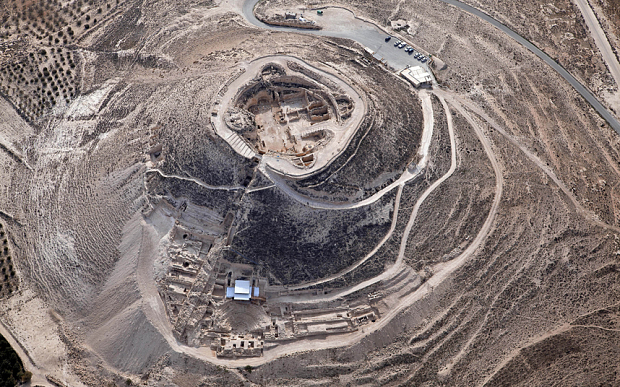
Israeli archeologists have uncovered an impressive entrance to Herod’s palace at Herodium. Located only three miles southeast of Bethlehem, Herodium played an important part in the events surrounding the early life of Christ.

The December announcement by Hebrew University archeologists Roi Porat, Yakov Kalman and Rachel Chachy dovetails well with the seasonal interest in the nativity accounts of Luke and Matthew in the New Testament.

While both Luke and Matthew wrote that King Herod governed Judea during the era of Jesus’ birth at Bethlehem (Luke 1:5, Matthew 2:1), they included nothing concerning Herod’s massive palace/fortress complex at nearby Herodium.

Herodium, like Herod’s other isolated palace/fortress complexes at Masada and Machaerus, was built on a mountain. To enhance its impressive scale, Herod artificially extended the height of the hill to make it the tallest mountain in the Judean desert.

While the site included the usual Herodian luxuries such as a palace, bathhouse, theatre and garden, Herodium was essentially a fortress, a place where Herod could find refuge if his people revolted.

Herod’s fear of a Jewish revolt led him to establish many fortresses in both urban centers (he maintained two in Jerusalem itself) and in isolated rural areas away from the urban centers.

A small community close to the fortress housed the construction teams and, later, the garrison soldiers and palace servants. The servants who waited on the king indeed worked in an impressive palace.

The newly uncovered entranceway apparently was still being constructed near the time of the monarch’s death.

As shown in one of the photographs, the entryway included three levels of arches in a 65-foot corridor that was 19 feet across and 65 feet in height leading to the palace’s courtyard. Curiously enough, the nearly completed entrance was abruptly stopped and backfilled around the time of Herod’s death. The archeologists speculated that the now-aging Herod instead sought to convert the entire palace into a memorial mound for his upcoming burial at the site.

Indeed, Herod’s plans for Herodium unfolded as Jesus was born and as He spent His early life in nearby Bethlehem. When the magi arrived in Jerusalem and announced they had come to worship the “king of the Jews,” Herod sent them to Bethlehem after learning the location of the Messiah’s birthplace from the chief priests and learned scholars. The monarch hoped to ascertain from the magi which of the town’s small children was the designated royal candidate. Then Herod hoped to execute the child (Matthew 2:1-8, 2:16).

When the magi failed to return with this information, Herod ordered his soldiers into Bethlehem to murder all children age 2 and under. Warned to flee to Egypt, the holy family escaped Herod’s plans, but an undisclosed number of children were killed by Herod’s soldiers. Although never stated in the biblical account, the soldiers who carried out the old king’s infamous order were either stationed in Jerusalem (seven miles from Bethlehem) or in the closer post at Herodium. In fact, Herodium overlooked Bethlehem and could have functioned as a convenient headquarters for Herod’s deadly operation.

While the holy family resided in Egypt, another Herodium connection to the early life of Christ took place. After a long and terribly painful illness, Herod died. His surviving eldest son (Herod had murdered his three oldest sons), Archelaus, then buried him in Herodium at a pre-selected tomb and gave his father an elaborate funeral at the site and spared no expense, according to the Jewish historian Josephus (Jewish War, 1,673).

Israeli archeologist Ehud Netzer claimed to have found Herod’s tomb and damaged sarcophagus (stone coffin) in 2007 at Herodium, but in 2013 and 2014 other archeologists have raised doubts about the tomb and the sarcophagus. Israeli archeologists Joseph Patrich and Benjamin Arubas largely based their doubts on the modest tomb site and the unimpressive sarcophagus. They believe that the mega-maniacal Herod would have commissioned a larger tomb and a more elaborate sarcophagus.

With Herod now buried in Herodium and with Archelaus eventually ruling over much of his father’s former kingdom as an “ethnarch” (“ruler of the people”), the New Testament noted the change in political leadership (Matthew 2:19-22). The change prompted Joseph to consider a move back to Judea (perhaps back to Bethlehem itself where the family had lived for about two years), but his misgivings about a Judea under the rule of an already unpopular Archelaus and a warning in a dream led him to reconsider. The decision was a wise one. A return to Bethlehem in the “shadow of Herodium” and the nearby royal city of Jerusalem placed the holy family at potential risk.

Instead, Joseph took his family back to Nazareth in Galilee (Matthew 2:22-23). Galilee was governed by Herod Antipas, the younger brother of Archelaus. At the time, this Herodian ruler, with the title of “tetrarch” (“ruler over a fourth”), was regarded as a milder alternative to the volatile Archelaus. Located far away from the recent unpleasant associations connected to Herodium and the slaughter of the children in Bethlehem, Joseph and Mary would raise Jesus in the peaceful surroundings of Nazareth.

The recent archeological find in Herodium and the continuing dispute concerning Herod’s tomb and sarcophagus calls attention to the background story of the early life of Christ as detailed in the Gospel of Matthew. Perhaps some further archeological discoveries at Herodium will uncover additional information about the familiar nativity narrative.

I liked this article on Baptist Press so much, I pasted it here in full – because of the links between history and the Bible. It’s also reported in secular news sources like NBC News and the UK Telegraph.

When I read stories like this, it really makes me question people who think that the New Testament books were not intended to be history. I think the default view has to be that the authors intended to write history, and then we do the work to see which parts pass historical tests – i.e. – how early, how many sources, how many eyewitnesses, etc. And, do we have archaeological evidence to corroborate the narrative.