Category Archives: News

What do ancient non-Christian sources tell us about the historical Jesus?

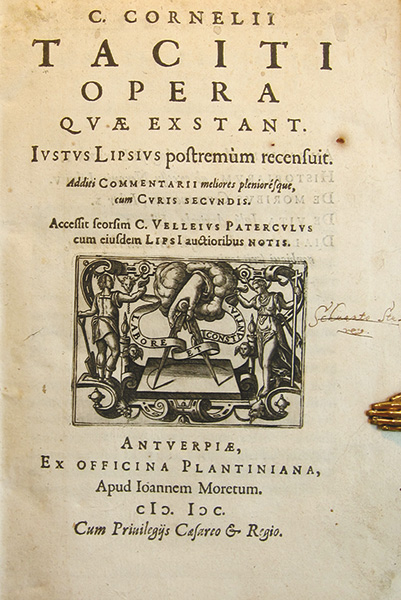
The Annals, by Roman historian Tacitus

This article from Biblical Archaeology covers all the non-Christian historical sources that discuss Jesus.

About the author:

Lawrence Mykytiuk is associate professor of library science and the history librarian at Purdue University. He holds a Ph.D. in Hebrew and Semitic Studies and is the author of the book Identifying Biblical Persons in Northwest Semitic Inscriptions of 1200–539 B.C.E. (Atlanta: Society of Biblical Literature, 2004).

Here are the major sections:

  • Roman historian Tacitus
  • Jewish historian Josephus
  • Greek satirist Lucian of Samosata
  • Platonist philosopher Celsus
  • Roman governor Pliny the Younger
  • Roman historian Suetonius
  • Roman prisoner Mara bar Serapion

And this useful excerpt captures the broad facts about Jesus that we get from just the first two sources:

We can learn quite a bit about Jesus from Tacitus and Josephus, two famous historians who were not Christian. Almost all the following statements about Jesus, which are asserted in the New Testament, are corroborated or confirmed by the relevant passages in Tacitus and Josephus. These independent historical sources—one a non-Christian Roman and the other Jewish—confirm what we are told in the Gospels:31

1. He existed as a man. The historian Josephus grew up in a priestly family in first-century Palestine and wrote only decades after Jesus’ death. Jesus’ known associates, such as Jesus’ brother James, were his contemporaries. The historical and cultural context was second nature to Josephus. “If any Jewish writer were ever in a position to know about the non-existence of Jesus, it would have been Josephus. His implicit affirmation of the existence of Jesus has been, and still is, the most significant obstacle for those who argue that the extra-Biblical evidence is not probative on this point,” Robert Van Voorst observes.32 And Tacitus was careful enough not to report real executions of nonexistent people.

2. His personal name was Jesus, as Josephus informs us.

3. He was called Christos in Greek, which is a translation of the Hebrew word Messiah, both of which mean “anointed” or “(the) anointed one,” as Josephus states and Tacitus implies, unaware, by reporting, as Romans thought, that his name was Christus.

4. He had a brother named James (Jacob), as Josephus reports.

5. He won over both Jews and “Greeks” (i.e., Gentiles of Hellenistic culture), according to Josephus, although it is anachronistic to say that they were “many” at the end of his life. Large growth
in the number of Jesus’ actual followers came only after his death.

6. Jewish leaders of the day expressed unfavorable opinions about him, at least according to some versions of the Testimonium Flavianum.

7. Pilate rendered the decision that he should be executed, as both Tacitus and Josephus state.

8. His execution was specifically by crucifixion, according to Josephus.

9. He was executed during Pontius Pilate’s governorship over Judea (26–36 C.E.), as Josephus implies and Tacitus states, adding that it was during Tiberius’s reign.

Some of Jesus’ followers did not abandon their personal loyalty to him even after his crucifixion but submitted to his teaching. They believed that Jesus later appeared to them alive in accordance with prophecies, most likely those found in the Hebrew Bible. A well-attested link between Jesus and Christians is that Christ, as a term used to identify Jesus, became the basis of the term used to identify his followers: Christians. The Christian movement began in Judea, according to Tacitus. Josephus observes that it continued during the first century. Tacitus deplores the fact that during the second century it had spread as far as Rome.

I remember reading the 1996 book by Gary Habermas entitled “The Historical Jesus: Ancient Evidence for the Life of Christ“. This book is a little before the time of most of you young Christian apologists, but back before the time of Lee Strobel and J. Warner Wallace, this is the stuff we all read. Anyway, in the book he makes a list of all that can be known about Jesus from external sources. And fortunately for you, you don’t have to buy the book because you can read chapter 9 of it right on his web site.

From Tacitus he gets this:

From this report we can learn several facts, both explicit and implicit, concerning Christ and the Christians who lived in Rome in the 60s A.D. Chronologically, we may ascertain the following information.

(1) Christians were named for their founder, Christus (from the Latin), (2) who was put to death by the Roman procurator Pontius Pilatus (also Latin), (3) during the reign of emperor Tiberius (14 37 A.D.). (4) His death ended the “superstition” for a short time, (5) but it broke out again, (6) especially in Judaea, where the teaching had its origin.

(7) His followers carried his doctrine to Rome. (8) When the great fire destroyed a large part of the city during the reign of Nero (54 68 A.D.), the emperor placed the blame on the Christians who lived in Rome. (9) Tacitus reports that this group was hated for their abominations. (10) These Christians were arrested after pleading guilty, (11) and many were convicted for “hatred for mankind.” (12) They were mocked and (13) then tortured, including being “nailed to crosses” or burnt to death. (14) Because of these actions, the people had compassion on the Christians. (15) Tacitus therefore concluded that such punishments were not for the public good but were simply “to glut one man’s cruelty.”

And from Josephus he gets this:

(1) Jesus was known as a wise and virtuous man, one recognized for his good conduct. (2) He had many disciples, both Jews and Gentiles. (3) Pilate condemned him to die, (4) with crucifixion explicitly being mentioned as the mode. (5) The disciples reported that Jesus had risen from the dead and (6) that he had appeared to them on the third day after his crucifixion. (7) Consequently, the disciples continued to proclaim his teachings. (8) Perhaps Jesus was the Messiah concerning whom the Old Testament prophets spoke and predicted wonders. We would add here two facts from Josephus’ earlier quotation as well. (9) Jesus was the brother of James and (10) was called the messiah by some.

So when you are reading the New Testament, these facts are the framework that you read within. It’s a good starting point when dealing with people who have never looked into who Jesus was and what he taught and what his followers believed about him, right from the start.

Right-to-work states gained jobs three times faster than forced union states

Gallup poll on right-to-work, August 2014

This is from economist Stephen Moore writing in Investors Business Daily.

He writes:

Wisconsin is poised this week to become the 25th “right-to-work state,” ending forced unionization and allowing individual workers to decide if they want to join a union or not.

The Wisconsin Senate just recently passed right-to-work, and our sources in Madison say that the House, which is controlled by Republicans, will enact a similar law in the days ahead.

Republican Gov. Scott Walker, a leading presidential candidate, is sure to sign the bill when it gets to his desk. “This isn’t anti-union,” insists Walker. “It restores worker rights and brings jobs back to Wisconsin.”

Some 3,000 liberal protesters stormed the Capitol in Madison over the weekend to reverse the momentum for the new law. This isn’t Walker’s first dust-up with union bosses. Four years ago, nearly 100,000 activists grabbed nationwide headlines when they protested his reforms in Wisconsin’s collective bargaining process with public employee unions.

If the new law passes, Wisconsin would join two other blue-collar, industrial Midwestern states — Michigan and Indiana — to recently adopt right-to-work. “If you had told me five years ago that right-to-work would become law in Indiana, Michigan and Wisconsin, I wouldn’t have thought it was even remotely possible,” says economist Arthur Laffer.

Laffer and I have conducted substantial economic research showing three times the pace of jobs gains in right-to-work states than in the states with forced union rules that predominate in deep blue states such as California, New York and Illinois.

In the 2003-13 period, jobs were up by 8.6% in right-to-work states, and up only 3.7% in forced union states. Most of the southern states, with the exception of Kentucky, are right-to-work

Many auto jobs in recent decades have moved out of Michigan and Ohio and into states such as Texas, Alabama and South Carolina, due in part to right-to-work laws in Dixie.

But as union power recedes in the Midwestern states, many of the region’s governors see factory jobs returning to their backyards. “Right to work is already lowering unemployment in Indiana and causing a manufacturing revival here,” says Gov. Mike Pence.

Companies are more attracted to right-to-work states, and that means more jobs become available.

Here is Congressional testimony from James Sherk, senior policy analyst in labor economics at The Heritage Foundation. I really recommend bookmarking this article. Even though it is very long, it is up-to-date and comprehensive. I am linking to it because he responds to objections to right-to-work laws raised by unions.

Do right-to-work laws hurt the middle class?:

Union Strength and the Middle Class. Unions and their supporters frequently claim the opposite: that unions helped build the middle class and weaker unions hurt all workers—not just union members. To make this point they often juxtapose the decline of union membership since the late 1960s with the share of income going to the middle class. The Economic Policy Institute did exactly this when criticizing the possibility of RTW in Wisconsin. These comparisons suffer from two problems. First, the absolute standards of living for middle-class workers have risen substantially over the past generation. Inflation-adjusted market earnings rose by one-fifth for middle-class workers between 1979 and 2011. After-tax incomes rose at an even faster pace. Middle-class workers today enjoy substantially higher standards of living than their counterparts in the 1970s.

Secondly, these figures conflate correlation with causation. During the time period EPI examined union membership correlates well with their measure of middle-class income shares. Extending the graph back another two decades eliminates this correlation. U.S. union density surged in the late 1930s and during World War II. It peaked at about a third of the overall economy and private-sector workforce in the mid-1950s. During this time period America had few global competitors. From the mid-1950s onward global competition increased and U.S. union membership steadily declined. Between 1954 and 1970 union density dropped from 34.7 percent to 27.3 percent. Unions lost over a fifth of their support in just over a decade and a half.

During this period middle-class income and living standards grew rapidly. No one remembers the 1950s and 1960s as bad for the middle class, despite the substantial de-unionization that occurred. Over a longer historical period changes in U.S. union strength show little correlation with middle-class income shares. Liberal analysts come to their conclusion by looking only at the historical period in which the two trends align.

Do right-to-work states have lower wages?:

Unions Argue RTW Hurts Wages. In the same vein, unions argue that RTW laws lower wages. As the Wisconsin AFL-CIO recently claimed:

These anti-worker Right To Work laws just force all working families to work harder for lower pay and less benefits, whether they’re in a union or not. The average worker makes about $5,000 less and pensions are lower and less secure in Right to Work states.

This statement contains a degree of truth: average wages in right-to-work states are approximately that much lower than in non-RTW states. This happens because right-to-work states also have below-average costs of living (COL). Virtually the entire South has passed RTW, but no Northeastern states have passed an RTW law. The Northeast has higher COL and higher average wages; the South has lower living costs and lower wages.

[…]All but one right-to-work state has living costs at or below the national average. All ten of the states with the highest COL have compulsory union dues. Analyses that control for these COL differences have historically found that RTW has no deleterious effects on workers’ real purchasing power.

Recently the Economic Policy Institute has claimed that workers in RTW states make 3 percent less than workers without RTW protection, even after controlling for living costs. Heritage replicated this analysis and found that EPI made two major mistakes: it included improper control variables and did not account for measurement error in their COL variables. These mistakes drive their results. Correcting these mistakes shows that private-sector wages have no statistically detectable correlation with RTW laws. The supplement and the appendices to this testimony explain the technical details of this replication. Properly measured, RTW laws have no effect on wages in the private sector.

Although the history of unions shows that unions were a valuable and necessary check on the power of greedy corporations in times past, today unions are using the dues they collect from workers to elect Democrats. The vast majority of political contributions made by the big unions go to Democrats.

Here’s one example, using the Service Employees International Union numbers:

Service Employees International Union

(Click for larger image)

So if you oppose what Democrat politicians are doing, it makes sense to free workers from being forced to pay union dues for causes that are against their values. The average rank-and-file member of a union does not share Democrat values on things like abortion and gay marriage, in my opinion. Why should they be forced to pay union dues that go to elect politicians who oppose their values?

Eric Holder’s DOJ finds officer Darren Wilson innocent in Michael Brown shooting

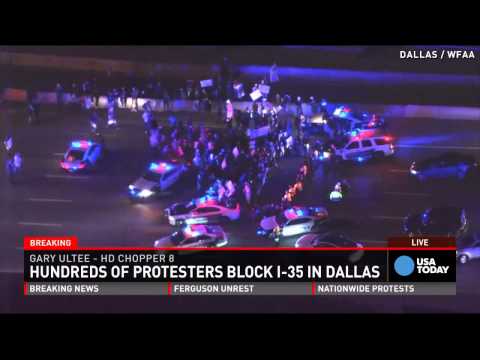
Ferguson protesters shut down highway

Normally, I would not post on this, but I think I must because of the way that the mainstream media and the culture as a whole swallowed a narrative that bashes police officers, and by extension the rule of law, and even the responsibility that criminals bear for their own actions.

Hot Air introduces the Department of Justice’s findings:

The DOJ — Eric Holder’s DOJ — is clear as can be that it thinks Wilson was justified in shooting Michael Brown.

[…][The DOJ report] was a considered argument that not only is Wilson not guilty of a federal civil rights charge, he’s not guilty of a criminal offense of any sort. Had Wilson gone to trial, he could have submitted this as his motion to dismiss and the court might well have torpedoed the indictment before opening arguments.

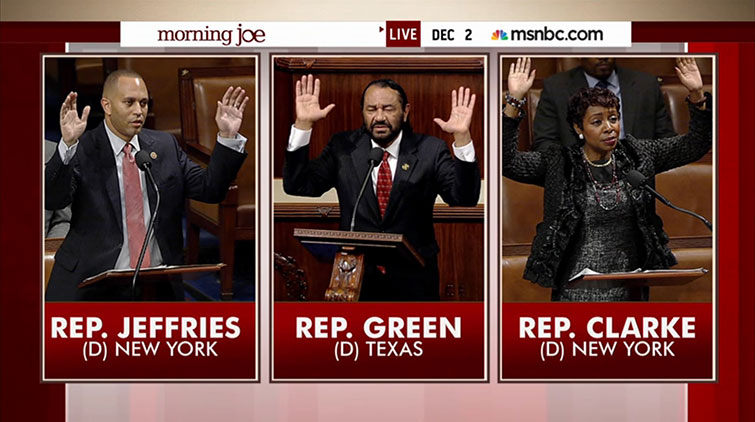
Hot Air extracts some of the most interesting parts of the report, and I am injecting some photos of “hands-up” Democrats in between the findings.

Page 82:

Wilson’s version is further supported by disinterested eyewitnesses Witness 102, Witness 104. Witness 105. Witness 108. and Witness 109. among others. Those witnesses all agree that Brown ran or charged toward Wilson and that Wilson shot at Brown only as Brown moved toward him. Although some of the witnesses stated that Brown briefly had his hands up or out at about waist-level, none of these witnesses perceived Brown to be attempting to surrender at any point when Wilson fired upon him. To the contrary, several of these witnesses stated that they would have felt threatened by Brown and would have responded in the same way Wilson did. For example. Witness 104 stated that as Wilson ran after Brown yelling “stop, stop. stop.” Brown finally turned around and raised his hands “for a second.” However. Brown then immediately balled his hands into fists and “charged” at Wilson in a “tackle run.” Witness 104 stated that Wilson fired only when Brown moved toward him and that she “would have fired sooner.” Likewise. Witness 105 stated that Brown turned around and put his hands up “for a brief moment.” then refused a command from Wilson to “get down” and instead put his hands “in running position” and maned running toward Wilson. Witness 105 stated that Wilson shot at Brown only when Brown was moving toward him. These witnesses’ accounts are consistent with prior statements they have given, consistent with the forensic and physical evidence, and consistent with each other’s accounts. Accordingly. we conclude that these accounts arc credible.

Democrats:

Democrats say "hands up!"
Democrats say “hands up!”

Page 84:

When the shootings are viewed, as they must be, in light of all the surrounding circumstances and what Wilson knew at the time, as established by the credible physical evidence and eyewitness testimony, it was not unreasonable for Wilson to fire on Brown until he stopped moving forward and was clearly subdued. Although, with hindsight. we know that Brown was not armed with a gun or other weapon, this fact does not render Wilson’s use of deadly force objectively unreasonable. Again. the key question is whether Brown could reasonably have been perceived to pose a deadly threat to Wilson at the time he shot him regardless of whether Brown was armed. Sufficient credible evidence supports Wilson’s claim that he reasonably perceived Brown to be posing a deadly threat. First. Wilson did not know that Brown was not armed at the time he shot him, and had reason to suspect that he might be when Brown reached into the waistband of his pants as he advanced toward Wilson. S

[…]While Brown did not use a gun on Wilson at the SUV, his aggressive actions would have given Wilson reason to at least question whether he might be armed, as would his subsequent forward advance and reach toward his waistband. This is especially so in light of the rapidly-evolving nature of the incident. Wilson did not have time to determine whether Brown had a gun and was not required to risk being shot himself in order to make a more definitive assessment.

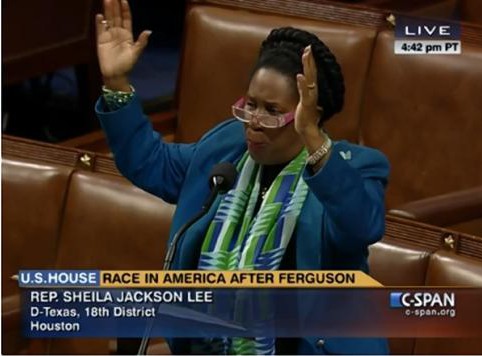
Democrats:

Another Democrat says "hands up"
Another Democrat says “hands up”

Here’s a witness who was disqualified:

Witness 101 is a 22-year-old black male who was walking in the middle of Canfield Drive with Brown when they encountered Wilson. Witness 101 made multiple statements to the media immediately following the incident that spawned the popular narrative that Wilson shot Brown execution style as he held up his hands in surrender. These media interviews occurred prior to Witness 101 giving his two statements. First, FBI and SLCPD jointly interviewed Witness 101 on August 13. 2014. in the presence of Witness 101’s mother. Witness 101’s two attorneys, and an individual who explained that he was in charge of Witness 101’s personal security. Witness 101 subsequently testified before the county grand jury.

After pointing out all the inaccuracies and inconsistencies in his testimony, the report concludes:

Witness 101 has a misdemeanor conviction for a crime of dishonesty likely admissible in federal court as impeachment evidence. As described above, material parts of Witness 101’s account are inconsistent with the physical and forensic evidence. internally inconsistent from one part of his account to the next, and inconsistent with other credible witness accounts that are corroborated by physical evidence. It is also unclear whether Witness 101 had the ability to accurately perceive the shootings. Witness 101 likely crouched down next to a white Monte Carlo as Wilson chased Brown. The Monte Carlo was facing west with a view of the passenger side of the SUV. Brown ran in the opposite direction that the Monte Carlo was facing. Witness accounts vary as to whether Witness 101 was ducking for cover on the passenger side of the Monte Carlo with his back to the shooting, or whether he fled the scene prior to the final shots being fired. Both Witness 101’s inconsistencies and his ability to perceive what happened, or lack thereof, make his account vulnerable to effective cross-examination and extensive impeachment. Accordingly, after a thorough review of all of the evidence, federal prosecutors determined material portions of Witness 101’s account lack credibility and therefore determined that his account does not support a prosecution of Darren Wilson.

Now, I want you to think about what it meant that the mainstream media in this country, and their allies in the Democrat party, were able to cause riots, vandalism, crime, and all manner of unrest because of a lie. Did you fall for it? Do you know anyone who did? I would like to think that the same people who went rioting will hear about this from their favorite media propagandists, but I don’t they they will. After all, getting to the truth is the last thing the media wanted to do. They won’t cover the correction to their lies. They wanted to cause divisions, and prop up the Democrat party as the savior of colored people.

I recommend that everyone watch this 15-minute TED.com talk with Sharyl Attkisson: (H/T Drew)

For the record, my skin color is about the same as Sheila Jackson Lee, above.