Category Archives: News

Brookings Institution: a $1.2 billion social program that doesn’t work

This is a surprising article coming from the leftist Brookings Institution.

They write:

Afterschool programs, or out-of-school time programs, burst into view in the late 1990s. The federal government—flush with budget surpluses of hundreds of billions—began spending more on the 21st Century Community Learning Centers (CCLC) program. The program was created by the 1994 Improving America’s Schools Act and had languished as an obscure provision to promote schools as community resources. Initially, the program received no appropriation, until Congress appropriated $40 million for it in 1998.

Spending exploded after the program pivoted to support afterschool programs. By 2002, the program’s appropriation was $1 billion. For a federal program to grow from $40 million to $1 billion in a few years happens rarely. The agency overseeing the program, the U.S. Department of Education, partnered with the Charles Stewart Mott Foundation to underwrite conferences and technical assistance for program providers, pumping millions more into the program.

In 1999, the Department of Education contracted with Mathematica Policy Research to evaluate the 21st Century program. The evaluation had elements that were both rigorous and representative. The elementary school part of the study was designed as an experiment; the middle school part was designed as a random sampling of programs around the country, with students participating in the program matched with students in neighboring schools (or the same school, in rural areas) that were not participating in the program. The evaluation collected data on a wide range of outcomes including grades, test scores, attendance, and behavior.[1]

Ultimately, the evaluation reported on how the program affected outcomes. In a series of reports released between 2003 and 2005 (here, here, and here), the answers emerged: the program didn’t affect student outcomes. Except for student behavior, which got worse. And small samples were not an issue explaining why findings were insignificant. The national evaluation included about 2,300 elementary school students and 4,400 middle school students. The results were insignificant because the estimates of program effects hovered around zero.

In the face of these results, one course of action would have been to at least reduce program spending, if not eliminate the program altogether. The Bush administration proposed a reduction of $400 million in the program budget, advocates rallied to the cause, Arnold Schwarzenegger got involved, and ultimately Congress left program spending unchanged. To this day, the program spends more than a billion dollars each year.

If the national evaluation was thought to be unreliable or errant, a sensible next step would be to do another, possibly with different focuses or features. That hasn’t happened. Or perhaps the evaluation findings were dismissed because other research has shown that afterschool programs are effective. It hasn’t. Echoing a previous 2006 review by Zief, Lauver, and Maynard, a 2015 review of dozens of studies that were published up to 2014 concluded that “mean effects were small and non-significant for attendance and externalizing behaviors.”[2](This is how researchers say the evidence shows that after school programs do not improve attendance or behavior.)

Two other pieces of evidence add to this picture. First, the U.S. Department of Education continues to collect and summarize the program’s annual performance reports (each state reports on its programs to the Department). Its most recent summary noted that ‘nearly all of the performance targets for the 2009-2010 reporting period were not reached.’ Second, a recent federal study of supplemental services programs found no effects on academic outcomes. The study examined programs that are required to be offered by schools that do not meet target levels of adequate yearly progress under No Child Left Behind. They are tutoring and academic support service programs offered outside the regular school day that have a stronger academic focus than the 21st Century programs (which can offer snacks, recreation, and youth development activities), and yet they still did not improve academic outcomes.

I am linking to this because I want people to understand that not every problem has to be solved by the government. It is possible that when politicians tell us that they want to solve a problem by taxing us and spending our money, it’s possible that what they spend our money on does not work. Normally, when it comes to government spending on children,it’s very hard to cut spending because compassionate people do not want to take money away “from the children”. Most Democrat voters do not even realize that money spent by the government either comes from taxation or borrowing from the next generation does not work, it can be very hard to cut funding for those those programs, because the powerful pro-government party has no interest in cutting government spending in any area. They get contributions from people who are very interested in big government.
New study: separating from mother causes children to have higher anxiety and fear

The Wall Street Journal reports on a new study.

It says:

We learn to be afraid. One of the oldest discoveries in psychology is that rats will quickly learn to avoid a sound or a smell that has been associated with a shock in the past—they not only fear the shock, they become scared of the smell, too.

A paper by Nim Tottenham of the University of California, Los Angeles in “Current Topics in Behavioral Neurosciences” summarizes recent research on how this learned fear system develops, in animals and in people. Early experiences help shape the fear system. If caregivers protect us from danger early in life, this helps us to develop a more flexible and functional fear system later. Dr. Tottenham argues, in particular, that caring parents keep young animals from prematurely developing the adult system: They let rat pups be pups and children be children.

Of course, it makes sense to quickly learn to avoid events that have led to danger in the past. But it can also be paralyzing. There is a basic paradox about learning fear. Because we avoid the things we fear, we can’t learn anything more about them. We can’t learn that the smell no longer leads to a shock unless we take the risk of exploring the dangerous world.

Many mental illnesses, from general anxiety to phobias to posttraumatic-stress syndrome, seem to have their roots in the way we learn to be afraid. We can learn to be afraid so easily and so rigidly that even things that we know aren’t dangerous—the benign spider, the car backfire that sounds like a gunshot—can leave us terrified. Anxious people end up avoiding all the things that just might be scary, and that leads to an increasingly narrow and restricted life and just makes the fear worse. The best treatment is to let people “unlearn” their fears—gradually exposing them to the scary cause and showing them that it doesn’t actually lead to the dangerous effect.

Neuroscientists have explored the biological basis for this learned fear. It involves the coordination between two brain areas. One is the amygdala, an area buried deep in the brain that helps produce the basic emotion of fear, the trembling and heart-pounding. The other is the prefrontal cortex, which is involved in learning, control and planning.

Regina Sullivan and her colleagues at New York University have looked at how rats develop these fear systems. Young rats don’t learn to be fearful the way that older rats do, and their amygdala and prefrontal systems take a while to develop and coordinate. The baby rats “unlearn” fear more easily than the adults, and they may even approach and explore the smell that led to the shock, rather than avoid it.

If the baby rats are periodically separated from their mothers, however, they develop the adult mode of fear and the brain systems that go with it more quickly. This early maturity comes at a cost. Baby rats who are separated from their mothers have more difficulties later on, difficulties that parallel human mental illness.

Dr. Tottenham and her colleagues found a similar pattern in human children. They looked at children who had grown up in orphanages in their first few years of life but then were adopted by caring parents. When they looked at the children’s brains with functional magnetic resonance imaging, they found that, like the rats, these children seemed to develop adultlike “fear circuits” more quickly. Their parents were also more likely to report that the children were anxious. The longer the children had stayed in the orphanages, the more their fear system developed abnormally, and the more anxious they were.

Whenever I read books about daycare, the word “anxiety” is the one that seems to be the most common.

It’s important for the mother to stay at home, and plans should be made before the marriage to make that financially feasible. The plans should start for each parent when they are deciding what the study, where to work, and so on. A working mother who puts her child in daycare will have to exercise extra care to make sure that the child is OK. And this becomes even harder to do when her stress levels go up from work. You can’t bond with a child if you can’t stop screaming obscenities and/or being violent because of work stress.

Another risk factor for anxiety is demanding a lot from a child (say, academically) but not taking the steps to monitor daily progress and provide daily assistance. Think of it as a scale from report-card-day tantrums all the way to daily monitoring and helping with homework. The closer the parents are to the report card day tantrums side of things, the more anxiety if is going to cause the child. Yes, it’s important for children to do well in school so that they can get jobs later. But tantrums don’t achieve anything except to scare them away from learning. Daily monitoring and listening is a better way to create the connection that reduces the child’s anxiety.

Report: UK moms with children as likely to work as women with no children

Stay-at-home moms in the UK at 25%

Dina sent me this stunning article from the UK Daily Mail.

It says:

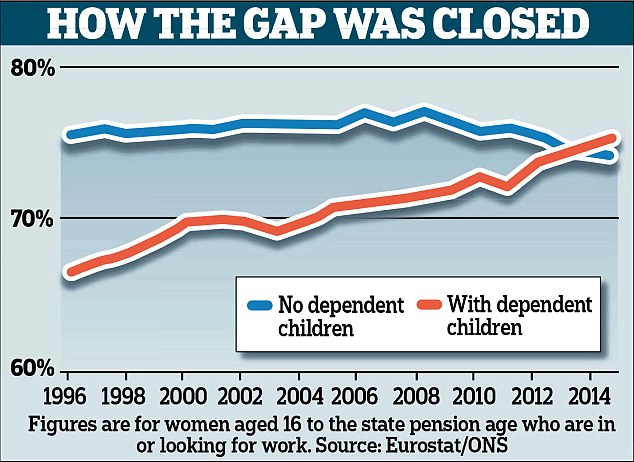
Mothers are now as likely to go out to work as women without children, figures showed yesterday.

The historic landmark reached last year means just one mother in four stays at home to raise children.

Figures from the Office for National Statistics showed 74.1 per cent of mothers with children under 16, or between 16 and 18 if they are still at school, are regarded as ‘participating in the labour market’. 

By comparison, 75 per cent of women without dependent children were either in work or looking for a job last year.

[…]The new estimates are based on the large-scale Labour Force Survey covering women who either have jobs or are unemployed and looking for work. The ONS report said benefit changes that have pressed single parents into looking for work may have influenced the change.

It added: ‘Other government policies, for example to fund 570 hours of free early education childcare a year in England for all three to four-year-olds, will have provided additional incentives to engage with the labour market.’

The biggest change has been among mothers of children under five. In 1996, 1.6 million of them were in the labour market, compared with 2.1 million last year. This represents a rise from 54.5 per cent of mothers of under-fives in work in 1996 to 65 per cent now.

There are three things I want to say about this.

First, it’s undeniable that daycare is not optimal for a child when compared with having a stay-at-home mom for the early years of childhood. That’s not my opinion, it’s a fact. Part of preparing to get married and have kids is understanding what marriage requires and what children need. Don’t rely on the government to provide for your kids, they are only interested in putting you to work so they can get your income taxes. That’s especially true for big-government leftist parties that want to weaken marriage and the traditional family in any case.

Second, it’s undeniable that government programs can make the choice to stay home or not more or less financially feasible. Make sure when you vote that you vote for smaller government and lower taxes. The bigger the government, the less money you have to run your own family game plan. Social programs exist so that the government can buy votes from people by transferring wealth from those who work to those who don’t. If you work and want to have a family, then vote for your family, not for big government.

Third, single men and women need to factor in the costs of a stay-at-home mom into their marriage plan early. Your 20s are not the time for you to waste money on alcohol, parties, contraceptives, and recreational sex with hawt atheists. Your pre-marriage years should be the time when you to get used to hard work and save a nest egg. If the needs of your future children are important to you, then you study STEM subjects or a trade in school, you get a real job after college, you pay off your student loans, and you start saving money for your marriage as soon as possible. Again, you can’t “feel” your way to a good marriage. Recklessness is not going to work.