Category Archives: News

New study: Average student loan balance at graduation hits record high under Obama

President Obama's student loan bubble
President Obama’s student loan bubble

The new study is discussed in The Federalist.

Excerpt:

Graduates from the class of 2014 can thank President Obama that they’re exiting college with the highest student loan burden ever. They graduated with an average of $28,950 in student loans, according to a new study by the Institute for College Access and Success (TICAS).

[…]A recent study from the Federal Reserve Bank of New York examining how student loans rose between 2001-2012 concluded that the more government subsidizes education, the more colleges raise their prices.

The study explains:

Yearly student loan originations grew from $53 billion to $120 billion between 2001 and 2012, with about 90% of originations in recent years occurring through federal student aid programs. Against this backdrop of increased borrowing, average sticker tuition rose 46% in constant 2012 dollars between 2001 and 2012, from $6,950 to $10,200.

In the years examined, tuition increased about 55 to 65 cents for every dollar the federal government gave out in student loans or Pell Grants.

Surprise! A government program designed to lower the cost of education actually did the opposite. Once colleges saw they could rake in money from helpless taxpayers, they figured: “Why stop now?” Consequently, tuition has skyrocketed due to government involvement.

Under Obama’s leadership, the U.S. Department of Education has increased the maximum Pell Grant award from $1,000 in 2008 to $5,730 for 2014-15. Additionally, it has doubled the number of students slated to receive these funds. If history is any indication, this expansion won’t lower the cost of higher education. In fact, it will probably do the opposite.

What’s more, increasing numbers of these loans aren’t getting repaid. Currently, about 40 million people owe about $1.2 trillion in student debt. Last year, 11.8 percent of student loans subsidized by the government fell into default, which is bad news for taxpayers, who are left holding the bag.

Well, if the rate of defaults is increasing, then how come bankers are still giving out these loans. Glad you asked. It’s not bankers who is giving out these loans with bank money. It’s Obama giving out these loans with taxpayer money. You see, Obama nationalized the student loan system in 2010, so that anyone can now get a loan no matter what they study, and no one has any requirement that they study something that allows them to pay the money back.

Investors Business Daily explains:

In 2010, Obama eliminated the federal guaranteed loan program, which let private lenders offer student loans at low interest rates. Now, the Department of Education is the only place to go for such loans.

Obama sold this government takeover as a way to save money — why bear the costs of guaranteeing private loans, he said, when the government could cut out the middleman and lend the money itself?

The cost savings didn’t happen. In fact, the Congressional Budget Office just increased its 10-year forecast for the loan program’s costs by $27 billion, or 30%.

What did happen was an explosive growth in the amount of federal student loan debt… The result of Obama’s action is striking. In each of the past six years, federal direct student loan debt has climbed by more than $100 billion.

And since Obama keeps making it easier and easier to avoid repaying those loans, it’s a problem that taxpayers will eventually have to shoulder.

The radically leftist New York Times, of all places, supports this view that big government is behind the rise in the cost of higher education (student loan bubble), just like big government was behind the housing bubble.

This is by Paul F. Campos, law professor at the radically leftist UC Boulder.

He writes:

[P]ublic investment in higher education in America is vastly larger today, in inflation-adjusted dollars, than it was during the supposed golden age of public funding in the 1960s. Such spending has increased at a much faster rate than government spending in general. For example, the military’s budget is about 1.8 times higher today than it was in 1960, while legislative appropriations to higher education are more than 10 times higher.

[…][F]ar from being caused by funding cuts, the astonishing rise in college tuition correlates closely with a huge increase in public subsidies for higher education. 

[…]As the baby boomers reached college age, state appropriations to higher education skyrocketed, increasing more than fourfold in today’s dollars, from $11.1 billion in 1960 to $48.2 billion in 1975. By 1980, state funding for higher education had increased a mind-boggling 390 percent in real terms over the previous 20 years. This tsunami of public money did not reduce tuition: quite the contrary.

[…]State appropriations reached a record inflation-adjusted high of $86.6 billion in 2009. They declined as a consequence of the Great Recession, but have since risen to $81 billion. And these totals do not include the enormous expansion of the federal Pell Grant program, which has grown, in today’s dollars, to $34.3 billion per year from $10.3 billion in 2000.

The more money that is attached to students, the more money universities charge – simple. Taxpayers are on the hook for all these defaulted loans, as well as state funding of higher education, as well as the increase in Pell grants. And what is Hillary Clinton’s response to all this? Why, to make taxpayers pay for college for everyone. Who do you think is going to pay for that?

Maybe we should be electing someone who actually knows how to make the costs of higher education go down so that students don’t have to be stuck with these huge student loan balances.
A lesson about men for marriage-minded women from the movie “High Noon”

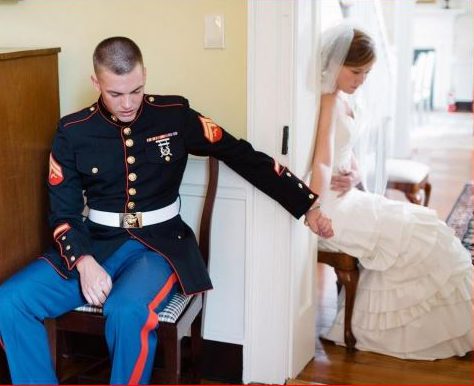
Marine prays with his wife on their wedding day

One of my favorite movies for explaining the differences between men and women is “High Noon” (1952).

Here’s the summary from IMDB:

Former marshal Will Kane (Gary Cooper) is preparing to leave the small town of Hadleyville, New Mexico, with his new bride, Amy (Grace Kelly), when he learns that local criminal Frank Miller has been set free and is coming to seek revenge on the marshal who turned him in. When he starts recruiting deputies to fight Miller, Kane is discouraged to find that the people of Hadleyville turn cowardly when the time comes for a showdown, and he must face Miller and his cronies alone.

The main theme of the film concerns Amy’s decision to break her wedding vows the very day that she makes them. She tells her new husband that he must bow to her will, and give up his male role as protector. When he explains his reasons for standing his ground to her practically (Miller will hunt them down) and morally (he has a duty protect the town), she dismisses both. She tells him that if he doesn’t run away from Miller and his gang with her, that she will get on the train and leave town by herself.

The intro of film shows the member’s of Miller’s gang assembling, and the words of the song explain the central conflict between husband and wife:

Here’s the part of the lyrics we care about:

The noonday train will bring Frank Miller.
If I’m a man I must be brave
And I must face that deadly killer
Or lie a coward, a craven coward,
Or lie a coward in my grave.

O to be torn ‘twixt love and duty!
S’posin’ I lose my fair-haired beauty!
Look at that big hand move along
Nearin’ high noon.

He made a vow while in State’s Prison,
Vow’d it would be my life or his’n
I’m not afraid of death, but O,
What will I do if you leave me?

Do not forsake me O my darlin’
You made that promise when we wed.
Do not forsake me O my darlin’
Although you’re grievin’, I can’t be leavin’
Until I shoot Frank Miller dead.

What’s interesting is that his new wife Amy apparently does not understand the meaning of wedding vows or the natural roles of good men as protectors of the weak, and fighters against evil. Although she vowed to stick by him and help him, the minute anything threatening appears that makes her feel unhappy, she abandons her vows and abandons her man. Let’s break down her mistakes now, using actual conversations from the movie.

First, she doesn’t understand or respect the man she married as a man:

Kane: [while riding out of town] It’s no good. I’ve got to go back, Amy.

Amy: Why?

Kane: This is crazy. I haven’t even got any guns.

Amy: Then let’s go on. Hurry.

Kane: No, that’s what I’ve been thinkin’. They’re making me run. I’ve never run from anybody before.

Amy: I don’t understand any of this.

Kane: [after looking at his vest watch] Well, I haven’t got time to tell ya.

Amy: Then don’t go back, Will.

Kane: I’ve got to. That’s the whole thing. [He turns the buggy around and rides back into town]

Her feelings and her desires for the world to be a happy place for her are so strong that they cloud her judgment.

Second, she doesn’t understand the threat posed by evil men:

More:

Kane: I sent a man up five years ago for murder. He was supposed to hang. But up North, they commuted it to life and now he’s free. I don’t know how. Anyway, it looks like he’s coming back.

Amy: I still don’t understand.

Kane: He was always wild and kind of crazy. He’ll probably make trouble.

Amy: But that’s no concern of yours, not anymore.

Kane: I’m the one who sent him up.

Amy: Well, that was part of your job. That’s finished now. They’ve got a new marshal.

Kane: He won’t be here until tomorrow. Seems to me I’ve got to stay. Anyway, I’m the same man with or without this. [He pins his badge on his vest]

Amy: Oh, that isn’t so.

Kane: I expect he’ll come lookin’ for me. Three of his old bunch are waiting at the depot.

Amy: That’s exactly why we ought to go.

Kane: They’ll just come after us, four of ’em, and we’d be all alone on the prairie.

Amy: We’ve got an hour.

Kane: What’s an hour?…What’s a hundred miles? We’d never be able to keep that store, Amy. They’d come after us and we’d have to run again, as long as we live.

Amy: No we wouldn’t, not if they didn’t know where to find us. Oh Will! Will, I’m begging you, please let’s go.

Kane: I can’t.

Amy: Don’t try to be a hero. You don’t have to be a hero, not for me.

Kane: I’m not trying to be a hero. If you think I like this, you’re crazy.

Instead of recognizing how her feelings are deceiving her about the threat and trusting her husband, she tries to force him to accept her mistaken view of reality by threatening to abandon him.

One of Kane’s ex-girlfriends has a talk with Amy, which helps her to understand who Kane is, and what is expected of her:

Amy: That man downstairs, the clerk, he said things about you and Will. I’ve been trying to understand why he wouldn’t go with me, and now all I can think of is that it’s got to be because of you…Let him go, he still has a chance. Let him go.

Helen: He isn’t staying for me. I haven’t spoken to him for a year – until today. I am leaving on the same train you are…What kind of woman are you? How can you leave him like this? Does the sound of guns frighten you that much?

Amy: I’ve heard guns. My father and my brother were killed by guns. They were on the right side but that didn’t help them any when the shooting started. My brother was nineteen. I watched him die. That’s when I became a Quaker. I don’t care who’s right or who’s wrong. There’s got to be some better way for people to live. Will knows how I feel about it.

Helen: I hate this town. I always hated it – to be a Mexican woman in a town like this.

Amy: I understand.

Helen: You do? That’s good. I don’t understand you. No matter what you say. If Kane was my man, I’d never leave him like this. I’d get a gun. I’d fight.

Amy: Why don’t you?

Helen: He is not my man. He’s yours.

Helen understands the need for a wife to stand by her man. But Amy’s response to evil is to shut her eyes and focus on feeling good and being happy. Notice that her “better way” is unspecified – it’s just a feeling she has that pacificism and no-violence will somehow “work” to stop evil. But in reality, pacifism is not a “better way” of dealing with evil – it does not work. Her pacifist response not only does not make evil go away, it actually encourages more evil. Weakness emboldens evildoers, and laying down your arms provokes them to do more evil. Will Kane knows this, but she won’t listen to him.

You can watch the final gunfight here, as well as Amy’s final decision:

So, this is why I really recommend this movie as a discussion-starter when you like a girl and are thinking of marrying her. It clarifies the essential problem with many young women today not being ready for marriage. To be fair, most women come around to respect their husbands and his different roles after they get married. However, the risk of divorce is so dangerous that it makes sense to bring it up for discussion before the marriage happens. Marriage is supposed to be an engine to serve God, and the success of that enterprise cannot be left to chance. You can’t just rely on the fact that she says the words of the vow, you have to check to see if she has a habit of keeping her promises when it goes against her own self-interest.

Ask yourself: Who are you, as a man? And does your woman accept that you have obligations to stand up to evil and do good ? Will she support you in your battle against evil, or will the marriage just be about her feelings and desires? I would especially beware of women who think that God is speaking to them through their feelings and desires. Look at her friends: are they practical and successful? Or are they irresponsible, unaccountable and reckless? Look at her father: does he have a plan for her, and does he lead her to be practical, frugal and hard-working? If you are not going to get an ally and a supporter in a wife, then you will not be able to serve God well, as a married man. Think about it.

New study: legalizing physician-assisted suicide increases suicide rates

A conflict of worldviews

Ryan T. Henderson writes about it for the Daily Signal.

He writes:

[T]he October issue of the Southern Medical Journal included a study examining the correlation between legalizing physician-assisted suicide and the overall suicide rate. The study, “How Does Legalization of Physician-Assisted Suicide Affect Rates of Suicide?”, contradicts the notion that legalizing assisted suicide would reduce the total number of suicides by helping people cope with their declining condition.

The study… showed that suicides increase when physician-assisted suicide is legalized: “Controlling for various socioeconomic factors, unobservable state and year effects, and state-specific linear trends, we found that legalizing PAS [physician-assisted suicide] was associated with a 6.3 percent increase in total suicides.” Later, the researchers commented that “the introduction of [physician-assisted suicide] seemingly induces more self-inflicted deaths than it inhibits.”

The study was intended to determine whether or not the legalization of physician-assisted suicide provides an effective form of suicide prevention for those considering non-assisted suicide. Such is the claim of the Swiss group EXIT, which advocates for the legalization of physician-assisted suicide on the basis that “the option of physician-assisted suicide is actually an effective form of suicide prevention.”

To test this claim, researchers took suicide rates from states that have already legalized physician-assisted suicide—including Oregon, Washington, and Vermont—and compared them both to the suicide rates in the same states before physician-assisted suicide was legalized, and to suicide rates in states where physician-assisted suicide is not yet legal.

According to the researchers, “There is no evidence that [physician-assisted suicide] is associated with significant reductions in nonassisted suicide for either older or younger people.”  Furthermore, the data “do not suggest that on average PAS leads to delays in non-assisted suicide.”

As one might suspect, the researchers found that instead of reducing suicides, legalizing physician-assisted suicide increases them. This uptick in suicides following the legalization of physician-assisted adds another reason to the already long list of reasons that physician-assisted suicide is bad policy.

I love this study, because this is the exact same methodology that economists like John Lott and Gary Beck use to analyze the effects of concealed carry laws on violent crime. This is the right way to explore how changes in the law change human behavior. You don’t want to just say what you think will happen, because it feels good to you. You want to look in other places and times where these laws have been tried, and then see the results. That’s the conservative approach to decision-making.