
Category Archives: Commentary

Three logical prerequisites for biological evolution to work

Hummingbird in flight

Biologist, blogger and super-mom Lindsay has written a post that explains what supporters of Darwinian mechanisms have to prove in order to explain the origin and diversity of life.

Here are the three things that Darwinists must demonstrate:

  1. It is possible to add biological information.
  2. There are more upward steps than downward steps (or at least a way to get more upward steps than downward steps at least some of the time).
  3. There does exist a gradual genetic pathway that can be climbed in tiny, incremental steps.

So first of all, the main two arguments for intelligent design and against naturalism are the origin of life and the Cambrian explosion. Both involve massive infusions of new biological information. So Lindsay is right to focus on whether Darwinism can add new biological information. But I wanted to focus on number three, because I really think that her post is about the burden of proof on Darwinists more than it is about our burden of proof. And we do need to get used to asking Darwinists for the evidence for their view.

Take a look at the detail on number three:

In order for evolution to be true, not only does information have to be added over time, but each successive change must occur in a living organism and it must be conserved by being passed on to offspring. Thus, the change cannot kill the organism or seriously disable it, or the change will not be passed on. This must be the case for EVERY step in the entire evolutionary sequence, no matter how small. At every step you must have a functional organism. Thus, the changes must be gradual enough that the tiny upward steps (if they exist) can achieve each new level without killing or disabling the organism. To use a simplistic analogy, if one tries to change from one word to another by changing one letter at a time (cat to cot to dot to dog, for example), there must, at every step, be an actual word that can be reached by changing one letter. In the Mount Improbable analogy, this means that there can be no upward jumps in the trail. If the maximum possible upward step is 6 inches, then there can be no 6 foot cliffs along the trail, or even 7 inch steps. If ever there is a step which requires more information than unguided evolution can provide, then evolution is falsified in that instance. It cannot account for the change in information if that is the case.

Now I have never seen a gradual genetic pathway from one body plan (phyla) to another body plan (phyla) in any peer-reviewed paper. What I need to see to believe in the ability of Darwinian mechanisms to drive change from one body plan to another is that sequence of changes at the genetic level. And I don’t just need to see the steps, I need to see the probabilities of getting the correct sequence of changes at the genetic level within the time available by chance. That’s what Darwinists assert in their theory – that’s what they need to prove. Talking about how one creature looks like another creature is irrelevant. My car looks like my Dads car, because we drive the same model, but different model years – and both cars are designed.

When people ask our side for evidence for our claims, we are able to produce the evidence to substantiate our claims, e.g. – cosmic fine-tuning factors or protein sequencing probabilities. I would like to see the other side do the same, and not just tell me a story. When I question people in the arts who accept Darwinism, they seem to be terribly disinterested in the details, and just want to jump to the conclusion shared by the smart people without thinking hard about all the steps in between. That’s intellectually lazy. The same thing happens with global warming with the non-scientists – they are more concerned about jumping to the “smart people” position, so you think that they’re smart. They aren’t really interested in hearing both sides, or looking at the evidence. I think people need to take it slow and look at the evidence, instead of deciding what to believe based on how other people perceive them. No need to rush to agreement to build up your self-esteem without doing the hard work first.

If you are looking to understand what the other side has to prove, and in a concise way, read her post.

Finally! Details about Michael Licona’s new Oxford University Press book

Investigation in progress

Here’s a new interview between Sean McDowell and Michael Licona about his new book. The new book is coming out in 2016, and it’s going to be published by Oxford University Press – probably the top academic press on the planet.

I found the interview on Sean McDowell’s blog.

It says:

Michael Licona is one of the world’s leading experts on the historical evidence for resurrection. I use his book The Resurrection of Jesus in my Master’s Level course atBiola. For the past few years, Dr. Licona has been working on some cutting-edge research related to Gospel contradictions. His research is both fascinating and groundbreaking. He answers a few of my questions:

SEAN MCDOWELL: Mike, what got you interested in the question of Gospel contradictions?

MIKE LICONA: Back in 2008 and 2009 I was publicly debating Bart Ehrman on the resurrection. He brought up Gospel contradictions as one of his major objections to the Gospels. I have noticed that this genuinely bothers many Evangelical Christians. As a result, I decided to look into it in more depth. I wasn’t so much concerned about resolving them, because I understood that if Jesus rose from the dead, Christianity is true, regardless of any errors that might be present in the Bible. So, even if there are contradictions in the Gospels, it wouldn’t negate the truth of Christianity. But it does bother a lot of Evangelicals, so that’s what got me interested in the topic. And to be honest, it did make me question the historical reliability of the Gospels.

MCDOWELL: What makes your approach to Gospel contradictions unique?

LICONA: Most approaches involve trying to harmonize various passages to see if all the details can fit together. This can be a legitimate practice. But many times it can go way too far. Both Richard Burridge and more recently Craig Keener have shown that the Gospels belong to the genre of “ancient biography.” If this is correct, it would be plausible that we would see the same amount of flexibility in the Gospels as we observe in other ancient biographies. So, I wanted to learn what those flexibilities were. By carefully reading ancient biographies written around the same time as the Gospels and comparing how they tell the same stories differently, I began to recognize that some of the differences resulted from compositional devices. Then when I went to the Gospels, I could see that the authors were probably employing the same compositional devices as other ancient biographers; specifically Plutarch. I began to realize that the differences across the Gospels are not so much contradictions but the result of compositional devices that were the standard practice in historical writing of that day.

So, this analysis of the genre of “ancient biography” might give us some useful tools for resolving passages that seem to be in conflict. For some reason, non-Christians want to ignore the main body of accepted facts about the historical Jesus, and focus on these minor details that seems to be in conflict. So I guess we need a book that explains them, and no one better than Mike Licona to do it.

On the other hand… I was actually talking about this with my best friends from my home town over the Christmas holidays. Before we broke out the Pandemic boardgame and the “Keep Talking and No One Explodes” computer game, Jen and Andrew wanted to know what was the most common thing that I was seeing from non-Christians. The most common thing I am seeing is that non-Christians are woefully out of touch with knowledge related to the worldview of Christian theism that are accepted by the broad spectrum of scholars.

To illustrate, I quoted from atheists who admit to the creation event, to the fine-tuning, to the problem of the origin of life, to the problem of the Cambrian explosion, to early dating of the gospels, early dating of the Pauline letters, minimal facts about the life of Jesus, and even minimal facts for an argument for the resurrection. I told Andrew and Jen the skeptics I encounter are intellectually dishonest. They don’t accept the things that mainstream atheist scholars accept about science and historical Jesus and philosophy of religion. And yet they feel comfortable about being on the fringe, because they justify their fringe view by pointing to nitpicky details like apparent Bible contradictions. I.e. – they point to disagreement about one or two angels at the discovery of the empty tomb, and they turn that minor point into support for their fringe view that the gospels were made up completely in the second and third centuries.

So, I guess we do have to be ready to respond to this nitpicking, and Licona’s book will help with that. But I also think that we need to be ready to haul skeptics back to reality. There is a lot we can know about science, philosophy and the historical Jesus that supports Christian theism, and we should disagreements about details get people away from those main points that scholars across the board accept.

New survey: ratio of liberal to conservative sociologists is 314 to 1

A new survey was reported at Heterodox Academy.

Excerpt:

Bill von Hippel and David Buss surveyed the membership of the Society for Experimental Social Psychology. That’s a professional society composed of the most active researchers in the field who are at least five years post-PhD. It’s very selective – you must be nominated by a current member and approved by a committee before you can join. Von Hippel and Buss sent a web survey to the 900 members of SESP and got a response rate of 37% (335 responses). So this is a good sample of the mid-level and senior people (average age 51) who produce most of the research in social psychology.

[…]At the end of the survey, they happened to include a very good set of measures of political identity. Not just self-descriptions, but also whom the person voted for in the 2012 US Presidential election. And they asked nine questions about politically valenced policy questions, such as “Do you support gun control?” “Do you support gay marriage?” and “Do you support a woman’s right to get an abortion?”

The results are interesting, here’s the part I wanted to highlight:

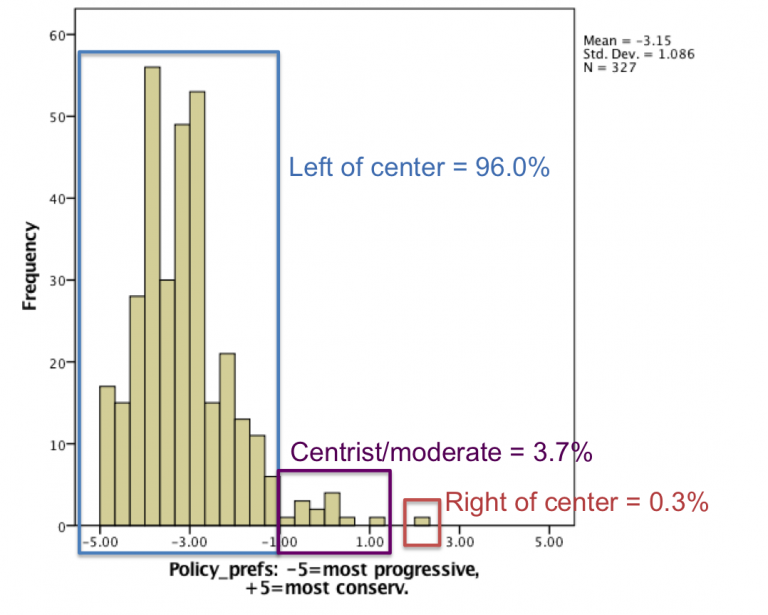
A third way of graphing the viewpoint diversity of these senior social psychologists is by computing an average score across all 9 of the politically valenced policy items. For each one, the 11 point response scale was labeled “strongly oppose” on the left-most point and “strongly support” on the right-most point. I converted all responses to the same 11 point scale used in figure 1 so that “strongly supporting” the progressive position (e.g., pro-choice) was scored as -5 and “strongly supporting” the conservative position (e.g., prayer in school) was scored as +5. That puts the leftists on the left and the rightists on the right of the graph. Here’s the graph:

Diversity of opinion in academia

I counted anyone whose average score fell between -1.0 and +1.0 (inclusive) as a centrist. The graph shows that 314 of the 327 participants (96.0%) had an average score below -1.0 (i.e., left of center), one had an average score above +1.0 (i.e., right of center), and 12 were centrists. That gives us a Left to Right ratio of 314 to one.

The one right of center guy is not even that far right of center!

So what should we say about this? Well, I’ll say this. Secular leftists in academia are the most narrow-minded, intolerant, bigoted people on the planet. They have all kids of hateful prejudices, and they are completely unable to consider any opinion that is different from their own. They only read material that they agree with, never anything they disagree with, because that causes them discomfort. They have no awareness of arguments and evidence from conservative or Christian viewpoints. All of this hateful bigotry does lead to active discrimination against Christians and conservatives in areas like hiring decisions, promotions, and so on. And what’s more, this secular leftism is not the result of any honest investigation of arguments and evidence. It’s just feelings-based nonsense.

Consider this post by moderate sociologist George Yancey.

He writes:

It is well established that academics tend to be more politically progressive and secular than the general population. It is obvious that they are highly educated. So academia theoretically should be a place where we would find a higher than normal level of Christianophobia. This Christianophobia may manifest in discrimination against conservative Christians. A few years ago I conducted research suggesting that this is the case. I found that academics were willing to discriminate against a prospective candidate for an academic position if they found out that the candidate is a conservative Protestant. In fact, they were more willing to discriminate against conservative Protestants than against any other social group included in my survey. Their willingness to discriminate against those Protestants was even more powerful than their willingness to discriminate against political conservatives. Religious intolerance trumps potential political intolerance among academics.

Of course simply because academics state that they are open to discriminating against conservative Protestants does not mean that they actually engage in such discrimination. A survey is not sufficient evidence. However, Rothman and Lichter conducted research documenting that academics with socially conservative beliefs tend to be located in lower status occupational positions even after controlling for demographic variables and their level of productivity. If conservative Protestants are more likely to have socially conservative beliefs than other academics, a reasonable belief, then this research suggests systematic evidence that there are occupational disadvantages in academia to having conservative Christian beliefs. Since academics have a willingness to discriminate against those Christians, this disadvantage cannot merely be due to their inability to do science, as the common stereotype of Christians seems to imply, but discrimination from academics who may be motivated by Christianophobia is likely an important factor.

So, do you still think it makes sense to take out loans to study subjects that are dominated by the secular left? They will literally deny you a degree that you earned, if you dissent from their radically leftist dogma at any point.

Should you borrow tens of thousands of dollars to be brainwashed by ivory-tower leftists? I think a better plan is to study something that pays – petroleum engineering, computer science, etc. It seems to me that it’s not really an education to spend four years learning the catechism of secular leftists. A real education should involve learning the arguments for both sides, in an environment that is open and truth-focused. The non-STEM departments of the university are not the place for learning. It’s just a secular leftist seminary.