Category Archives: Commentary

What difference does believing in evolution make?

Investigation in progress

In this post, the word evolution refers to the theory that unguided natural forces such as mutation and natural selection can explain the emerge of life from non-life, as well as the diversification of simple single-celled organisms in the diversity of animal life that we observe today, and in the fossil record. mean merely change over time, or variations within types “micro-evolution”. I mean molecules-to-man evolution, with nothing detectable done to guide any part of the process by any outside intelligence, be it natural or supernatural.

What else do people believe when they accept evolution as true?

Evolution News reports on a new poll:

From the earliest days of civilization, humans have considered themselves exceptional among living creatures. But a new survey by Discovery Institute of more than 3,400 American adults indicates that the theory of evolution is beginning to erode that belief in humanity’s unique status and dignity.

According to the survey, 43 percent of Americans now agree that “Evolution shows that no living thing is more important than any other,” and 45 percent of Americans believe that “Evolution shows that human beings are not fundamentally different from other animals.”

The highest levels of support for the idea that evolution shows that humans aren’t fundamentally different from other animals are found among self-identified atheists (69 percent), agnostics (60 percent), and 18 to 29 year-olds (51 percent).

The theory of evolution is also reshaping how people think about morality. A majority of Americans (55 percent) now contend that “Evolution shows that moral beliefs evolve over time based on their survival value in various times and places.”

“Since the rise of Darwin’s theory, leading scientists and other thinkers have insisted that human beings are just another animal, and that morality evolves based on survival of the fittest,” says historian Richard Weikart, author of the new book The Death of Humanity: And the Case for Life (Regnery).

What this new survey shows is just how pervasive these ideas have become in our culture. Many people no doubt continue to believe that humans are unique, but most do not think that evolution supports that position. Many critics of my earlier scholarship will be disconcerted to see this data, which powerfully supports my arguments about the way that Darwinism devalues human life, a key point I explain further in my new book.

Weikart is a professor of history at California State University, Stanislaus, and a Senior Fellow with Discovery Institute’s Center for Science & Culture.

So, it definitely makes  a difference whether you believe in evolution or not. I have found that even Christians who believe in evolution have some very weird things going on elsewhere in their worldviews. Let’s just say that I don’t know any conservative Christians who accept evolution.

Take a look at Howard Van Till, who taught at a seminary for many years. He always asserted that evolution and Christianity were compatible. That’s what he told his students. He was regarded as one of the foremost proponents of theistic evolution – the view that God exists and sits around doing nothing while animal diversity appears without any detectible design work on his part.

Take a look at this event that Van Till did for a FREETHOUGHT group a while back.

Excerpt:

FROM CALVINISM TO FREETHOUGHT: The Road Less Traveled
by Howard J. Van Till

Professor of Physics and Astronomy, Emeritus
Calvin College
Presented 5/24/2006 for the Freethought Association of West Michigan
Lightly edited 5/26/2006

Precis: Born into a Calvinist family, shaped by a Calvinist catechism training, educated in the Calvinist private school system, and nurtured by a community that prized its Calvinist systematic theology, I was a Calvinist through and through. For 31 years my teaching career was deeply rooted in the Calvinism I had inherited from my community.

During most of that time it was a fruitful and satisfying experience. Nonetheless, stimulated in part by the manner in which some members of that community responded to my efforts to practice what I had learned from my best teachers, I eventually felt the need to extend my intellectual exploration into philosophical territories far outside the one provided by Calvinism. Did I complete the lengthy journey from Calvinism to Freethought? The listener will be the judge.

Freethought is a politically correct happy-clappy term for atheism, by the way. Trying to put a positive spin on it, I guess.

Evolution means unguided evolution. It means that natural processes do all the work, and there is nothing required from any supervening intelligence – natural or supernatural. That idea has consequences for your worldview.

One last point, and this is important. I don’t reject evolution because I find the consequences of the idea distasteful. I reject it because it is not supported by the evidence in two crucial areas: the origin of the simplest living replicating organism, and the sudden appearance of a wide variety of body plans in the Cambrian explosion within a very short period of time. I have no problem with science challenging my interpretation of the Bible – that’s why I am for an old universe and an old Earth. But evolution is not scientifically grounded – it’s really a philosophical speculation that is required by a metaphysical assumption called naturalism. And since I am an adherent of experimental science, and not theoretical speculative philosophy, I reject it. And so should you.

Related posts


Thinking practically about the gospel with an illustration from a war movie

The city of Mogadishu, in Somalia, Africa

First, let’s get an overview that helps us understand the context and goals of the mission we are going to discuss.

The scene is set in Somalia, Africa, in 1992. There a civil war between two warlords: Ali Mahdi and Mohammed Farah Aidid. The war has destroyed agricultural operations, and the people are starving. The United Nations are trying to help, but Aidid hijacks the food from UN aircraft so that he can use the food to gain control of the people. Hundreds of thousands of Somalis are dying of starvation. The UN requests American military forces to secure the air-dropped supplies so they can be distributed to the starving people.

In December 1992, President George H.W. Bush answers the call, sending 25,000 troops to Somalia to protect the food from the Somali warlords. However, in 1993, Bill Clinton is elected. He orders that the number of U.S. troops be reduced to 12,000. Following an attack by Aidid on Pakistani peace-keepers, the U.N. issues a resolution to capture those responsible. The U.S. armed forces have the arms and training to battle evil, so they get the call to capture Aidid and his lieutenants.

In late August 1993, Task Force Ranger is deployed to Mogadishu to capture Aidid and his lieutenants at the Olympic Hotel. The U.S. force consists of 440 troops from the Army Rangers and Army Delta Force special forces, commanded by General William Garrison. Garrison requested light armored units (Bradley Infantry Fighting vehicles) that would offer more protection than the unarmored HMMWV Humvees. Garrison was denied the light armor by the Clinton administration. Garrison requested heavier air support (AC-130 Spectre gunships) that would offer better fire support than the UH-60 Blackhawk miniguns. Garrison was denied the air support by the Clinton administration. The Clinton administration did not want the American forces to appear too heavily armed for the peace-keeping role.

The actual mission turned out to be much harder than it needed to be, because of the resources denied by the Clinton administration. Although the Aidid lieutenants were captured, Aidid himself escaped. Eighty-four American soldiers were wounded. Eighteen American soldiers were killed, and their bodies were dragged through the streets of Mogadishu. This was shown over and over by the media, and it undermined American resolve to help the Somali people. As a result, Clinton had the excuse he needed to retreat the American military.

(Source: Nova Online)

Two heroes lost their lives

Today, I want to talk about two of the men who lost their lives in Operation Gothic Serpent. They are Master Sergeant Gary I. Gordon and Sergeant First Class Randall D. Shughart – a Delta Force sniper team.

Here is a clip from the movie Blackhawk Down, which shows what happened to them:

The pilot of the downed Blackhawk was protected by the two men who volunteered to go in after him. They requested that they be inserted at the crash site, even though they knew that reinforcements were likely not going to be there in time to save them. They made the request to go and help the pilot three times before being allowed to go in. Their first two requests were denied by their commanding officer, because the odds against their survival were so overwhelming. The rescued pilot was later released by his captors, and the two heroes were awarded the Medal of Honor for their brave actions.

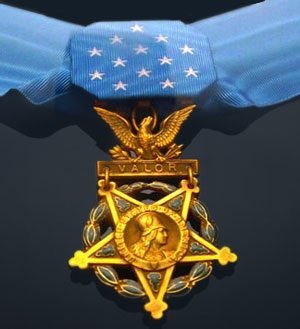
A Congressional Medal of Honor

Here is a description of the requirements to be awarded a Medal of Honor:

The Medal of Honor is the highest military decoration that may be awarded by the United States government. It is presented by the President of the United States, in the name of Congress, and is conferred only upon members of the United States Armed Forces who distinguish themselves through conspicuous gallantry and intrepidity at the risk of life above and beyond the call of duty:

  • While engaged in action against an enemy of the United States;
  • While engaged in military operations involving conflict with an opposing foreign force; or
  • While serving with friendly foreign forces engaged in an armed conflict against an opposing armed force in which the United States is not a belligerent party.

You can read the official details of their actions.

The point of this post

It is important for Christians to be familiar with real-world examples of people giving their lives in order to save the lives of others. When we see real-world examples of self-sacrifice, it helps us to understand what Jesus really achieved for us, and what he must have felt making that hard choice to volunteer to go in and rescue us. In general, my philosophy when it comes to the Bible is to make every effort to connect what the Bible says to the real world. We must not push Christianity into some far-off world of piety and feelings. We must make connections to real evidence and real life, so that what the Bible says becomes practical, and so that we have a deep friendship with and sympathy for God revealed in Jesus Christ. In real life, being willing to give your life to save someone else is hard. Understanding how that really happens will help us to value what Jesus has done for us.

Bible verses

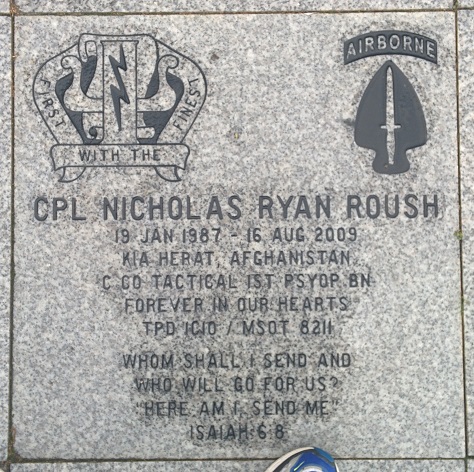
I saw this verse on the ground outside the Airborne & Special Operations Museum in Fayetteville, NC, where I went for my summer vacation in 2015. (Thanks to my friend Curby who hosted me)

Isaiah 6:8:

Then I heard the voice of the Lord saying, “Whom shall I send? And who will go for us?”

And I said, “Here am I. Send me!”

Here is the picture I took (yes, that is my running shoe):

“Here am I, send me” Isaiah 6:8

When confronted with an opportunity to imitate Christ in his self-sacrifice, we should think less about ourselves and our own desires, and take the opportunity to serve others effectively. We do not do what makes us happy, and we do not pursue fun and thrills. We do what heals, we do what helps others. We do not push away our responsibility to imitate Christ by caring for those in danger. Christianity is not just about “not doing bad things”. It’s the good things you do because of your relationship with Jesus that show your real allegiance, and give you the experience of being a Christian in deed.

And here is another good verse:

John 15:13:

13 Greater love has no one than this: to lay down one’s life for one’s friends.

If you get a chance to watch the movie Blackhawk Down, then do so. I highly recommend it. You can also read the book that the movie is based on.

I love the Medal of Honor books by Edward F. Murphy. He writes about all the people who have been awarded the Medal of honor in different wars: World War II, the Korean War, and the Vietnam War.

Getting to know the real Ted Cruz, an account from his close friend Jay Nordlinger

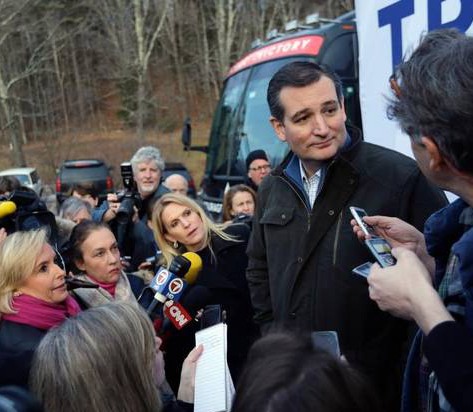
Ted Cruz meets voters at a campaign event

There was a three-part series in National Review which I found just fascinating, and a good antidote to the hit pieces you see from the Republican establishment, which they attack Cruz for “likability”. As regular readers of National Review know, Jay Nordlinger is more of an establishment type. But he backed Cruz from the beginning in the GOP primary, because he has known Cruz personally for a long time.

Here are the three parts:

From part 1:

I met Ted Cruz on the presidential campaign of George W. Bush in 2000. I had taken a leave of absence from NR to assist that campaign. This was in mid-September, for the last six or seven weeks of the campaign. […]Ted was a domestic-policy advisor on the campaign.

We bonded, as they say. We had many a late-night discussion at Earl Campbell’s barbecue joint and other choice spots.

On judges:

Ted had a fancy education. He went to Princeton University, where he was a debate champion, and to Harvard Law School, where he was an editor on several publications, including the Law Review.

But I noticed something on the campaign — the campaign in 2000: He had a scrappy, outsider’s heart.

More on his background: He clerked for Judge Mike Luttig, on the Fourth Circuit. In fact, Ted made me aware of Luttig, and I came to admire this judge almost as much as Ted did. Then Ted clerked for the chief justice of the United States: William Rehnquist.

In fact, I think Ted learned to play tennis just to play with the chief. I’ll have to check with Ted on that.

An additional note on Mike Luttig: When a Supreme Court seat came open in 2005, Ted pushed for Luttig’s nomination. So did I, in my capacity as an opinion journalist (not that I had great pull). When John Roberts got the nod, we supported this nomination, of course, as all conservatives did. But our heart was with Luttig.

I back Edith Hollan Jones and Janice Rogers Brown for Supreme Court picks, but J. Michael Luttig is on my list, further down.

On school choice:

Tell you a story. Ted was, and is, an impassioned advocate of school choice. He thinks it’s shocking — immoral — that poor kids are trapped in hopeless, violent schools. One day, he was telling me about lawyers in the opposite camp: the camp of the education establishment. (For once, I think the word “establishment” is appropriate. Or Bill Bennett’s word: “Blob.”)

“You could practically smell the sulfur coming off them,” said Ted.

I don’t have permission to tell that story. But what the hell. It’s done. (Ted can sue me!)

Promoting school choice is the civil rights issue of our time. We have to get the money out of the government, and back into the hands of parents, so that they are free to choose schools that serve their children, instead of indoctrinating their children. We need kids who can get private sector jobs, not recite global warming dogma and put condoms on cucumbers.

On the free enterprise system:

Ted was exceptionally versatile. He knew a lot about the law, of course. And about domestic policy, of course. He was a domestic-policy adviser. He had Medicare Part B and all that jazz down pat. I am still a little hazy about these things, never being able to get through a white paper. Even the abstract …

He knew a lot about economics, and was a big free-marketeer. When he was in high school, he took part in something called the Free Enterprise Institute. They read Hayek, Friedman, Bastiat, everything. Ted imbibed. And saw the reason of.

He knew a lot about foreign policy, and was a hawk. Also, he was a “social conservative.” That term is weak, but it will have to do. Ted opposed abortion, for example — and knew why.

This is important: Ted was amazingly free of cynicism. What do I mean by that? I mean, he reallybelieved in America, free enterprise, and all that rah-rah stuff. Other people feel the need to roll their eyes a bit. Not Ted.

Here’s something from part two, now:

Ted worked at the Justice Department and at the Federal Trade Commission. Then he was solicitor general of Texas (under the attorney general, Greg Abbott, who would become governor). Frankly, I didn’t know that states had solicitors general until Ted became one.

I blogged before about Ted’s experience pushing for free-market policies at the Federal Trade Commission, and for gun rights and religious liberty as Solicitor General of Texas. Everywhere he has gone, he has pushed conservative positions. If you were hiring a candidate and went strictly off of resume, this would be the guy you would hire. Trump would not get an interview – he has no resume.

Cruz’s record in the Senate:

Ted has a wider libertarian streak than I do. (Bill Buckley: “Within every conservative is a streak of libertarianism.”) Also, he has less patience for the “establishment” than I do. But, you know? He was the one who got elected, and you know what else? He kept his promises to the voters.

Some may not have liked those promises. But, by golly, he kept them. Which is refreshing in a politician.

And he did not sit around. Oh, no. He did not mark time. A senator observed, “Ted has done more in a couple of years here than some of our colleagues have done in decades.”

Cruz got a lot of legislation passed, more than Rubio.

And from the third part:

Obviously, the Cruz style is not for everyone. But I can say this, to conservatives (and to anyone else, for that matter): If he is president, he will do everything humanly possible to repeal Obamacare. And to prevent Iran from going nuclear. And to do other hard, vital things. I don’t know if these things can be done. But I feel sure that, if they can, Ted will do them. He will go the last mile, and beyond.

Like everyone else, he likes popularity more than unpopularity. But if popularity clashes with the right course of action, popularity will have to go. Ted is used to opposition and scorn. And he would do anything — walk through fire, chew on glass — to keep this country free.

You can read more about Cruz’s achievements in this post.

Related posts