All posts by Wintery Knight

https://winteryknight.com/

1 Corinthians 15: the earliest source for the basic facts about the life of Jesus

The Son of God became flesh and dwelt among us

First, the creed – which is found in 1 Corinthians 15:3-8:

3For what I received I passed on to you as of first importance: that Christ died for our sins according to the Scriptures,

4that he was buried, that he was raised on the third day according to the Scriptures,

5and that he appeared to Peter, and then to the Twelve.

6After that, he appeared to more than five hundred of the brothers at the same time, most of whom are still living, though some have fallen asleep.

7Then he appeared to James, then to all the apostles,

8and last of all he appeared to me also, as to one abnormally born.

Almost all historians accept this creed as dating back to within 5 years of the death of Jesus. But why?

Here’s a great article from Eric Chabot, director of Ratio Christi Apologetics Alliance, The Ohio State University to explain why.

Excerpt:

The late Orthodox Jewish scholar Pinchas Lapide was so impressed by the creed of 1 Cor. 15, that he concluded that this “formula of faith may be considered as a statement of eyewitnesses.” (5)

Paul’s usage of the rabbinic terminology “passed on” and “received” is seen in the creed of 1 Cor. 15:3-8:

“For what I received I passed on to you as of first importance: that Christ died for our sins according to the Scriptures, that he was buried, that he was raised on the third day according to the Scriptures, and that he appeared to Peter, and then to the Twelve. After that, he appeared to more than five hundred of the brothers at the same time, most of whom are still living, though some have fallen asleep. Then he appeared to James, then to all the apostles, and last of all he appeared to me also, as to one abnormally born.”

[…]While the word “received” (a rabbinical term) can also be used in the New Testament of receiving a message or body of instruction or doctrine (1 Cor.11:23; 15:1, 3; Gal. 1:9, 12 [2x], Col 2:6; 1 Thess 2:13; 4:1; 2 Thess 3:6), it also means means “to receive from another.” This entails that Paul received this information from someone else at an even earlier date. 1 Corinthians is dated 50-55 A.D. Since Jesus was crucified in 30-33 A.D. the letter is only 20-25 years after the death of Jesus. But the actual creed here in 1 Cor. 15 was received by Paul much earlier than 55 A.D.

[…]Even the co-founder Jesus Seminar member John Dominic Crossan, writes:

“Paul wrote to the Corinthians from Ephesus in the early 50s C.E. But he says in 1 Corinthians 15:3 that “I handed on to you as of first importance which I in turn received.” The most likely source and time for his reception of that tradition would have been Jerusalem in the early 30s when, according to Galatians 1:18, he “went up to Jerusalem to visit Cephas [Peter] and stayed with him fifteen days” (11).

This comment by Crossan makes sense because within the creed Paul calls Peter by his Aramic name, Cephas. Hence, if this tradition originated in the Aramaic language, the two locations that people spoke Aramaic were Galilee and Judea. (12) The Greek term “historeo” is translated as “to visit” or “to interview.” (13) Hence, Paul’s purpose of the trip was probably designed to affirm the resurrection story with Peter who had been an actual eyewitness to the resurrected Christ (1 Cor. 15:5).

I know what you’re thinking. You’re thinking “Hey WK, isn’t John Dominic Crossan that wacky liberal atheist who is on the far-left fringe of historical Jesus scholarship? So wacky, that he actually thought that Secret Gospel of Mark was real, instead of just being a hoax?” Yes, that’s the nutty John Dominic Crossan I mean. The very one.

Here’s a bit more about this early creed from Gary Habermas.

Quote:

Paul is clear that this material was not his own but that he had passed on to others what he had received earlier, as the center of his message (15:3). There are many textual indications that the material pre-dates Paul. Most directly, the apostle employs paredoka and parelabon, the equivalent Greek terms for delivering and receiving rabbinic tradition (cf. 1 Cor. 11:23). Indirect indications of a traditional text(s) include the sentence structure and verbal parallelism, diction, and the triple sequence of kai hoti Further, several non-Pauline words, the proper names of Cephas (cf. Lk. 24:34) and James, and the possibility of an Aramaic original are all significant. Fuller attests to the unanimity of scholarship here: “It is almost universally agreed today that Paul is here citing tradition.”[4] Critical scholars agree that Paul received the material well before this book was written.[5]

The most popular view is that Paul received this material during his trip to Jerusalem just three years after his conversion, to visit Peter and James, the brother of Jesus (Gal. 1:18-19), both of whose names appear in the appearance list (1 Cor. 15:5; 7). An important hint here is Paul’s use of the verb historesai (1:18), a term that indicates the investigation of a topic.[6] The immediate context both before and after reveals this subject matter: Paul was inquiring concerning the nature of the Gospel proclamation (Gal. 1:11-2:10), of which Jesus’ resurrection was the center (1 Cor. 15:3-4, 14, 17; Gal. 1:11, 16).

Critical scholars generally agree that this pre-Pauline creed(s) may be the earliest in the New Testament. Ulrich Wilckens asserts that it “indubitably goes back to the oldest phase of all in the history of primitive Christianity.”[7] Joachim Jeremias agrees that it is, “the earliest tradition of all.”[8] Perhaps a bit too optimistically, Walter Kasper even thinks that it was possibly even “in use by the end of 30 AD . . . .”[9]

Indicating the wide approval on this subject, even more skeptical scholars frequently agree. Gerd Ludemann maintains that “the elements in the tradition are to be dated to the first two years after the crucifixion of Jesus. . . . not later than three years. . . . the formation of the appearance traditions mentioned in I Cor.15.3-8 falls into the time between 30 and 33 CE. . . .”[10] Similarly, Michael Goulder thinks that it “goes back at least to what Paul was taught when he was converted, a couple of years after the crucifixion.”[11] Thomas Sheehan agrees that this tradition “probably goes back to at least 32-34 C.E., that is, to within two to four years of the crucifixion.”[12] Others clearly consent.[13]

Overall, my recent overview of critical sources mentioned above indicates that those who provide a date generally opt for Paul’s reception of this report relatively soon after Jesus’ death, by the early to mid-30s A.D.[14] This provides an additional source that appears just a half step removed from eyewitness testimony.

(3) Paul was so careful to assure the content of his Gospel message, that he made a second trip to Jerusalem (Gal. 2:1-10) specifically to be absolutely sure that he had not been mistaken (2:2). The first time he met with Peter and James (Gal. 1:18-20). On this occasion, the same two men were there, plus the apostle John (2:9). Paul was clearly doing his research by seeking out the chief apostles. As Martin Hengel notes, “Evidently the tradition of I Cor. 15.3 had been subjected to many tests” by Paul.[15]

These four apostles were the chief authorities in the early church, and each is represented in the list of those who had seen the resurrected Jesus (1 Cor. 15:5-7). So their confirmation of Paul’s Gospel preaching (Gal. 2:9), especially given the apostolic concern to insure doctrinal truth in the early church, is certainly significant. On Paul’s word, we are again just a short distance from a firsthand report.

(4) Not only do we have Paul’s account that the other major apostles confirmed his Gospel message, but he provides the reverse testimony, too. After listing Jesus’ resurrection appearances, Paul tells us he also knew what the other apostles were preaching regarding Jesus’ appearances, and it was the same as his own teaching on this subject (1 Cor. 15:11). As one, they proclaimed that Jesus was raised from the dead (15:12, 15). So Paul narrates both the more indirect confirmation of his Gospel message by the apostolic leaders, plus his firsthand, direct approval of their resurrection message.

That’s how solid this early creed is – even atheists like Crossan and Ludemann accept it as historically reliable. It’s historical bedrock, as Michael Licona likes to say. This is the stuff that everyone accepts – across the ideological spectrum. How do you account for this evidence in your worldview, especially given that Paul never recanted his preaching about Jesus?
New study: “Medicare For All” would cost $32.6 trillion, but it’s actually more

A Christian friend of mine who is divorced with children surprised me by telling me that she favored single payer health-care. I asked her if she realized that people would have to be taxed to pay for all this free health care, and she seemed to be aware of it. But even I didn’t realize how much it would really cost.

Investor’s Business Daily reports on a couple of recent studies – one from the left, and one from the far-left – that both agreed on the price tag for universal health care.

Excerpt:

Last year, 16 Senators, including three presidential hopefuls, co-sponsored Sanders’ “Medicare for all” bill. And earlier this month, more than 70 Democrats signed on to form a “Medicare for all” caucus. Support for the bill is now something of a litmus test for Democratic hopefuls.

Do they have any idea what they’re endorsing?

A new study out Monday from George Mason University’s Mercatus Center finds that Sanders plan would add to federal spending in its first 10 years, with costs steadily rising from there. That closely matches other studies — including one by the liberal Urban Institute — that looked at Sanders’ plan.

To put this in perspective, “Medicare for all” would the size of the already bloated federal government. Doubling corporate and individual income taxes wouldn’t cover the costs.

Even this is wildly optimistic. To get to this number, author Charles Blahous had to make several completely unrealistic assumptions about savings under Sanders’ hugely disruptive plan.

The first is a massive cut in payments to providers. Sanders wants to apply Medicare’s below-market rates across the board, which would amount to a roughly 40% cut in payments to doctors and hospitals. Blahous figures this will save hundreds of billions of dollars a year.

But cuts of that magnitude would drive doctors out of medicine and hospitals out of business, since the only way providers can afford Medicare’s cut-rate reimbursements today is by charging private payers more.

The study also assumes that shoving everyone into a government health care plan would cut administrative costs by $1.6 trillion over the next decade and prescription drug costs by $846 billion. Neither of those are likely, and wouldn’t make much of a difference in overall spending anyway. Private insurance overhead accounts for about 6% of national health spending, and drugs less than 10%.

There’s also the fact that every other federal health program has seen costs explode “unexpectedly” after they were enacted. The per-enrollee cost of ObamaCare’s Medicaid expansion, for example, is almost 49% higher than expected. Medicare itself cost nearly 10 times as much as projected in its first 25 years.

The author of the Mercatus study was nominated Barack Obama to be a member of the Board of Trustees of the Social Security Trust Funds. That might explain his questionable assumptions about costs. And the Urban Institute is even further to the left. There can be no doubt that the true cost of the Sanders health care plan would be much higher than what these two studies calculated it to be.

Now, you might think that we can just tax the people who earn the most money to pay for all this spending.

In 2012, John Stossel wrote this in Forbes:

If the IRS grabbed 100 percent of income over $1 million, the take would be just $616 billion.

In 2011, the Tax Foundation explained that even if you taxed ALL THE DISPOSABLE INCOME from all the people who make $200,000 or more, you would only raise $1.53 trillion dollars:

There’s simply not enough wealth in the community of the rich to erase this country’s problems by waving some magic tax wand.

[…]After everyone making more than $200,000/year has paid taxes, the IRS would need to take every single penny of disposable income they have left. Such an act would raise approximately $1.53 trillion. It may be economically ruinous, but at least this proposal would actually solve the problem.

Taxing the rich isn’t enough to pay for single payer health care. $32.6 trillion over 10 years works out to $3.26 trillion per year. We’re not going to pay that off even with $1.53 trillion a year of additional revenue. And this is assuming that the wealthy would just allow themselves to be made into slaves, and keep working even if the government takes all their money.

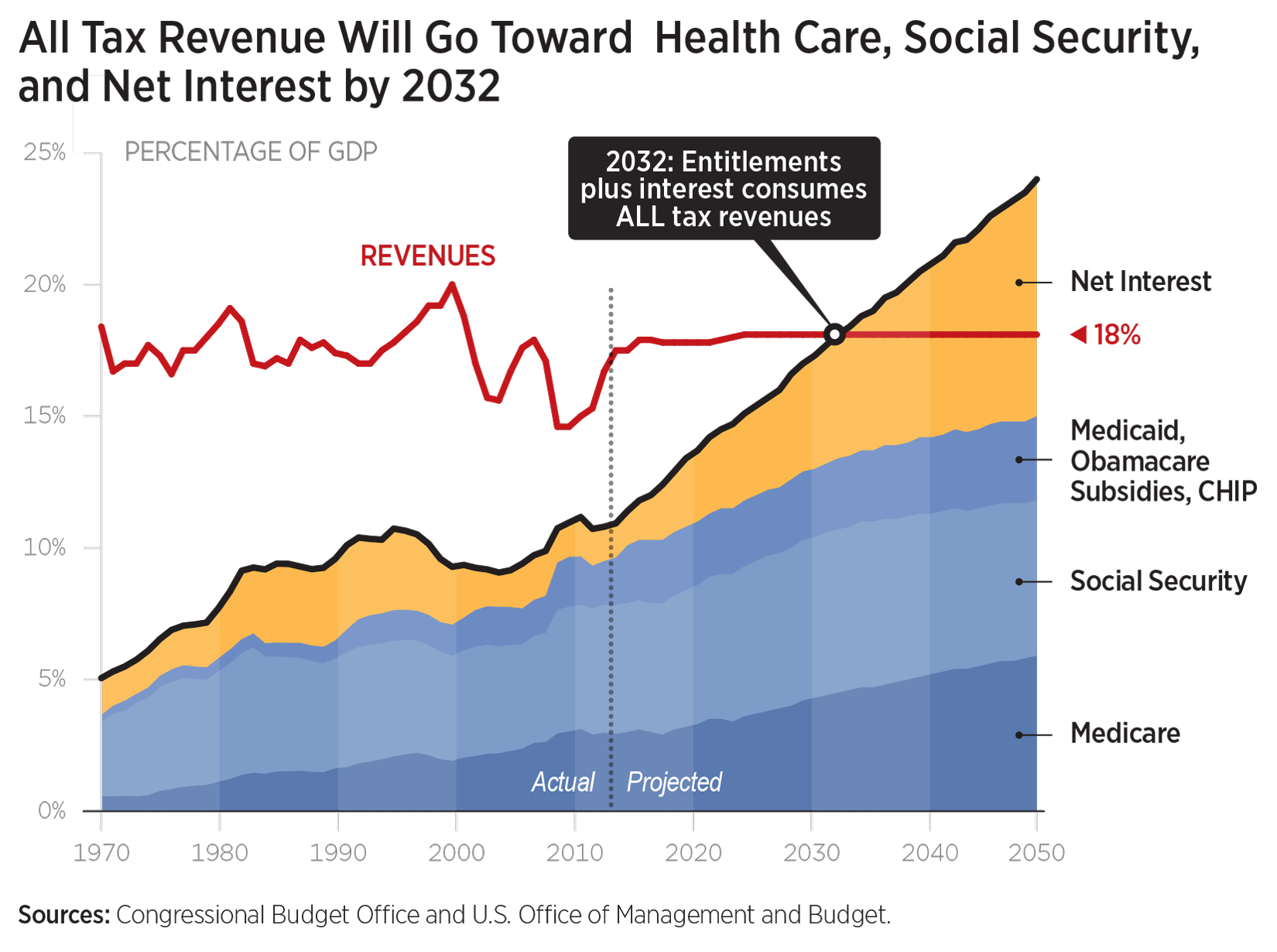
Pretty soon, our mandatory expenses will consume all of our tax revenues

Who is going to pay for all the spending we already have scheduled? As the graph above shows, things are going to get worse in the future as the big entitlement programs pay out more than current tax rates take in. I’m sure glad that I’m going to be retiring before 2032, and I’m not going to be stuck with the bill for this. It’s one thing for me to get out of bed every morning to be paid only 75% of what I earn. I certainly wouldn’t want to be working if the tax rates here were more like Europe, so that I’d be taking home less than half of what I earn. No thank you!

By the way, it might be a good idea to think about whether you want to have children or not before you vote. Children are expensive, and if we keep electing the big spenders like Obama, then there isn’t going to be any money left over to run a family and raise kids. Think about it before you vote with your feelings only.

New study: 1 in 8 divorces is caused by student loan debt

I already mentioned the studies that show that marrying a non-virgin is less stable than marrying a virgin. But what about student loans? Are they a risk factor for divorce, too? I was reading over at Captain Capitalism and saw this CNBC article, which discusses data relevant to our recent discussion about whether men ought to prefer debt-free virgins without tattoos.

Excerpt:

When it comes to student loan debt, “for richer, for poorer” doesn’t quite cut it.

In general, finances are the leading cause of stress in a relationship, according to a study by SunTrust Bank, but student debt takes a particularly hard toll on a marriage.

More than a third of borrowers said college loans and other money factors contributed to their divorce, according to a recent report from Student Loan Hero, a website for managing education debt.

In fact, 13 percent of divorcees blame student loans specifically for ending their relationship, the report found. Student Loan Hero surveyed more than 800 divorced adults in June.

Now, when deciding whether to marry and who to marry, it does make sense to me to think about what needs to be bought and how much these things cost, and where the money will come from. It just makes sense to me that people who are REALLY interested in marriage will be interested in doing what works to prepare for marriage. You can’t just do whatever you want before marrying, because marriage involves being faithful to your spouse, and buying things that you need for the marriage enterprise, like a home, and baby stuff. It doesn’t make any sense to say “I want to get married” and then not prepare for marriage by being careful about what behavior marriage requires of you.

This 2017 article from Harvard Business Review is interesting.

It says:

Examining 46,934 resumes shared on Glassdoor by people who graduated between 2010 and 2017, the researchers looked at each person’s college major and their post-college jobs in the five years after graduation. They then estimated the median pay for each of those jobs (also using Glassdoor data) for employees with five years of experience or less. Their key finding: “Many college majors that lead to high-paying roles in tech and engineering are male dominated, while majors that lead to lower-paying roles in social sciences and liberal arts tend to be female dominated, placing men in higher-paying career pathways, on average.”

Here’s the plot, and you can click it to expand it:

Starting salaries by major, broken out by gender
Median salaries by major, broken out by gender – don’t study things at the bottom!

Maybe we can just simplify this whole issue by saying “it’s unwise to marry people who choose not to prepare themselves for marriage”. That goes for men and women, by the way. Basically, you can avoid student loans if you study something that you don’t feel like studying, and work jobs that you don’t feel like working, and don’t buy things that you feel like buying. Don’t marry people who are led by their feelings. Marry someone who demonstrates self-control.

Anyway, I feel obligated to post a relevant Dave Ramsey video, just to remind everyone that stewardship of money is a Christian virtue, and that being forgiven by Jesus for your sins doesn’t make you good with money.

This one from 2014: (H/T Robb)

When I was in high school, I was far more interested in becoming an English teacher than I was in becoming a software engineer. It was my Dad who overruled my choice of college major when I was still in high school. He had me take a first-year English course at a local university. When I saw how politicized and useless it was (they were studying all sorts of politically correct postmodern relativist stuff, instead of the Great Works, and they weren’t trying to learn any wisdom from any of it), I chose computer science. I did what was likely to work, instead of what was easy and fun and made me feel good. I think this makes me a grown-up. And marriage should only be done if there are two grown-ups involved in the enterprise.