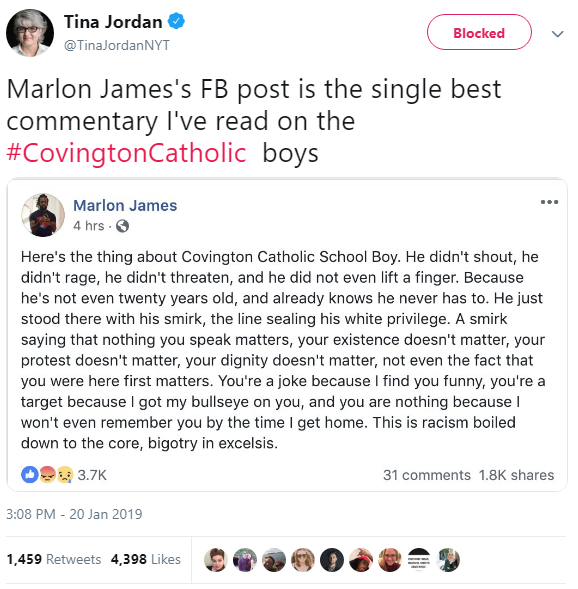
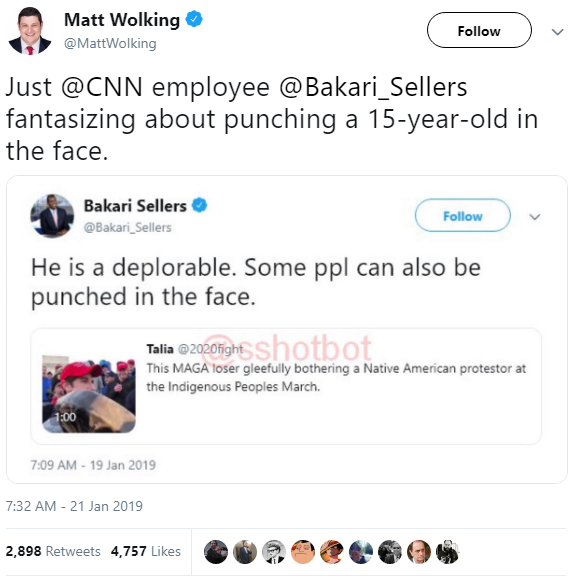
When is it OK to incite violence against people on Twitter? Well, you just have to be a CNN journalist, and your victim just has to be a white male. In the past few days, journalists from CNN and other mainstream media outlets have called for violence against Catholic high school students.
When an edited clip of Catholic teenagers surrounding a Native American man first emerged, it was billed as evidence of racist high school students harassing an Indigenous person.
Journalists, celebrities, and others with blue checkmarks on Twitter rushed to condemn the kids as racists, even though it was clear from the beginning that something was amiss.
As The Daily Wire’s Emily Zanotti previously reported, the original video does not show what it was alleged to have shown and was clearly taken out of some larger context. Still, this did not stop the verified Twitter users from condemning and threatening kids based on no more evidence than the media’s say so and the fact that they were white boys wearing Make America Great Again hats.
On Monday morning, Mediate posted an article collecting some of the various tweets that have since been deleted after more information became available and exonerated the students who were waiting for a bus when they were taunted with racial slurs from some Black Hebrew Israelites and confronted by the Native Americans.
That Daily Wire article explains how a New York Times journalist named Kara Swisher tweeted several times that the boys in the edited video clip were Nazis. Actual Nazis.
Another New York Times editor named Tina Jordan accused the students in the edited clip of racism, despite his never speaking a word!
New York Times editor calls Catholic students racists
But there were THREE CNN employees who attacked the Catholic students on Twitter.
Here’s the first CNN journalist:
Another CNN journalist incites violence against Christian students
Here’s another CNN journalist:
Another CNN journalist attacks Christian parents and teachers
This tweet from CNN employee Reza Aslan is still up at time of writing:
CNN journalist calls for violence against Christian student
There was a lot more discussion of the biased news media on the Ben Shapiro podcast from Monday night. He was furious.
Ben Shapiro responds to media bias
Here is the full show:
At 14:30, Ben Shapiro does something that that CNN would not do. He shows the confrontation in context.
The video clearly shows the students ignoring anti-white racism directed against them, and it also shows that Phillips walked right up to them. They didn’t accost him. He walked up to the students, and banged his drum right in their faces. He sought out the crowd, walked into the middle of it, and caused the confrontation.
CNN could not do show the confrontation in context, because it did not fit with their progressive Democrat narrative. And CNN could not interview the students, they only interviewed the liar, because he agreed with them.
This resulted in the students and their parents being harrassed, and targeted with threats of violence, and even death threats. Death threats, thanks to false journalism by CNN. This is nothing more than libel that incited violence against innocent people.
Ben Shapiro only talks about the confrontation for the first 30 minutes or so, but I still think it is worth watching just so that people have the appropriate level of distrust for the mainstream media.
Hillary Clinton and her ally, the Human Rights Campaign
Hey, have you ever seen those bumper stickers with a yellow equal sign on a blue background? That is the symbol of the Human Rights Campaign. They have the support of prominent Democrats, like Hillary Clinton, and Barack Obama, who have spoken at their events. Today’s post is about the co-founder of the HRC.
Prominent Democrat donor Terry Bean was indicted earlier this month on two counts of sodomy and one count of sex abuse for allegedly having sex with a teenage boy.
Bean was arraigned Thursday on the charges, TV station KGW8 reported. He pleaded not guilty and was taken into custody at Lane County jail in Oregon. He was released Thursday and told KGW8 he was “innocent.”
The indictment was filed on Jan. 4 but made public following the arraignment.
Bean, a gay rights activist who donated almost $70,000 of his own money to former President Barack Obama’s campaign, was charged with sexual abuse in 2014 but the case was dismissed after the alleged victim did not testify. Prosecutors refiled the charges after this, court records stated, according to The Oregonian. The “alleged victim is not named in the new indictment” but the dates are similar to the previous charges, KGW8 noted.
Bean, a real estate developer, and his former boyfriend, Kiah Lawson, allegedly had sex with a 15-year-old boy in a Eugene, Oregon, hotel in September 2013. They allegedly used the app Grindr to arrange the sexual encounter. Lawson was also charged but his case was dismissed.
The Human Rights Campaign has a lot of corporate partners, who agree with the vision of Terry Bean and his organization. You can see a list of HRC corporate supporters right here.
Anyway, this isn’t the first time that something like this has happened.
The mayor of Seattle, Ed Murray, said on Tuesday that he would resign after announcing in May that he would not seek a second term. Several men have come forward to accuse Mr. Murray of sexually abusing them decades ago, when they were underage.
The announcement came just hours after The Seattle Times published a story with an account by a fifth man, Mr. Murray’s cousin, who said Mr. Murray had abused him in the 1970s.
[..]Mr. Murray, 62, a Democrat, is the city’s first openly gay mayor, and had served in the State Legislature for many years before being elected in 2013.
[…]The liberal Mr. Murray is generally considered a father of Washington’s same-sex marriage law, which he pressed in the State Legislature for years.
a member of the San Francisco Human Rights Commission
two men who adopted nine children
two men who adopted a boy
an activist who ran an organization for boys
two men who adopted a boy from Russia
It happens all the time, and with very prominent people. Allies and donors to the secular left elite. Yet, the mainstream media never seems to have much to say about these cases. I wonder why.
What does morality mean to atheists?
Should we be surprised when wealthy Democrat men take advantage of underage boys? I don’t see why, given that belief in God is on the decline in our society.
Let’s review what objective morality (moral realism) really means in practice for atheists:
In a universe of electrons and selfish genes, blind physical forces and genetic replication, some people are going to get hurt, other people are going to get lucky, and you won’t find any rhyme or reason in it, nor any justice. The universe that we observe has precisely the properties we should expect if there is, at bottom, no design, no purpose, no evil, no good, nothing but pitiless indifference.
Whatever morality atheists try to claim, the truth is that their worldview cannot ground it rationally. This universe is an accident. There are no objective human rights. There is no objective morality. There is no free will nor moral agency. There is no judge of our actions when we die. Other human beings are just lumps of matter to be used for our own pleasure, as long as we are powerful enough to escape the disapproval of those accursed Bible-believers. Can you expect people to behave morally when public expressions of Christianity are effectively banned by the secular left?
Sherlock Holmes and John Watson: let’s take a look at the facts
Have you ever heard Gary Habermas, Michael Licona or William Lane Craig defend the resurrection of Jesus in a debate by saying that the resurrection is the best explanation for the “minimal facts” about Jesus? The lists of minimal facts that they use are typically agreed to by their opponents during the debates. Minimal facts are the parts of the New Testament that meet a set of strict historical criteria. These are the facts that skeptical historians agree with, totally apart from any religious beliefs.
So what are the criteria that skeptical historians use to derive a list of minimal facts about Jesus?
The other way, more influential in contemporary New Testament scholarship, is to establish specific facts about Jesus without assuming the general reliability of the Gospels. The key here are the so-called “Criteria of Authenticity” which enable us to establish specific sayings or events in Jesus’ life as historical. Scholars involved in the quest of the historical Jesus have enunciated a number of these critieria for detecting historically authentic features of Jesus, such as dissimilarity to Christian teaching, multiple attestation, linguistic semitisms, traces of Palestinian milieu, retention of embarrassing material, coherence with other authentic material, and so forth.
It is somewhat misleading to call these “criteria,” for they aim at stating sufficient, not necessary, conditions of historicity. This is easy to see: suppose a saying is multiply attested and dissimilar but not embarrassing. If embarrassment were a necessary condition of authenticity, then the saying would have to be deemed inauthentic, which is wrong-headed, since its multiple attestation and dissimilarity are sufficient for authenticity. Of course, the criteria are defeasible, meaning that they are not infallible guides to authenticity. They might be better called “Indications of Authenticity” or “Signs of Credibility.”
In point of fact, what the criteria really amount to are statements about the effect of certain types of evidence upon the probability of various sayings or events in Jesus’ life. For some saying or event S and evidence of a certain type E, the criteria would state that, all things being equal, the probability of S given E is greater than the probability of S on our background knowledge alone. So, for example, all else being equal, the probability of some event or saying is greater given its multiple attestation than it would have been without it.
What are some of the factors that might serve the role of E in increasing the probability of some saying or event S? The following are some of the most important:
(1) Historical congruence: S fits in with known historical facts concerning the context in which S is said to have occurred.
(2) Independent, early attestation: S appears in multiple sources which are near to the time at which S is alleged to have occurred and which depend neither upon each other nor a common source.
(3) Embarrassment: S is awkward or counter-productive for the persons who serve as the source of information for S.
(4) Dissimilarity: S is unlike antecedent Jewish thought-forms and/or unlike subsequent Christian thought-forms.
(5) Semitisms: traces in the narrative of Aramaic or Hebrew linguistic forms.
(6) Coherence: S is consistent with already established facts about Jesus.
For a good discussion of these factors see Robert Stein, “The ‘Criteria’ for Authenticity,” in Gospel PerspectivesI, ed. R. T. France and David Wenham (Sheffield, England: JSOT Press, 1980), pp. 225-63.
Notice that these “criteria” do not presuppose the general reliability of the Gospels. Rather they focus on a particular saying or event and give evidence for thinking that specific element of Jesus’ life to be historical, regardless of the general reliability of the document in which the particular saying or event is reported. These same “criteria” are thus applicable to reports of Jesus found in the apocryphal Gospels, or rabbinical writings, or even the Qur’an. Of course, if the Gospels can be shown to be generally reliable documents, so much the better! But the “criteria” do not depend on any such presupposition. They serve to help spot historical kernels even in the midst of historical chaff. Thus we need not concern ourselves with defending the Gospels’ every claim attributed to Jesus in the gospels; the question will be whether we can establish enough about Jesus to make faith in him reasonable.
And you can see Dr. Craig using these criteria to defend minimal facts in his debates. For example, in his debate with Ehrman, he alludes to the criteria when making his case for the empty tomb.
Here, he uses multiple attestation and the criteria of embarrassment:
Among the reasons which have led most scholars to this conclusion are the following:
1. The empty tomb is also multiply attested by independent, early sources.
Mark’s source didn’t end with the burial, but with the story of the empty tomb, which is tied to the burial story verbally and grammatically. Moreover, Matthew and John have independent sources about the empty tomb; it’s also mentioned in the sermons in the Acts of the Apostles (2.29; 13.36); and it’s implied by Paul in his first letter to the Corinthian church (I Cor. 15.4). Thus, we have again multiple, early, independent attestation of the fact of the empty tomb.
2. The tomb was discovered empty by women.
In patriarchal Jewish society the testimony of women was not highly regarded. In fact, the Jewish historian Josephus says that women weren’t even permitted to serve as witnesses in a Jewish court of law. Now in light of this fact, how remarkable it is that it is women who are the discoverers of Jesus’ empty tomb. Any later legendary account would certainly have made male disciples like Peter and John discover the empty tomb. The fact that it is women, rather than men, who are the discoverers of the empty tomb is best explained by the fact that they were the chief witnesses to the fact of the empty tomb, and the Gospel writers faithfully record what, for them, was an awkward and embarrassing fact.
There are actually a few more reasons for believing in the empty tomb that he doesn’t go into in the debate, but you can find them in his written work. For example, in his essay on Gerd Ludemann’s “vision” hypothesis. That essay covers the reasons for all four of his minimal facts.
So, if you are going to talk about the resurrection with a skeptic, you don’t want to invoke the Bible as some sort of inerrant/inspired Holy Book.
Try this approach instead:
Explain the criteria that historians use to get their lists of minimal facts
Explain your list of minimal facts
Defend your list of minimal facts using the criteria
Cite skeptics who admit to each of your minimal facts, to show that they are widely accepted
List some parts of the Bible that don’t pass the criteria (e.g. – guard at the tomb, Matthew earthquake)
Explain why those parts don’t pass the criteria, and explain that they are not part of your case
Challenge your opponent to either deny some or all the facts, or propose a naturalistic alternative that explains the facts better than the resurrection
Don’t let your opponent attack any of your minimal facts by attacking other parts of the Bible (e.g. – the number of angels being one or two, etc.)
And remember that there is no good case for the resurrection that does not make heavy use of the early creed in 1 Corinthians 15:3-8.
The best essay on the minimal facts criteria that I’ve read is the one by Robert H. Stein in “Contending with Christianity’s Critics“. It’s a good short essay that goes over all the historical criteria that are used to derive the short list of facts from which we infer the conclusion “God raised Jesus from the dead”. That whole book is really very, very good.