All posts by Wintery Knight

https://winteryknight.com/

What will the Republican and Democrat plans for the economy mean for you?

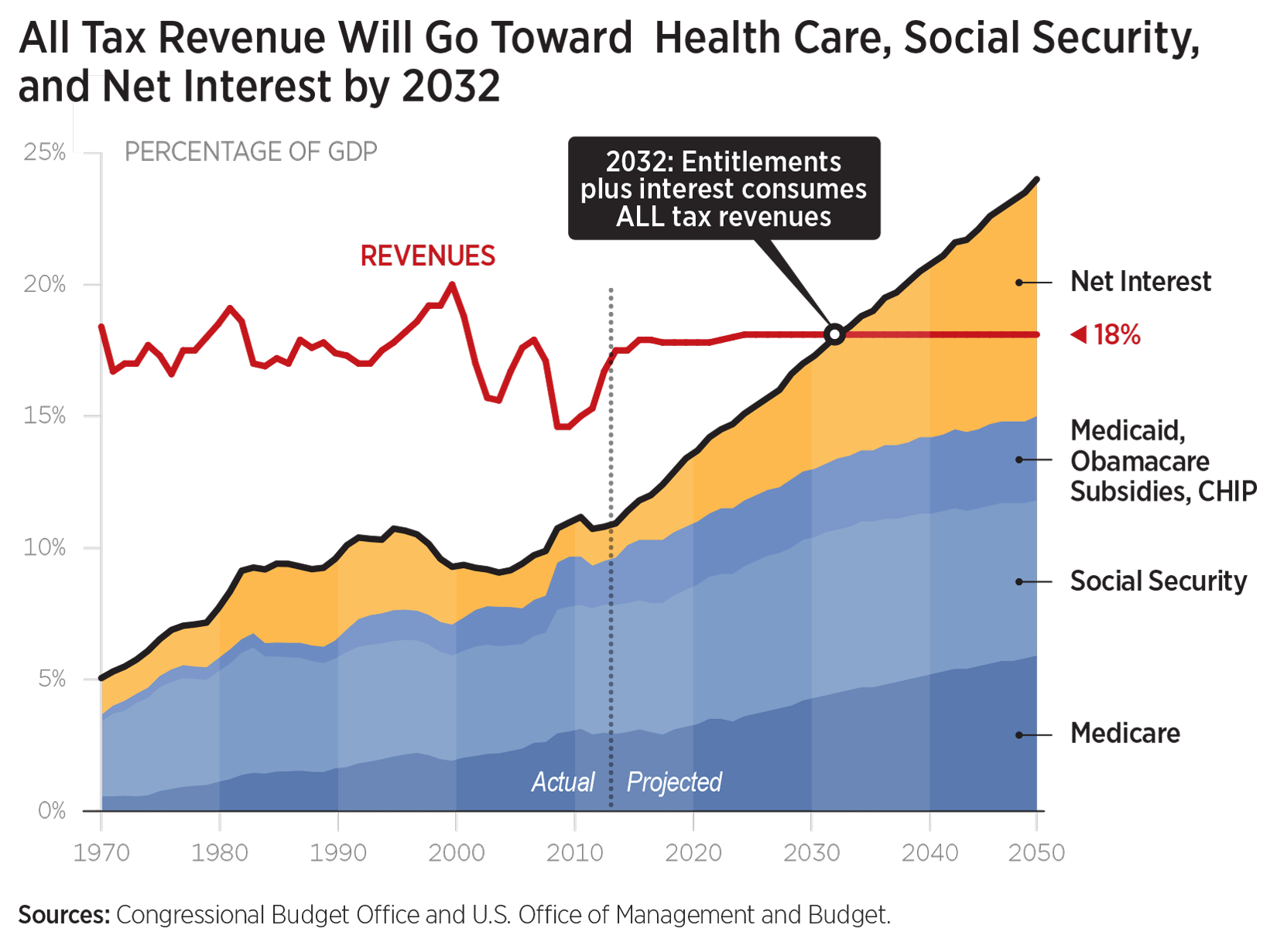
Pretty soon, our mandatory expenses will consume all of our tax revenues

I found two very good articles about the Republican and Democrat plans for taxing and spending. On the one hand, there’s an article about the effects of the Trump tax cuts, posted at the Washington Times. On the other hand, there’s an article posted at the radically leftist Vox, about the cost of Democrat party spending plans. I wonder which one is better for you and your family?

First, let’s look at the effects of the Trump tax cuts:

Almost immediately, numerous employers — including Boeing, AT&T, FedEx, CVS, and others — began offering bonuses to their employees. Nearly 200 companies, including Walmart, announced wage hikes due to the 2017 tax cut. Still others enjoyed higher contributions to their retirement plans.

The benefits soon went beyond that, however. The tax cut contributed to the strong economy we’ve been enjoying, leading many businesses to hire more and more workers. The United States added more than 2.6 million new jobs in the year following the passage of the tax cut — nearly a 25 percent increase from the previous year.

Unemployment is way down, with jobless claims at their lowest since 1969, thanks in large part to the tax cut.

[…]The Heritage Foundation used IRS data to produce a special report last year that shows how widespread the tax benefits truly are.

They found that in 2018 taxpayers would save an average of $1,400. Even better, married couples with two children would save more than twice that: $2,917.

So, that sounds pretty good if you’re a taxpayer. You got to keep more of the money you earned, and spend it on the things you wanted for yourself and your loved ones. If that money had gone to government, then government employees would have taken half for their own salaries and benefits, and then the rest might have been spent in a wasteful way by someone who never earned it.

By the way, you might think that taking less money from the people who earn it would cause tax revenues to go down. But that’s not the case. Whenever you allow job creators and workers to keep more of what they earn, they work harder and take more risks developing better products and services. This naturally results in more revenue to the government from increased economic activity. In Feburary of 2018, after the tax cuts were in effect a whole year, federal revenues were $1.4 billion HIGHER than the previous year.

But let’s see what the Democrats can do for the taxpayer, by looking at this article in the far-left Vox.

It says:

Sanders has proposed a Social Security expansion, including higher cost-of-living adjustments and higher minimum benefit levels, that the liberal Tax Policy Center estimates will cost $188 billion over the next decade.

The Tax Policy Center also scores the Sanders “free college” proposal at $807 billion over the next decade. (Note that free college benefits students from wealthy families and those whose tuition is currently affordable.)

Next, the center estimates that Sanders’s proposal of up to 12 weeks of paid family leave for new parents and for people with serious health conditions would cost another $270 billion.

Those costs, however, pale beside the cost of replacing private insurance, including copayments, with a Medicare-for-all plan. The liberal Urban Institute estimates that Sanders’s single-payer health plan would add $32 trillion in federal costs over the decade.

[…]Ocasio-Cortez and Senate Democrats also want to guarantee a job for anyone who wants one, at $15 per hour plus benefits. The liberal Center on Budget and Policy Priorities, commissioned a report by outside scholars Darrick Hamilton, William Darity, and Mark Paul that estimates the cost of a more modest proposal along these lines (with a lower wage, for example). It suggested the cost would be $56,000 apiece for 9.7 million enrollees, for a total of $6.8 trillion over the next decade.

[…]Finally, Senate Democrats have promised $1 trillion for new infrastructure, and House Democrats are rallying around legislation to pay off all $1.4 trillion in student loan debt — both of which the far left generally supports. I will exclude vague promises such as universal pre-K and expanded special education funding.

Total cost: $42.5 trillion in new proposals over the next decade, on top of the $12.4 trillion baseline deficit.

OK, that does sound like a lot of money, but the rich are just sitting on trillions and trillions of dollars that they aren’t even using, right? So the total cost of all this spending is only $42.5 trillion of new spending and $12.4 trillion of existing spending, for  a total of about $55 trillion dollars over the next 10 years. I’m sure that if we just raised taxes by 5% on the rich, we could easily raise 10 times that amount, right?

Not quite.

In 2011, the Tax Foundation explained that even if you taxed ALL THE INCOME from all the people who make $200,000 or more, you would only raise $1.53 trillion dollars:

So taking half of the yearly income from every person making between one and ten million dollars would only decrease the nation’s debt by 1%. Even taking every last penny from every individual making more than $10 million per year would only reduce the nation’s deficit by 12 percent and the debt by 2 percent. There’s simply not enough wealth in the community of the rich to erase this country’s problems by waving some magic tax wand.

Finally, to put everything in perspective, think about what would need to be done to erase the federal deficit this year: After everyone making more than $200,000/year has paid taxes, the IRS would need to take every single penny of disposable income they have left. Such an act would raise approximately $1.53 trillion. It may be economically ruinous, but at least this proposal would actually solve the problem.

Now, if I were a rich person making over $200,000 a year, and someone came along and told me they would take all of it, I would not continue to work. And I doubt they would either. But taking all this money from “the rich” would just barely cover the BASELINE deficit of $12.4 trillion over the next 10 years. It would not cover the new $42.5 trillion of Democrat spending plans.

Think about that. What that means is that can’t pay for their spending even if they take every penny from “the rich”. Do you know what that means? It means they’re going to have to take money from YOU, the ordinary middle class American taxpayer. Something to keep in mind.


Bible study: responsibilities and obligations in Philippians 1-4

Bible study that hits the spot

Here are some parts of Philippians that speak to an issue that I think is a problem today for many Christians – self-centeredness.

Philippians 2 talks about the importance of not being self-centered, but instead being focused on the needs of others.

Phil 2:1-8:

2 Therefore if there is any encouragement in Christ, if there is any consolation of love, if there is any fellowship of the Spirit, if any affection and compassion,2 make my joy complete by being of the same mind, maintaining the same love, united in spirit, intent on one purpose. 3 Do nothing from selfishness or empty conceit, but with humility of mind regard one another as more important than yourselves; 4 do not merely look out for your own personal interests, but also for the interests of others. 5 Have this attitude in yourselves which was also in Christ Jesus, 6 who, although He existed in the form of God, did not regard equality with God a thing to be grasped, 7 but emptied Himself, taking the form of a bond-servant, and being made in the likeness of men. 8 Being found in appearance as a man, He humbled Himself by becoming obedient to the point of death, even death on a cross.

And Phil 2:19-23:

19 But I hope in the Lord Jesus to send Timothy to you shortly, so that I also may be encouraged when I learn of your condition. 20 For I have no one else of kindred spirit who will genuinely be concerned for your welfare. 21 For they all seek after their own interests, not those of Christ Jesus. 22 But you know of his proven worth, that he served with me in the furtherance of the gospel like a child serving his father.

Nothing very complicated here, it’s important to look out for the interests of others and to be concerned about their welfare.

I think it’s a good idea to be practical about partnering with people, and instead of just speaking words like “I care” or “I’ll pray for you”, try to find out what needs to be done and do it. Solve the problem with actions. Prayer is important, of course, because so much of what happens to that other person is in God’s hands. You aren’t going to be around all the time, but God is, so talk to him about the other person and what you’re planning to do. But you must also do your part, and do it intelligently and effectively. (The New Testament book of James talks about the need to accompany good wishes with actions that solve the problem)

Also don’t just stand back and give orders while feeling righteous. Many people want to influence others by just quoting the Bible, putting on pious airs, or using mere words. This doesn’t work in any area of the real world. Instead, take a more active approach. Think about the problem that is preventing someone from serving Christ well, and then act to make it easier for the person to do the right thing.

I’ve been able to achieve good success by praying AND performing supportive actions, rather than by issuing commands or prayer alone. For example, I’ve gotten people to transition for useless careers into IT careers, got them to pay off their high-interest debts, got them to switch their majors from something useless to something useful, got them to move on from an abortion or a divorce, got them to not commit suicide, listened to their health problems, helped them pass the GRE or the GMAT or something, got them to take a better job, got them to do a public speaking engagement, taught them how to debate their atheist brother, sponsored a Christian speaker at their university, helped them recover from bad parents, etc. It’s pretty fun to partner with people to further the Kingdom, but if you just leave it at prayer and giving orders, you won’t get the same good results.

All it takes to move from prayer alone to prayer and solutions is to think about other people like a puzzle, and then sacrifice some of your time or your money to build them up. I have a lot of experience doing this, but it’s not something that I learned to do in church. Church doesn’t teach you to be practical about following the Bible intelligently and with your own initiative. It’s set up to favor emotions (singing) and passive listening. To be active, you have to think about the Bible from a higher strategic level. Think about who Jesus is, and then follow his example. Don’t read the Bible in order to just feel happy or sound pious, instead try to make a plan to really DO good. Your goal should be to achieve a result in line with Jesus’ character and goals.

By the way, part of being able to partner with other people to solve problems with actions is being capable yourself. Don’t study stupid things in college. Don’t get into debt. Don’t try to fill your days with fun and thrills. Instead, study hard things, get hard jobs in the private sector, save your money, and learn useful skills. That way, you’ll be able to do more when something more than passive words or feelings is needed. One time, a woman I knew severely hurt her hand at work. She has OCD, and liked to clean the stairs in her house every day. She has a furry cat who drops fur everywhere. So she was lugging this heavy vacuum up and down the stairs every day. And spending a lot of time ironing with an old-fashioned heavy iron, too. So I bought her a hand vacuum and a fancy new iron. With the extra time she saved, she was able to do more reading, public speaking and helping others. Doing Christianity well means making yourself strong, so you can look after others with more than just feelings, piety and prayers.

Philippians is my favorite book of the Bible. And the most important thing about Philippians is that it’s good to be focused on other people, and not on ourselves, and to think of the interests of others, not our own interests. It’s good to get down into the weeds of other people’s problems, and act to self-sacrificially to solve them. Read the book (it’s short) and see if there are not people who you could partner with by helping them solve problems so they can be more effective.

New study: the cheapest and most effective way to reduce carbon emissions is to plant more trees

What's the best solution to higher carbon emissions?
What’s the best solution to higher carbon emissions?

Many people favor Big Government solutions to the problem of carbon emissions. For example, the Green New Deal proposed by the Democrats would abolish all gas, oil and coal energy. That plan would raise taxes and require massive restrictions on free markets and individual consumers. But there is a better way, and it was just published in the prestigious peer-reviewed journal Science.

Economist Robert P. Murphy wrote a very interesting article about the new study for the Mises Institute.

He writes:

A recent article in the Guardian trumpeted the findings of a new study published in Science that found massive tree planting would be — by far — the cheapest and most effective approach to mitigating climate change. Ironically, the new thinking shows the pitfalls of political approaches to combating so-called “negative externalities.” The good news about tree planting disrupts the familiar narrative about carbon taxes that even professional economists have been feeding the public for years.

He quotes the Guardian article so:

Planting billions of trees across the world is by far the biggest and cheapest way to tackle the climate crisis, according to scientists, who have made the first calculation of how many more trees could be planted without encroaching on crop land or urban areas.

As trees grow, they absorb and store the carbon dioxide emissions that are driving global heating. New research estimates that a worldwide planting programme could remove two-thirds of all the emissions that have been pumped into the atmosphere by human activities, a figure the scientists describe as “mind-blowing”.

[…]“This new quantitative evaluation shows [forest] restoration isn’t just one of our climate change solutions, it is overwhelmingly the top one,” said Prof Tom Crowther at the Swiss university ETH Zurich, who led the research. “What blows my mind is the scale. I thought restoration would be in the top 10, but it is overwhelmingly more powerful than all of the other climate change solutions proposed.”

OK, so this plan will work, but will it cost less than the $52.6 to $93 trillion dollars over 10 years needed for the Green New Deal?

Yes:

Citing a figure that planting a new tree costs roughly 30 cents, Prof. Crowther remarked that we could plant the target of 1 trillion trees by spending about $300 billion.

Just FYI, the cost per household for the Green New Deal is between $361,010 and $653,010, according to the Washington Free Beacon.

As a conservative, I recognize that sometimes I have to be willing to spend taxpayer money on a small government solution in order to  avoid other big government solutions to a problem. The same thing is true for individual health savings accounts funded by a government voucher. I don’t like spending taxpayer money, but sometimes spending a little is better than creating a huge bureaucracy that will require spending a lot more.