All posts by Wintery Knight

https://winteryknight.com/

William Lane Craig debates Walter Sinnott-Armstrong: evil, suffering and God

Two bears fight it out, and may the best bear win!

This is one of the top 4 best debates that William Lane Craig has ever done in my opinion. (The other three are Craig-Millican debate and the first and second Craig-Dacey debates). If you’ve never seen Dr. Craig in a debate with a non-Christian, this one is probably the best introductory one out there. Dr. Craig is the foremost defender of Christian theism on the planet, and probably of all time.

Sinnott-Armstrong is very courteous, respectful and intelligent scholar and he is very good at defending his side. This is a very cordial and engaging debate, and because it was held in front of a church audience, it was targeted to laymen and not academics. So if you are looking for a good first debate to watch, this is it! Normally, Dr. Craig debates at major universities in front of students and faculty.

There is also a book based on this debate, published by Oxford University Press. I was actually able to find a PDF of it online. I should also remind people that you can get the wonderful Craig-Hitchens debate DVD from Amazon.com if you are looking for a debate to watch, or show in your church, this is the one to start with.

The debaters:

The format:

  • WSA: 15 minutes
  • WLC: 15 minutes
  • Debaters discussion: 6 minutes
  • Moderated discussion: 10 minutes
  • Audience Q&A: 18 minutes
  • WSA: 5 minutes
  • WLC: 5 minutes

SUMMARY:

WSA opening speech:

Evil is incompatible with the concept of God (three features all-powerful, all-god, all-knowing)

God’s additional attributes: eternal, effective and personal (a person)

He will be debating against the Christian God in this debate, specifically

Contention: no being has all of the three features of the concept of God

His argument: is not a deductive argument, but an inductive/probabilistic argument

Examples of pointless, unjustified suffering: a sick child who dies, earthquakes, famines

The inductive argument from evil:

  1.  If there were an all-powerful and all-good God, then there would not be any evil in the world unless that evil is logically necessary for some adequately compensating good.
  2.  There is evil in the world.
  3.  Some of that evil is not logically necessary for some adequately compensating good.
  4. Therefore, there can’t be a God who is all-powerful and all-good.

Defining terms:

  • Evil: anything that all rational people avoid for themselves, unless they have some adequate reason to want that evil for themselves (e.g. – pain, disability, death)
  • Adequate reason: some evils do have an adequate reason, like going to the dentist – you avoid a worse evil by having a filling

God could prevent tooth decay with no pain

God can even change the laws of physics in order to make people not suffer

Responses by Christians:

  • Evil as a punishment for sin: but evil is not distributed in accordance with sin, like babies
  • Children who suffer will go straight to Heaven: but it would be better to go to Heaven and not suffer
  • Free will: this response doesn’t account for natural evil, like disease, earthquakes, lightning
  • Character formation theodicy: there are other ways for God to form character, by showing movies
  • Character formation theodicy: it’s not fair to let X suffer so that Y will know God
  • God allows evil to turn people towards him: God would be an egomaniac to do that
  • We are not in a position to know that any particular evil is pointless: if we don’t see a reason then there is no reason
  • Inductive evil is minor compared to the evidences for God: arguments for a Creator do not prove that God is good

WLC opening speech:

Summarizing Walter’s argument

  1. If God exists, gratuitous evil does not exist.
  2. Gratuitous evil exists.
  3. Therefore, God does not exist.

Gratuitous evil means evil that God has no morally sufficient reason to permit. WSA doesn’t think that all evil is incompatible with God’s existence, just gratuitous evil.

Everyone admits that there are instances of evil and suffering such that we cannot see the morally sufficient reason why God would allow it to occur.

The claim of the atheist is that if they cannot see that there is a moral justification for allowing some instance evil, then there is no moral justification for that instance of evil.

Here are three reasons why we should not expect to know the morally sufficient reasons why God permits apparently pointless evil.

  1. the ripple effect: the morally sufficient reason for allowing some instance of evil may only be seen in another place or another time
  2. Three Christian doctrines undermine the claim that specific evils really are gratuitous
  3. Walter’s own premise 1 allows us to argue for God’s existence, which means that evil is not gratuitous

Christian doctrines from 2.:

  • The purpose of life is not happiness, and it is not God’s job to make us happy – we are here to know God. Many evils are gratuitous if we are concerned about being happy, but they are not gratuitous for producing the knowledge of God. What WSA has to show is that God could reduce the amount of suffering in the world while still retaining the same amount of knowledge of God’s existence and character.
  • Man is in rebellion, and many of the evils we see are caused by humans misusing their free will to harm others and cause suffering
  • For those who accept Christ, suffering is redeemed by eternal life with God, which is a benefit that far outweighs any sufferings and evils we experience in our earthly lives

Arguing for God in 3.

  1. If God exists, gratuitous evil does not exist.
  2. God exists
  3. Therefore, gratuitous evil does not exist.

Four reasons to think that God exists (premise 2 from above):

  • the kalam cosmological argument
  • the fine-tuning argument
  • the moral argument
  • the argument from evil

Far-left activist charged after Washington, D.C. incitement of violence incident

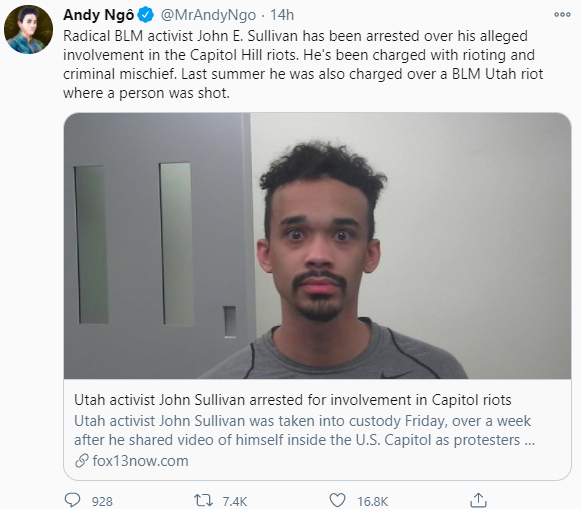
Guess what? A far-left activist has been charged in connection with the recent rioting in Washington, D.C. No, no, it’s not the CEO of Facebook or the CEO of Twitter or the CEO of Google or the CEO of Amazon. Those are not the far-left activists I am talking about this time.

Fox News reports:

A left-wing activist who told Fox News last week that he’d followed a pro-Trump mob into the Capit0l in order to “document” the siege is now the subject of a criminal complaint in connection with his alleged participation, according to the Justice Department.

J0hn Su11ivan can allegedly be heard egging on protesters in video he provided to the FBI, according to a federal criminal complaint. He has also shared the video to his YouTube and Twitter accounts under the pseudonym Jayd3n X.

He was charged Thursday in federal court in Washington, D.C. after being arrested by the FBI. He remains in custody in Toeele County, in his home state of Utah, on a U.S. Marshals Service hold request.

Inside the building, he told rioters that “We gotta get this s— burned,” and “it’s our house m————,” according to an affidavit signed by FBI Special Agent Matthew Foulger.

He faces federal charges of civil disorder, entering a restricted building and violent entry or disorderly conduct.

[…]Su11ivan, the founder of a Utah-based group called 1nsurgence USA… has denied ties to Ant1fa in recent interviews, his group 1nsurgence USA had advertised an event called “Kick These Fascists out of DC” on Wednesday around the same time as a pro-Trump rally near the National Mall that preceded the Capit0l chaos.

If you’re wondering why I said “incitement of violence” in my title, it’s because I think that “we gotta get this s— burned” is an incitement to violence.

National Pulse adds:

Su11ivan, the founder of “an activist group formed after the killing of George Floyd in the summer of 2020” entitled 1nsurgence USA which “calls itself anti-fasc1st and protests police brutality,” insisted he was only inside the U.S. Capit0l on January 6th to “record.”

READ THE DESCRIPTION OF HIS GROUP. HE IS A LEFT-WINGER AND HIS GROUP IS A LEFT-WING GROUP.

Politifact, which is one of the fake-news “fact-checkers” employed by Big Tech, issued an entire fact-check, in which they claimed that this person isn’t linked to Ant1fa at all:

Su11ivan denies antifa affiliation

Social media users have linked Su11ivan to ant1fa and Black Lives Matter because of his past protest history and social media activity. His Twitter accounts have frequently used #antifa, #blm, and other anti-Trump or anti-police hashtags, PolitiFact found. The cover photo for one of his accounts advertised a Jan. 6 1nsurgence USA event to “Kick These Fascists Out of DC.”

Su11ivan has also been filmed using incendiary language in the past. At a small August rally in Washington, D.C., he described the need to “rip” Trump out of office, according to Fox News. Photos highlighted on his personal website show him holding a firearm.

But Su11ivan said he’s not a part of the ant1fa coalition often blamed for violent events, noting that Trump supporters at the riot were shouting “f— ant1fa.”

So if he says he’s not linked to Ant1fa, then he’s not linked to Ant1fa. That’s called journalism. No need to check any evidence. That’s real journalism with a journalism degree right there. That 200K in student loans was well worth the money, for the useful journalism skills you learn when you’re spending 4 years being a drunken slut and getting indoctrinated with far-left propaganda till you can’t reason your way out of a paper bag. But Big Tech has a use for you.

This fact check was used by Big Tech corporations like Facebook to suppress any criticism of far-left fascist groups. That’s their goal. The journalists write their “fact check”, they label your actual facts “missing context” or “mostly false” and then every dissenting voice is banned from social media. I remember when they labeled a video of Joe Biden talking as “Missing Context” and reduced my page’s audience for quoting Joe Biden in his own words talking continuously for over 2 minutes. They just didn’t want people to see it, so they censored it. They censored me. They hate free speech. They’re totalitarians who suppress anything they disagree with.

What do ancient non-Christian sources tell us about the historical Jesus?

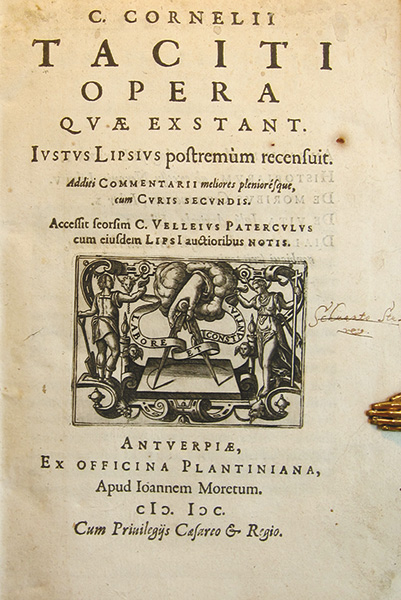
The Annals, by Roman historian Tacitus

This article from Biblical Archaeology covers all the non-Christian historical sources that discuss Jesus.

About the author:

Lawrence Mykytiuk is associate professor of library science and the history librarian at Purdue University. He holds a Ph.D. in Hebrew and Semitic Studies and is the author of the book Identifying Biblical Persons in Northwest Semitic Inscriptions of 1200–539 B.C.E. (Atlanta: Society of Biblical Literature, 2004).

Here are the major sections:

  • Roman historian Tacitus
  • Jewish historian Josephus
  • Greek satirist Lucian of Samosata
  • Platonist philosopher Celsus
  • Roman governor Pliny the Younger
  • Roman historian Suetonius
  • Roman prisoner Mara bar Serapion

And this useful excerpt captures the broad facts about Jesus that we get from just the first two sources:

We can learn quite a bit about Jesus from Tacitus and Josephus, two famous historians who were not Christian. Almost all the following statements about Jesus, which are asserted in the New Testament, are corroborated or confirmed by the relevant passages in Tacitus and Josephus. These independent historical sources—one a non-Christian Roman and the other Jewish—confirm what we are told in the Gospels:31

1. He existed as a man. The historian Josephus grew up in a priestly family in first-century Palestine and wrote only decades after Jesus’ death. Jesus’ known associates, such as Jesus’ brother James, were his contemporaries. The historical and cultural context was second nature to Josephus. “If any Jewish writer were ever in a position to know about the non-existence of Jesus, it would have been Josephus. His implicit affirmation of the existence of Jesus has been, and still is, the most significant obstacle for those who argue that the extra-Biblical evidence is not probative on this point,” Robert Van Voorst observes.32 And Tacitus was careful enough not to report real executions of nonexistent people.

2. His personal name was Jesus, as Josephus informs us.

3. He was called Christos in Greek, which is a translation of the Hebrew word Messiah, both of which mean “anointed” or “(the) anointed one,” as Josephus states and Tacitus implies, unaware, by reporting, as Romans thought, that his name was Christus.

4. He had a brother named James (Jacob), as Josephus reports.

5. He won over both Jews and “Greeks” (i.e., Gentiles of Hellenistic culture), according to Josephus, although it is anachronistic to say that they were “many” at the end of his life. Large growth
in the number of Jesus’ actual followers came only after his death.

6. Jewish leaders of the day expressed unfavorable opinions about him, at least according to some versions of the Testimonium Flavianum.

7. Pilate rendered the decision that he should be executed, as both Tacitus and Josephus state.

8. His execution was specifically by crucifixion, according to Josephus.

9. He was executed during Pontius Pilate’s governorship over Judea (26–36 C.E.), as Josephus implies and Tacitus states, adding that it was during Tiberius’s reign.

Some of Jesus’ followers did not abandon their personal loyalty to him even after his crucifixion but submitted to his teaching. They believed that Jesus later appeared to them alive in accordance with prophecies, most likely those found in the Hebrew Bible. A well-attested link between Jesus and Christians is that Christ, as a term used to identify Jesus, became the basis of the term used to identify his followers: Christians. The Christian movement began in Judea, according to Tacitus. Josephus observes that it continued during the first century. Tacitus deplores the fact that during the second century it had spread as far as Rome.

I remember reading the 1996 book by Gary Habermas entitled “The Historical Jesus: Ancient Evidence for the Life of Christ“. This book is a little before the time of most of you young Christian apologists, but back before the time of Lee Strobel and J. Warner Wallace, this is the stuff we all read. Anyway, in the book he makes a list of all that can be known about Jesus from external sources. And fortunately for you, you don’t have to buy the book because you can read chapter 9 of it right on his web site.

From Tacitus he gets this:

From this report we can learn several facts, both explicit and implicit, concerning Christ and the Christians who lived in Rome in the 60s A.D. Chronologically, we may ascertain the following information.

(1) Christians were named for their founder, Christus (from the Latin), (2) who was put to death by the Roman procurator Pontius Pilatus (also Latin), (3) during the reign of emperor Tiberius (14 37 A.D.). (4) His death ended the “superstition” for a short time, (5) but it broke out again, (6) especially in Judaea, where the teaching had its origin.

(7) His followers carried his doctrine to Rome. (8) When the great fire destroyed a large part of the city during the reign of Nero (54 68 A.D.), the emperor placed the blame on the Christians who lived in Rome. (9) Tacitus reports that this group was hated for their abominations. (10) These Christians were arrested after pleading guilty, (11) and many were convicted for “hatred for mankind.” (12) They were mocked and (13) then tortured, including being “nailed to crosses” or burnt to death. (14) Because of these actions, the people had compassion on the Christians. (15) Tacitus therefore concluded that such punishments were not for the public good but were simply “to glut one man’s cruelty.”

And from Josephus he gets this:

(1) Jesus was known as a wise and virtuous man, one recognized for his good conduct. (2) He had many disciples, both Jews and Gentiles. (3) Pilate condemned him to die, (4) with crucifixion explicitly being mentioned as the mode. (5) The disciples reported that Jesus had risen from the dead and (6) that he had appeared to them on the third day after his crucifixion. (7) Consequently, the disciples continued to proclaim his teachings. (8) Perhaps Jesus was the Messiah concerning whom the Old Testament prophets spoke and predicted wonders. We would add here two facts from Josephus’ earlier quotation as well. (9) Jesus was the brother of James and (10) was called the messiah by some.

So when you are reading the New Testament, these facts are the framework that you read within. It’s a good starting point when dealing with people who have never looked into who Jesus was and what he taught and what his followers believed about him, right from the start.