All posts by Wintery Knight

https://winteryknight.com/

What the public school did to the teacher who warned a student about transformer regret

This story actually came out on July 1st, but I have been a little busy writing podcast scripts, and didn’t have time to blog about it. I thought it was an interesting story, because it really shows how far left the public schools have gone down the “don’t judge” road. Now, they are actually punishing male teachers who warn students about the long-term risks of following social trends.

So, the first thing to say is that I wrote a previous post about how transforming is related to peer pressure. Basically, kids are wanting to transform because it provides them with social benefits, especially giving them immunity from being judged. But what’s interesting is how it is affecting children who don’t have depression or any social problems.

Check out this recent article from City Journal (the journal of the Manhattan Institute), which talks about what is really going on in schools:

Patricia (a pseudonym) is the mother of a teenage girl who in recent years has come to identify as transgender. She lives in California, considers herself progressive, votes Democrat, and leads a group for parents of children with rapid onset gender dysphoria (ROGD)—that is, youth who suddenly experience distress with their bodies and believe that undergoing medical “transition” will make them whole again. When I spoke to her recently, she recounted how her daughter’s at-first-lesbian and then trans identity emerged in response to feelings of shame about being white.

I have since spoken to more than a dozen ROGD parents and parent-group leaders who tell a similar story. Their schools compulsively tell their children how awful it is to be white, how white people enjoy unearned “privilege,” how they benefit from “systems” put in place by and for white people for the sole purpose of oppressing “people of color.” Plagued by guilt, the children—almost all of them girls—rush to the sanctuary of “LGBTQ+” identity. Once there, they are catapulted into hero status. According to Patricia, some teachers at her daughter’s school are more forgiving toward “queer” and “trans” kids who hand in their homework late.

The students, especially the girls, absorb this messaging. They are acutely sensitive to how identity affects their social status and academic fortunes. They want the warmth that comes with queer/trans identity, but above all they don’t want to be thought of as vicious oppressors.

What happens if a teacher tries to warn a student about transforming?

The Daily Caller has a story about that:

A Colorado teacher was disciplined after suggesting to a transgender student that the rise in transgenderism is a “trend” that some come to regret, according to documents provided to the Daily Caller from the educator.

The student wanted the teacher to help the student pass the course, and the teacher agreed to knock out some of the bad grades. Then the teacher, in a P.S., warned the student to do more research about the long-term consequences of transforming. He warned the student about permanent effects of treatment.

Here is what the school did to the teacher for telling the student to research the decision to transform:

Jefferson County Public Schools sent Vagos a letter of reprimand arguing that he violated the district’s policy of “harassment of students based on sexual orientation.” Vagos was told he can no longer use the word “trend” when discussing transgender ideology, according to the reprimand letter.

“Your response to this student and the provision of this link imparts a lack of support and reduces a student’s self-identification as being transgendered as a “trend” rather than something real the student is experiencing,” the letter read.

A substitute teacher was provided in Vagos’ absence as he underwent a “Gender Inclusion 101” training provided by the Jefferson County Equity, Diversity, and Inclusion team. Videos from the training included “Avery’s Story,” “Mom, I’m Not A Girl: Raising a Transgender Child,” and “What is a Gender Inclusive School?” Another training was provided by “Gender Spectrum.”

He made his career choice. Now it’s very difficult for him to transition into a private sector career with 15 years of experience teaching children. So he had to jump through their secular left hoops to save his job. He probably had a wife and kids to support. This is why I recommend to young people to do STEM degrees, and private sector jobs. You can always find work no matter what.

There was a time in my life when I wanted to be an English literature teacher more than anything. I won a couple of awards for best English literature student in high school (and a couple for computer science, too). I really liked finding the wisdom in classic literature – the real stuff: Shakespeare, Spenser, Austen, etc. But I can’t really recommend to Christians that they pursue a career in public education at this time. And I certainly don’t recommend that Christian parents put their children into public schools.

Whatever you are doing in your life, make sure you run the numbers and have enough for homeschooling or private Christian schools. Homeschooling is the better option. It won’t be cheap, but you can’t put Christian kids into public schools.

Mark D. Linville: does Darwinian evolution make morality rational?

Have you ever heard an atheist tell you that naturalistic evolution is an answer to the moral argument? I have. And I found a good reply to this challenge in the book “Contending With Christianity’s Critics“. The chapter that responds to the challenge is authored by Dr. Mark D. Linville. It is only 13 pages long. I have a link to the PDF at the bottom of this post.

First, a bit about the author:

Blog: The Tavern at the End of the World
Current positions:

  • PhD Research Fellow
  • Tutoring Fellow in Philosophy

Education:

  • PhD in Philosophy with a minor in South Asian Studies and a specialization in Philosophy of Religion, University of Wisconsin-Madison
  • MA in Philosophy, University of Wisconsin-Madison
  • MA in Philosophy of Religion, Trinity Evangelical Divinity School
  • MA in Theology, Cincinnati Christian Seminary
  • BA in Biblical Studies, Florida Christian College

Here is his thesis of the essay:

Darwin’s account of the origins of human morality is at once elegant, ingenious, and, I shall argue, woefully inadequate. In particular, that account, on its standard interpretation, does not explain morality, but, rather, explains it away . We learn from Darwin not how there could be objective moral facts, but how we could have come to believe—perhaps erroneously—that there are.

Further, the naturalist, who does not believe that there is such a personal being as God, is in principle committed to Darwinism, including a Darwinian account of the basic contours of human moral psychology. I’ll use the term evolutionary naturalism to refer to this combination of naturalism and Darwinism. And so the naturalist is saddled with a view that explains morality away. Whatever reason we have for believing in moral facts is also a reason for thinking naturalism is false. I conclude the essay with a brief account of a theistic conception of morality, and argue that the theist is in a better position to affirm the objectivity of morality.

And here’s a sample to get your attention:

But even if we are assured that a “normal” person will be prompted by the social instincts and that those instincts are typically flanked and reinforced by a set of moral emotions, we still do not have a truly normative account of moral obligation. There is nothing in Darwin’s own account to indicate that the ensuing sense of guilt—a guilty feeling—is indicative of actual moral guilt resulting from the violation of an objective moral law. The revenge taken by one’s own conscience amounts to a sort of second-order propensity to feel a certain way given one’s past relation to conflicting first-order propensities (e.g., the father’s impulse to save his child versus his impulse to save himself). Unless we import normative considerations from some other source, it seems that, whether it is a first or second-order inclination,one’s being prompted by it is more readily understood as a descriptive feature of one’s own psychology than material for a normative assessment of one’s behavior or character. And, assuming that there is anything to this observation, an ascent into even higher levels of propensities (“I feel guilty for not having felt guilty for not being remorseful over not obeying my social instincts…”) introduces nothing of normative import. Suppose you encounter a man who neither feels the pull of social, paternal or familial instincts nor is in the least bit concerned over his apparent lack of conscience. What, from a strictly Darwinian perspective, can one say to him that is of any serious moral import? “You are not moved to action by the impulses that move most of us.” Right. So?

The problem afflicts contemporary construals of an evolutionary account of human morality. Consider Michael Shermer’s explanation for the evolution of a moral sense—the “science of good and evil.” He explains,

By a moral sense, I mean a moral feeling or emotion generated by actions. For example, positive emotions such as righteousness and pride are experienced as the psychological feeling of doing “good.” These moral emotions likely evolved out of behaviors that were reinforced as being good either for the individual or for the group.2

Shermer goes on to compare such moral emotions to other emotions and sensations that are universally experienced, such as hunger and the sexual urge. He then addresses the question of moral motivation.

In this evolutionary theory of morality, asking “Why should we be moral?” is like asking “Why should we be hungry?” or “Why should we be horny?” For that matter, we could ask, “Why should we be jealous?” or “Why should we fall in love?” The answer is that it is as much a part of human nature to be moral as it is to be hungry, horny, jealous, and in love.3

Thus, according to Shermer, given an evolutionary account, such a question is simply a non-starter. Moral motivation is a given as it is wired in as one of our basic drives. Of course, one might point out that Shermer’s “moral emotions” often do need encouragement in a way that, say, “horniness,” does not. More importantly, Shermer apparently fails to notice that if asking “Why should I be moral?” is like asking, “Why should I be horny?” then asserting, “You ought to be moral” is like asserting, “You ought to be horny.” As goes the interrogative, so goes the imperative. But if the latter seems out of place, then, on Shermer’s view, so is the former.

One might thus observe that if morality is anything at all, it is irreducibly normative in nature. But the Darwinian account winds up reducing morality to descriptive features of human psychology. Like the libido, either the moral sense is present and active or it is not. If it is, then we might expect one to behave accordingly. If not, why, then, as a famous blues man once put it, “the boogie woogie just ain’t in me.” And so the resulting “morality” is that in name only.

In light of such considerations, it is tempting to conclude with C. S. Lewis that, if the naturalist remembered his philosophy out of school, he would recognize that any claim to the effect that “I ought” is on a par with “I itch,” in that it is nothing more than a descriptive piece of autobiography with no essential reference to any actual obligations.

When it comes to morality, we are not interested in mere descriptions of behavior. We want to know about prescriptions of behavior, and whether why we should care about following those prescriptions. We are interested in what grounds our sense of moral obligation in reality. What underwrites our sense of moral obligation? If it is just rooted in feelings, then why should we obey our moral sense when obeying it goes against out self-interest? Feelings are subjective things, and doing the right thing in a real objective state of affairs requires more than just feelings. There has to be a real objective state of affairs that makes it rational for us to do the right thing, even when the right thing is against our own self-interest. That’s what morality is – objective moral obligations overriding subjective feelings. I wouldn’t trust someone to be moral if it were just based on their feelings.

The PDF is right here for downloading, with the permission of the author.

Knight and Rose Show – Episode 13: Why Should I Be Moral?

Welcome to episode 13 of the Knight and Rose podcast! In this episode, we compare Christianity and atheism to see how each one rationally grounds the moral point of view. If you like this episode, please subscribe to the podcast, and subscribe to our Youtube channel. We would appreciate it if you left us a 5-star review on Apple Podcasts or Spotify.

Podcast description:

Christian apologists Wintery Knight and Desert Rose discuss apologetics, policy, culture, relationships, and more. Each episode equips you with evidence you can use to boldly engage anyone, anywhere. We train our listeners to become Christian secret agents. Action and adventure guaranteed. 30-45 minutes per episode. New episode every week.

Episode 13:

Episode  Summary:

Wintery Knight and Desert Rose contrast Christianity and atheism to see which worldview makes it rational for humans to behave morally. We talk about cosmology, objective moral values, objective moral duties, and free will in each worldview. We talk about how humans discover moral values and duties in each worldview. We discuss the meaning and significance of behaving morally in the Christian worldview compared to the atheist worldview. We compare moral exemplars of Christianity and secular leftism.

Speaker biographies

Wintery Knight is a black legal immigrant. He is a senior software engineer by day, and an amateur Christian apologist by night. He has been blogging at winteryknight.com since January of 2009, covering news, policy and Christian worldview issues.

Desert Rose did her undergraduate degree in public policy, and then worked for a conservative Washington lobbyist organization. She also has a graduate degree from a prestigious evangelical seminary. She is active in Christian apologetics as a speaker, author, and teacher.

Acknowledgements

Two philosophers assisted us with the script for this episode, Tom and Blake.

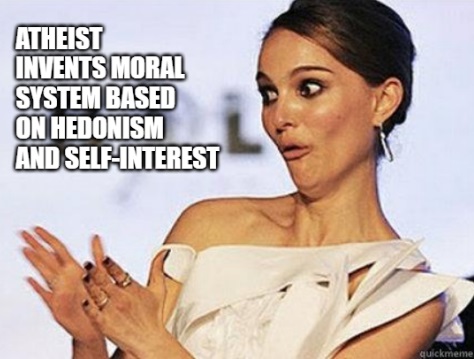
Memes

Atheist Morality
Atheist Morality

References

How the discovery of the cosmic microwave background radiation falsified atheism by Wintery Knight

How the WMAP satellite confirmed nucleosynthesis predictions and falsified atheism by Wintery Knight

Robin Collins lectures on the fine-tuning argument at Pepperdine University

Can We Be Good without God? by William Lane Craig

Reasons for Divine Commands by William Lane Craig (David Baggett’s article on Divine Command Theory)

Seven Reasons Why Moral Apologetics Points to Christianity by David Baggett

C. Stephen Evans on Accountability and Obligations in Christian Theism (YouTube video)

Can Atheists Rationally Ground Objective Moral Values and Duties? by Wintery Knight

Making Sense of Morality: Wielenberg’s Naturalistic Ethics by R. Scott Smith (Platonism)

Highlights From Debate with Erik Wielenberg. Part One by William Lane Craig

Highlights From Debate with Erik Wielenberg. Part Two by William Lane Craig

Utilitarianism and the Moral Life by J. P. Moreland (Utilitarianism)

To Defend Marriage, We Should Learn a Lesson From Apolgoetics by Jay Richards (PDF)

Mark D. Linville: does Darwinian evolution make morality rational?

God, Naturalism, and the Foundations of Morality by Paul Copan (PDF)

William Wilberforce and Abolishing the Slave Trade: How True Christian Values Ended Support of Slavery by Rusty Wright

The seven fatal flaws of moral relativism by Wintery Knight

William Lane Craig lectures on the moral argument at Georgia Tech

What useful things can Christians learn by studying metaphysics?

Stealing from God: Why Atheists Need God to Make Their Case by Frank Turek

Why Should I Be Moral? by Kai Nielsen (an atheist philosopher)

What was sexual behavior like in the Roman empire, before Christianity took over? by Wintery Knight

Accused sex trafficker Jeffrey Epstein was a major Democratic donor by The Blaze

Harvey Weinstein Has Donated Nearly $600,000 to Democrats by the Washington Free Beacon

The Complete Atheist’s Guide to Rationally Grounding Objective Morality on Atheism by Wintery Knight

Was Stalin an atheist? Is atheism or communism responsible for mass murders? by Wintery Knight

90 Atheist Quotes that All Christians and Atheists Should Read by James Bishop

What got me started on apologetics? William Lane Craig debate transcripts by Wintery Knight (debates on atheism and morality)

Podcast RSS feed:

https://feed.podbean.com/knightandrose/feed.xml

You can use this to subscribe to the podcast from your phone or tablet. I use the open-source AntennaPod app on my Android phone.

Podcast channel pages:

Video channel pages:

Music attribution:

Strength Of The Titans by Kevin MacLeod
Link: https://incompetech.filmmusic.io/song/5744-strength-of-the-titans
License: https://filmmusic.io/standard-license