All posts by Wintery Knight

https://winteryknight.com/

Wayne Grudem explains what the Bible says about spending, saving and charity

A practical lecture on money – spending, saving, charitable giving – from famous pastor Wayne Grudem.

I like the way that Wayne Grudem navigates the Bible finding the passages that tell you who God is, so that you can make better decisions by analyzing alternatives and choosing the one that gives your Boss a maximum return on investment. He’s very practical.

The MP3 file is here.

The PDF outline is here.

Spending:

  • Christianity does not teach asceticism (= don’t enjoy anything in this world), Paul condemns it in 1 Timothy 4:1-5
  • When you buy nice things, even if it is a little more expensive, it’s an opportunity to be thankful for nice things that God has provided
  • Even being rich is OK, but don’t let it make you haughty and arrogant, and don’t set your hopes on your money (see 1 Tim 6:17)
  • It is important for you to earn money, and you are supposed to use it to support yourself and be independent
  • It is possible to overspend and live recklessly (Luke 15:13) and it’s also possible to overspend and live too luxuriously
  • Increasing your income through career progression is wise, because it allows you to give away more and save more
  • God gives us freedom to decide how much we spend, how much we give away, and how much we save
  • every choice a Christian makes with money will give him or her more or less reward in his or her afterlife
  • Do not spend more than you have – you should make every effort to get out of debt as quickly as possible

Saving:

  • Saving money is wise so you can help yourself and others, and have money in your old age when you will not be working
  • If you do not save your own money, you end up being dependent on others (e.g. – family or taxpayers)
  • Not saving money for the future is a way of “putting God to the test” (Matt 4:7)
  • You are to “be dependent on no one”, to the extent that you can (1 Thes 4:12)
  • We don’t know the future, that’s why we should prepare for an emergency, and buy insurance to guard (James 4:13-17)
  • It’s right for us to learn how to save to be able to buy bigger assets, like a car or a college education
  • Saving and investing in stocks and bonds lets people in business start and grow companies, creating jobs and new products
  • Don’t over-save, trusting too much in money more than you trust in God (Ps 62.10; Matt 6:19,24; Luke 12:15-21)

Giving:

  • it is required for the people of God to give something out of what they earn, but no percentage is specified (Deut 26:12-13)
  • you do not give money to become right with God, you can’t earn your salvation
  • a Christian gives to show God that you trust him to take care of you, and to experience trusting him through your giving
  • the quality of your resurrection life with God is affected by giving you do for the Kingdom (Phil 4, Matt 6:19-21; 1 Tim 6:18-19)
  • when you get involved in the lives of others and give to them, you have the joy of experiencing caring for others (Acts 20:35)
  • it’s possible to give too little, but it’s also possible to give too much – be careful about pride creeping in as well

The first part of this lecture made me think of my treat for the week, which is to get a double chicken burrito bowl after my weight lifting. It is very easy to say grace when you are hovering over a double chicken burrito bowl. It is good to have nice things especially when it makes you thankful for what you have.

I was so happy listening to this talk because he was condemning bad stewardship, which I see in a lot of young people these days. I was happy until he got to the part about trusting in your savings for your security, and then I thought – that’s what I do wrong! I save a lot but it’s not just for emergencies and to share with others, like he was saying – I want a sense of security. This was more of a temptation in my 20s than it is now in my 30s, though.

Charity should hurt

I can remember being in my first full-time job as a newly hired junior programmer when the 2001 recession struck. I would cry while signing checks to support William Lane Craig’s Reasonable Faith ministry, because I was so scared. I had no family or friends where I lived to help me if anything went wrong, and that’s been the story of my working life. If anything goes wrong, there is no backup. But it’s that experience of crying when I gave that allows me to say today “that’s when I became the man I am, that’s what a man does when he is a follower of Jesus”. If you are not doing the actions of charity, then you will not having the experience of trusting God and letting him lead you. There is more to the Christian life than just saying the right things – you have to do the right things.

Don’t follow your heart

If you’re scared about giving when you are young, then do what I did in my 20s: work 70-hour weeks, get promoted often, and save everything you earn. I volunteered every Saturday for 9 months in order to get my first white-collar part-time job when I was still in high-school. The faster you increase your savings, the easier it’s going to be to take a genuine interest in caring for the people around you. Read Phil 1 (fellowship), Phil 2 (concern for others), and Phil 4 (charity). Turn off your emotions and desires when it comes to choosing what to study and what work to do, and put Philippians into practice. Your freedom to give is very much tied to the quality of your decisions of what to study, where to work, how much you spend on entertainment, and so on. That’s why you need to turn off your feelings and desires and do what works, even it it’s not fun, and even if it involves responsibilities, expectations and obligations.

Knight and Rose Show – Episode 19: The Historical Reliability of the Gospels

Welcome to episode 19 of the Knight and Rose podcast! In this episode, Wintery Knight and Desert Rose discuss the historical reliability of the four Gospels – four ancient biographies about the life of Jesus. If you like this episode, please subscribe to the podcast, and subscribe to our YouTube channel. We would appreciate it if you left us a 5-star review on Apple Podcasts or Spotify.

Podcast description:

Christian apologists Wintery Knight and Desert Rose discuss apologetics, policy, culture, relationships, and more. Each episode equips you with evidence you can use to boldly engage anyone, anywhere. We train our listeners to become Christian secret agents. Action and adventure guaranteed. 30-45 minutes per episode. New episode every week.

Episode 19:

Episode  Summary:

Wintery Knight and Desert Rose discuss several lines of evidences supporting the historical reliability of the four Gospels, for example: consistency with contemporary non-Christian sources, name disambiguation, undesigned coincidences, confirmation of historical details, etc. We also discuss whether miracles are possible. Finally, we recommend resources on Gospel reliability for all skill levels.

Speaker biographies

Wintery Knight is a black legal immigrant. He is a senior software engineer by day, and an amateur Christian apologist by night. He has been blogging at winteryknight.com since January of 2009, covering news, policy and Christian worldview issues.

Desert Rose did her undergraduate degree in public policy, and then worked for a conservative Washington lobbyist organization. She also has a graduate degree from a prestigious evangelical seminary. She is active in Christian apologetics as a speaker, author, and teacher.

Notes:

I accidently said that the expression “clear as spiderwebs” is from Shakespeare, but it’s actually a line from Cyrano de Bergerac. I feel bad for getting this wrong! Bad WK.

Recommended resources:

Beginner:

Intermediate

Advanced:

Podcast RSS feed:

https://feed.podbean.com/knightandrose/feed.xml

You can use this to subscribe to the podcast from your phone or tablet. I use the open-source AntennaPod app on my Android phone.

Podcast channel pages:

Video channel pages:

Music attribution:

Strength Of The Titans by Kevin MacLeod
Link: https://incompetech.filmmusic.io/song/5744-strength-of-the-titans
License: https://filmmusic.io/standard-license

New survey of 20 studies about breast cancer – abortion link

I’ve blogged about a half-dozen studies from different countries on the link between abortion and breast cancer. It’s always interesting to keep up with the research, so we know what to tell young people about the likely consequences of their choices with sex and abortion. The survey was reported by Life News.

Excerpt:

In 2018, the Breast Cancer Prevention Institute funded and published “Induced Abortion as an Independent Risk Factor for Breast Cancer: A Systematic Review and Meta-analysis of Studies on South Asian Women” in Issues in Law and Medicine. (A meta-analysis looks at separate but similar studies in order to use the pooled data for statistical significance. It is regarded by scientists as very strong evidence.)

Of the 20 studies analyzed, 16 were done on Indian women. The meta-analysis found a 151% increased risk of breast cancer after an induced abortion.

In 2014, “Breast Cancer and Induced Abortion,” an analysis also published in Issues in Law and Medicine, revealed that the incidence of breast cancers increased 10-14 years after an abortion. This analysis was consistent with the known biology of breast cancer. There was no statistically significant increase in breast cancer risk before 10 years and after 14 years of an abortion.

Induced abortion in India, referred to as “Medical Termination of Pregnancy,” was legalized in 1971. Sons are most highly prized and sex selection abortions, although illegal, are not uncommon.

A study published in the Lancet 2006 and based on conservative assumptions, reported that the practice of sex-selection accounts for about a half million missing female births yearly. Over the past two decades this translates into the abortion of some 10 million female fetuses.

Abortion is especially a problem for Indian women, because – as in China – India is very pro-abortion. Both India and China have a very pro-abortion culture, and sex-selection abortion is seen as normal.

Here are a couple of studies that focused on China and Chinese women who choose abortion.

Study 1: (September 2010)

Based on the expression of estrogen receptor (ER), progesterone receptor (PR) and HER2/neu (HER2), breast cancer is classified into several subtypes: luminal A (ER+ and/or PR+, HER2-), luminal B (ER+ and/or PR+, HER2+), HER2-overexpressing (ER-, PR-, and HER2+) and triple-negative (ER-, PR-, and HER2-). The aim of this case-control study is to determine reproductive factors associated with breast cancer subtypes in Chinese women. A total of 1,417 patients diagnosed with breast cancer in the First Affiliated Hospital, China Medical University, Shenyang, China between 2001 and 2009 and 1,587 matched controls without a prior breast cancer were enrolled.

[…]Postmenopause and spontaneous abortion were inversely associated with the risk of luminal tumors. By contrast, multiparity, family history of breast cancer and induced abortion increased the risk of breast cancer.

Study 2: (March 2010)

OBJECTIVE: To explore the risk factors of breast cancer for better control and prevention of the malignancy.

METHODS: The clinical data of 232 patients with pathologically established breast cancer were investigated in this 1:1 case-control study to identify the risk factors of breast cancer.

RESULTS: The history of benign breast diseases, family history of carcinoma andmultiple abortions were the statistically significant risk factors of breast cancer, while breast feeding was the protective factor.

CONCLUSION: A history of benign breast diseases, family history of carcinoma and multiple abortions are all risk factors of breast cancer.

Those are both about abortion and breast cancer in China.

And more recently, I blogged about a very recent study from China which concluded thus:

IA is significantly associated with an increased risk of breast cancer among Chinese females, and the risk of breast cancer increases as the number of IA increases. If IA were to be confirmed as a risk factor for breast cancer, high rates of IA in China may contribute to increasing breast cancer rates.

The effect seems to be most observable for women who have induced abortions before ever completing a pregnancy.

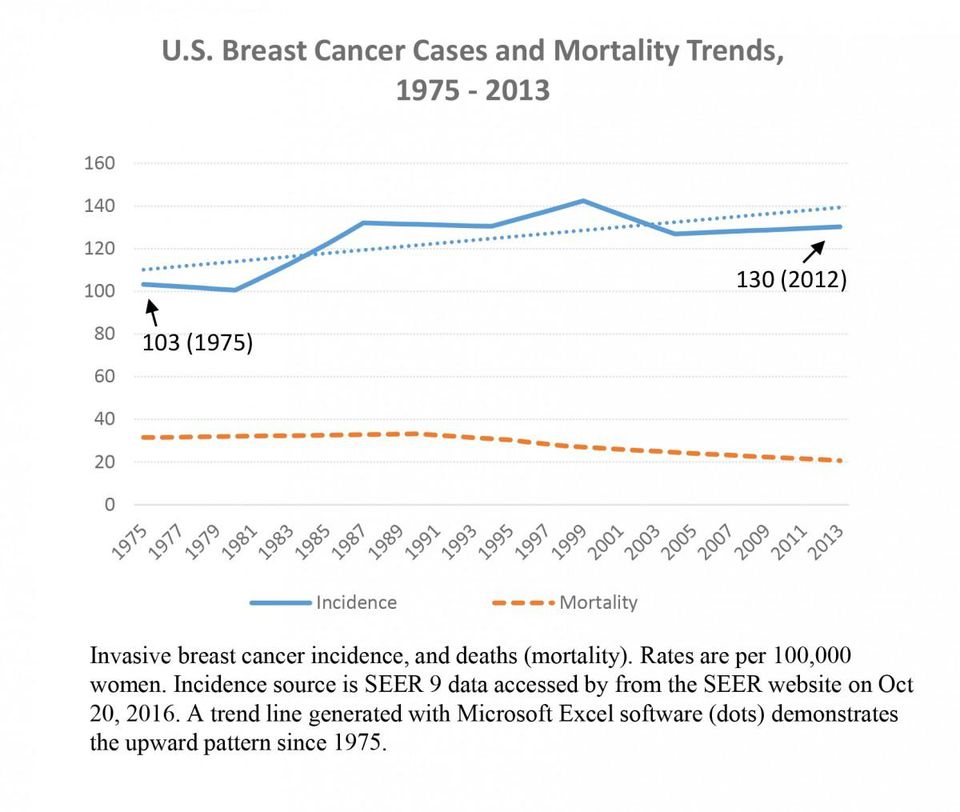
Even though the United States has massively focused on breast cancer screening and treatment, (in contrast to other cancers, such as prostate cancer), the rate of breast cancer has not declined:

Despite much attention and funding, breast cancer rates rising
Breast cancer rates have been rising since abortion was legalized

(Source)

We have so much attention on breast cancer in the West. Many charities raising money for it. Policy changes to promote early testing. Taxpayer money being spent to stop it. And yet the rate has not gone down. It started going up right around the time abortion became legal.