I started watching this speech fully expecting that I would not be posting it. But by the end of the speech, I was really excited to post it!
Here’s the speech she delivered in Iowa last Friday. (H/T Shane from Caffeinated Thoughts)
And here’s the Q&A period after the speech:
Given the quality of the speech, I think you’re likely to see something like it in her response to Obama’s State of the Union speech, which will be broadcast after Paul Ryan’s official response.
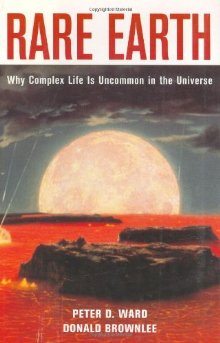
It’s the thesis of a recent book written by two scientists at the University of Washington.
Here’s the blurb:
What determines whether complex life will arise on a planet? How frequent is life in the Universe?
In this exciting new book, distinguished paleontologist Peter D. Ward and noted astronomer Donald Brownlee team up to give us a fascinating synthesis of what’s now known about the rise of life on Earth and how it sheds light on possibilities for organic life forms elsewhere in the Universe.
Life, Ward and Brownlee assert, is paradoxically both very common and almost nowhere. The conditions that foster the beginnings of life in our galaxy are plentiful. But contrary to the usual assumption that if alien life exists, it’s bound to be intelligent, the authors contend that the kind of complex life we find on Earth is unlikely to exist anywhere else; indeed it is probably unique to our planet.
With broad expertise and wonderful descriptive imagery, the authors give us a compelling argument, a splendid introduction to the emerging field of astrobiology, and a lively discussion of the remarkable findings that are being generated by new research. We learn not only about the extraordinary creatures living in conditions once though inimical to life and the latest evidence of early life on Earth, but also about the discoveries of extrasolar planets, the parts Jupiter and the Moon have played in our survival, and even the crucial role of continental drift in our existence.
Insightful, well-written, and at the cutting edge of modern scientific investigation, Rare Earth should interest anyone who wants to know about life elsewhere and gain a fresh perspective on life at home which, if the authors are right, is even more precious than we may ever have imagined.
And here’s a review by Library Journal:
“Renowned paleontologist Ward (Univ. of Washington), who has authored numerous books and articles, and Brownlee, a noted astronomer who has also researched extraterrestrial materials, combine their interests, research, and collaborative thoughts to present a startling new hypothesis: bacterial life forms may be in many galaxies, but complex life forms, like those that have evolved on Earth, are rare in the universe. Ward and Brownlee attribute Earth’s evolutionary achievements to the following critical factors: our optimal distance from the sun, the positive effects of the moon’s gravity on our climate, plate tectonics and continental drift, the right types of metals and elements, ample liquid water, maintainance of the correct amount of internal heat to keep surface temperatures within a habitable range, and a gaseous planet the size of Jupiter to shield Earth from catastrophic meteoric bombardment. Arguing that complex life is a rare event in the universe, this compelling book magnifies the significance — and tragedy — of species extinction. Highly recommended for all public and academic libraries.”
Note that Peter Ward is a militant atheist (he has debated against Stephen C. Meyer), and Donald Brownlee is an agnostic. These are not Christians, nor are they even theists. However, I have the book, I have read the book, and I recommend the book. I usually have this book on my shelf at work for show-and-tell.
Now for the latest news about the hypothesis of the book. (H/T Brian Auten of Apologetics 315)
There are always going to be optimistic predictions by scientists who need to attract research funding, but those are hopes and speculations. The data we have today says Earth is rare. The number of conditions required for complex life of any kind is too high for us to be optimistic about alien life in this galaxy, at least. And as the number of requirements for life roll in, the odds of finding alien life that can contact us get slimmer and slimmer.
Dr Howard Smith, a senior astrophysicist at Harvard University, believes there is very little hope of discovering aliens and, even if we did, it would be almost impossible to make contact.
So far astronomers have discovered a total of 500 planets in distant solar systems – known as extrasolar systems – although they believe billions of others exist.
But Dr Smith points out that many of these planets are either too close to their sun or too far away, meaning their surface temperatures are so extreme they could not support life.
Others have unusual orbits which cause vast temperature variations making it impossible for water to exist as a liquid – an essential element for life.
Dr Smith said: ‘We have found that most other planets and solar systems are wildly different from our own.
‘They are very hostile to life as we know it.’
‘The new information we are getting suggests we could effectively be alone in the universe.
‘There are very few solar systems or planets like ours. It means it is highly unlikely there are any planets with intelligent life close enough for us to make contact.’ But his controversial suggestions contradict other leading scientists – who have claimed aliens almost certainly exist.
These arguments are actually quite useful, and I include them in my standard list of scientific arguments for theism. (See below) You have to know this stuff cold. Most people believe in aliens because they watched movies made by artists. As a result, they think that humans are nothing special and that God is not interested in us in particular. Which is very convenient for them, because it means they can do whatever they want and not care what God thinks about what they are doing. If you want to defend against the idea that humans are nothing special, and that we were not placed here for a purpose, and that we are not accountable and obligated to seek and know the Creator/Designer, then you’ll need more than feelings. You’ll need science. You’ll need the best science available.
Republican Congressman Paul Davis Ryan has represented Wisconsin’s first House district since 1999, and in his sixth term he began to emerge as the new face of the Republican Party. Despite the heavily Democratic demographic of his home district, Ryan ran as a conservative in 1998 and won, beating the Democratic favorite by 15 percentage points. Before running for Congress, Ryan worked for several conservatives, including Sen. Sam Brownback and former housing secretary Jack Kemp. In 2009, Ryan offered conservative alternatives to both the 2010 Democratic Budget and Obama’s health care reform plan.
Early Life:
Paul Ryan was born Jan. 29, 1970 in Janesville, Rock County, Wisc., the youngest of Paul Sr. and Betty Ryan’s four children. He was raised Catholic. Sharing the same first name as his father, Ryan’s childhood nickname was “P.D.” Ryan attended Joseph A. Craig High School, and between his sophomore and junior year, his father died (Ryan was just 16). His father’s death provided Ryan with Social Security benefits until his 18th birthday, which he used to pay for his education at Miami University of Ohio. Ryan, a member of the Delta Tau Delta fraternity, graduated in 1992 with a degree in economics and political science.
Congressional Races:
When Republican House Rep. Mike Neumann announced he was running for Senate, Ryan decided to run for Wisconsin’s first House District, which Neumann was vacating. Although the district is predominantly Democratic, Ryan, a conservative Republican, was also a home-grown fifth-generation resident of Janesville. Ryan first faced 35-year-old beer distributor Brian Morello in the Republican primary and after beating him went on to a 15-point victory over Democrat Lydia Spottswood in the general election. For the next four races, Ryan would defeat Democrat Jeffrey C. Thomas. In 2008, he defeated Democrat Marge Krupp.
Work as Congressman:
One of the first things Ryan did as a Congressman was to convert an old truck into an office so he could hold office hours in the far reaches of his district. As a ranking Member of the Committee on the Budget, Ryan introduced HR 6110, “A Roadmap for America’s Future” a comprehensive proposal that tackles the interrelated crises in health care, Medicare, Medicaid, Social Security, the tax code and the national deficit. In 2009, he joined other House leaders in introducing an alternative to President Barack Obama’s budget proposal for 2010.
Family:
Spending a large amount of his time serving his constituents in Washington, Ryan met tax attorney Janna Little, who lived in Arlington, Va. An Oklahoma native, Little graduated from Wellesley College and George Washington University Law School. In 2000, Ryan asked Little to marry him at Big St. Germain Lake in northern Wisconsin, one of his favorite fishing spots. The couple was married in Oklahoma City in December 2000. They have one daughter, Elizabeth and two sons, Charles and Samuel, in Janesville.
Ryan on Five Major Issues:
Abortion: Has a 100 percent voting record with the National Right to Life Committee. Voted against allowing embryonic stem cell research. Voted against the transportation of minors across state lines for abortions. Voted against partial birth abortions except to save a mother’s life.
Immigration: Voted in favor of building a fence along the Mexican border. Voted in favor of extending Immigrant Residency rules. Voted in favor of comprehensive immigration reform without amnesty.
Civil Rights: Voted in favor of prohibiting job discrimination based on sexual orientation. Voted to protect the pledge of allegiance. Has expressed support for an amendment to ban flag desecration.
Families: Voted to ban gay adoptions in Washington. Voted to constitutionally define marriage as between one man and one woman. Voted to reduce the Marriage Tax by $399 billion over 10 years. Voted to establish a nationwide AMBER alert system for missing children.
Gun Control: Has an “A” rating by the National Rifle Association. In 1999, he voted to decrease gun waiting periods from three days to one. Voted to prevent gun makers, gun manufacturers and gun sellers from being sued for gun misuse.
Elected in 2006, Congresswoman Michele Bachmann is the first Republican woman to be elected to the U.S. House of Representatives from Minnesota. In only her first term, Congresswoman Bachmann developed a reputation as a “principled reformer” who stays true to her conservative beliefs while pushing for real reform of the broken ways of Washington. And, her strong advocacy for her constituents earned her a second term in Congress in November 2008.
She is a leading advocate for bipartisan earmark reform and tax relief and is a staunch opponent of wasteful government spending. She is among the leaders in the U.S. House pushing for increased energy exploration in the U.S. to provide much needed relief at the pump for hard-working Americans and put our nation on the path to energy independence.
Prior to serving in the U.S. Congress, Bachmann served in the Minnesota State Senate. She was elected to the Minnesota State Senate in 2000 where she championed the Taxpayers Bill of Rights. And, prior to that, Bachmann spent five years as a federal tax litigation attorney, working on hundreds of civil and criminal cases. That experience solidified Bachmann’s strong support for efforts to simplify the Tax Code and reduce tax burdens on family and small business budgets.
Congresswoman Bachmann currently sits on the Financial Services Committee. This committee is tasked with the oversight of numerous financial sectors including housing, real estate and banking. This also gives the Congresswoman keen insight into the housing crisis and credit crunch, leading her to be a staunch opponent of the taxpayer-funded bailout of Wall Street. The 6th Congressional District of Minnesota contains parts of six counties, stretching from Stillwater past St. Cloud, including suburbs of the Twin Cities, which encompasses one of the nation’s largest financial services sectors, making Congresswoman Bachmann’s position on the Financial Services Committee particularly important.
Congresswoman Bachmann is a graduate of Anoka High School and Winona State University. Bachmann and her husband, Marcus, live in Stillwater where they own a small business mental health care practice that employs 42 people. The Bachmanns have five children, Lucas, Harrison, Elisa, Caroline, and Sophia. In addition, the Bachmanns have opened their home to 23 foster children, which has inspired Congresswoman Bachmann to become one of Congress’ leading advocates for foster and adopted children, earning her bipartisan praise for her efforts.
Here is a collection of news stories about Representative Michele Bachmann: