All posts by Wintery Knight

https://winteryknight.com/

Bible study: what difference does the resurrection of Jesus make?

Bible study that hits the spot

Here’s an article from Bible.org, written by famous New Testament manuscript expert Dan Wallace. (H/T Eric Chabot, Ratio Christi OSU)

There is a lot in this article, but I’ll just snip out one that I think is interesting.

First, what does the Old Testament say about the doctrine of the resurrection in Judaism?

The resurrection of the dead was not plainly revealed in the OT until very late in salvation history. It was not until the Jews were taken in captivity, in the sixth century BC, that this was clearly articulated. Daniel 12:1-2 is the principal text: it speaks of the resurrection of both the righteous and the unrighteous:

At that time shall arise Michael, the great prince who has charge of your people. And there shall be a time of trouble, such as never has been since there was a nation till that time; but at that time your people shall be delivered, every one whose name shall be found written in the book. And many of those who sleep in the dust of the earth shall awake, some to everlasting life, and some to shame and everlasting contempt. (RSV)

Why was it not clearly revealed till then? It was not revealed until there was a felt need for it. When the Jews had no present (because of the captivity) they had to look to the future. The revelation of the resurrection came at precisely the time when the people of God needed hope for the future.

What is significant about this is how masterful are God’s insights into human nature. In the NT era, one religious group in Palestine did not embrace the resurrection as a true doctrine: the Sadducees (cf. Mark 12:18)–that is why they were “sad, you see!” The Sadducees were in charge of the temple. They derived their income from the sacrifices. In a sense, they were the precursors to modern TV evangelists. They had it good! They were the rich aristocracy that ran the place.

Those who have it good in this life don’t often long for the next. The Sadducees illustrate this. The resurrection is a truth especially precious to those who are poor and those who are hopeless. It is precious to those who long for heaven enough that earth holds no sway over them.

This means something to me. I didn’t grow up with parents who had any plan for me. I had to figure out what I was supposed to be doing with my life on my own, because they were both too busy doing their own things. This is true even to this day. After I became a Christian, there were many things that I wanted to achieve in this life. But for a variety of reasons, those most of those things never happened. I wanted to do great things for God, like getting married, having a family, getting a PhD and teaching computer science in a secular university. But things that I had intended to do for God just didn’t happen the way I had hoped.

I often find myself thinking of Heaven, and having that eternal perspective on this life. One of the things that is the hardest to accept is that being a Christian makes many things I’d like to do a lot harder. It certainly didn’t open any doors at school, or now, at work. I’m glad my salvation doesn’t depend on achieving anything in particular. And I’m especially glad that my salvation doesn’t depend on what anyone thinks of me. I find it almost impossible in this culture to get any respect by doing the things that I think are really important.

I think if a person were really successful at what they tried to do, then it would be really hard for them to give up living and go to be with Jesus. That’s not a problem for me, though. If fact, if the resurrection were not true, then I wouldn’t be able to say that my life was a very good life, measuring success the way people do.

The resurrection teaches correct apologetics methodology

Did you know that Jesus provided the resurrection as evidence for those who were skeptical of his claims to be God stepping into history?

Here’s an article from Got Questions? on the “Sign of Jonah”, which appears in the gospels of Matthew and Luke.

It says:

The phrase “sign of Jonah” was used by Jesus as a typological metaphor for His future crucifixion, burial, and resurrection. Jesus answered with this expression when asked by the Pharisees for miraculous proof the He was indeed the Messiah. The Pharisees remained unconvinced of Jesus’ claims about Himself, despite His having just cured a demon-possessed man who was both blind and mute. Shortly after the Pharisees accused Jesus of driving out demons by the power of Satan, they said to Him, “Teacher, we want to see a sign from you.” He answered, “A wicked and adulterous generation asks for a sign! But none will be given it except the sign of the prophet Jonah. For as Jonah was three days and three nights in the belly of a huge fish, so the Son of Man will be three days and three nights in the heart of the earth. The men of Nineveh will stand up at the judgment with this generation and condemn it; for they repented at the preaching of Jonah, and now something greater than Jonah is here” (Matthew 12:38–41).

To fully appreciate the answer that Jesus gave, we must go to the Old Testament book of Jonah. In its first chapter, we read that God commanded the prophet Jonah to go to the city of Nineveh and warn its people that He was going to destroy it for its wickedness. Jonah disobediently ran from the Lord and headed for the city of Tarshish by boat. The Lord then sent a severe storm that caused the crew of the ship to fear for their lives. Jonah was soon thrown overboard and swallowed by a great fish where he remained for “three days and three nights” (Jonah 1:15–17). After the three-day period, the Lord caused the great fish to vomit Jonah out onto dry land (Jonah 2:10).

It is this three days that Jesus was referring to when He spoke of the sign of Jonah.

I often bring up the Sign of Jonah when I am dealing with Christians who don’t want to learn how to explain their faith to non-Christians persuasively. I’m glad that story is in there!

The resurrection is a very important part of the life of the Christian. I argued in this post that it makes a difference to your feelings about your own life, and it makes a difference to your case-making with non-Christians.

If you could rescue EITHER embryos OR a 5-year-old, what would you do?

I'm Scheming Unborn Baby, and I approve this study
I’m Scheming Unborn Baby, and I approve this message

I overheard Ben Shapiro talking about some pro-abortion tweet that went viral on Twitter. Basically, the snarky pro-abortion person tried to make the case that unborn children don’t deserve legal protections because people have a moral intuition to save a 5-year-old instead of an embryo, if they can only choose one. The best response to this dilemma comes from Robert George, professor at Princeton University and Christopher Tollefsen.

Their article was posted at The Public Discourse.

Excerpt:

We agree that considering the case as described by Sandel, most people in Jones’s circumstances would choose to rescue the girl. However, this by no means shows that human embryos are not human beings or that they may be deliberately killed to produce stem cells, or in an abortion.

The first thing to notice is that the case as described is not, in fact, analogous to the suggestion that we should perform embryo-destructive research for the benefits it might provide us, or to the suggestion that it is permissible to abort an unborn human being. In both such cases, we are being invited to kill, or authorize the killing of, human embryos or fetuses in order to provide benefits to others. But in the fire scenario, there is no killing; the deaths of the embryos who are lost when Jones opts to save the girl are not killings—no one is acting to destroy the embryos or cause their deaths—but rather are the kind of death we accept as side effects in various cases in which, for example, acting to save one or some persons means that we are unable to save another or others.

Second, there are differences between the embryos and the five-year-old girl that are or can be morally relevant to the decision concerning whom to rescue. For example, the five-year-old will suffer great terror and pain in the fire, but the embryos will not. Moreover, the family of the five-year-old presumably loves her and has developed bonds of attachment and affection with her that will mean much greater grief in the event of her death than in the event of the death of the embryos. While these concerns would not justify killing, they can play a legitimate role in determining how we may allocate scarce resources and, in some cases, whom we may or should rescue. Often, the (or at least a) morally correct decision cannot be made just on the numbers—a point that even utilitarians are willing to acknowledge. And so, for example, it is morally relevant in some cases where choices of whom to rescue must be made that a person we could save is (for example) our own son or daughter, even if saving him or her means that we cannot save, say, three of our neighbors’ children who end up perishing in the fire from which we saved our own child.

The analogy, like Judith Jarvis Thomson’s violin analogy, completely ignores the fact that in a pregnancy, the baby is created as a result of the decisions of the mother and the father of the baby. This is not some stranger, this is their child. And in the case of abortion, it’s not being done to save a 5-year-old. I once heard of a case where a woman killed her unborn child so she wouldn’t look fat on the beach, during her vacation. Hardly a morally sufficient reason.

I really liked this:

The possibility that resources might be used and even, perhaps, lives risked to save the frozen embryos calls to mind the story with which we began our book Embryo: A Defense of Human Life. In 2005, in the aftermath of Hurricane Katrina, a police crew in New Orleans did save a canister of fourteen hundred human embryos from a hospital. Our book began with Noah, one of those embryos, who sixteen months later emerged, via Caesarean section, into the light of the world and his parents’ love. But if those officers had never made it to Noah’s hospital, or if they had abandoned those canisters of liquid nitrogen, the toll of Katrina would have been fourteen hundred human beings higher than it already was, and Noah, sadly, would have perished before having the opportunity to meet his loving family.

The harm of abortion is exactly like the harm of murder in general… each act deprives a person of all of their future. And this against the victim’s will, and without adequate moral justification.

An embryo has a unique genetic signature different from his mother, different from his father. He is a different person, and, if given shelter and food, he will grow up just like any of us do. Is it such a terrible thing to give food and shelter to another human being, that was created as a direct result of the choices of grown-ups? We don’t get to resort to murder of others just in order to make our own lives easier, do we?

Labor unions donated $765 million between 2012 and 2016, and 99% went to left-wing groups

Political contributions by the American Federation of Teachers union

Astonishing article from the Daily Signal.

Excerpt:

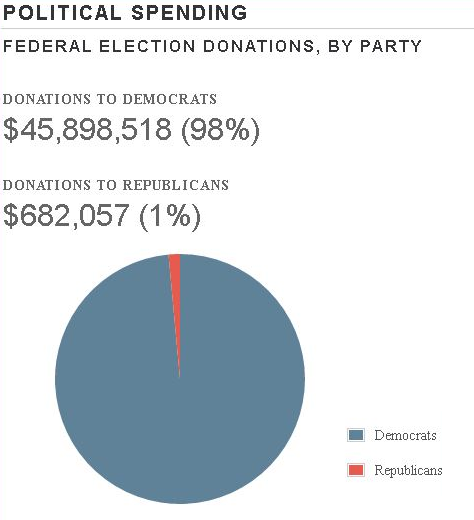
Unions across the country donated $765 million to various organizations over the last four years, and 99 percent of that cash went to liberal-leaning causes.

Labor unions gave $764,952,394 to left-wing special interests between 2012 and 2016, according to the Center for Union Facts. Of the nearly $765 million, 99 percent of union political contributions went to left-wing causes. The Center for Union Facts compiled a comprehensive database of information about labor unions in the United States: outlining union spending, salary information, dues revenue data, and more using data from the U.S. Department of Labor.

Examples of who gets the money:

The department’s data show between 2012 and 2016, roughly $240 million went to left-wing political groups. Labor unions gave $77 million to special-interest groups and another $13 million to environmental groups. Over $25 million went to groups like the Coalition of Black Trade Unionists, the National Association for the Advancement of Colored People, and the Rainbow PUSH Coalition.

During this same time frame, almost $307 million went to the Democratic Party and aligned groups, including Media Matters, the Clinton Foundation, Mi Familia Vota, the National Democratic Club, the Advocacy Fund, Progressive Democrats of America, and Planned Parenthood.

[…]Here’s how much a few pro-abortion groups received from labor unions since 2007, according to Luka Ladan, communications director for the Center for Union Facts:

  • Planned Parenthood: $1.18 million
  • Emily’s List: $810,000
  • NARAL Pro-Choice America: $45,000

Examples of who gives the money:

Here are the dollar amounts since 2007 that a few labor unions have given for abortion lobby funding:

  • American Federation of Teachers: $1,150,000
  • American Federation of State, County, and Municipal Employees: $520,100
  • International Association of Firefighters: $10,000
  • Service Employees International Union: $180,000
  • United Association: $40,000
  • United Auto Workers: $100,000
  • United Food and Commercial Workers International Union: $35,000

Teachers, non-import auto workers, government employees. All pro-abortion. I never buy cars made by union employees, I’d just be funding abortionists.

I think there was a time in America’s history where unions were actually doing some good, but that time has long gone. We can’t allow labor unions to take the country in the direction of Greece and Venezuela, otherwise none of us will have jobs, and we’ll be selling our bodies for food, like they do in other communist countries. I would like to see some legislation banning public sector unions outright, and then a national right to work law should finish off the private sector unions, since rank-and-file private sector union workers are typical not radical leftists. We definitely need a national voucher law to get the money out of the public schools and back into the hands of parents.

Whenever well-meaning people vote for more taxpayer more for union-dominated fields like education, keep in mind that a  significant portion of this money gets funneled back into anti-American causes. Be careful about wanting to spending more taxpayer money “for the children”, because it often turns out to just be more taxpayer money for the Planned Parenthood, or for the Clinton Foundation, etc.