New study: “Medicare For All” would cost $32.6 trillion, but it’s actually more

A Christian friend of mine who is divorced with children surprised me by telling me that she favored single payer health-care. I asked her if she realized that people would have to be taxed to pay for all this free health care, and she seemed to be aware of it. But even I didn’t realize how much it would really cost.

Investor’s Business Daily reports on a couple of recent studies – one from the left, and one from the far-left – that both agreed on the price tag for universal health care.

Excerpt:

Last year, 16 Senators, including three presidential hopefuls, co-sponsored Sanders’ “Medicare for all” bill. And earlier this month, more than 70 Democrats signed on to form a “Medicare for all” caucus. Support for the bill is now something of a litmus test for Democratic hopefuls.

Do they have any idea what they’re endorsing?

A new study out Monday from George Mason University’s Mercatus Center finds that Sanders plan would add to federal spending in its first 10 years, with costs steadily rising from there. That closely matches other studies — including one by the liberal Urban Institute — that looked at Sanders’ plan.

To put this in perspective, “Medicare for all” would the size of the already bloated federal government. Doubling corporate and individual income taxes wouldn’t cover the costs.

Even this is wildly optimistic. To get to this number, author Charles Blahous had to make several completely unrealistic assumptions about savings under Sanders’ hugely disruptive plan.

The first is a massive cut in payments to providers. Sanders wants to apply Medicare’s below-market rates across the board, which would amount to a roughly 40% cut in payments to doctors and hospitals. Blahous figures this will save hundreds of billions of dollars a year.

But cuts of that magnitude would drive doctors out of medicine and hospitals out of business, since the only way providers can afford Medicare’s cut-rate reimbursements today is by charging private payers more.

The study also assumes that shoving everyone into a government health care plan would cut administrative costs by $1.6 trillion over the next decade and prescription drug costs by $846 billion. Neither of those are likely, and wouldn’t make much of a difference in overall spending anyway. Private insurance overhead accounts for about 6% of national health spending, and drugs less than 10%.

There’s also the fact that every other federal health program has seen costs explode “unexpectedly” after they were enacted. The per-enrollee cost of ObamaCare’s Medicaid expansion, for example, is almost 49% higher than expected. Medicare itself cost nearly 10 times as much as projected in its first 25 years.

The author of the Mercatus study was nominated Barack Obama to be a member of the Board of Trustees of the Social Security Trust Funds. That might explain his questionable assumptions about costs. And the Urban Institute is even further to the left. There can be no doubt that the true cost of the Sanders health care plan would be much higher than what these two studies calculated it to be.

Now, you might think that we can just tax the people who earn the most money to pay for all this spending.

In 2012, John Stossel wrote this in Forbes:

If the IRS grabbed 100 percent of income over $1 million, the take would be just $616 billion.

In 2011, the Tax Foundation explained that even if you taxed ALL THE DISPOSABLE INCOME from all the people who make $200,000 or more, you would only raise $1.53 trillion dollars:

There’s simply not enough wealth in the community of the rich to erase this country’s problems by waving some magic tax wand.

[…]After everyone making more than $200,000/year has paid taxes, the IRS would need to take every single penny of disposable income they have left. Such an act would raise approximately $1.53 trillion. It may be economically ruinous, but at least this proposal would actually solve the problem.

Taxing the rich isn’t enough to pay for single payer health care. $32.6 trillion over 10 years works out to $3.26 trillion per year. We’re not going to pay that off even with $1.53 trillion a year of additional revenue. And this is assuming that the wealthy would just allow themselves to be made into slaves, and keep working even if the government takes all their money.
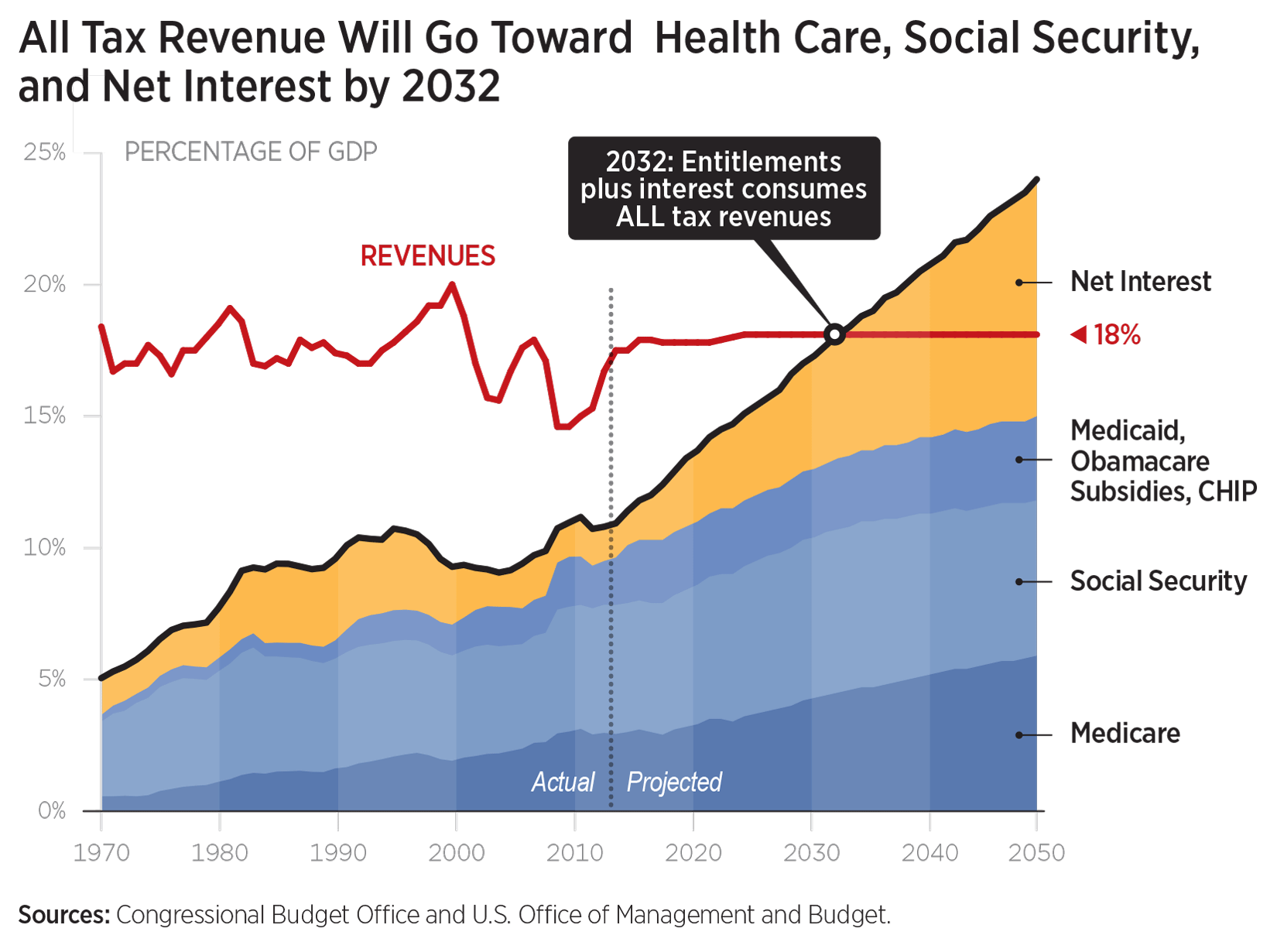
Pretty soon, our mandatory expenses will consume all of our tax revenues

Who is going to pay for all the spending we already have scheduled? As the graph above shows, things are going to get worse in the future as the big entitlement programs pay out more than current tax rates take in. I’m sure glad that I’m going to be retiring before 2032, and I’m not going to be stuck with the bill for this. It’s one thing for me to get out of bed every morning to be paid only 75% of what I earn. I certainly wouldn’t want to be working if the tax rates here were more like Europe, so that I’d be taking home less than half of what I earn. No thank you!

By the way, it might be a good idea to think about whether you want to have children or not before you vote. Children are expensive, and if we keep electing the big spenders like Obama, then there isn’t going to be any money left over to run a family and raise kids. Think about it before you vote with your feelings only.

New study: 1 in 8 divorces is caused by student loan debt

I already mentioned the studies that show that marrying a non-virgin is less stable than marrying a virgin. But what about student loans? Are they a risk factor for divorce, too? I was reading over at Captain Capitalism and saw this CNBC article, which discusses data relevant to our recent discussion about whether men ought to prefer debt-free virgins without tattoos.

Excerpt:

When it comes to student loan debt, “for richer, for poorer” doesn’t quite cut it.

In general, finances are the leading cause of stress in a relationship, according to a study by SunTrust Bank, but student debt takes a particularly hard toll on a marriage.

More than a third of borrowers said college loans and other money factors contributed to their divorce, according to a recent report from Student Loan Hero, a website for managing education debt.

In fact, 13 percent of divorcees blame student loans specifically for ending their relationship, the report found. Student Loan Hero surveyed more than 800 divorced adults in June.

Now, when deciding whether to marry and who to marry, it does make sense to me to think about what needs to be bought and how much these things cost, and where the money will come from. It just makes sense to me that people who are REALLY interested in marriage will be interested in doing what works to prepare for marriage. You can’t just do whatever you want before marrying, because marriage involves being faithful to your spouse, and buying things that you need for the marriage enterprise, like a home, and baby stuff. It doesn’t make any sense to say “I want to get married” and then not prepare for marriage by being careful about what behavior marriage requires of you.

This 2017 article from Harvard Business Review is interesting.

It says:

Examining 46,934 resumes shared on Glassdoor by people who graduated between 2010 and 2017, the researchers looked at each person’s college major and their post-college jobs in the five years after graduation. They then estimated the median pay for each of those jobs (also using Glassdoor data) for employees with five years of experience or less. Their key finding: “Many college majors that lead to high-paying roles in tech and engineering are male dominated, while majors that lead to lower-paying roles in social sciences and liberal arts tend to be female dominated, placing men in higher-paying career pathways, on average.”

Here’s the plot, and you can click it to expand it:

Starting salaries by major, broken out by gender
Median salaries by major, broken out by gender – don’t study things at the bottom!

Maybe we can just simplify this whole issue by saying “it’s unwise to marry people who choose not to prepare themselves for marriage”. That goes for men and women, by the way. Basically, you can avoid student loans if you study something that you don’t feel like studying, and work jobs that you don’t feel like working, and don’t buy things that you feel like buying. Don’t marry people who are led by their feelings. Marry someone who demonstrates self-control.

Anyway, I feel obligated to post a relevant Dave Ramsey video, just to remind everyone that stewardship of money is a Christian virtue, and that being forgiven by Jesus for your sins doesn’t make you good with money.

This one from 2014: (H/T Robb)

When I was in high school, I was far more interested in becoming an English teacher than I was in becoming a software engineer. It was my Dad who overruled my choice of college major when I was still in high school. He had me take a first-year English course at a local university. When I saw how politicized and useless it was (they were studying all sorts of politically correct postmodern relativist stuff, instead of the Great Works, and they weren’t trying to learn any wisdom from any of it), I chose computer science. I did what was likely to work, instead of what was easy and fun and made me feel good. I think this makes me a grown-up. And marriage should only be done if there are two grown-ups involved in the enterprise.

Robert Gagnon debates gay activist Jayne Ozanne on Bible vs homosexuality

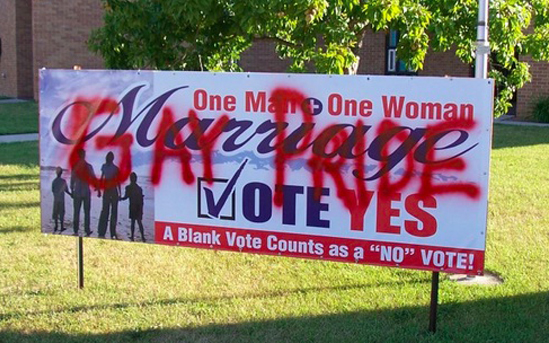
Gay activist vandalizes pro-marriage sign

I am tempted to say that this is the best podcast I have ever heard on the Unbelievable show. Do anything you have to do in order to listen to this podcast.

Details:

Prof Robert Gagnon has become a well-known voice advocating the traditional biblical view on sexuality. In a highly charged show he debates the scriptural issues on sexuality with Jayne Ozanne, the director of Accepting Evangelicals who came out as gay earlier this year.

The MP3 file is here.

If you can only listen for 15 minutes, then start at 49 minutes in and listen from there.

The following summary is rated MUP for made-up paraphrase. Reader discretion is advised.

Summary:
Intro:

  • Speaker introductions
  • Gagnon: scholars who support gay marriage agree that the Bible doesn’t support it
  • Gagnon: scholars who support gay marriage agree Jesus taught male-female marriage
  • Ozanne: I went to the hospital because I was sick from trying to suppress my gay desires
  • Ozanne: Doctors told me that I would die if I didn’t act on my gay desires
  • Ozanne: I decided to reinterpret the Bible to fit with my gay desires
  • Ozanne: According to my new interpretation, Jesus actually supports my gay desires

Segment 1: Genesis

  • Ozanne: In Genesis the Bible says that Adam needs a woman to complete him
  • Ozanne: I reinterpret this to mean that Adam needed a “complementarian human being”
  • Ozanne: Genesis doesn’t say whether Eve was complemented by Adam in that chapter
  • Ozanne: It’s not critical that men are complemented by women, a man could complement a man
  • Ozanne: Genesis 2 doesn’t talk about children, it’s all about adult needs from a relationship
  • Gagnon: Genesis 2 has never been interpreted that way in all of history
  • Gagnon: Genesis 2 language specifically implies a human being who is opposite/different
  • Gagnon: Genesis 2 language translates to complement or counterpart
  • Gagnon: Genesis as a whole teaches that the sexuality is for male and female natures
  • Gagnon: The extraction of something from the man that is given to the woman is complementarian
  • Ozanne: I think that people can be complementary outside of male-female Genesis language
  • Ozanne: I don’t want to discuss specific words and texts and Greek meanings
  • Gagnon: the text has always been read and interpreted to support male/female complementarity
  • Gagnon: the male-female nature argument is made because the two natures are complementary
  • Ozanne: the text was interpreted by patriarchal males who treated women like property, it’s biased
  • Ozanne: what is important to me is how Christ interprets Genesis (?? how does she know that?)
  • Ozanne: I am passionate about my interpretation of Scripture which supports my gay desires
  • Gagnon: just because a person is passionate about their interpretation it doesn’t make it right
  • Gagnon: I am not arguing for the male-female view based on passion, but on scholarship, evidence and history
  • Ozanne: both sides are equally passionate about their interpretations (?? so both are equally warranted?)
  • Ozanne: the real question is why God “allowed” two different interpretations of Scripture

Segment 2: Is homosexuality a sin?

  • Gagnon: Jesus affirmed traditional sexual morality, which forbids homosexuality
  • Gagnon: Jesus teaches that marriage is male-female, and limited to two people
  • Gagnon: No one in history has interpreted the Bible to say that homosexuality was not immoral
  • Ozanne: Jesus came to bring life, and that means he supports homosexuality
  • Ozanne: I was dying, and embracing my gay desires allowed me to live, so Jesus approves of me
  • Ozanne: God says “I am who I am” and that means he approves of me doing whatever I want
  • Ozanne: There is an imperative to be who I am, and that means embracing my gay desires
  • Gagnon: Jesus argued that the twoness of the sexual bond is based on the twoness of the sexes
  • Gagnon: Jesus did not come to gratify people’s innate desires, he called people to repent of sin
  • Gagnon: Jesus did reach out to sinners but he never condoned the sins they committed
  • Gagnon: Jesus’ outreach to tax collectors collecting too much and sexual sinners is the same: STOP SINNING
  • Ozanne: I don’t think that Romans 1 is talking about homosexuality
  • Ozanne: I think it’s talking about sexual addiction, not loving, committed gay relationships
  • Ozanne: Paul was condemning pederasty in Romans 1, not loving, long-term, consensual sexual relationships between gay adults
  • Gagnon: nothing in the passage limits the condemnation to pederasty
  • Gagnon: the passage was never interpreted to be limited to pederasty in history
  • Gagnon: rabbis and church fathers knew about committed two-adult same-sex relationships, and said they were wrong
  • Gagnon: the argument for marriage is based on the broad two-nature argument, with no exceptions
  • Gagnon: the condemnation is not limited to exploitative / coercive / lustful / uncommitted relationships
  • Gagnon: even pro-gay scholars agree the passage cannot be interpreted Ozanne’s way (he names two)

Segment 3: The showdown (49:00)

  • Ozanne: I don’t care how many pages people have written on this
  • Ozanne: God says that “the wisdom of the wise I will frustrate” so you can’t use scholars, even pro-gay scholars, to argue against my passionate interpretation
  • Ozanne: I am not interested in the text or history or scholarship or even pro-gay scholars who agree with you
  • Ozanne: what decides the issue for me is my mystical feelings about God’s love which makes my sexual desires moral
  • Ozanne: you are certain that this is wrong, but your view does not “give life” to people
  • Ozanne: your scholarship and historical analysis is “a message of death” that causes teenagers to commit suicide (= you are evil and a meany, Robert)
  • Ozanne: “I pray for you and your soul” (= opposing me will land you in Hell) and “I hope that listeners will listen with their hearts” (?? instead of their minds?)
  • Ozanne: you can prove anything you want with research, even two mutually exclusive conclusions, so you shouldn’t rely on scholarship and research since it could be used to prove my view as well
  • Ozanne: instead of relying on research, you should rely on your heart and your feelings about God’s love to decide what the Bible teaches about sexual morality
  • Gagnon: you are distorting the gospel in order to make your case
  • Gagnon: attacking my “certainty” is an ad hominem attack to cover your dismissmal of the scholarship and history
  • Gagnon: you distort the gospel to make it seem like Christ just wants us to get what we want, when we want it, with who we want it with
  • Gagnon: Christ calls us to take up our cross, to lose our lives and to deny ourselves
  • Gagnon: you have a notion of what “fullness of life” is, but it’s not reflective of the gospel
  • Gagnon: Paul’s life was much more troubling than yours, mine or anyone else around here
  • Gagnon: Paul was beaten, whipped, stoned, poorly sheltered, poorly clothed, poorly fed, shipwrecked, and anxious for his churches
  • Gagnon: on your view, he should have been miserable and angry with God all the time
  • Gagnon: but instead Paul was constantly thankful and rejoicing to be able to suffer with Jesus and look forward to the resurrection
  • Gagnon: I have suffered too, but the suffering we go through never provides us with a license to violate the commandments of God
  • Ozanne: “the ultimate thing is what people feel God has called them to”
  • Ozanne: My goal right now is to tell young people that homosexuality is fine so they don’t commit suicide
  • Ozanne: the view that homosexuality is wrong is “evil and misguided”
  • Gagnon: the greater rates of harm in the gay community are intrinsic to homosexual unions, not caused by external disapproval of homosexuality

Segment 4: Concluding statements

  • Gagnon: gay male relationships on average have more sex partners and more STDs
  • Gagnon: female relationships on average have shorter-length relationships and more mental issues
  • Gagnon: the greater rates of harm are because there is no complementarity / balance in the relationships
  • Gagnon: everyone has some disappointment or suffering in their lives that hurts them, and that they are tempted to break the rules to fix, but we should not break the rules in order to be happy
  • Ozanne: both sides are passionate, so no one can be right, and evidence proves nothing
  • Ozanne: only feelings about “what God is doing” can allow us to decide what counts as sin or not
  • Ozanne: the main thing that is at stake here is to make people like us, not to decide what the Bible says about sin
  • Ozanne: my message to people is to do whatever you want, and ignore mean people who don’t affirm you
  • Ozanne: we should be more opposed to mean people who make non-Christians feel unloved than about doing what the Bible says