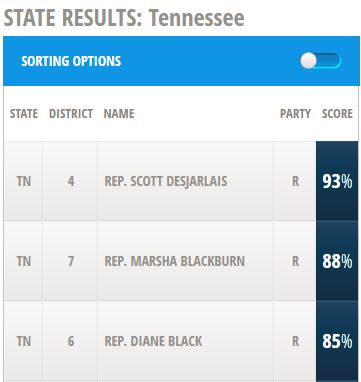
Diane Black is running for governor of Tennessee

Heritage Action Scorecards show most conservative legislators

Exciting news in Tennessee!

Previously, I blogged about how my favorite Congresswoman Marsha Blackburn had entered the Tennessee Senate race for the seat being vacated by squishy moderate Bob Corker. I have blogged about Marsha Blackburn’s activities many times on this blog, going back for many years. Although Marsha Blackburn is a wonderful candidate for the Senate, Tennessee still needs a conservative governor.

Here is the latest news from Fox News, authored by Diane Black – another Congresswoman I admire.

Excerpt:

I became chairman of the House Budget Committee one year ago and have been proud to serve in that role along with our new president. He has pushed an agenda of action – responsible budgeting, repealing ObamaCare’s worst mandates, and aggressive tax-cutting to get our economy going. This has been exactly the kind of work I came to Congress to do and we have done it.

But my heart has always been at home. This why today I’m announcing that I will now step down as chairman of the House Budget Committee, while continuing to serve in Congress, to devote more attention to my next challenge: seeking the governorship of Tennessee.

When I was elected to Congress in 2010, I had three main goals: repeal ObamaCare, reform the tax code and start attacking the growing federal debt and deficits. In just one year, the Budget Committee has taken significant steps to achieve all of these goals.

She’s the current Chair of the House Budget Committee and probably had a lot to do with the splendid House version of that tax cut bill that I liked so much. But she’s not only good on fiscal issues, she’s also a member of the House pro-life caucus, and was involved in the Select Investigative Panel on Planned Parenthood – an investigation of the selling of unborn baby body parts. Marsha Blackburn chaired the panel.

The Washington Examiner says that she has a few rivals – but none of them were recognizable to me:

The gubernatorial race is slated for Nov. 6, 2018, the same day as the midterm elections in Congress. Republican Gov. Bill Haslam, the incumbent, is prohibited by Tennessee law from running for a third term. Black joins a field of other Republicans who have announced their candidacies, including former state Sen. Mae Beavers; Randy Boyd, former commissioner of the Department of Economic and Community Development under Haslam; Rep. Beth Harwell, speaker of the Tennessee House; businessman Bill Lee; and realtor Kay White.

Black will continue to work on the Ways and Means Committee. Before being elected to Congress, she was a Tennessee state representative and senator.

In a statement from the House Budget Committee’s office, Black urged her colleagues to address “unsustainable mandatory programs.”

“Without question, it is critical that lawmakers take real action to reverse the trajectory of our nation’s growing debt,” she said.

I always support the candidates with the best record of achieving conservative results in the teeth of opposition. That’s why I liked Scott Walker and Ted Cruz in the GOP primary. It’s good to see Marsha Blackburn and Diane Black running for Senate and Governor, respectively. They also both have experience fighting for conservative principles and achieving results in the teeth of opposition. I am very happy to see people with records of achieving results running for higher office. I noticed that Diane Black has a degree in nursing, and a private sector career as a nurse, prior to entering politics. I think gives her a practical, evidence-based background, which so many non-STEM politicians lack.

Alexander Vilenkin: “All the evidence we have says that the universe had a beginning”

I’ve decided to explain why physicists believe that there was a creation event in this post. That is to say, I’ve decided to let famous cosmologist Alexander Vilenkin do it.

From Uncommon Descent.

Excerpt:

Did the cosmos have a beginning? The Big Bang theory seems to suggest it did, but in recent decades, cosmologists have concocted elaborate theories – for example, an eternally inflating universe or a cyclic universe – which claim to avoid the need for a beginning of the cosmos. Now it appears that the universe really had a beginning after all, even if it wasn’t necessarily the Big Bang.

At a meeting of scientists – titled “State of the Universe” – convened last week at Cambridge University to honor Stephen Hawking’s 70th birthday, cosmologist Alexander Vilenkin of Tufts University in Boston presented evidence that the universe is not eternal after all, leaving scientists at a loss to explain how the cosmos got started without a supernatural creator. The meeting was reported in New Scientist magazine (Why physicists can’t avoid a creation event, 11 January 2012).

[…]In his presentation, Professor Vilenkin discussed three theories which claim to avoid the need for a beginning of the cosmos.

The three theories are chaotic inflationary model, the oscillating model and quantum gravity model. Regular readers will know that those have all been addressed in William Lane Craig’s peer-reviewed paper that evaluates alternatives to the standard Big Bang cosmology.

But let’s see what Vilenkin said.

More:

One popular theory is eternal inflation. Most readers will be familiar with the theory of inflation, which says that the universe increased in volume by a factor of at least 10^78 in its very early stages (from 10^−36 seconds after the Big Bang to sometime between 10^−33 and 10^−32 seconds), before settling into the slower rate of expansion that we see today. The theory of eternal inflation goes further, and holds that the universe is constantly giving birth to smaller “bubble” universes within an ever-expanding multiverse. Each bubble universe undergoes its own initial period of inflation. In some versions of the theory, the bubbles go both backwards and forwards in time, allowing the possibility of an infinite past. Trouble is, the value of one particular cosmic parameter rules out that possibility:

But in 2003, a team including Vilenkin and Guth considered what eternal inflation would mean for the Hubble constant, which describes mathematically the expansion of the universe. They found that the equations didn’t work (Physical Review Letters, DOI: 10.1103/physrevlett.90.151301). “You can’t construct a space-time with this property,” says Vilenkin. It turns out that the constant has a lower limit that prevents inflation in both time directions. “It can’t possibly be eternal in the past,” says Vilenkin. “There must be some kind of boundary.”

A second option explored by Vilenkin was that of a cyclic universe, where the universe goes through an infinite series of big bangs and crunches, with no specific beginning. It was even claimed that a cyclic universe could explain the low observed value of the cosmological constant. But as Vilenkin found, there’s a problem if you look at the disorder in the universe:

Disorder increases with time. So following each cycle, the universe must get more and more disordered. But if there has already been an infinite number of cycles, the universe we inhabit now should be in a state of maximum disorder. Such a universe would be uniformly lukewarm and featureless, and definitely lacking such complicated beings as stars, planets and physicists – nothing like the one we see around us.

One way around that is to propose that the universe just gets bigger with every cycle. Then the amount of disorder per volume doesn’t increase, so needn’t reach the maximum. But Vilenkin found that this scenario falls prey to the same mathematical argument as eternal inflation: if your universe keeps getting bigger, it must have started somewhere.

However, Vilenkin’s options were not exhausted yet. There was another possibility: that the universe had sprung from an eternal cosmic egg:

Vilenkin’s final strike is an attack on a third, lesser-known proposal that the cosmos existed eternally in a static state called the cosmic egg. This finally “cracked” to create the big bang, leading to the expanding universe we see today. Late last year Vilenkin and graduate student Audrey Mithani showed that the egg could not have existed forever after all, as quantum instabilities would force it to collapse after a finite amount of time (arxiv.org/abs/1110.4096). If it cracked instead, leading to the big bang, then this must have happened before it collapsed – and therefore also after a finite amount of time.

“This is also not a good candidate for a beginningless universe,” Vilenkin concludes.

So at the end of the day, what is Vilenkin’s verdict?

“All the evidence we have says that the universe had a beginning.”

This is consistent with the Borde-Guth-Vilenkin Theorem, which I blogged about before, and which William Lane Craig leveraged to his advantage in his debate with Peter Millican.

The Borde-Guth-Vilenkin (BGV) proof shows that every universe that expands must have a space-time boundary in the past. That means that no expanding universe, no matter what the model, can be eternal into the past. No one denies the expansion of space in our universe, and so we are left with a cosmic beginning. Even speculative alternative cosmologies do not escape the need for a beginning.

Conclusion

If the universe came into being out of nothing, which seems to be the case from science, then the universe has a cause. Things do not pop into being, uncaused, out of nothing. The cause of the universe must be transcendent and supernatural. It must be uncaused, because there cannot be an infinite regress of causes. It must be eternal, because it created time. It must be non-physical, because it created space. There are only two possibilities for such a cause. It could be an abstract object or an agent. Abstract objects cannot cause effects. Therefore, the cause is an agent.

Now, let’s have a discussion about this science in our churches, and see if we can’t train Christians to engage with non-Christians about the evidence so that everyone accepts what science tells us about the origin of the universe.

Was the Trump-Russia Steele dossier the FBI’s “insurance policy” against Trump?

Why do people think that CNN are biased leftist clowns?

This is an article from the venerable Andy C. McCarthy, writing for National Review. He knows something investigations of this sort, having investigated and successfully prosecuted the men responsible for the 1993 World Trade Center bombing. What does he think about the Trump-Russia dossier that dominated the far-left mainstream media news cycle for months after Trump’s election?

He writes:

The FBI’s deputy director Andrew McCabe testified Tuesday at a marathon seven-hour closed-door hearing of the House Intelligence Committee. According to the now-infamous text message sent by FBI agent Peter Strzok to his paramour, FBI lawyer Lisa Page, it was in McCabe’s office that top FBI counterintelligence officials discussed what they saw as the frightening possibility of a Trump presidency.

That was during the stretch run of the 2016 campaign, no more than a couple of weeks after they started receiving the Steele dossier — the Clinton campaign’s opposition-research reports, written by former British spy Christopher Steele, about Trump’s purportedly conspiratorial relationship with Vladimir Putin’s regime in Russia.

Was it the Steele dossier that so frightened the FBI? I think so.

There is a great deal of information to follow. But let’s cut to the chase: The Obama-era FBI and Justice Department had great faith in Steele because he had previously collaborated with the bureau on a big case. Plus, Steele was working on the Trump-Russia project with the wife of a top Obama Justice Department official, who was personally briefed by Steele. The upper ranks of the FBI and DOJ strongly preferred Trump’s opponent, Hillary Clinton, to the point of overlooking significant evidence of her felony misconduct, even as they turned up the heat on Trump. In sum, the FBI and DOJ were predisposed to believe the allegations in Steele’s dossier. Because of their confidence in Steele, because they were predisposed to believe his scandalous claims about Donald Trump, they made grossly inadequate efforts to verify his claims. Contrary to what I hoped would be the case, I’ve come to believe Steele’s claims were used to obtain FISA surveillance authority for an investigation of Trump.

There were layers of insulation between the Clinton campaign and Steele — the campaign and the Democratic party retained a law firm, which contracted with Fusion GPS, which in turn hired the former spy. At some point, though, perhaps early on, the FBI and DOJ learned that the dossier was actually a partisan opposition-research product. By then, they were dug in. No one, after all, would be any the wiser: Hillary would coast to victory, so Democrats would continue running the government; FISA materials are highly classified, so they’d be kept under wraps. Just as it had been with the Obama-era’s Fast and Furious and IRS scandals, any malfeasance would remain hidden.

This is what we know about who paid for the Trump-Russia dossier (the Clinton campaign), and who passed the dossier to the news media (the Clinton bloggers).

I think we need to read these resignations the same way as we read the resignations of high-ranking Obama officials who were investigated and discovered to be using their political positions as weapons to attack Republicans, e.g. – Eric Holder, Lois Lerner, etc.

Basically, the lesson from all of this is that Democrats are no different than corrupt left-wing politicians in other communist regimes. They don’t understand any sort of standard of morality that would require them to do their jobs with integrity. To be a Democrat is to think that morality is a delusion, and that anything is permissible. This is a consequences of abandoning God as author of objective moral values and duties. And that’s why we should not be electing secular leftists to have power over us. It’s too dangerous to let godless people have that kind of power. We shouldn’t see the abuses of power in other left-wing regimes of the past as something different and distinct from the secular leftists in our own country.