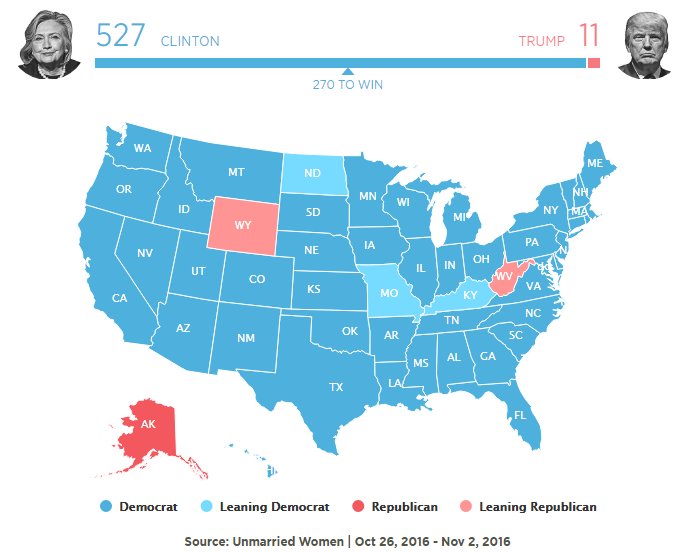
What your political views say about your suitability for marriage and parenting

SurveyMonkey election poll cross tabs for unmarried women Nov 2016

Would you like your marriage to be long-lasting and fulfilling? Marriage isn’t just about two people who have a lot in common getting together to have fun. Marriage is a commitment, and it requires specific character traits like the willingness to take responsibility to care for others self-sacrificially. Some of these marriage-friendly character traits can be difficult to detect, but you can evaluate a person’s character by asking them about what policies they oppose and support.

1. Are you opposed to no-fault divorce laws?

No-fault divorce laws allow one spouse to leave the marriage at any time, for any reason, or for no reason at all. If you support no-fault divorce, then your view of marriage is that it’s something to be entered into lightly, because it can be exited easily. You’ll be walking down the aisle thinking “oh well, if it doesn’t work out, I can always get a divorce”. If you oppose no-fault divorce laws, then your view of marriage is that there is no escape hatch. You’ll probably be a lot more careful about getting married. Since you are convinced that marriage is built to last forever, you’ll have a courtship of at least 12 months, and involve both sets of parents in the process. If you put commitment above happiness, you’re ready for marriage.

2. Are you opposed to abortion laws?

Abortion laws basically make it easy for two people to have recreational sex, and then get rid of any complications that result quickly and easily. This way, both the people that created the effect can escape the responsibility for what they did, and keep right on pursuing their goals and dreams. If you support abortion laws, you’re really saying that you can engage in recreational sex with people who are unwilling to accept responsibility for any children that result. If you are pro-life, then you’re saying that people should be careful about having sex, and be ready to take responsibility for a child, should one appear. Being responsible is good preparation for marriage.

3. Are you supportive of daycare for young kids?

Daycare services are essential for couples who need both the father and the mother to be working. The advantage of both parents working is that you can afford lots of shiny new stuff – like vacations, boats, shoes and handbags. Studies show that children don’t die during daycare, although if you put a child in daycare, there will be effects on the child’s behavior, such as higher anxiety and aggression. If you oppose daycare, you’re putting the needs of your children above your need for shiny stuff. Putting the needs of children first is a sign that you are ready for the self-sacrifice that marriage requires.

4. Are you in favor of smaller government?

If you’re in favor of smaller government, then you would rather keep taxes low so that more money stays in the family. If you support bigger government, then you think that government knows how to spend your money better than you and your spouse do. Additionally, government usually likes to spend more money than they take in. For example, in the last 8 years, we’ve added $10 trillion dollars to the debt, which is now $20 trillion. If you oppose higher taxes and bigger government, then you want government to pass on less debt to your children. Putting your kids’ financial well-being over your own is pro-marriage.

5. Are you in favor of school choice?

If you’re opposed to school choice, then you think that government should decide which schools your children will attend. School choice laws allow parents to give money to the schools they think are best for the children. If a school has excellent teachers and teaches students skills that they can use in their professional lives, then parents can choose that school. Schools have to compete to provide higher quality to parents, for lower cost. If you support giving parents more choice, then you put the needs of children – especially poor, minority children – above the needs of education administrators and teacher unions. Putting kids fist is pro-marriage.

6. Are you in favor of premarital sex?

Premarital sex is really fun (so I’m told). You can have sex with people who are just really attractive, even if these people have lousy character. Your friends will be impressed, and you’ll feel more attractive – like you were climbing a ladder of attractiveness with each new partner. If you combine sex with being drunk, then you can’t remember anything after. And you can’t feel guilty if the booze made you do it, right? On the other hand, if you present yourself to your spouse as a virgin, you are telling them that you have self-control, that you take sex as communication rather than recreation, and that they can trust you to be faithful by keeping sex inside the marriage. Trust is important for a good marriage.

7. Are you in favor of welfare for single mothers?

Sometimes, women find themselves pregnant before they are married. If you think that giving taxpayer money to women who have babies before they have husbands is a good idea, then you are rewarding behavior that creates fatherless children. Raising a child without a father causes serious behavioral problems. Boys tend to become more violent, and are more likely to commit crimes. Girls tend to engage in sex at earlier ages. If you oppose encouraging fatherlessness with welfare, you want women to get married before they have kids. Taking the needs of children seriously is pro-marriage.

8. Are you in favor of same-sex marriage?

When a man and a man get married and acquire children, those children will not be raised with their birth mother. Similarly with lesbians, the children will not grow up with their birth father. Studies show that children suffer from not being raised by their biological parents. For example, children of same-sex parents have lower graduation rates than children raised by heterosexual couples. If you think that children have a right to a stable relationship with their biological mother and father, then you place a higher value on the needs of children as opposed to the needs of adults. That’s a good sign you’re ready for marriage.

9. Are you in favor of radical feminism?

This one comes to us from Lindsay, who blogs at Lindsay’s Logic. She says that opposing radical feminism “shows that you do not think the purpose of marriage is to make women happy, but to work as a team to serve God and raise good children.” Indeed. Marriage doesn’t work if the woman approaches it as an accessory. Marriage is about a man and a woman sacrificing their own interests and compromising in order to work together as a team. Husbands and children have needs that women should care about. Feminism teaches women that husbands and children are less important than their careers, hobbies and interests. Feminism is anti-marriage.

10. Are you responsible with earning, saving and giving away money?

This one comes to us from Bob P. He says that marriages work better when both spouses are “committed to financial planning, budgeting and a renunciation of debt to support a lifestyle. Disagreement about financial issues is one of the greatest causes of marital stress.” If you’re able to choose a college major or a trade that you don’t like, but that pays well, that’s a positive. If you’re able to string together jobs so that your resume is gap-less, that’s a positive. If you’re able to save money even though it means you’re having less fun, that’s a positive. If you’re able to give away money to others to support them, that means you’re able to sacrifice your interests for the benefit of others. That’s pro-marriage.

Well, how did you do? Leave your ideas for more policies and points of view that are marriage-friendly in the comments.
Why are people like Glennon Doyle Melton and Jen Hatmaker so famous?

I keep seeing all these people in the culture like Rob Bell, Rachel Held Evans, Brian McLaren, Joel Osteen getting all this support from Christians – support that the people I admire like Jay Richards, William Lane Craig, Scott Klusendorf and Ryan T. Anderson don’t seem to get.

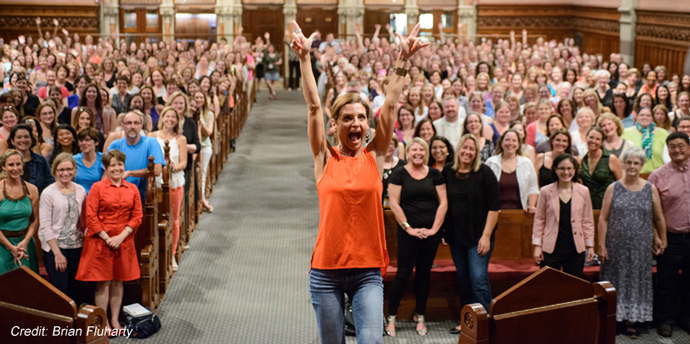
Glennon Doyle Melton in a church

First, here is Glennon being celebrated in the far-left Washington Post.

Excerpt:

Christian author Glennon Doyle Melton — known as the “ultimate confessional writer” for her honest portrayals of her struggling marriage, addiction and eating disorder — has opened up with another big revelation.

She is dating again, her new partner is a woman and that woman is celebrity soccer champ Abby Wambach.

[…]Melton’s news comes three months after she announced her divorce from Craig Melton, her husband of 14 years…

[…]Glennon Doyle Melton has reiterated for years her position affirming that same-sex marriage is not sinful and celebrating love in various forms. A few Christian writers who champion LGBT rights in the church congratulated Melton on Twitter on Sunday night. (Another Christian mom and blogger, Jen Hatmaker, came under fire last month for announcing her support of same-sex marriage for the first time.)

Melton’s coming out follows fellow inspirational author and friend Elizabeth Gilbert, of “Eat, Pray, Love” fame. Gilbert announced in September she was in a romantic relationship with her female best friend, just two months after divorcing over the summer.

Both Melton and Gilbert, who had not openly been in lesbian relationships before, first shared their news on Facebook, discussed the importance of living their truth and referred to their new partners as “my person.”

The similarities reflect what fans immediately notice: Both women value transparency and share an open-life-memoir writing style. Both have undergone spiritual journeys, separations and sexual awakenings.

[…]Melton and Gilbert have appeared on her career-making book list and popular programs. During a personable Oprah Winfrey Network interview in September, Oprah called Melton a “breath of fresh air.”

[…]Gilbert and Melton met for the first time last fall, but Melton has long admired and been inspired by Gilbert. “For the past decade she has been a minister to me,” she said.

I sent this story to a young lady I admire very much, and I was greatly comforted by her reply: “She is very deceived as to the truth. ” Thank God for women who care more what the Bible says than being popular. Just because a woman is physically fit and charismatic, that doesn’t make her a role model for Bible-believing Christians. Her book is endorsed as “epic” by Elizabeth Gilbert, which is a good sign that doesn’t mean that she is reliable where it counts – defending the moral values taught in the Bible.

Brandon and Jen Hatmaker
Brandon and Jen Hatmaker (actual photo, not Photoshopped)

Here’s an article by former lesbian Rosaria Butterfield posted at The Gospel Coalition about Jen Hatmaker and her husband Brandon.

It says:

If this were 1999—the year that I was converted and walked away from the woman and lesbian community I loved—instead of 2016, Jen Hatmaker’s words about the holiness of LGBT relationships would have flooded into my world like a balm of Gilead. How amazing it would have been to have someone as radiant, knowledgeable, humble, kind, and funny as Jen saying out loud what my heart was shouting: Yes, I can have Jesus and my girlfriend. Yes, I can flourish both in my tenured academic discipline (queer theory and English literature and culture) and in my church.

[…]To be clear, I was not converted out of homosexuality. I was converted out of unbelief. I didn’t swap out a lifestyle. I died to a life I loved. Conversion to Christ made me face the question squarely: did my lesbianism reflect who I am (which is what I believed in 1999), or did my lesbianism distortwho I am through the fall of Adam? I learned through conversion that when something feels right and good and real and necessary—but stands against God’s Word—this reveals the particular way Adam’s sin marks my life. Our sin natures deceive us. Sin’s deception isn’t just “out there”; it’s also deep in the caverns of our hearts.

How I feel does not tell me who I am. Only God can tell me who I am, because he made me and takes care of me. He tells me that we are all born as male and female image bearers with souls that will last forever and gendered bodies that will either suffer eternally in hell or be glorified in the New Jerusalem. Genesis 1:27 tells me that there are ethical consequences and boundaries to being born male and female.

[…]I only know who I really am when the Bible becomes my lens for self-reflection, and when the blood of Christ so powerfully pumps my heart whole that I can deny myself, take up the cross, and follow him.

The essential mistake that all the popular people make is that they distort the Bible in order to feel good about themselves and to be liked by other people. But sometimes, when you put being liked by other people first, you neglect the more important goal of being liked by God. Feeling good and being liked is not the same as being faithful and obedient to God. And God does not like when people misrepresent his character to non-Christians who are “looking for loopholes” in his Word. The whole point of Christianity is self-denial and self-sacrificial obedience, as modeled in Jesus, who gave up his wishes and desires by being willing to die to save others.

1 Corinthians 6:9-10: (Paul writing)

Or do you not know that the unrighteous will not inherit the kingdom of God? Do not be deceived: neither the sexually immoral, nor idolaters, nor adulterers, nor men who practice homosexuality,

10 nor thieves, nor the greedy, nor drunkards, nor revilers, nor swindlers will inherit the kingdom of God.

Matthew 19:1-11: (Jesus’ view of marriage)

1 Now when Jesus had finished these sayings, he went away from Galilee and entered the region of Judea beyond the Jordan.

2 And large crowds followed him, and he healed them there.

3 And Pharisees came up to him and tested him by asking, “Is it lawful to divorce one’s wife for any cause?”

4 He answered, “Have you not read that he who created them from the beginning made them male and female,

5 and said, ‘Therefore a man shall leave his father and his mother and hold fast to his wife, and the two shall become one flesh’?

6 So they are no longer two but one flesh. What therefore God has joined together, let not man separate.”

7 They said to him, “Why then did Moses command one to give a certificate of divorce and to send her away?”

8 He said to them, “Because of your hardness of heart Moses allowed you to divorce your wives, but from the beginning it was not so.

9 And I say to you: whoever divorces his wife, except for sexual immorality, and marries another, commits adultery.”

10 The disciples said to him, “If such is the case of a man with his wife, it is better not to marry.”

11 But he said to them, “Not everyone can receive this saying, but only those to whom it is given.

If you want to read reflections on these teachings that honor the plain meaning of the words, then by all means, pick up Ryan T. Anderson’s “Truth Overruled: The Future of Marriage and Religious Freedom” and Michael L. Brown’s “Can You Be Gay and Christian?: Responding With Love and Truth to Questions About Homosexuality“. It’s more important to align your beliefs with reason and evidence than with feelings and peer-approval.

Even ordinary Christians like me who are single have to say no to our desires to have sex before we are married. Although it is fashionable in the LGBT community to say “God wouldn’t make me have desires that I couldn’t fulfill” and “it’s not fair because straight people can fulfill their desires” this is baloney. I’m straight, and I have been thwarted in fulfilling my desire for sex for decades. It’s a normal Christian life to go without something you need and to be hungry. It’s not exceptional. This is obvious to anyone who reads the Bible and accepts the plain meaning of the words. Jesus didn’t tell people things that they wanted to hear, he told them hard truths that sometimes got him into a lot of trouble with sinful people. I’m really not sure why people who claim to be Christians are attracted to the exact opposite – false teachers who say things that make them feel good and negate the need for forgiveness from God, followed by repentance from sin.

Why should law-abiding Americans be allowed to own handguns?

A message from Females with Firearms

Here’s a news story from the Washington Free Beacon that shows what happens when law-abiding Americans are allowed to own handguns.

Excerpt:

A Florida police officer is alive and the suspect who was beating him is dead thanks to the intervention of an armed citizen on Monday.

The incident began when Deputy First Class Dean Bardes, a 12-year-veteran of the Lee County Sheriff’s Office, attempted to pull over a car. When the driver refused to stop, a high-speed chase ensued. When the suspect did finally stop, witnesses say he attacked Bardes.

“There was a lot of other lives that he was putting at risk, including mine and my daughter’s,” one witness, Nicole Ambrosini, told ABC affiliate WZVN. “I saw a car approaching me from behind at a very fast rate.”

“I saw the deputy and the suspect out of their cars with the doors both wide open and they were some type of altercation,” she continued.

The suspect appeared to gain the upper hand during the altercation.

“He just kept beating him and beating him,” a second witness, Shanta Holditch, told the news station. She said the suspect was “throwing him to the ground and punching him in all different directions.”

That is when witnesses say an armed man got out of his car and yelled at the suspect to stop hitting the officer. Holditch said the suspect “refused to get off the officer and the officer kept yelling, ‘shoot him, shoot him, shoot him.’”

Then witnesses heard three shots and saw the suspect collapse on top of the officer.

“I heard like three shots,” another witness, identified as Mr. Smith, told WZVN. “He fell down on top of the police officer. After a moment, the police officer rolled him back over, got on his mic, then rolled over back on the ground besides the guy.”

WINK News reports that the suspect may have been armed, but it is unclear if he or Bardes fired any shots during the altercation. He died after being shot by the citizen who intervened to help Bardes. That citizen holds a Concealed Weapons License, according to WINK.

Bardes was taken to Lee Memorial Hospital for treatment and has since been released.

According to this web site, Florida has some of the best gun laws for self-defense of any of the 50 states. If a policeman was attacked in a state like Illinois or New York or New Jersey, that policeman would be dead.

What would the secular leftists who oppose gun ownership say to the police officer in this situation? “Too bad” or maybe “have a nice death”. What about all the left-wing lawyers and progressive judges who have mistrust and contempt for law-abiding citizens? They’d say “let the policeman die” or “the criminal is the real victim”. It’s very fashionable in progressive circles to favor criminals over police officers. And they have no respect for a man’s traditional role to be a protector of his family and others in the community. Progressives don’t think about the real consequences of taking guns away from law abiding people. They want to feel good, and preen for others, but they don’t really aim to DO good.

Let’s go beyond feelings, though, and look at the peer-reviewed literature, so that we can have accurate beliefs about reality.

The peer-reviewed research

Whenever I get into discussions about gun control, I always mention two academic books by John R. Lott and Joyce Lee Malcolm.

Here is a paper by Dr. Malcolm that summarizes one of the key points of her book.

Excerpt:

Tracing the history of gun control in the United Kingdom since the late 19th century, this article details how the government has arrogated to itself a monopoly on the right to use force. The consequence has been a tremendous increase in violent crime, and harsh punishment for crime victims who dare to fight back. The article is based on the author’s most recent book, Guns and Violence: The English Experience (Harvard University Press, 2002). Joyce Malcom is professor of history at Bentley College, in Waltham, Massachusetts. She is also author of To Keep and Bear Arms: The Origins of an AngloAmerican Right (Harvard University Press, 1994).

Upon the passage of The Firearms Act (No. 2) in 1997, British Deputy Home Secretary Alun Michael boasted: “Britain now has some of the toughest gun laws in the world.” The Act was second handgun control measure passed that year, imposed a near-complete ban on private ownership of handguns, capping nearly eighty years of increasing firearms restrictions. Driven by an intense public campaign in the wake of the shooting of schoolchildren in Dunblane, Scotland, Parliament had been so zealous to outlaw all privately owned handguns that it rejected proposals to exempt Britain’s Olympic target-shooting team and handicapped target-shooters from the ban.

And the result of the 1997 gun ban:

The result of the ban has been costly. Thousands of weapons were confiscated at great financial cost to the public. Hundreds of thousands of police hours were devoted to the task. But in the six years since the 1997 handgun ban, crimes with the very weapons banned have more than doubled, and firearm crime has increased markedly. In 2002, for the fourth consecutive year, gun crime in England and Wales rose—by 35 percent for all firearms, and by a whopping 46 percent for the banned handguns. Nearly 10,000 firearms offences were committed.

[…]According to Scotland Yard, in the four years from 1991 to 1995 crimes against the person in England‟s inner cities increased by 91 percent. In the four years from 1997 to 2001 the rate of violent crime more than doubled. The UK murder rate for 2002 was the highest for a century.

I think that peer-reviewed studies – from Harvard University, no less – should be useful to those of us who believe in the right of self-defense for law-abiding people. The book by economist John Lott, linked above,compares the crime rates of all U.S. states that have enacted concealed carry laws, and concludes that violent crime rates dropped after law-abiding citizens were allowed to carry legally-owned firearms. That’s the mirror image of Dr. Malcolm’s Harvard study, but both studies affirm the same conclusion – more legal firearm ownership means less crime.