Is Trump right to say that Bush lied about the Iraq war, and there were no WMDs?

There was a debate on Saturday night, and Donald Trump started screaming like an unhinged psychopath not once, not twice, but THREE TIMES.

Red State introduces the meltdowns:

In Saturday’s CBS Republican presidential debate Donald Trump was the biggest loser. It wasn’t even close. Worse, the Donald was whiney, uncivil and so very un-presidential. He threw Trumpertantrum after Trumpertantrum, interrupted again and again and was booed over and over.

Here they are:

You can listen to all three meltdowns and read the transcripts in the Red State article. Let’s look at them.

The third statement about Planned Parenthood has already been turned into an ad by Ted Cruz, who was called a liar by Trump in the debate. The new Cruz ad shows Trump saying exactly what Cruz said that he said about Planned Parenthood on the Sean Hannity show.

I’m going to cover the “George W. Bush lied us into war and there were no WMDs there” statement below, and then this afternoon, I’ll cover the “Putin is a leader and there’s no evidence that he assassinated anyone” statement.

Here’s the part of the transcript that’s relevant:

DICKERSON: … On Monday, George W. Bush will campaign in South Carolina for his brother. As you’ve said tonight, and you’ve often said, the Iraq war and your opposition to it was a sign of your good judgment. In 2008, in an interview with Wolf Blitzer, talking about President George W. Bush’s conduct of the war, you said you were surprised that Democratic leader Nancy Pelosi didn’t try to impeach him. You said, quote: “Which, personally, I think would have been a wonderful thing.” When you were asked what you meant by that and you said: “For the war, for the war, he lied, he got us into the war with lies.” Do you still believe President Bush should have been impeached?

[…]TRUMP: You do whatever you want. You call it whatever you want. I want to tell you. They lied. They said there were weapons of mass destruction, there were none. And they knew there were none. There were no weapons of mass destruction.

Two points to make about this.
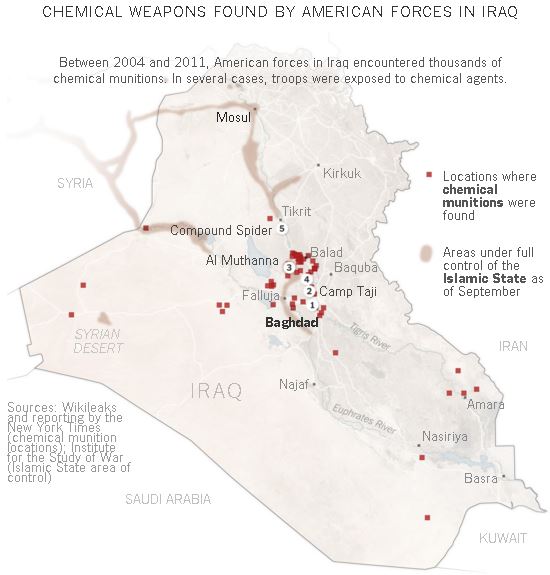
Chemical weapons found in Iraq

First, we did find WMDs in Iraq – lots of them. And this was reported in the radically leftist New York Times, of all places.

Read it:

Five years after President George W. Bush sent troops into Iraq, these soldiers had entered an expansive but largely secret chapter of America’s long and bitter involvement in Iraq.

From 2004 to 2011, American and American-trained Iraqi troops repeatedly encountered, and on at least six occasions were wounded by, chemical weapons remaining from years earlier in Saddam Hussein’s rule.

In all, American troops secretly reported finding roughly 5,000 chemical warheads, shells or aviation bombs, according to interviews with dozens of participants, Iraqi and American officials, and heavily redacted intelligence documents obtained under the Freedom of Information Act.

Second point, three different reports found that George W. Bush did not lie about the WMDs, nor did he pressure the intelligence agencies.

Excerpt:

Everyone was convinced that Saddam had WMDs. It remains a fact Saddam used WMDs against and his own people. The intelligence and common wisdom that Iraq still possessed such weapons at the time we liberated Iraq proved to be wrong, but that doesn’t equate to a lie. So lets go over the facts again.

The Bipartisan Senate Select Committee Report On The U.S. Intelligence Community’s Prewar Intelligence Assessments On Iraq found no evidence of political pressure to change the intelligence community’s judgments related to Iraq’s weapons programs. At pages 284-285 the report states:

Conclusion 83. The Committee did not find any evidence that Administration officials attempted to coerce, influence or pressure analysts to change their judgments related to Iraq’s weapons of mass destruction capabilities.

[Redacted]

Conclusion 84. The Committee found no evidence that the Vice President’s visits to the Central Intelligence Agency were attempts to pressure analysts, were perceived as intended to pressure analysts by those who participated in the briefings on Iraq’s weapons of mass destruction programs, or did pressure analysts to change their assessments.

Besides that report, two other independent investigations came to the same conclusion.

The Robb-Silberman Commission On The Intelligence Capabilities Of The United States Regarding Weapons Of Mass Destruction likewise found “no evidence of political pressure.” At pages 50-51 the Robb-Silberman report states: The Commission found no evidence of political pressure to influence the Intelligence Community’s pre-war assessments of Iraq’s weapons programs. As we discuss in detail in the body of our report, analysts universally asserted that in no instance did political pressure cause them to skew or alter any of their analytical judgments. We conclude that it was the paucity of intelligence and poor analytical tradecraft, rather than political pressure, that produced the inaccurate pre-war intelligence assessments.

The British Butler Report, Review Of Intelligence On Weapons Of Mass Destruction similarly “found no evidence of deliberate distortion.”

Trump can say anything he wants, but the facts are what they are.

Trump supporters in denial

I know 3 Trump supporters, and I’ve tried to speak to them about things like eminent domain, support for bank bailouts, single payer health care, touchback amnesty, Planned Parenthood support, support for Vladimir Putinadultery and divorce, support for the gay rights agenda, four bankruptcies, etc. Their response has been do deny the evidence. Trump never did those things, all the news articles are lies, and all the videos of Trump saying those things are fake. I expect better than that from Trump supporters. This time, the stakes are as high as they could be: 4-5 Supreme Court picks.  This is the ballgame for America.

Meet Ted Cruz’s secret weapon: his supportive and loving wife Heidi Cruz

Texas senator Ted Cruz, his wife Heidi Cruz and their two daughters

For Valentine’s Day, I thought it would be a good idea to post something about the power behind GOP presidential candidate Ted Cruz. I read a half-dozen articles for this post about Heidi, as well as Ted Cruz’s book where he talks about her. But this article from the Texas Tribune basically captures the point that I wanted to make about what makes a woman great.

The article says:

[Heidi] Cruz, 43, grew up in San Luis Obispo, Calif., the daughter of a dentist and dental hygienist who are Seventh-day Adventists.

When she was 5, Heidi’s parents signed her up for piano lessons, and she insisted on practicing an hour and sometimes two each night. At age 8, when her parents first enrolled her in school, a family trip to Washington sparked an interest in politics. By fifth grade, Heidi announced she wanted to go to Harvard Business School.

“I don’t even know how she knew about Harvard Business School. It wasn’t in our world at all,” her mother, Suzanne Nelson, said in an interview. “A good word to describe her is ‘driven.’ I don’t really know what has made her so driven.”

[…]Cruz went to Claremont McKenna College and was active in the college Republicans and interested in appointive political office, said her mentor, Edward Haley. She also was intent on a career in business first. She moved to New York after graduation and worked on emerging markets at J.P. Morgan, an area in which she was interested after spending summers in Africa doing missionary work with her parents. She was put on the Latin America desk and taught herself to speak Spanish between 18-hour work days.

Cruz achieved her dream of attending Harvard Business School but turned down a job at Goldman Sachs to work on George W. Bush’s 2000 presidential campaign.

[…][S]he met Ted Cruz, who by his own admission turned off campaign colleagues with what he described as a “cocky” attitude. But not Heidi Nelson. She said he reminded her of “a 1950s movie star.” He grilled her on her hopes, aspirations and dreams during their first date. They were married the following year.

She was the star when the couple arrived in Washington, netting jobs at the Treasury Department and then the White House, working as a Latin America director on the National Security Council. Ted Cruz was floundering, and he moved back to Texas to become the state’s solicitor general with hopes of launching a political career. They lived apart for more than a year, until she gave up her job and moved to Texas.

After the move, she suffered through a period of depression.

“When I moved to Texas, it really was for Ted, and I wasn’t comfortable with that,” she told The Washington Post in September. She said she recovered with spiritual counseling. She started working at Goldman Sachs in Houston; she was promoted to managing director.

And she began to apply her talents to her husband’s political career.

[…]She now holds her own campaign events, talking up her husband’s values and laying out what the campaign sees as a grass-roots path to victory.

[…]She remains the campaign’s top fundraiser, now making many calls from the road instead of from the campaign’s airy Houston headquarters, where she installed a playroom with pillows decorated with raspberry prints for the girls. Cruz said she aims to make 30 calls a day but typically averages about 20 to 25; she is calling from the campaign and super PAC lists and trying to persuade donors to give the maximum allowed under federal election law.

“I don’t want to say it’s easy, and I don’t close every deal,” she said. “I think people want to be a part of something that addresses the main issue of the day, number one, which is Washington versus the people.”

[…]Ted Cruz told an audience in Winterset, Iowa, on Monday that the couple’s decision to run for president was difficult for his wife.

“Heidi spent a lot of years building a very, very successful career. And when we were deciding whether to run, particularly when you’re parents of young girls, that’s not an easy decision. And she was struggling with it,” he said.

Ted Cruz said his wife was driving, listening to a CD of Christian music sent by her sister-in-law. She was struck by a song about seeking the face of the Lord and pulled over on the freeway and started crying, he said. That moment, he said, “changed her heart,” and she decided that the race was about God, the country and the future.

Now, Heidi Cruz says her main job is to bolster her husband’s candidacy.

“There are women who use their husband’s candidacies for their own” purposes, she said recently while being driven to yet another airport. “I love my life. I love my career. This is not for me. This is for our country.”

She has a great education and work experience. And she wants to use that to help her husband. It hasn’t been easy, but in the end, she chose her husband’s plan over her own.

How to get kissed: Heidi Cruz helping her husband
How to get kissed by a man who loves you: Heidi Cruz helping her husband

Here is one more quote from a 2013 article on Heidi Cruz, from the radically leftist New York Times, of all places:

In a glimpse into their marriage that Mr. Cruz called “illustrative,” he recalled saying to his wife in the weeks before his Senate primary, when he was still behind in the polls, “Sweetheart, I’d like us to liquidate our entire net worth, liquid net worth, and put it into the campaign.”

“What astonished me, then and now, was Heidi within 60 seconds said, ‘Absolutely,’ with no hesitation,” said Mr. Cruz, who invested about $1.2 million — “which is all we had saved,” he added — into his campaign.

A lot of that money was money she had earned, working those 18-hour-days at J.P. Morgan. All that education, all that hard work – she sacrificed it all because her husband was running for the Senate to make a difference.

It was a good idea for her to go and do those difficult degrees and take those difficult jobs, otherwise, she would not have the background and skills necessary to be effective for her husband. But, when push comes to shove and her husband gets himself mixed up in something important, then she drops everything to support him. That’s what a Christian wife ought to do.

William Lane Craig’s secret weapon is his amazing wife Jan

My favorite painting: "Godspeed" by Edmund Blair Leighton, 1900
My favorite painting: “Godspeed” by Edmund Blair Leighton, 1900

I want to draw your attention to a talk on “Vision in Life” given by Dr. William Lane Craig. Dr. Craig is the ablest defender of the Christian faith operating today. He has done formal academic debates with all of the best known atheists on major university campuses in front of thousands of university students.

It turns out that he owes a lot of his success to his amazing wife Jan.

The MP3 file is here. (32 minutes)

This talk was Dr. Craig’s chapel address to Biola University students.

About 11 minutes into the talk, Bill describes what happened after he finished his Bachelor’s degree at Wheaton:

And so I joined the staff of Campus Crusade for Christ for 2 years, and was assigned to Northern Illinois University. And that was where I met my wife Jan. She was a graduate of the University of North Dakota where she had come to faith in Christ. And she had a similar vision for her life of evangelism and discipleship.

And as we worked at NIU together, she with gals and I with the guys, leading students to Christ and discipling them to walk with the Lord, we fell in love. And we decided that we would be more effective if we joined forces and became a team.

So their reason for getting together was because they thought that they would be more effective in evangelism and discipleship if they worked as a team.

It is at this point in the talk where Bill begins to explain just how Jan molded him into the lean, mean debating machine that travels the world striking terror into the hearts of atheists.

Bill’s first story about Jan occurs early after their marriage while he is working on his first Masters degree at Trinity:

And it was also at that time that I began to see what an invaluable asset the Lord had given me in Jan. I remember I came home from classes one day, and found her at the kitchen table with all the catalogs and schedules and papers spread out in front of her and she said, “look! I’ve figured out how you can get two Masters degrees at the same time that it would normally take to get one! All you have to do is take overloads every semester, go to all full-time summer school and do all these other things, and you can do two MAs in the time it takes to do one!”

And I thought, whoa! Are you sure you really want to make the commitment it takes to do this kind of thing? And she said, “Yeah! Go for it!” And it was then I began to see that God had given me a very special woman who was my supporter – my cheerleader – and who really believed in me. And as long as she believed in me, that gave me the confidence to dream bigger dreams, and to take on challenges that I had never thought of before.

In an article on his web site, he talks about how Jan encouraged him to do his first Ph.D:

As graduation from Trinity neared, Jan and I were sitting one evening at the supper table in our little campus apartment, talking about what to do after graduation. Neither of us had any clear leading or inclination of what we should do next.

So Jan said to me, “Well, if money were no object, what would you really like to do next?”

I replied, “If money were no object, what I’d really like to do is go to England and do a doctorate under John Hick.”

“Who’s he?” she asked.

“Oh, he’s this famous British philosopher who’s written extensively on arguments for the existence of God,” I explained. “If I could study with him, I could develop a cosmological argument for God’s existence.”

But it hardly seemed a realistic idea.

The next evening at supper Jan handed me a slip of paper with John Hick’s address on it. “I went to the library today and found out that he’s at the University of Birmingham in England,” she said. “Why don’t you write him a letter and ask him if you can do a doctoral thesis under him on the cosmological argument?”

What a woman! So I did, and to our amazement and delight Professor Hick wrote back saying he’d be very pleased to supervise my doctoral work on that subject. So it was an open door!

And in the same article, he explains how Jan encouraged him to get his second Ph.D:

As Jan and I neared the completion of my doctoral studies in Birmingham, our future path was again unclear to us. I had sent out a number of applications for teaching positions in philosophy at American universities but had received no bites. We didn’t know what to do.

I remember it like yesterday. We were sitting at the supper table in our little house outside Birmingham, and Jan suddenly said to me, “Well, if money were no object, what would you really like to do next?”

I laughed because I remembered how the Lord had used her question to guide us in the past. I had no trouble answering the question. “If money were no object, what I’d really like to do is go to Germany and study under Wolfhart Pannenberg.”

“Who’s he?”

“Oh, he’s this famous German theologian who’s defended the resurrection of Christ historically,” I explained. “If I could study with him, I could develop a historical apologetic for the resurrection of Jesus.”

Our conversation drifted to other subjects, but Jan later told me that my remark had just lit a fire under her. The next day while I was at the university, she slipped away to the library and began to research grants-in-aid for study at German universities. Most of the leads proved to be defunct or otherwise inapplicable to our situation. But there were two grants she found that were possibilities. You can imagine how surprised I was when she sprung them on me!

Both of these Ph.D experiences are also described in the talk. And the talk concludes as follows:

I am so thankful to be married to a woman who is tremendously resourceful, tremendously talented and energetic, who could have pursued an independent career in any number of areas, but instead, she has chose to wed her aspirations to mine, and to make it her goal to make me the most effective person I can be, for Christ. And she has been like my right arm in ministry over these many years. And it is a tremendous privilege to be a team with a person like that.

And you young men, I would encourage you, if you marry, to find a gal who shares your vision, not some independent vision, but who is interested in aligning herself with you, and pursuing together a common vision and goal that will draw you [together], so that you will avoid the growing separateness that so often creeps into marriages.

And now you know the rest of Bill’s story. The person you marry will have an enormous influence on the impact you will have for Christ and his Kingdom. It is up to you to decide whether that influence is going to be positive or negative, by deciding if you will marry, and if you do marry, by deciding whom you will marry.

You may also be interested in this talk given by William Lane Craig, entitled “Healthy Relationships” (National Faculty Leadership Conf. 2008) (audio here) In that talk, he offers advice to Christians who want to have a marriage that is consistent with their Christian faith.