Asian-Americans being discriminated against by the secular left in academia

Now for some of you, this post is going to be a surprise. Most of you will have learned in school that whites are racist against blacks, and that’s why blacks underperform in education. What you probably didn’t know is that Asians outperform in education, so that “racism” cannot possibly be what is holding back blacks. However, there is real racism and discrimination in education. It comes from the university admissions people, who want to punish Asian-Americans for their academic success. They want to keep them out of the best universities, because there are too many of them, and it threatens “diversity”.

According to this very popular article in ultra-leftist The Economist, the Asian-Americans are pushing back against the progressive racists in academia.

The article says:

MICHAEL WANG, a young Californian, came second in his class of 1,002 students; his ACT score was 36, the maximum possible; he sang at Barack Obama’s inauguration; he got third place in a national piano contest; he was in the top 150 of a national maths competition; he was in several national debating-competition finals. But when it came to his university application he faced a serious disappointment for the first time in his glittering career. He was rejected by six of the seven Ivy League colleges to which he applied.

“I saw people less qualified than me get better offers,” says Mr Wang. “At first I was just angry. Then I decided to turn that anger to productive use.” He wrote to the universities concerned. “I asked: what more could I have done to get into your college? Was it based on race, or what was it based on?” He got vague responses—or none. So he complained to the Department of Education. Nothing came of it. “The department said they needed a smoking gun.”

In May this year Mr Wang joined a group of 64 Asian-American organisations that made a joint complaint to the Department of Education against Harvard, alleging racial discrimination. That follows a lawsuit filed last year against Harvard and the University of North Carolina by a group of Asian-American students making similar charges. The department rejected the claim in July, but another two complaints have since been filed by Asian-Americans, one against Harvard and one against nine other universities.

The article points out that Ivy League universities are allowed to discriminate against Asians by race. So Asian admissions are flat. But at the California Institute of Technology (Caltech), which is the top experimental science university in the United States, Asian admissions have been soaring. Why? California does not allow discrimination by race in admissions.

Here’s the graph:
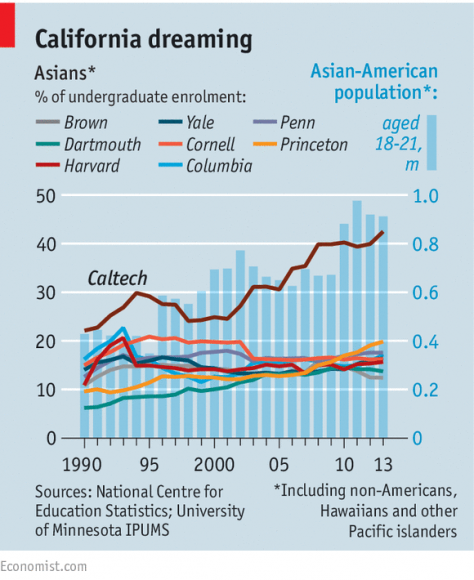
Admissions of Asian-Americans at Caltech compared to Ivy League

Read this:

Some Asians allege that the Ivy Leagues have put an implicit limit on the number of Asians they will admit. They point to Asians’ soaring academic achievements and to the work of Thomas Espenshade and Alexandria Walton Radford of Princeton, who looked at the data on admissions and concluded that Asian-Americans need 140 SAT points out of 1,600 more than whites to get a place at a private university, and that blacks need 310 fewer points. Yet in California, where public universities are allowed to use economic but not racial criteria in admissions, 41% of Berkeley’s enrolments in 2014 were Asian-Americans and at the California Institute of Technology 44% were (see chart).

[…]For the moment the court has taken the view that universities may take race into account, but racial quotas are not on. The Ivies deny running a racial quota. But in its comment on the Asian groups’ complaint, Harvard defends the use of race as a criterion in admission—“a class that is diverse on multiple dimensions, including on race, transforms the educational experience of students from every background and prepares our graduates for an increasingly pluralistic world”—and describes its admissions process as “holistic”, meaning it takes into account considerations wider than mere test scores.

Many Asian parents think this is wrong. They woke up a long time ago to the need to counter the stereotype of the maths-nerd Asian who does nothing but work, and encouraged their children to diversify—into music, debating, charity work, sports, everything that is supposed to increase students’ chances of admission. But many who have excelled in those areas, including Mr Wang and Irene Liu, a student from Massachusetts with a similarly stellar CV, were rejected by the Ivy League. Ms Liu’s mother, Tricia, says, “I feel angry about it. We came for the American dream: you work hard, you do well. This just doesn’t add up.” Irene has accepted a place at a top Canadian university, and is happy about it. Her mother isn’t: “It breaks my heart that she’s going abroad. If she had gone to Harvard, I could have brought her dumplings.”

I often blog about depressing and negative things on this blog because there is so much going wrong in a world run by the secular left, especially because church pastors and Christian parents seem to be so committed to the idea that Christianity has nothing to do with anything outside of the church walls. But this topic is a big win for us. We should be open to presenting conservative ideas and values to Asian-Americans. We have BOTH of the Asian-American governors (Bobby Jindal and Nikki Haley) as conservative Republicans. We also favor more choice and competition in education. There is an opportunity for new alliances here. I am hopeful.

UPDATE: Asian friend writes this to me:

I sounded the alarm on this years ago. But what has come of it? The lesson I have learned is that Asians don’t count. Asians don’t count as a minority, even though we are the smallest minority. Asians don’t count as non-whites, even though liberals in particular are sexually aroused by the fantasy of the exotic in Asian culture, particularly women. Asians don’t count as a governmentally oppressed group, even though the first racially specific legislation passed in Congress was the Chinese Exclusion act of 1882 and were targeted for internment camps during WWII. Asians don’t count, because despite all hardships, Asians do not waste time trying to rectify the past but make a better lives for themselves. And in so doing, they make a better lives for their children and their community. The successes of Asians in America is a big negative pull on the narrative of the Left, but it has no effect. Why not? Because flouting the narrative renders Asians as a people group irrelevant, to be ignored over #blacklivesmatter or whatever.

Asian woes have been more recent than slavery, yet they seem to be doing fine. Maybe their strong views of marriage and family have something to do with it?

Dr. Jennifer Roback Morse lectures on basic economics

Dr. Jennifer Roback Morse

Here is a podcast on basic economics from Dr. Jennifer Roback Morse.

About the speaker:

Jennifer Roback Morse, Ph.D. is the founder and President of the Ruth Institute — a project of the National Organization for Marriage — which seeks to promote life-long married love to college students by creating an intellectual and social climate favorable to marriage.

She is also the Senior Research Fellow in Economics at the Acton Institute for the Study of Religion and Liberty.

She is the author of Smart Sex: Finding Life-long Love in a Hook-up World, (2005) and Love and Economics: Why the Laissez-Faire Family Doesn’t Work (2001), recently reissued in paperback, as Love and Economics: It Takes a Family to Raise a Village.

Dr. Morse served as a Research Fellow for Stanford University’s Hoover Institution from 1997-2005. She received her Ph.D. in economics from the University of Rochester in 1980 and spent a postdoctoral year at the University of Chicago during 1979-80. She taught economics at Yale University and George Mason University for 15 years.

The MP3 file is here.

Topics:

  • The study of economics is anti-postmodern – there is objective truth independent of what people think
  • The study of economics believes in fixed principles of human nature
  • Economics studies the allocation of scarce resources that have alternative uses
  • Economics studies how people exchange resources
  • How both people who engage in a voluntary trade always believe that they will be better off
  • How both people who engage in a voluntary trade both benefit from the exchange
  • How incentives motivate people to act
  • Understanding supply and demand
  • Understanding how “free” government services are rationed
  • Understanding opportunity costs
  • How prices signal producers to produce more or less, and consumers to buy or not buy
  • Market-driven prices versus price controls
  • The role of substitution
  • The necessity of allowing failure in a free market

The requirements of economic growth:

  • private property
  • contracts
  • the profit motive
  • competition
  • free trade
  • entrepreneurship, creativity and innovation
  • the rule of law

If you want to learn more about basic economics, I recommend picking up a book or two by Thomas Sowell – the first book I usually give away is “Intellectuals and Society”, and then next “Basic Economics”.

New study: adopted kids struggle, even with well-educated, wealthy parents

I’ll explain why I am posting this below, but for now, let’s take a look at the study, which is discussed at Family Studies. (H/T Brad Wilcox tweet)

Excerpt:

To expand what we know about adopted students, for this Institute for Family Studies research brief, I carried out a fresh analysis of data from a large longitudinal study of 19,000 kindergarten students that was conducted by the National Center for Education Statistics beginning in 1998.

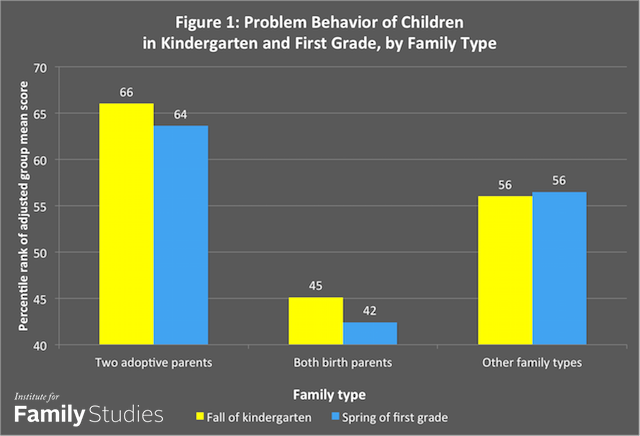
[…]Kindergarten and first-grade teachers were asked to rate the classroom behavior of children in the ECLS-K sample—how well they got along with other children in a group situation. In both the fall of kindergarten and the spring of first grade, adopted children were more likely than biological ones to be reported to get angry easily and often argue or fight with other students.

Here’s the first chart:

Adopted kids struggle in school
Adopted kids more likely to engage in problem behaviors

And more results:

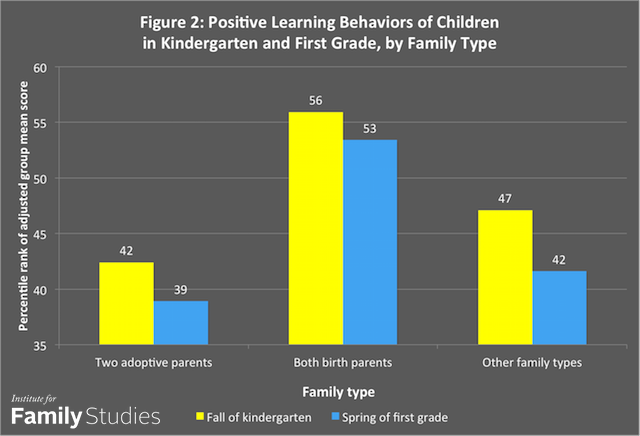
Children in the ECLS-K were also rated by their teachers on how well they paid attention in class, whether they seemed eager to learn new things, and whether they persisted at challenging learning tasks. Scores on these measures have proven to be predictive of later academic performance and career success beyond elementary school.5 Adopted children were rated less highly with respect to such positive approaches to learning than were children being raised by both birth parents.

Here’s the second chart:

Adopted kids struggle to pay attention in class

And even more results:

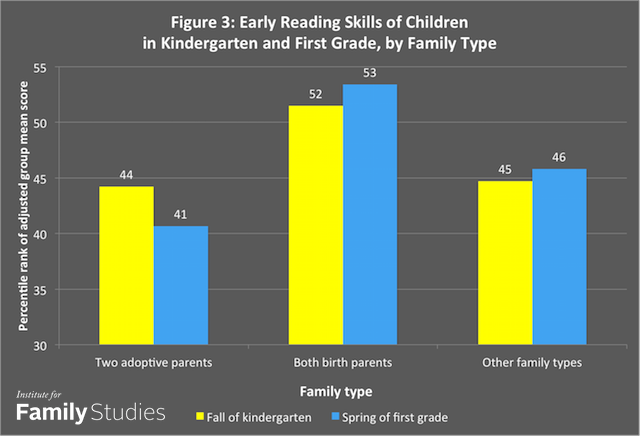
As the participating children began kindergarten, the ECLS-K assessed their pre-reading skills, such as recognizing letters by name, associating sounds with letters, identifying simple words by sight.

Here’s the third chart:

Adopted kids struggle with reading skills

And now math results:

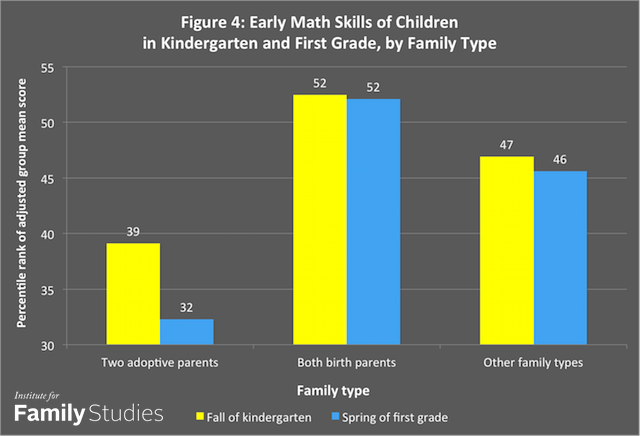
In the fall of their kindergarten year, the ECLS-K assessed children’s pre-arithmetic skills like counting by rote, recognizing written numerals, and understanding greater, lesser, and equal relationships.

Here’s the fourth chart:

Adopted kids struggle with math skills

The article concludes:

Attachment theory holds that a warm, intimate, and continuous relationship with at least one adult, usually the mother, is essential for the mental health of infants and young children. Children who do not develop a stable and secure bond during early childhood, or have the bond disrupted, are subject to both short-term distress reactions and longer-term abnormalities in their feelings and behavior toward other people. Not having a stable maternal bond is apt to produce long-lasting deficits in the child’s social development, deficiencies that are not easily remedied by a new home environment, no matter how favorable.

Some adopted children experienced neglect, abuse, or other stressful events prior to their adoption. According to traumatic stress theory, the likelihood of long-term emotional scars depends on the intensity and duration of the stress. Severe or prolonged early stress can have long-lasting effects on a child’s development, effects that a supportive adoptive family may only partly ameliorate.

So what do I want to say about this? I want to warn young women, especially young Christian women, that children work best when grown-ups plan their lives in such a way that they can provide for what the children need, at the time they need it. And if you miss the window of opportunity to have your own kids and raise them yourself, then you can’t just fix it at the last minute with ad hoc alternatives.

But for some reason, I get a lot of kickback from young women when I tell them what studies say about things like marriage, premarital sex, cohabitation, infertility, day care, and on and on and on. The Christian women in particular dismiss all the facts with stuff like:

God is leading me to choose fun and thrills now. That’s what my feelings say (and all my friends and family tell me that my feelings are God speaking to me). Tingles and peer-approval rationalize my choice to delay marriage and child-bearing. Who cares about stuff evidence? I don’t like to hear about constraints and deadlines. So I’ll just keep up this plan to run up debts, go on missionary trips, and have fun traveling till I’m 90 years old. God always calls people to do what feels good. I’m going on an adventure! And it will be easy to find a good husband and raise happy and effective kids later – whenever I feel like it. Er, I mean when God leads me to feel like it. Yeah.

So even though all of these studies show the need for timings, pre-conditions, best practices, and so on, that can all be dismissed because the feelings are God speaking to her, and God can somehow magically make all the data not apply to her. One of my married friends once wrote to a young, single fun-seeking feminist telling her about the risks of delaying marriage and child-bearing for too long, and the fun-seeker came back to me dismissing the whole letter because “I don’t like the feeling that I am being constrained”. So, the advice of old Christian women (Titus 2:4) can be dismissed because the young adventurous feminist didn’t like the feeling of being confronted by reality by someone who had more wisdom and experience than she did.

What young children need is their mom, and a Dad who can provide for her to stay home during the crucial first 5 years of their lives. That is more important than pursuing fun and thrills, then grabbing for children as if they were handbags at the last second after natural child-bearing becomes impossible. The right thing to do is to use your 20s preparing financially and otherwise to have kids when you are young, and to be financially set up to stay home with them during the critical years. Choosing a man who can provide, and who understands the best practices for having and raising children is vital, if you want your children to be effective and influential for Christ and his kingdom.

I do think that if a couple is intentionally adopting because they want the challenge and want to help a child who really needs it, then it’s praiseworthy to do that. I just don’t want someone who isn’t ready for the challenge thinking that adoption is the same, so they can delay marriage and children.I know that I am lazy, and I always want to do things the easy way. E.g. – I buy new cars, not used cars. I will buy hand-fed birds, not rescue birds. I would buy a new house, not a fixer-upper. I’m just not cut out for doing things that are hard. I have no ability to struggle through when there is resistance. When I face rejection or resistance to trying to grow or lead someone, I just give up. I think what I was saying to young women was – don’t delay marriage and child-bearing, you’ll get better results with less work.

Related posts