Review of evidential apologetics book by pastor shows where church needs to improve

Theology that hits the spot

Whenever I talk to Christians, I find that they hold one of two views about what faith is.

The first view of faith is the Biblical view of faith as active trust in propositions we know to be true, because we have reasons and evidence to believe those propositions. This view is not only rooted in the Bible, but it extends through Augustine and Aquinas to the present day. I have written about this view of faith before, and quoted many theologians in support of it. In the Bible, people use miracles as a sign in order to convince skeptics. For example, Peter appeals to the resurrection in Acts 2. The Bible teaches that faith is active trusting based on evidence.

The second view is blind faith. This view is nowhere in the Bible, and this view asserts that becoming a Christian is a leap-of-faith in the dark against all the evidence. This view not only minimizes evidence, but it actually opposes presenting evidence to unbelievers and skeptics in the way that the Bible teaches. This view is nowhere in the Bible, and it was not the method used by Jesus or his followers. It is an unBiblical way of viewing faith, but it is very popular in some circles of Christianity. It is also popular among atheists, because this is what many Christian leaders and pastors tell them that faith is.

Consider this review of a recent book that defends the Gospels and the historicity of the resurrection by one such fideist pastor.

He writes:

There are, however, two significant shortcomings to the book.

First, Cold-Case Christianity places far too much emphasis on the role of extrabiblical sources. No doubt there is a legitimate role for biblical archaeology and extrabiblical writing from antiquity. Christianity is, after all, a faith firmly rooted in human history. But there is a grave danger when truth is suspended because of an apparent lack of corroboration from extrabiblical sources. And Wallace, I’m afraid, wanders too close to this dark side of apologetics.

All of chapter 12, for instance, is devoted to proving the Gospels have external corroborative evidence—“evidence that are independent of the Gospel documents yet verify the claims of the text” (183). Wallace then addresses the historicity of the pool of Bethesda and makes another worrying statement: “For many years, there was no evidence for such a place outside of John’s Gospel. Because Christianity makes historical claims, archaeology ought to be a tool we can use to see if these claims are, in fact, true” (201-202, emphasis added).

In other words, Wallace seems to suggest we cannot affirm the truth of the Gospel accounts without the stamp of approval from archaeology and other extrabiblical sources. Such reasoning is dangerous, not least because it cannot affirm the inerrancy of the Bible. But also, it places the final court of appeal in the realm of extrabiblical sources rather than of God’s all-sufficient, all-powerful Word.

That is a textbook definition of fideism – that belief is somehow more pious and praiseworthy the less evidence we have. And the best way to have less evidence is to study nothing at all, but to just make a leap-of-faith in the dark. Of course, a leap-of-faith can land you anywhere – Islam, Mormonism. Presumably this pastor is like the Mormons who eschew all evidence and prefer to detect the truth of Mormonism by “the burning of the bosom” which happens when people read the all-sufficient, all-powerful Book of Mormon. His view of faith is identical to theirs, and 180 degrees opposed to the Bible. He has made his leap-of-faith, and that leap-of-faith is not accountable to arguments and evidence. His faith is private and personal, based on his own feelings. He considers it blasphemous to have to demonstrate what he believes to those who disagree with him. Where is this in the Bible? It’s nowhere. But it is everywhere in anti-intellectual Christian circles.

There is a good response to this blind-faith pastor on Deeper Waters. Much less angry than my response.

Excerpt:

The dark side of apologetics? Did I somehow step into a Star Wars universe?

Yes. How horrible to show that the Bible is backed up by sources outside of it. How terrible to show that these events did not happen in a vacuum. Thankfully, no one in the Bible took this approach.

Except for the fact that when the gospel was being preached, there were no gospels per se and there were no epistles. Paul told Agrippa that the events done weren’t done in a corner. In other words, investigate the claims for yourself! The early testimony was eyewitness testimony. Sources like Tacitus and others show the eyewitnesses were right! This was not done in a corner! This was done out in the open! Archaeology helps us confirm the biblical writings and shows that unlike the pagan myths, these events were rooted in a place and time. Is there some danger that our faith will be destroyed by outside sources?

It really becomes a fideistic approach. If your worldview is true, you should have no problem putting it to the strictest scrutiny. If it is not, then you will have a problem. No Christian should fear further research into what they believe. No Christian should have a problem with extra-biblical sources. Now I do agree there is a problem with stating that EVERYTHING must be backed extra-biblically. I think this is a prejudice we too often have where nothing in the Bible can be considered historical unless it’s verified somewhere else. A gospel account alone could count as a historical claim itself that can be investigated, and indeed is in NT scholarship, but where we can get extra-biblical evidence, I’m all for it.

[…]Christianity is a faith that is rooted in evidences so we should be able to use evidences to demonstrate it. I have often been told by those of the presuppositional bent that the approach is used all the time in the Bible. The problem is I can’t find one. I get told passages like “The fear of the Lord is the beginning of wisdom.” Yes. It is. Wisdom refers to godly living. It doesn’t refer to confirming the gospel to be true. When I look at the apostles in every case, I see them pointing to evidences.

It is pastors like Pastor Bungle above who are responsible for the great falling away from Christianity that we are seeing when we look at young people. We need pastors who connect the claims of the Christian worldview to evidence.
Wisconsin Supreme Court halts John Chisholm’s fascist witch hunts

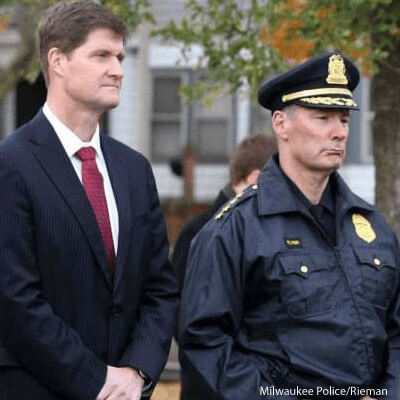
District attorney John Chisholm (left)

I blogged three times previously about this rogue Democrat district attorney from Wisconsin, (January 2014, April 2015, July 2015), who was sending armed police to break down the doors of the homes of conservatives, in pre-dawn military-style raids. Well, the case went to the Wisconsin Supreme Court, and the decision came out on Wednesday.

The radically left-wing Milwaukee Journal-Sentinel has the story.

Excerpt:

Dealing Gov. Scott Walker a victory just as his presidential campaign gets underway, the Wisconsin Supreme Court in a sweeping decision Thursday ruled the governor’s campaign and conservative groups had not violated campaign finance laws.

The ruling means the end of the investigation, which has been stalled for 18 months after a lower court judge determined no laws were violated even if Walker’s campaign and the groups had worked together as prosecutors believe.

It could also reshape how campaigns are run in Wisconsin because it makes clear campaigns can work closely with outside groups, allowing more political money to flow without the names of donors being disclosed.

Also, the decision builds momentum for rewriting campaign finance laws, overhauling the state’s elections and ethics agency, and limiting the ability of prosecutors to conduct John Doe probes. Republicans who control the Legislature have argued such investigations should not be conducted in political cases and targets of inquiries shouldn’t be barred from speaking out publicly.

The ruling dealt with three pieces of litigation, and the justices split 4-2 on the campaign finance laws that were at the center of the probe.

Writing for the majority, Justice Michael Gableman found collaboration between issue groups and campaigns was not illegal. He ordered prosecutors to return all records they seized and destroy any copies they made of them.

“It is utterly clear that the special prosecutor has employed theories of law that do not exist in order to investigate citizens who were wholly innocent of any wrongdoing,” Gableman wrote.

Calling the challengers brave, Gableman wrote that their litigation gave the court “an opportunity to re-endorse its commitment to upholding the fundamental right of each and every citizen to engage in lawful political activity and to do so free from the fear of the tyrannical retribution of arbitrary or capricious governmental prosecution. Let one point be clear: our conclusion today ends this unconstitutional John Doe investigation.”

National Review reviews the types of raids ordered by the Democrats against conservatives:

In two separate reports, National Review described these raids in detail. (The court cited our reports in its opinion.) On October 3, 2013, multiple Wisconsin conservatives were awakened by a persistent pounding on the door, their houses were illuminated by floodlights, and police — sometimes with guns drawn — poured into their homes. Once inside, the investigators turned the private residences of these innocent conservative citizens “upside down,” seeking an extraordinarily broad range of documents and information. These raids were supplemented by subpoenas that secured for investigators massive amounts of electronic information.

[…]The raid victims have suffered severe, long-term consequences as a result of these raids. Almost to a person, they say they no longer feel secure in their own homes. They report watching what they say, terrified that overt political involvement could lead their homes to be invaded again. One victim said, “I tried to create a home where the kids always feel safe. Now they know they’re not. They know men with guns can come in their house, and there’s nothing we can do.” Another victim — whose son was home alone when police arrived, guns drawn — is haunted by this chilling thought: “He could have been in the shower. They could have broken the door down. He could have been shot. Over politics.”

Funny how the media doesn’t make a big deal out of this story, isn’t it? Seems like it would be an important thing to report on.

Well, this story is still not over. Now we wait for civil lawsuits to be filed, so that Chisholm is bankrupted. I would also like to see criminal charges filed, and I hope he spends the rest of his life in jail. That would be justice, which is something he clearly needs a lesson in.

Obama learned nothing from Fort Hood: four marines killed in gun free zone

Another shooting in another gun-free zone
Another multiple-victim shooting in another gun-free zone

Breitbart News has the story.

Excerpt:

After gunman Muhammad Youssef Abdulazeez, a Muslim immigrant from Kuwait, allegedly shot and killed four Marines in Chattanooga, Tennessee, former NYPD detective Harry Houck said the military’s “gun-free zone” mindset has to change.

Speaking to CNN Newsroom, Houck said, “I’m a Marine. And this really is hitting me a little harder here than normal that [these Marines] weren’t able to protect themselves at the time this occurred.”

“We need people that are armed,” he added. He also said that even if that means getting armed guards, then so be it; something has to change.

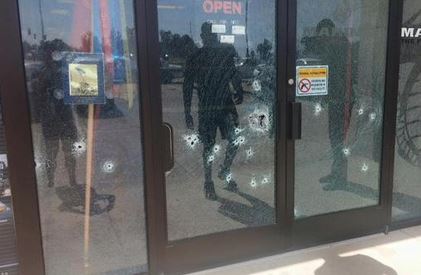
[…]Ironically, one of the earliest post-attack photos of the recruiting center shows shattered glass and bullet holes by the very sign that designated the office a gun free zone.

You can see the photo above, with the gun-free zone sticker.

So, let me make two points about this.

First, the shooter was not some poor person who just needed to be given a job, as the State Department spokeswomen, e.g. Marie Harf, are always trying to tell us.

The Tennessean explains:

Authorities identified the gunman as Muhammad Youssef Abdulazeez of Hixson, Tenn., though the spelling of his first name was in dispute, with federal officials and records giving at least four variations.

[…]The shooting suspect’s family lived there about 15 years and did not bring attention to themselves, according to neighbor Dean McDaniel.

[…]It was unclear whether Abdulazeez was a U.S. or Kuwaiti citizen.

University of Tennessee at Chattanooga officials confirmed that Abdulazeez graduated in 2012 with a degree in electrical engineering. He also interned at the Tennessee Valley Authority, the agency confirmed. 

Second, this was not an episode of “senseless violence” or “workplace violence”, as politically correct leftists might like to say. This guy was a Muslim and he was “very religious”.

Ryan Smith told the Times Free Press that he wrestled with Abdulazeez at Red Bank High School.

Smith said that Abdulazeez was very religious and that he would argue “back and forth” with the boys’ high school wrestling coach during fasting rituals.

This was not a random attack.

Recall the Fort Hood attack, another gun-free zone. That time, it was Major Nidal Hasan, a devout Muslim, and Obama called that attack “workplace violence”. Not terrorism! It’s “workplace violence”.

The problem with not taking domestic terrorism seriously is that instead of fixing the gun-free zones that enable these attacks, we keep going as before, and invite more attacks. Obama learned nothing from Fort Hood, and now four more U.S. Marines are dead because of his difficulty at accepting reality.