Do tax hikes, welfare spending and minimum wage hikes lower income inequality?

Here’s Heritage Foundation economist Stephen Moore to explain.

He writes:

Massachusetts Sen. Elizabeth Warren recently appeared on one of the late night talk shows, beating the class warfare drum and arguing for billions of dollars in new social programs paid for with higher taxes on millionaires and billionaires. In recent years, though, blue states such as California, Illinois, Delaware, Connecticut, Hawaii, Maryland and Minnesota adopted this very strategy, and they raised taxes on their wealthy residents. How did it work out? Almost all of these states lag behind the national average in growth of jobs and incomes.

So, if income redistribution policies are the solution to shrinking the gap between rich and poor, why do they fail so miserably in the states?

The blue states that try to lift up the poor with high taxes, high welfare benefits, high minimum wages and other Robin Hood policies tend to be the places where the rich end up the richest and the poor the poorest.

California is the prototypical example. It has the highest tax rates of any state. It has very generous welfare benefits. Many of its cities have a high minimum wage. But day after day, the middle class keeps leaving. The wealthy areas such as San Francisco and the Silicon Valley boom. Yet the state has nearly the highest poverty rate in the nation. The Golden State, alas, has become the inequality state.

In a new report called “Rich States, Poor States” that I write each year for the American Legislative Exchange Council with Arthur Laffer and Jonathan Williams, we find that five of the highest-tax blue states in the nation—California, New York, New Jersey, Connecticut and Illinois—lost some 4 million more U.S. residents than entered these states over the last decade. Meanwhile, the big low-tax red states—Texas, Florida, North Carolina, Arizona and Georgia—gained about this many new residents.

What’s wrong? Isn’t raising taxes, growing government and spending more on welfare supposed to make reduce income inequality? Well, the trouble is that you need to think about things from the point of view of the people who create the jobs. People who want to start a business prefer to move to states where they can keep more of the money they earned. So, that’s why there is a mass exodus from states that don’t allow job creators to keep the money they earn. And naturally, they hire workers in their new state once they get there. Eventually people in the high-tax states move to where the jobs are, too.

Stephen Moore has actually measured it:

The least “regressive” tax states [high tax states] had average population growth from 2003 to 2013 that lagged below the national trend. The 10 most highly “regressive” tax states [low tax states], including nine with no state income tax, had population growth on average 4 percent above the U.S. average. Why was that? Because states without income taxes have twice the job growth of states with high tax rates. 

[…]Ohio University economist Richard Vedder and I compared the income gap in states with higher tax rates, higher minimum wages and more welfare benefits with states on the other side of the policy spectrum. There was no evidence that states with these liberal policies had helped the poor much and, in many cases, these states recorded more income inequality than other states as measured by the left’s favorite statistic called the Gini Coefficient.

[…]The 19 states with minimum wages above the $7.25 per hour federal minimum do not have lower income inequality. States with a super minimum wage—such as Connecticut ($9.15), California ($9.00), New York ($8.75), and Vermont ($9.15)—have significantly wider gaps between rich and poor than states without a super minimum wage.

No, I am not an economist, but I think that this is because the real minimum wage is ZERO, and that’s what more people in high minimum wage states make compared to people in low minimum wage states. If Seattle raises the minimum wage to $15 and the workers end up making the real minimum wage (ZERO) because job creators can’t pay them, then naturally the gap between rich and poor increases.

I think it’s always a good idea for people to think about things from the point of view of the small business job creator, and it all makes sense. If you want to get trained in how to do this, I recommend picking up introductory books by economists like Thomas Sowell, Milton Friedman or even F.A. Hayek. The goal here is to achieve good results, not to have good intentions.

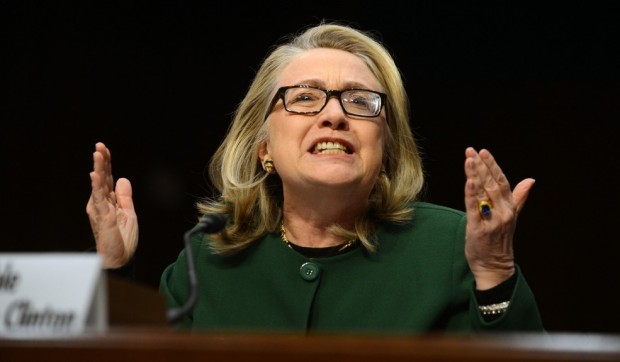
“Dead broke” Hillary Clinton makes more money in an hour than top-paid CEO

$300,000 an hour for a speech

Astonishing article from the Washington Examiner.

Excerpt:

Democratic presidential candidate Hillary Clinton is drawing a populist bead on lavish Wall Street pay packages as she revs up her march to the 2016 Democratic presidential nomination, but in some respects the fat-per-speech fee she can charge puts her far ahead of the top 10 highest-paid American CEOs.

“I think it’s fair to say that if you look across the country, the deck is stacked in favor of those already at the top. There’s something wrong when CEOs make 300 times more than the American worker…,” Clinton said during her first campaign swing last week at an Iowa community college.

Bashing Wall Streeters is part of Clinton’s strategy of remaking her image to appear more sympathetic to middle class voters, while also appealing to left-wing Democrats who are attracted to Sen. Elizabeth Warren, D-Mass., and the even more radical supporters of Sen. Bernie Sanders, the Vermont socialist who talks of seeking the 2016 nomination.

Let’s compare the per-hour rate of pay for Hillary compared to the top American CEOs:

On that basis, the CEOs are pikers compared to an hour of Clinton speaking for $300,000. Hammergren, for example, makes only $63,076 for the same hour of labor. Clothing magnate Ralph Lauren, the second best-paid CEO on the Forbes list receives $32,067. Vornado Realty’s Michael Fasitelli, the third-place CEO, gets $30,961 per hour.

Now at least those CEOs are being paid to produce a return – invent new products and services that people are willing to pay for. What does a speech do? Do the people who pay for it get anything in return? What does she talk about?

Here’s a sample from one of her speeches:

I think she is making a pitch there for Soviet-style re-education camps – not sure why this is worth $300,000, comrades.

But she’s not the only hypocrite on the left.

Here’s a crazy racist, pro-abortion MSNBC commentator named Melissa Harris-Perry:

According to the IRS, although she likely makes a substantial living anchoring a weekend MSNBC show and as a professor at Wake Forest University, the left-wing Melissa Harris-Perry does not pay her taxes. The Internal Revenue Service just placed a $70,000 tax lien against Harris-Perry.

She is the second left-wing MSNBC anchor caught not paying her fair share. Al Sharpton reportedly owes Uncle Sam upwards of $3 million.

According to Harris-Perry, a left-wing activist who frequently rails against the wealthy for not paying enough taxes, the tax bill is from 2013, and she and her husband plan to pay the lien off as quickly as possible.

Harris-Perry is most famous for her the terrible things she has said about Mitt Romney’s black grandchild, wearing tampon earrings, and telling parents that their children belong to the community.

Meanwhile, here she is advocating for higher taxes:

Indeed! People on the left often advocate in favor of higher taxes, but you shouldn’t infer from that that they want to pay higher taxes themselves. Studies show that people on the left give far less money to charity as well. They talk about the poor, but when they get the chance to do something about it, they don’t. It’s just a pose, but it works on a lot of stupid people to get them to vote Democrat.

New book by Peter Schweizer: Clinton State Department favored foreign donors

Hillary Clinton: secretive, entitled, hypoctritical

This is from the radically leftist New York Times, of all places.

They write:

The book does not hit shelves until May 5, but already the Republican Rand Paul has called its findings “big news” that will “shock people” and make voters “question” the candidacy of Hillary Rodham Clinton.

“Clinton Cash: The Untold Story of How and Why Foreign Governments and Businesses Helped Make Bill and Hillary Rich,” by Peter Schweizer — a 186-page investigation of donations made to the Clinton Foundation by foreign entities — is proving the most anticipated and feared book of a presidential cycle still in its infancy.

The book, a copy of which was obtained by The New York Times, asserts that foreign entities who made payments to the Clinton Foundation and to Mr. Clinton through high speaking fees received favors from Mrs. Clinton’s State Department in return.

“We will see a pattern of financial transactions involving the Clintons that occurred contemporaneous with favorable U.S. policy decisions benefiting those providing the funds,” Mr. Schweizer writes.

His examples include a free-trade agreement in Colombia that benefited a major foundation donor’s natural resource investments in the South American nation, development projects in the aftermath of the Haitian earthquake in 2010, and more than $1 million in payments to Mr. Clinton by a Canadian bank and major shareholder in the Keystone XL oil pipeline around the time the project was being debated in the State Department.

This is the piece that is missing in this Clinton Foundation story – the piece that could sink her, even if she has a $2.5 billion campaign war chest.

The book description from Amazon.com:

In 2000 Bill and Hillary Clinton owed millions of dollars in legal debt. Since then they’ve earned over $130 million. Where did the money come from? Most people assume the Clintons amassed their wealth through lucrative book deals and high-six-figure fees for speaking gigs. Now Peter Schweizer shows who is really behind those enormous payments.

In his New York Times best-selling books Extortion and Throw Them All Out, Schweizer detailed patterns of official corruption in Washington that led to congressional resignations and new ethics laws. In Clinton Cash he follows the Clinton money trail, revealing the connection between their personal fortune, their close personal friends, the Clinton Foundation, foreign nations, and some of the highest ranks of government.

Schweizer reveals the Clintons’ troubling dealings in Kazakhstan, Colombia, Haiti, and other places at the Wild West fringe of the global economy, where business is often conducted on the basis of bribes and personal connections. In this blockbuster exposé, Schweizer does not allege illegal or unethical behavior; he merely presents the troubling facts he’s uncovered. Meticulously researched and scrupulously sourced, filled with headline-making revelations, Clinton Cash raises serious questions of judgment, of possible indebtedness to an array of foreign interests, and ultimately of fitness for high public office.

Peter Schweizer is one of my favorite authors, and his research in his previous books was first class scholarship. I’m excited to see that he is hitting this story with a thorough review right when the story is heating up. He has to do the work that the mainstream media won’t do, or we will end up with another Obama.

Related posts