
Indian economist Aparna Mathur, whose work I’ve featured here before, writes about it in Forbes magazine.
Excerpt:
The fabric of our society is changing. In 1980, approximately 78 percent of families with children were headed by married parents. In 2012, married parents headed only 66 percent of families with children. In a new report, Bradford Wilcox and Robert Lerman explore the role of family structure with new data and analysis, and document how this retreat from marriage is not simply a social and cultural phenomenon. It has important economic implications for, amongst others, men’s labor force participation rates, children’s high school dropout rates and teen pregnancy rates. Since these factors are highly correlated with economic opportunity and the ability to move up the income ladder, this suggests that income inequality and economic mobility across generations are critically influenced by people’s decisions and attitudes towards marriage. Understanding the role of family structure is therefore key to understanding the big economic challenges of our time.
[…]Wilcox and Lerman document how the shift away from marriage and traditional family structures has had important consequences for family incomes, and has been correlated with rising family-income inequality and declines in men’s labor force participation rates. Using data from the Current Population Survey, the authors find that between 1980 and 2012, median family income rose 30 percent for married parent families, For unmarried parents, family incomes rose only 14 percent.
These differential patterns of changes in family income have exacerbated family-income inequality. Since unmarried parent families generally expand the ranks of low-income families, while high-income, high-education adults increasingly marry partners from similar socioeconomic backgrounds, inequality trends are worsened. Comparing the 90th percentile families to the 10th percentile families in 2012, the top 10 percent had incomes that were more than 11 times higher than the bottom 10 percent. However, if we restrict the sample to married families with children, the ratio drops to nearly 7, suggesting that within married families, income inequality is less stark. The authors estimate that approximately 32 percent of the growth in family-income inequality between 1979 and 2012 is associated with changes in family structure. Other research, studying the period 1968-2000, finds that the changing family structure, accounted for 11 percent of the rise widening of the income gap between the bottom and top deciles.
Another interesting observation relates to the trends in employment participation by men. The Wilcox-Lerman study finds that for married fathers, employment and participation rates have remained consistently higher than for married men with no children and unmarried men with no children. The authors speculate that between 1980 and 2008, about 51 percent of the decline in men’s employment rates can be associated with the retreat from marriage.
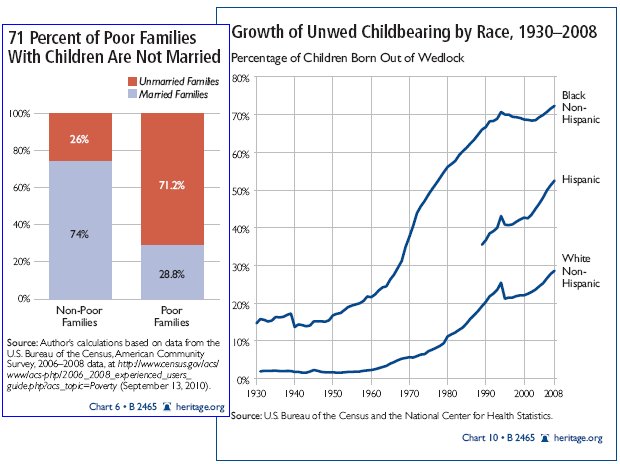
And why is single motherhood so ascendant today? Well, part of it is the loss of morality caused by secularism. If there is no God, then there is no way we ought to be, so let’s just do whatever makes us feel good, and pass the bill to the taxpayers. That only works, though, if we elect politicians who want taxpayers who are responsible to pay for the ones who are irresponsible.
So have we done that? Yes – Robert Rector explains in The Daily Signal.
He writes:
It is no accident that the collapse of marriage in America largely began with the War on Poverty and the proliferation of means-tested welfare programs that it fostered.
When the War on Poverty began, only a single welfare program—Aid to Families with Dependent Children —assisted single parents.
Today, dozens of programs provide benefits to families with children, including the Earned Income Tax Credit, Temporary Assistance for Needy Families, the Women, Infants and Children food program, Supplemental Security Income, food stamps, child nutrition programs, public housing and Section 8 housing, and Medicaid.
Although married couples with children can also receive aid through these programs, the overwhelming majority of assistance to families with children goes to single-parent households.
The burgeoning welfare state has promoted single parenthood in two ways. First, means-tested welfare programs such as those described above financially enable single parenthood. It is difficult for single mothers with a high school degree or less to support children without the aid of another parent.
Means-tested welfare programs substantially reduce this difficulty by providing extensive support to single parents. Welfare thereby reduces the financial need for marriage. Since the beginning of the War on Poverty, less-educated mothers have increasingly become married to the welfare state and to the U.S. taxpayer rather than to the fathers of their children.
As means-tested benefits expanded, welfare began to serve as a substitute for a husband in the home, and low-income marriage began to disappear. As husbands left the home, the need for more welfare to support single mothers increased. The War on Poverty created a destructive feedback loop: Welfare promoted the decline of marriage, which generated a need for more welfare.
A second major problem is that the means-tested welfare system actively penalizes low-income parents who do marry. All means-tested welfare programs are designed so that a family’s benefits are reduced as earnings rise. In practice, this means that, if a low-income single mother marries an employed father, her welfare benefits will generally be substantially reduced. The mother can maximize welfare by remaining unmarried and keeping the father’s income “off the books.”
For example, a single mother with two children who earns $15,000 per year would generally receive around $5,200 per year of food stamp benefits. However, if she marries a father with the same earnings level, her food stamps would be cut to zero.
So you see, the thing the left complains about the most is actually the thing they do the most to cause. They are all about taxpayer-funded welfare programs and growing government to make more and more people dependent. They are causing the income inequality and then complaining about what they cause.
 WINTERY KNIGHT
Nice tie-up. I would have missed it for a day or two.
LikeLike
Reblogged this on Jessica A Bruno (waybeyondfedup).
LikeLike
You may be interested in a paper that argues Patriarchy leads to wealth and civilization:
http://www.fisheaters.com/garbagegeneration.html
LikeLike