
This article from Popular Mechanics will astonish you. (H/T Uncommon Descent via a tweet from J. Warner Wallace)
Excerpt:
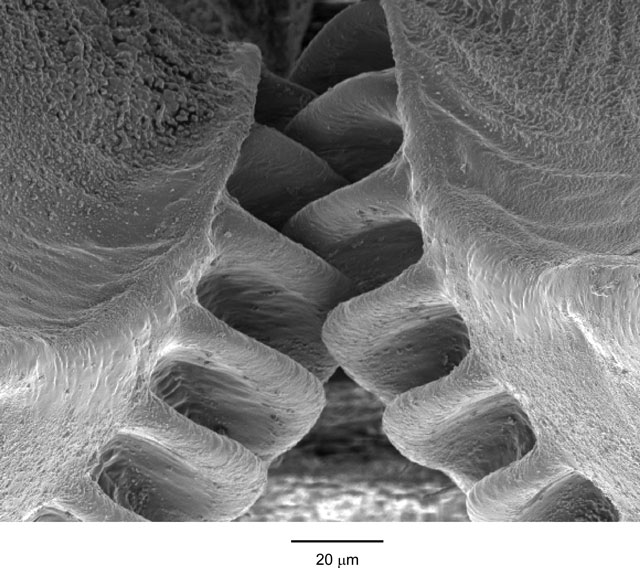
With two diminutive legs locked into a leap-ready position, the tiny jumper bends its body taut like an archer drawing a bow. At the top of its legs, a minuscule pair of gears engage—their strange, shark-fin teeth interlocking cleanly like a zipper. And then, faster than you can blink, think, or see with the naked eye, the entire thing is gone. In 2 milliseconds it has bulleted skyward, accelerating at nearly 400 g’s—a rate more than 20 times what a human body can withstand. At top speed the jumper breaks 8 mph—quite a feat considering its body is less than one-tenth of an inch long.
This miniature marvel is an adolescent issus, a kind of planthopper insect and one of the fastest accelerators in the animal kingdom. As a duo of researchers in the U.K. report today in the journal Science, the issus also the first living creature ever discovered to sport a functioning gear.
[…]The gears themselves are an oddity. With gear teeth shaped like cresting waves, they look nothing like what you’d find in your car or in a fancy watch. (The style that you’re most likely familiar with is called an involute gear, and it was designed by the Swiss mathematician Leonhard Euler in the 18th century.) There could be two reasons for this. Through a mathematical oddity, there is a limitless number of ways to design intermeshing gears. So, either nature evolved one solution at random, or, as Gregory Sutton, coauthor of the paper and insect researcher at the University of Bristol, suspects, the shape of the issus’s gear is particularly apt for the job it does. It’s built for “high precision and speed in one direction,” he says. “It’s a prototype for a new type of gear.”
Another odd thing about this discovery is that although there are many jumping insects like the issus—including ones that are even faster and better jumpers—the issus is apparently the only one with natural gears. Most other bugs synchronize the quick jolt of their leaping legs through friction, using bumpy or grippy surfaces to press the top of their legs together, says Duke University biomechanics expert Steve Vogel, who was not involved in this study. Like gears, this ensures the legs move at the same rate, but without requiring a complicated interlocking mechanism. “There are a lot of friction pads around, and they accomplish pretty much of the same thing,” he says. “So I wonder what extra capacity these gears confer. They’re rather specialized, and there are lots of other jumpers that don’t have them, so there must be some kind of advantage.”
Even stranger is that the issus doesn’t keep these gears throughout its life cycle. As the adolescent insect grows, it molts half a dozen times, upgrading its exoskeleton (gears included) for larger and larger versions. But after its final molt into adulthood—poof, the gears are gone. The adult syncs its legs by friction like all the other planthoppers. “I’m gobsmacked,” says Sutton. “We have a hypothesis as to why this is the case, but we can’t tell you for sure.”
These gears remind me of the parts of the bacterial flagellum, which also correspond to machine parts, as Dr. Fazale Rana of Reasons to Believe has argued. But if you’re a naturalist, then this all happened by chance.

 WINTERY KNIGHT