
Toronto man who is suspected in mall shooting was under “house arrest”

How ineffective is the justice system in Canada? Well the Conservatives are trying to lock it down, but things like “house arrest” are very popular with liberal elites.

Here’s what you can do in Canada while under “house arrest” for some other crime:

A 23-year-old man was supposed to be under house arrest when police say he opened fire this weekend inside a busy Toronto shopping mall, killing one and leading to injuries to seven others.

The suspect, Christopher Husbands, is now in custody after surrendering early Monday, police said.

[…]He faces one count of first-degree murder and six counts of attempted murder, according to police. Husbands appeared around 3:30 p.m. in a Toronto courtroom, where he was formally charged, CNN affiliate CTV reported.

[…]The detective described Husbands as a “charged individual (who) was on house arrest conditions, not to be outside his residence” when he was out with people — including Ahmed Hassan, the 24-year-old man police say he shot dead — on Saturday at the Eaton Centre mall in downtown Toronto.

In Canada, as in the UK (and here), criminals are apparently less at risk of being put in jail than law-abiding people who defend themselves.

Excerpt:

Chen owns the Lucky Moose Food Mart in Toronto. When a career thief ripped him off yet again in May 2009, he had had enough. Chen chased down the thug, tied him up with twine and stuffed him into the back of a van, then called police.

When police arrived, however, Chen was the one charged with numerous crimes including kidnapping, forcible confinement and having a concealed weapon. The last count was added because Chen keeps a box cutter in his back pocket for work. 

[…]The senate committee also heard from Joseph and Marilyn Singleton of Taber, Alberta.

When the couple returned home to their rural acreage after a dinner in May 2010, they found a suspected thief trying to flee after he and two others had allegedly broken into their house, trashed their home and stolen their belongings.

When the suspect tried to smash through their garage door with his getaway car, Joseph feared for his wife, who was standing on the other side of it, calling police. Joseph hit the 20-year-old in the head with the butt end of an axe to subdue him. The homeowner was charged with assault with a weapon and assault causing bodily harm, offences that carry up to 10 years in prison. The charges were later dropped.

The repeat offender, who was on bail after threatening another homeowner with a crowbar, was given house arrest.

“One of the hardest things I have ever had to do is answer questions from my young grandchildren, trying to explain why their grandfather was in trouble for protecting their grandmother,” Joseph told the committee.

Marilyn echoed his feelings. “At the time of our home invasion, I never would have dreamed that Joe would be charged for possibly saving my life. If he did not take action, it’s possible he would have had to explain to our children and grandchildren why he did not take action to protect their mother and grandmother.”

Defending themselves against the charges cost the couple $30,000, draining their retirement savings.

I guess that the jails in Canada are meant primarily for law-abiding people or legal gun owners. Criminals apparently go free, aka “house arrest”. That’s liberal jurisprudence – all very tolerant, you know. Let’s hope the Conservatives can fix the mess the Liberal Party made.
Peter J. Williams lectures on the historicity of the resurrection

Here’s the lecture:

There are lots of interesting things in this lecture:

  • non-Christian accounts of early Christianity
  • textual issues with resurrection passages
  • the concept of resurrection
  • specific teachings of Jesus

The total is 100 minutes long, but if you give it a listen, I’m sure you will hear something new. He actually lectures only for the first hour, and then the hosting pastor speaks for 23 minutes and then there is some Q&A with the church members until the end.

Ronald Reagan’s 40th anniversary D-Day speech: the boys of Pointe du Hoc

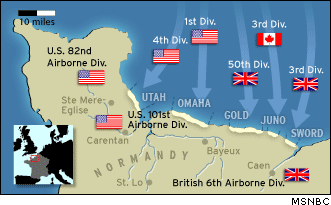
June 6, 1944 D-Day Normandy Invasion Map

It’s June 6th, today, and it’s the anniversary of D-Day: the Allied invasion of northern France – the beginning of the end of World War 2. One of the most pivotal events of that day was the assault on German gun emplacements by members of the Army Rangers at a fortified position called “Pointe du Hoc”.

President Ronald Reagan recognized the soldiers who attacked Pointe du Hoc back in 1984:

You can read the full transcript of that speech here.

Ronald Reagan also made the case for gratitude and vigilance:

Here’s the hymn that starts to play at the end:

The Boys of Pointe du Hoc

Here’s a summary of the Pointe du Hoc mission:

[Lt. Col. James Earl] Rudder took part in the D-Day landings as Commanding Officer of the United States Army’s 2nd Ranger Battalion. His U.S. Army Rangers stormed the beach at Pointe du Hoc and, under constant enemy fire, scaled 100-foot (30 meter) cliffs to reach and destroy German gun batteries. The battalion’s casualty rate for this perilous mission was greater than 50 percent. Rudder himself was wounded twice during the course of the fighting. In spite of this, they dug in and fought off German counter-attacks for two days until relieved. He and his men helped to successfully establish a beachhead for the Allied forces.

You can watch a three-clip documentary on it, too: part 1, part 2, part 3.

You can read the complete story about their successful effort to destroy the 6 155mm German guns here on Military History Online. Although initially, the Rangers did not find the guns where they had expected them, they did find them further back behind the cliffs and destroyed them there, removing a threat to the forces that would be landing later.

What does D-Day mean to Christians in particular?

A female Christian friend asked me what she should be thinking about when I sent her one of the videos above, and so I wrote her this to explain why I sent her the video:

To make you close your eyes and think in a more practical way about what it means for someone to sacrifice their lives to save you, of course. What it means to look up cliffs at machine guns, barbed wire and mortars raining death on you and to take a rope in your hands and to climb up a sheer cliff, under heavy fire, in order to save generations yet unborn and freedom itself.

To think about a concrete example helps us to be able to appreciate what Christ did for us in giving his life for us so that we could be free of sin, as well.

This is the insight that drives my entire interest in war and military history, in fact.

What does this mean: “Greater love has no man than this, that a man lay down his life for his friends.”

The more you know about D-Day, the more fearful what Jesus did appears, and the more you can be grateful.

Bullets and shrapnel are scary… and so are nails and lashes. Why on Earth would anyone endure either for me? And what should my response be to it?

I think it is helpful to explain Christianity to those who are not yet Christian, and for Christians to fully appreciate what Christianity is all about.

We were in peril. And now we have been saved. But at a cost.

I think that it’s important for Christians to look to history, art, poetry and music to help them to reflect and comprehend the sacrifice that Christ made for us in dying on the cross to protect us from peril. What must the cross have looked like to Jesus? It must have been something like what the Omaha beach looked like to the Americans landing in Normandy. Jesus saw whips, thorns and nails, and the heroes of Normandy saw 88 mm AT guns, 81 mm mortars and MG42 machine guns. How should you feel about people who face death on your behalf? Think about it.