
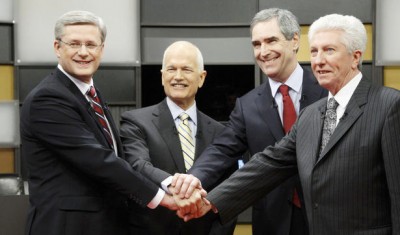
From left-wing Global TV, a university professor scores the first English-language debate in the Canadian Federal election.
Excerpt:
How well did the four leaders present their points?
Dr. Royce Koop: Harper is very effective at getting his message across. He is very clear, disciplined, and it’s tough to knock him off his game. Ignatieff is not communicating as well as I thought he would. He’s clearly new to this debate format.
Who were the clear aggressors and/or defenders throughout the debate?
Dr. Royce Koop: As can be expected, the three opposition leaders are the aggressors and Harper is the defender. However, Duceppe has distinguished himself as an aggressor. His opening comment was a strong, sharp attack of Harper. However, Harper is effectively defending himself in this debate. His strength is being disciplined, and he’s keeping his cool very well.
Who preformed best?
Dr. Royce Koop: Harper behaved like the PM-in-waiting. These debate formats actually favour the incumbent PM. Everyone is attacking them, and so they are able to rise above it all and act prime-ministerial. This is how Chretien survived the debates in 1997 and 2000, by riding above all the attacks, and Harper is doing so very effectively tonight.
What was your impression of the Harper-Ignatieff face-off? Who won that tete-a-tete?
Dr. Royce Koop: I think that Harper won that exchange, but it was a close call. Ignatieff has to be able to knock Harper off his game, and he hasn’t been able to do so effectively. He came close at the conclusion of the first exchange between them, but Harper came out on top.
A left-wing report from the Markdale Standard.
Excerpt:
Harper projected calm competence and self-assurance from the outset. He carried that through, almost without interruption, to his closing statement two hours later.
There was one moment when Ignatieff had an opening. That was in the prolonged section on democracy. Ignatieff was pressing hard. He scored some good hits on Stephen Harper, branding him a control freak who disrespects democratic institutions and, by extension, Canadians. It was a compelling segment and for a few moments it seemed like Ignatieff might turn the tide.
It didn’t happen. The debate moved on to other topics and ended, advantage Harper, on health care. Here Harper was very strong, looking pragmatic and sensible as the others sought in vain to breach his defence.
Harper’s debating skills, designed for TV, outmatched all three of the other contestants. Most tellingly, he looked constantly at the camera when answering questions, not at his opponents. He was the only one to do so consistently, though NDP leader Jack Layton also used this technique towards the end.
But Harper was rock-solid with it, constantly gazing into the camera, speaking directly Canadians in reassuring tones. With his body language he projected calm confidence. He kept his gestures small and controlled and within the circumference of his body – an effective technique on television.
[…]Tomorrow, look for Harper’s numbers in English Canada to rise sharply, into the low 40s. This will come as bitter brew to Liberal supporters across Canada, but it’s the simple reality: A Conservative majority is back on the table.
How did Harper win the debate? By using evidence.
Excerpt:
Canada’s good economic standing relative to its G8 counterparts, and the country’s relatively quick emergence from recession, can, in part, be credited to encouraging investment in the corporate sector, Mr. Harper said.
While in power, the Stephen Harper Conservatives have cut the corporate tax rate from 22.5% to 16.5%, with a further reduction to 15% scheduled for 2012.
To then foist a sudden reversal in policy on corporate Canada would send the wrong message to investors, Mr. Harper said on Tuesday. He quoted Jack Mintz, a public policy expert at the University of Calgary, as saying that the additional taxes proposed by the Liberals would cost the Canadian economy 200,000 jobs and $40-billion in business investment over the long run.
“Every credible economic analyst, every major business group in this country, says that if you raise taxes, you will hurt growth, hurt jobs and hurt revenue,” Mr. Harper said.
He must be the only politician I know who actually EXPLAINS why corporate tax-hikes are a bad idea. The government needs to cut taxes to attract corporations to move to their country, and to encourage their people to start or grow businesses. That’s where jobs COME FROM. And when people are working, because they have lots of jobs to choose from, they are happier and they pay more in taxes than if they were unemployed. And when people are employed, the government spends less on unemployment and other welfare programs. Notice that our corporate tax rate down here is 36%. More than double the Canadian corporate tax rate. Compared to the Canadians, we spend way too much, and we create far fewer jobs.
If the left-wing newspapers are calling it a victory for Harper, then it was a landslide victory for Harper. I am talking William Lane Craig vs Christopher Hitchens landslide victory. I can hardly wait to see the poll numbers from up north tomorrow. The latest pre-debate poll has Harper leading the socialist Liberal party by 12 points. (H/T Jeanie)
UPDATE: Post-debate poll shows that Harper won the debate.
Related posts
- Stephen Harper’s Conservatives unveil “Here for Canada” platform
- Harper would ban political contributions from unions and corporations
- A closer look at Stephen Harper’s Family Tax Cut plan
- Poll finds 68% of Canadians positive on Canadian economy
- Canada created twice the number of jobs as the United States in January
- Canadian prime minister Stephen Harper vows to end long-gun registry
- Stephen Harper makes a stand against North Korean aggression
- Fiscally conservative Canada campaigns against global bank tax
- Federal conservatives in Canada aim to cut spending and waste from budget
- Canada’s finance minister proposes changes to mortgage lending laws
- Supreme Court sides with Conservative Party against price-fixing monopoly
- Canadian prime minister Stephen Harper seeks increased trade with India
- Canadian Evangelicals and Catholics more opposed to secularism and socialism
- Members of Canadian socialist parties oppose child sex-trafficking crime bill
- Harper instructs foreign minister to denounce Libyan dictator
- Canadians to walk out of Ahmadinejad’s speech at UN
- Canada signs free trade deal with Panama
- Harper pays surprise visit to troops in Afghanistan
- Investors Business Daily says Harper better leader than Obama
- Round-up of US news media interviews with Stephen Harper
 WINTERY KNIGHT