Tag Archives: Wisdom

New study: women seeking to have a child should start before age 32

Brain vs Heart, from: theawkwardyeti.com

Dina sent me this sobering piece of research from the New Scientist which is perfect for all the young feminists who have been taught in college that marriage should be put off, and women can easily get pregnant after age 40.

Excerpt:

It’s a question many people will ask themselves at some point in their lives: when should I start a family? If you know how many children you’d like, and whether or not you would consider, or could afford, IVF, a computer model can suggest when to start trying for your first child.

Happy with just one? The model recommends you get started by age 32 to have a 90 per cent chance of realising your dream without IVF. A brood of three would mean starting by age 23 to have the same chance of success. Wait until 35 and the odds are 50:50 (see “When to get started”).

The suggestions are based on averages pulled from a swathe of data so don’t give a personal prediction. And of course, things aren’t this simple in real life – if only family size and feelings about IVF were the only factors to consider when planning a family. But the idea behind the model is to help people make a decision by condensing all the information out there into an accessible form.

“We have tried to fill a missing link in the decision-making process,” says Dik Habbema at Erasmus University in Rotterdam, the Netherlands, one of the creators of the model. “My son is 35 and many of his friends have a problem deciding when to have children because there are so many things they want to do.”

It’s a scenario that will be familiar to many; the age at which people have their first child has been creeping up over the last 40 or so years. For example, the average age at which a woman has her first child is 28 in the UK and has reached 30 in Italy, Spain and Switzerland. In the US, the birth rate for women in their 20s has hit a record low, while the figures for those over 35 have increased over the last few decades.

The decision is more pressing for women thanks to their limited supply of eggs, which steadily drop in quantity and quality with age. Female fertility is thought to start declining at 30, with a more significant fall after the age of 35.

[…]The new model incorporates data from studies that assess how fertility naturally declines with age. The team took information on natural fertility from population data collected over 300 years up to the 1970s, which includes data on 58,000 women.

I have often tried to talk to young women about the need to get their lives in gear. I advise them to work summers during high school, obtain a STEM degree in university, minimize borrowing money by going to community college for the generic prerequisites, don’t have premarital sex, get a job related to their STEM field straight out of college, pay off their debts, move out of their parents’ house, start investing from the first paycheck, marry between age 25-30, and then start having children after the first two “stabilizing” years of marriage. This is sound advice, rooted in my careful reconnaissance of the things that human beings care about and need in their old age. This advice is not bullying, it comes from reading many, many relevant papers. It comes from putting the knowledge gained from reading the papers into practice, and seeing results where appropriate.

I am giving you the numbers. Straight out of a peer-reviewed study. Don’t follow your heart. Don’t listen to your friends. Follow the science. Make your decisions within the boundaries of reality. God will not save you from foolish decisions.

Related posts

Move over housing bubble and student loan bubble: here’s pension bubble!

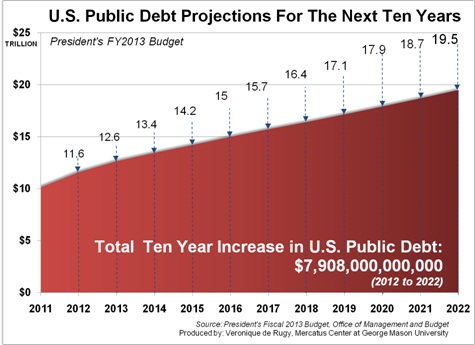
Obama 2013 Budget Debt Projection

Recently, I was talking to Dina about which state I would like to live in. I looked at a whole bunch of factors like tax rates, housing prices, religious liberty laws, voting patterns… but I also looked at state obligations to pay pensions.

Let’s take a look at the story from the Washington Examiner to see why this is important.

It says:

Years of gimmicks and politically motivated benefit increases for government workers have left America’s states and municipalities with pension funds that are short at least $1.5 trillion — and possibly as much as $4 trillion if the investment returns of these funds don’t live up to expectations in coming years.

[…]Since 2007, states and localities have been forced to increase annual contributions into pensions by $43 billion, or 65 percent, and in various places these rising payments are crowding out other government services or driving taxes higher or both. Retirement debt has even played a crucial role in high-profile government bankruptcies — including in Detroit; Stockton, California; and Central Falls, Rhode Island. Fixing the problem is proving expensive, and it won’t happen quickly in places with the worst debt.

[…][O]fficials in Stockton spent years enhancing benefits to workers without understanding the debts they were accruing. The city agreed back in the 1990s, for instance, to pay not only its own share of contributions into the pension system, but those of staff, too. It also guaranteed healthcare for life for retirees.

[…]Facing $400 million in pension debt and $450 million in promises for future healthcare, the city declared bankruptcy in 2012. Employees lost some of their perks, like healthcare in retirement, but citizens suffered, too. Trying to save money, the city cut essential services, including the police department, and crime soared.

[…]Places that cannot reform pensions, or where legislators were slow to act, are inevitably seeing tax increases to finance these steep obligations. In Pennsylvania, 164 school districts applied in 2014 to increase property taxes above the state’s 2.1 percent tax cap. Every one of them listed pension costs as a reason for the higher increases. In West Virginia, the state has given cities the right to impose their own sales tax to pay for increased pension costs.

Several cities, including Charleston, have already gone ahead with the new tax. Chicago Mayor Rahm Emanuel tried to impose a $250 million property tax increase last year to start wiping out pension debt in the Windy City, where pensions are only 35 percent funded. When the City Council balked, Chicago instead passed $62 million in other taxes, including a levy on cell phone use, as a stopgap measure. But the city faces a pension bill that is scheduled to rise by half a billion dollars annually in 2016.

I was able to find a helpful table that shows the solvency of all the public sector pension plans in each state. There are sensible states where I could live. It’s also important to look at the trend to see what direction the state is moving in, and thankfully the table had that information.

Anyway, here is the point I want to make about this.

When I look at these numbers, I feel sad, because it means that I have to be careful about my spending, and not spend too much on things that are fun in the short-term. I also cannot stop working to take a year off to go backpacking in Europe, because that would wreck my resume, and lose me a whole bunch of earned income. Sometimes, reality causes us to feel bad like that, so we run away from it. We find people who will agree with our feelings, and we shut out people who see things clearly. But we as Christians should not make decisions based on intuitions and feelings. And it doesn’t even work if you wrap up a bad decision in spiritual language, i.e. – “God told me…”, either. As much as I might feel like spending my money on frivolous things, I know in my mind that I cannot do that. I don’t like having constraints on my freedom, but to ignore data like this in my decision-making would not end well for me.

Sue Bohlin of Probe Ministries recently wrote a wonderful post about short-term pain versus long-term pleasure.

She writes:

Decision-making often involves choosing between short-term pleasure or short-term pain. (Usually it’s more like short-term inconvenience.)

Short-term pleasure often leads to long-term pain, and short-term pain often leads to long-term pleasure. What doesn’t work, and is a horribly unrealistic expectation for life, is short-term pleasure leading to long-term pleasure! (Wouldn’t THAT be nice?!)

Maturity and wisdom is displayed by the choices we make, especially when we exercise patience and self-control, not insisting on the instant-gratification jolt of “I want it NOW!!!” Many of our choices for pleasure in the right-now end up costing us down the road, causing pain later. You know, like that fourth brownie that tastes soooooo good in the moment, but then you can’t zip up your jeans a few days later. Or indulging your child’s demands and whims today because you want to be the “cool parent” and you want them to like you, but then you start to notice the ugliness of that child’s sense of self-absorbed entitlement. Short-term pleasure, even when that pleasure is simply trying to avoid pain, results in long-term unpleasant consequences.

But when we recognize the value of self-control and self-denial in the present, so that we can reap the harvest of pleasure in the future, that’s wisdom. Mark Twain advised, “Do one thing every day you don’t want to do.” That’s good advice, but of course God thought of that much earlier! Using self-control and self-denial is how we fulfill the biblical idea of not indulging the flesh (Galatians 5:16).

[…]Jesus said, “If anyone wants to become My follower, he must deny himself, take up his cross daily, and follow Me.” (Luke 9:23) Denying ourselves, taking up our cross, and following Jesus are all about short-term pain with major long-term pleasures!

Sue is wise. And her newest post is all about how to deal with feelings.

She says:

What is the biblical perspective on how to handle overwhelming feelings?

There are healthy and unhealthy ways to do that.

The healthy way to deal with strong feelings starts with thinking wisely about feelings in general. Our pastor often says that feelings are real (we do feel them, often intensely), but they’re not reliable (they make terrible indicators of what is true). So we should acknowledge them, but not be led by them.

Especially powerful, overwhelming feelings.

Allowing yourself to be controlled by your feelings is unwise and immature. The flip side of that is our example of Jesus in the Garden of Gethsemane. No one ever experienced the strength of horrific feelings like He did, to the point of sweating blood. He allowed Himself to feel His feelings, but then He turned in trust to His Father, submitting to His will. He set the bar for how to handle overwhelming feelings: feel the feelings, and trust the Lord.

Often, though, especially in the young, people deal with their strong feelings in unhealthy ways.

Feel the feelings, but don’t let them into your decision-making.

Are Christians responsible for making plans and making good decisions?

Here’s a wonderful post on decision making and the will of God posted on Neil’s blog. Neil links to another post where someone is trying to figure out what God wants him to do.

Excerpt:

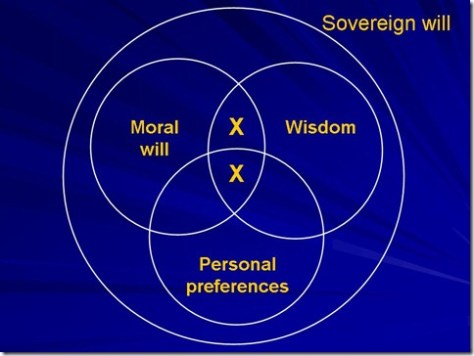
Really short version: Aside from direct and clear personal revelation from God, you don’t have access to his sovereign will when making decisions.  Therefore you must look at other factors.  If it isn’t moral, don’t do it.  If it is moral but not wise, don’t do it.  If it is moral and wise, then use your personal preferences.

Using this model you can end up with a wise and biblical decision, but you have avoided the traps of the “God told me to ____” routine.  People who run around saying that God told them this and that convey a super-spirituality that can leave less mature believers wondering if they really have a relationship with God (i.e., “God doesn’t tell me every little thing to do, so maybe I don’t really know him.”).

He has a helpful picture posted as well:

This is actually a very important topic for me, because I like making plans and making good decisions. I like being the quarterback or squad leader of my own life. I like to pick objectives and then make plans to achieve them. (Nothing too exotic, just simple stuff like saving money or reading more books)

Actually, I really oppose the idea that God has a magical fairy tale will for each person that will make them happy and fulfilled. For me, life isn’t like that. I don’t expect God to lead me along like a child at a scavenger hunt. I expect to survey the battlefield where I am and then do something to make a difference. There are lots of things you can do that will please God. Should you focus on your career and sponsor apologetics conferences? Or should you use your spare time preparing Sunday school lessons? There are lots of good things you could do to please God. Your job is to pick the one that will be the most effective. It doesn’t matter if it makes you happy, it only matters if it’s effective and if you are good at it.

Who is Rifleman Dodd?

A while back, I was busily working my way through the U.S. Marine Corps Official Reading List, and I came across a book by C.S. Forester called Rifleman Dodd, or alternatively titled Death to the French. It’s a work of historical fiction that takes place during the Napoleonic wars. The story is about a British marksman named Dodd, who is cut off from his own lines during a withdrawal maneuver. He is subsequently left to fend for himself behind enemy lines. An ordinary man might be full of despair and forget about his mission entirely. But Dodd is no ordinary man. Not only does he find a way to survive by finding food to eat, water to drink and places to sleep, but he also tries to remember his orders and to think about what he can do to advance the cause of his General, the Duke of Wellington.

Here’s an excerpt from a gritty book review:

It’s about a green-coated British infantry rifleman in the Napoleonic Wars, an age when rifles were a novelty and most of the army was red-coated and carried muskets. Private Matthew Dodd gets separated from his regiment during a retreat and finds himself stranded behind enemy (French) lines in Portugal. With the occasional aid of some natives, but mostly on his own, he harasses the French with his rifle and tries to prevent them from building a bridge across the Tagus River. It’s a remarkable tale of survival and solitary achievement, of a rank-and-file soldier who lives by his wits and slowly learns to make plans without orders, and shows leadership qualities and a knowledge of warfare.

I think we’re in the same situation as Dodd.

There is no point in us looking for breadcrumb trails to happiness at this point. That’s not the point of Christianity. The point of Christianity is friendship with God, imitation of Christ, honoring moral obligations, self-sacrificial love for your neighbor (and even your enemies!), and dedication to the truth – whether anyone else likes you or not. It’s not supposed to make you happy, and it’s not necessarily going to be a normal life like everyone else has. Things may not work out the way you’d like them to.

We seem to be making such a big deal about compassion and forgiveness in the Christian life these days – such a big emphasis on our feelings. Almost like we have forgotten that we have obligations to our friend – and his objectives. A relationship doesn’t mean that one person completely disregards the character and goals of the other person and then is automatically granted forgiveness whenever they want it. That’s not a friendship – that’s using someone else for your own ends. Maybe it’s time to remember what this is all about.