
Tag Archives: Winner

The top article on National Review is about Herman Cain

Here’s the story on National Review. Everyone is going ga-ga for Herman Cain!

The first few lines:

‘How many of you think Herman Cain won the debate?”

Twenty hands shot up.

“Well, we can stop right there,” said Frank Luntz, a fast-talking political consultant, as he paced before a Fox News focus group on May 5. “This is unprecedented.”

Luntz pointed to the top row, looking for answers. One by one, South Carolina Republicans in trucker caps and business suits raved about Cain. After watching the 65-year-old spar with fellow GOP presidential contenders, many were itching to join his ranks.

“He’s a breath of fresh air,” explained one gentleman. “He is the godfather of business sense, and he can attack Obama well,” declared a middle-aged lady. Others nodded vigorously.

Luntz was stunned. “[Cain] was not a real candidate before tonight,” he exclaimed. “What happened?”

[…]Cain, a former corporate executive and talk-radio host, did more than that; he won over a slew of Republicans pining for a 2012 candidate. Though he was standing among better-known Republicans such as Tim Pawlenty and Ron Paul, Cain’s rich baritone, business smarts, and sharp one-liners connected.

It’s easy to see why: He was frank and refreshing. But more notably, on a stage full of state and congressional leaders, Cain used his outsider status to his advantage. “Most of the people who are in elective office in Washington, D.C., they have held public office before,” he noted during one exchange. Then, with expert comedic timing, he quipped: “How’s that workin’ for you?”

[…]Since the debate, Cain has seen his fortunes rise. The latest Zogby poll shows him trailing only New Jersey governor Chris Christie in popularity among GOP-primary voters. In Washington State over the weekend, Cain won a Republican straw poll.

Online, the buzz is palpable. He was a trending topic on Twitter during the debate; on Facebook, he has 84,000 friends, a number that’s growing every day. Conservatives may not know much about him, but they like what they are hearing. As Rush Limbaugh remarked on his radio show after the debate, “Herman Cain made me think I was listening to me in every answer.”

And my favorite part:

Cain’s thirst for self-improvement was evident at the start. He grew up in Atlanta, the son of working-class parents — his father a chauffeur, his mother a domestic worker. They had always dreamed of owning their own home, not living in a “half-home,” an attached unit. They achieved that goal. They wanted their two sons to graduate from college. Both did.

Cain saw his parents’ hard work as a simple, inspirational example: Work hard, trust in God, have no fear, and you can achieve the American dream. To him, it is more than a political idea; it is central to who he is as a citizen, and as a potential presidential candidate. Once he earned a bachelor’s degree in mathematics from Morehouse College in 1967, Cain was determined to map his own path to success.

The early motivator, and Cain says it unabashedly, was wealth. Working as a systems analyst for the United States Navy in Dahlgren, Va., Cain made $7,729 a year. At age 23, he made a personal goal to one day earn $20,000. As he settled into his position, he noticed that advancement — and an increased salary — would require a graduate degree. So he searched for the top computer-science program he could find, predicting that future jobs would require such skills.

Cain selected Purdue University in Indiana. He was not exactly eager to return to the classroom, but he knew that he needed to learn more and improve his résumé. After surviving a string of difficult courses and exams and earning his master’s degree in 1971, he returned to the Navy full-time and was granted a GS-13 position. His new salary: $20,001.

The rest of the article explains how he rose through the ranks at Pillsbury, Burger King, and Godfather Pizza. My goodness, this man is just an ordinary man who came from nowhere to achieve everything. He is everything that Republicans represent. His life reflects the American Dream. Please, let this man save us from the RINOs: Romney, Huckabee and Gingrich.

Notice the part where the article mentions that Cain is a Baptist preacher. He is not afraid to talk about his faith in public.

Here’s a 1-minute introduction to Herman Cain:

Also, here’s a 30-minute CPAC speech by Herman Cain. Here is video of the South Carolina debate, and the focus group response. My friend Robb posted the video of Cain beating up Bill Clinton, which is referenced in the article.

Video of the first Republican presidential debate in South Carolina

Herman Cain
Herman Cain

The first GOP presidential debate for 2012 was held in South Carolina the evening of May 5, 2011. Participants were Rep. Ron Paul (R-TX), Minnesota Governor Tim Pawlenty, businessman Herman Cain, former Pennsylvania Senator Rick Santorum, and former New Mexico Governor Gary Johnson.

And here’s who the focus group picked as the winner – almost unanimously: (H/T The Other McCain)

Herman Cain!

You can watch the full debate below. The debate was moderated by some of my favorite Fox News people: Juan Williams, Bret Bair, Chris Wallace and Shannon Bream. This is the most even-handed questioning I have ever seen in a public debate, especially Chris Wallace.

Part 1 of 4:

Part 2 of 4:

Part 3 of 4:

Part 4 of 4:

Here’s the latest poll by PPP, a Democrat polling firm, from 5/5 to 5/8:

Romney Huckabee Trump Palin Gingrich Paul Bachmann Pawlenty
18 19 8 12 13 8 7 5

Herman Cain, Mitch Daniels and Rick Santorum had no score.

My candidate is Michele Bachmann. I don’t like any of the others in that poll. I absolutely cannot stand Romney, Huckabee, Trump, Gingrich, and Paul. I don’t think Palin should run. Pawlenty is highly qualified, but not conservative enough for me.

A 30-minute Herman Cain speech is here.

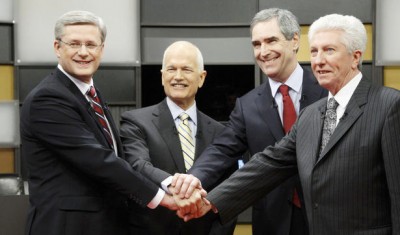
Stephen Harper wins English-language election debate

Stephen Harper shakes hands with petulant children

From left-wing Global TV, a university professor scores the first English-language debate in the Canadian Federal election.

Excerpt:

How well did the four leaders present their points?

Dr. Royce Koop: Harper is very effective at getting his message across. He is very clear, disciplined, and it’s tough to knock him off his game. Ignatieff is not communicating as well as I thought he would. He’s clearly new to this debate format.

Who were the clear aggressors and/or defenders throughout the debate?

Dr. Royce Koop: As can be expected, the three opposition leaders are the aggressors and Harper is the defender. However, Duceppe has distinguished himself as an aggressor. His opening comment was a strong, sharp attack of Harper. However, Harper is effectively defending himself in this debate. His strength is being disciplined, and he’s keeping his cool very well.

Who preformed best?

Dr. Royce Koop: Harper behaved like the PM-in-waiting. These debate formats actually favour the incumbent PM. Everyone is attacking them, and so they are able to rise above it all and act prime-ministerial. This is how Chretien survived the debates in 1997 and 2000, by riding above all the attacks, and Harper is doing so very effectively tonight.

What was your impression of the Harper-Ignatieff face-off? Who won that tete-a-tete?

Dr. Royce Koop: I think that Harper won that exchange, but it was a close call. Ignatieff has to be able to knock Harper off his game, and he hasn’t been able to do so effectively. He came close at the conclusion of the first exchange between them, but Harper came out on top.

A left-wing report from the Markdale Standard.

Excerpt:

Harper projected calm competence and self-assurance from the outset. He carried that through, almost without interruption, to his closing statement two hours later.

There was one moment when Ignatieff had an opening. That was in the prolonged section on democracy. Ignatieff was pressing hard. He scored some good hits on Stephen Harper, branding him a control freak who disrespects democratic institutions and, by extension, Canadians. It was a compelling segment and for a few moments it seemed like Ignatieff might turn the tide.

It didn’t happen. The debate moved on to other topics and ended, advantage Harper, on health care. Here Harper was very strong, looking pragmatic and sensible as the others sought in vain to breach his defence.

Harper’s debating skills, designed for TV, outmatched all three of the other contestants. Most tellingly, he looked constantly at the camera when answering questions, not at his opponents. He was the only one to do so consistently, though NDP leader Jack Layton also used this technique towards the end.

But Harper was rock-solid with it, constantly gazing into the camera, speaking directly Canadians in reassuring tones. With his body language he projected calm confidence. He kept his gestures small and controlled and within the circumference of his body – an effective technique on television.

[…]Tomorrow, look for Harper’s numbers in English Canada to rise sharply, into the low 40s. This will come as bitter brew to Liberal supporters across Canada, but it’s the simple reality: A Conservative majority is back on the table.

How did Harper win the debate? By using evidence.

Excerpt:

Canada’s good economic standing relative to its G8 counterparts, and the country’s relatively quick emergence from recession, can, in part, be credited to encouraging investment in the corporate sector, Mr. Harper said.

While in power, the Stephen Harper Conservatives have cut the corporate tax rate from 22.5% to 16.5%, with a further reduction to 15% scheduled for 2012.

To then foist a sudden reversal in policy on corporate Canada would send the wrong message to investors, Mr. Harper said on Tuesday. He quoted Jack Mintz, a public policy expert at the University of Calgary, as saying that the additional taxes proposed by the Liberals would cost the Canadian economy 200,000 jobs and $40-billion in business investment over the long run.

“Every credible economic analyst, every major business group in this country, says that if you raise taxes, you will hurt growth, hurt jobs and hurt revenue,” Mr. Harper said.

He must be the only politician I know who actually EXPLAINS why corporate tax-hikes are a bad idea. The government needs to cut taxes to attract corporations to move to their country, and to encourage their people to start or grow businesses. That’s where jobs COME FROM. And when people are working, because they have lots of jobs to choose from, they are happier and they pay more in taxes than if they were unemployed. And when people are employed, the government spends less on unemployment and other welfare programs. Notice that our corporate tax rate down here is 36%. More than double the Canadian corporate tax rate. Compared to the Canadians, we spend way too much, and we create far fewer jobs.

If the left-wing newspapers are calling it a victory for Harper, then it was a landslide victory for Harper. I am talking William Lane Craig vs Christopher Hitchens landslide victory. I can hardly wait to see the poll numbers from up north tomorrow. The latest pre-debate poll has Harper leading the socialist Liberal party by 12 points. (H/T Jeanie)

UPDATE: Post-debate poll shows that Harper won the debate.

Related posts