
Tag Archives: West Virginia

GAO study: EPA regulations will kill coal plant jobs and raise energy prices

From CNS News.

Excerpt:

New regulations issued by the Environmental Protection Agency will lead to the closure of older, coal-fired power plants and boost electricity prices in some parts of the country, according to a new report from the Government Accountability Office.

The GAO, at the behest of Sen. Jay Rockefeller (D-W.Va.), reviewed a host of information from government sources such as the EPA and Energy Information Agency (EIA) as well as private energy-sector forecasters to determine the likely impact of four new EPA regulations aimed at coal-fired power plants.

[…]GAO found that as many as 12 percent of coal-fired power plants may be closed because the EPA regulations make it too expensive for power companies to operate them, despite coal being one of world’s cheapest fuels.

“It is uncertain how power companies may respond to four key Environmental Protection Agency (EPA) regulations, but available information suggests companies may retrofit most coal-fueled generating units with controls to reduce pollution, and that 2 to 12 percent of coal-fueled capacity may be retired,” GAO said.

These changes – either installing expensive retrofits or closing power plants – will drive up electricity prices by as much as 13.5 percent in some areas of the country.

“Available information suggests these actions would likely increase electricity prices in some regions,” GAO said. “Regarding prices, the studies GAO reviewed estimated that increases could vary across the country, with one study projecting a range of increases from 0.1 percent in the Northwest to an increase of 13.5 percent in parts of the South more dependent on electricity generated from coal.”

Coal is the country’s single-largest source of electricity, accounting for 42 percent of power generation in 2011, GAO reported.

[…]The regulations at issue were all put in place by President Obama’s EPA to deal with power plant emissions and industrial waste called coal ash, the byproduct of burning coal.

This is another issue to communicate to everyone who will be voting in November. We already have price inflation from rising gas prices due to insufficient energy production at home, as well as currency inflation from several rounds of money printing and debt monetization. If we have to add to that higher electricity costs, then we really will be in trouble.
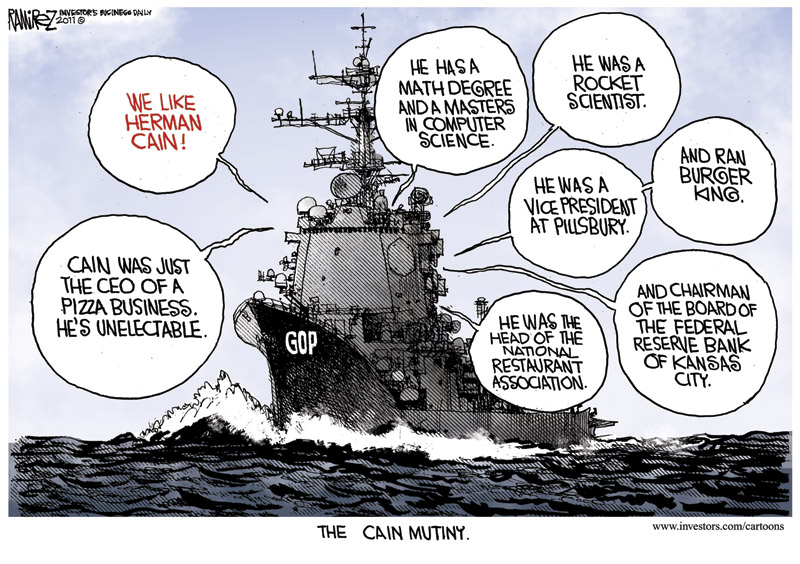
Herman Cain leads in Ohio, Hawaii, Iowa, North Carolina, Nebraska, West Virginia

The Cain Mutiny
The Cain Mutiny

From the Democrat Public Policy Polling firm.

Excerpt:

Herman Cain’s poll momentum is continuing for at least another week.  PPP surveys conducted over the weekend in Ohio and Hawaii find him with a large lead in both states.  That now makes 7 consecutive polls over the last 3 weeks- a national one and state polls in Ohio, Hawaii, Iowa, North Carolina, Nebraska, and West Virginia- that have found Cain leading the way.

[…]Tea Party voters continue to be the primary driver of Cain’s momentum. In Ohio he gets 46% of their support to 15% for Gingrich and 11% for Bachmann with Romney finishing all the way back in 4th place at 9%. It’s a similar story in Hawaii- there Cain and Romney actually tie at 30% each among non-Tea Party Republicans.  But with the Tea Pary crowd Cain gets a whooping 52% to 12% for Bachmann and 9% for Romney. These numbers represent a recurring theme in our polls- Romney doesn’t necessarily need to win Tea Pary voters but he sure needs to not lose them by 40 points if he hopes to win the nomination.

[…]The big loser in these polls is Rick Perry.  The low numbers of Republicans planning to vote for him is a concern but his even bigger issue is that GOP voters are now saying that they just flat out don’t like him. In Ohio his favorability is 40/42 with the primary electorate and in Hawaii it’s 36/40. His problem isn’t that Republican voters just like someone else better than him- it’s that at this point they don’t even like him at all.  He has some serious image rehabilitation to do to get back in this race.

[…]In addition to Cain the other candidate continuing to show some surprising momentum in Newt Gingrich. He gets a solo third in Ohio and a tie for third in Hawaii, and the numbers in the Buckeye State show the improvement in his image over the last 5 months.  When PPP last tested his favorability in May he was at 42/34 with primary voters. Now that’s improved to 56/32 and the only Republican with a better net favorability is Cain.

Results:

Poll Cain’s lead (%) Second place (%)
National 30 Romney 22
Ohio 34 Romney 19
Hawaii 36 Romney 24
Iowa 30 Romney 22
North Carolina 27 Romney/Gingrich 17
Nebraska 30 Gingrich 16
West Virginia 24 Gingrich 18

I wonder when the liberal Mitt Romney will be dropping out of the race? Perhaps he can go work for Obama, since he seems to agree so much with him.

Related posts

Republicans introduce national right-to-work legislation

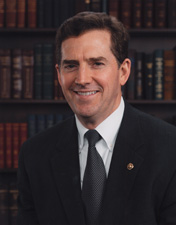
Sen. James Demint

From the Hill.

Excerpt:

Eight Republican Senators introduced a bill Tuesday giving workers a choice as to whether to join labor unions, which they argue will boost the nation’s economy and provide an increase in wages.

Sen. Jim DeMint (R-S.C.), introduced the National Right to Work Act to “reduce workplace discrimination by protecting the free choice of individuals to form, join, or assist labor organizations, or to refrain from such activities,” according to a statement.

Seven other Republicans signed onto the effort: Sens. Tom Coburn (Okla.), Orrin Hatch (Utah), Mike Lee (Utah), Rand Paul (Ky.), James Risch (Idaho), Pat Toomey (Pa.) and David Vitter (La.).

“Facing a steady decline in membership, unions have turned to strong-arm political tactics to make forced unionization the default position of every American worker, even if they don’t want it,” Hatch said. “This is simply unacceptable. At the very least, it should be the policy of the U.S. government to ensure that no employee will be forced to join a union in order to get or keep their job.

“Republicans cited a recent poll they said shows that 80 percent of union members support having their policy and that “Right to Work” states outperform “forced-union” states in factors that affect worker well being.

From 2000 to 2008, about 4.7 million Americans moved from forced-union to right to work states and a recent study found that there is “a very strong and highly statistically significant relationship between right-to-work laws and economic growth,” and that from 1977 to 2007, right-to-work states experienced a 23 percent faster growth in per capita income than states with forced unionization.

“To see the negative impacts of forced unionization, look no further than the struggling businesses in states whose laws allow it,” Vitter said. “It can’t be a coincidence that right-to-work states have on balance grown in population over the last 10 years, arguably at the expense of heavy union-favoring states.”

DeMint blamed the problems faced by U.S. automakers on the unions.

“Forced-unionism helped lead to GM and Chrysler’s near bankruptcy and their requests for government bailouts as they struggled to compete in a global marketplace,” he said. “When American businesses suffer because of these anti-worker laws, jobs and investment are driven overseas.”

If you want to attract businesses, then you need to have pro-business laws. That’s where jobs come from – businesses.

Here’s an article about states who are trying to pass these laws to attract more employers.

Excerpt:

Currently 14 states beyond Indiana and Wisconsin are considering legislation that would limit union benefits and/or collective bargaining power. They are: Alaska, Hawaii, Maine, Michigan, Minnesota, Missouri, Montana, New Hampshire, New Mexico, Ohio, Pennsylvania, Virginia, Washington (state) and West Virginia. In any number of these states, supporters have planned or held rallies against the measures. But public support might be less than deep. According to a Rasmussen Poll conducted late last week and released Monday, 48 percent of likely U.S. voters sided with Wisconsin Governor Walker whereas only 38 percent sided with his union opponents; the other 14 percent were undecided. And 50 percent of the respondents favored reducing their home state’s government payroll by one percent a year for 10 years either by reducing the work force or reducing their pay. Only 28 percent opposed such action.

This is how we are going to turn the recession around. Cut off the spending on left-wing special interests – NPR, PBS, ACORN, Planned Parenthood, Unions. They all will have to pay their own way, just like the grown-ups do.