The Washington Times reports on the latest numbers from the Census Bureau.
Excerpt:
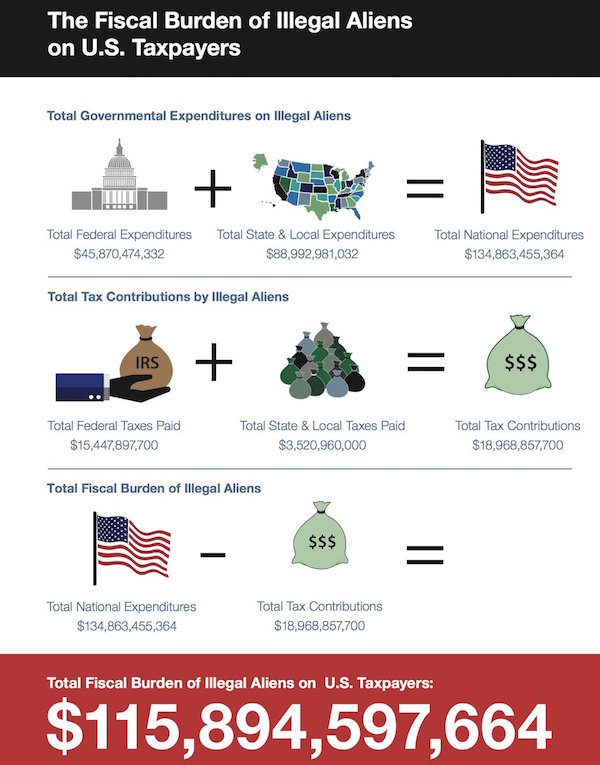
The latest Census Bureau numbers find that more than seven of 10 households headed by immigrants in California, and nearly the same amount in Texas, are on the taxpayer dole.
[…]According to the latest numbers from 2014, fully 63 percent of non-citizens are living off at least one welfare program. That translates into 4.68 million households.
[…]“Concern over immigrant welfare use is justified, as households headed by non-citizens’ use means means-tested welfare at high rates,” said the Center for Immigration Studies, in its report on the numbers. “Non-citizens in the data include illegal immigrants, long-term temporary visitors like guest workers, and permanent residents who have not naturalized.”
What’s most troublesome about the Census findings is the fact that the 63 percent of non-citizens on welfare actually grows to 70 percent for those who stay in-country 10 years or longer — meaning the entitlement mind only solidifies.
Meaning non-citizens on welfare don’t tend to get off welfare.
The reason I am posting about this study is because of the widespread perception on the left that all opposition to illegal immigration is just caused by racism. And similarly, support for border security has nothing to do with preventing crime and protecting our national security. It’s all caused by racism too. Well, when you look at a study like this, you can clearly see that people who oppose illegal immigration and support border security have other things on their minds than racism.
Right now, we are nearly $28 trillion in debt. And it’s climbing by over $1 trillion per year. We’re already spending too much money. Interest on the debt is becoming a larger and larger part of our budget, leaving less money for real priorities like defense and infrastructure. Someone is going to have to pay for all these handouts that are driving us into debt. Young people people have the most to lose, because they have their whole professional lives ahead of them.
I just want to be clear about something. I am very much in favor of skilled immigration. I think that people who come here to WORK should be allowed to come here to WORK. While they are WORKING they should be ineligible for collecting any money from the government. They should not be able to vote or influence elections. They should not be able to bring any of their non-working relatives here. They should be deported if they commit a felony. They should be deported if they lose or quit their jobs. And if they are able to keep working, following the law, and staying off the dole, for a period of 10 years, then they should be allowed to apply for green cards. But our current system isn’t oriented towards skilled immigrants. All the concern on the left AND on the right AND in the churches is about refugees and illegal immigrants.
Personally, I think we could be a LOT more accepting of skilled immigrants if we got rid of all the welfare programs. After all, if there is no welfare to be collected, then why would people even want to come here? The only reason they would come would be for the right reason – for liberty. And in order to stay, they would have to work and follow the law. That’s who we want to bring in. If we only brought in law-abiding workers, then we could be a lot more generous about letting people of all races in.
And from a political point of view, we don’t do well when we import a bunch of big government liberals from countries that don’t accept American ideals, like individual liberty and limited government.
As far as I’m concerned, there should only be two paths to citizenship for immigrants: skilled labor and military service. And both of those for 10 years minimum. But that’s not how the current system works. I just want everyone to understand that this is not an issue that has no effect on taxpayers. If we bring in unskilled immigrants and refugees, then we are going to have to pay for their schooling, their health care, and maybe even basics like food and spending money.
In this post, I have the video of a debate on the topic of what Christians should think about economics and economic policies. In addition to the video, I summarized the two opening speeches and the two rebuttals, for those who prefer to read rather than watch. We’ll start with a short biography about each of the debaters.
The video recording:
The debaters
Jay Richards:
Jay Richards, Ph.D., is a Senior Fellow of the Discovery Institute where he directs the Center on Wealth, Poverty and Morality, and is a Visiting Scholar at the Institute for Faith, Work & Economics. Most recently he is the co-author with James Robison of the best-selling Indivisible: Restoring Faith, Family, and Freedom Before It’s Too Late”.
In addition to writing many academic articles, books, and popular essays on a wide variety of subjects, he recently edited the new award winning anthology, God & Evolution: Protestants, Catholics and Jews Explore Darwin’s Challenge to Faith . His previous book was Money, Greed, and God: Why Capitalism Is the Solution and Not the Problem (HarperOne, May 2009), for which he received a Templeton Enterprise Award in 2010.
[…]In recent years, he has been a Contributing Editor of The American at the American Enterprise Institute, a Visiting Fellow at the Heritage Foundation, and a Research Fellow and Director of Acton Media at the Acton Institute. Richards has a B.A. with majors in Political Science and Religion, an M.Div. (Master of Divinity) and a Th.M. (Master of Theology), and a Ph.D. (with honors) in philosophy and theology from Princeton Theological Seminary.
Jim Wallis:
Jim Wallis (born June 4, 1948) is a Christian writer and political activist. He is best known as the founder and editor of Sojourners magazine and as the founder of the Washington, D.C.-based Christian community of the same name. Wallis is well known for his advocacy on issues of peace and social justice. […]He works as a spiritual advisor to President Barack Obama.
[…]In 2010, Wallis admitted to accepting money for Sojourners from philanthropist George Soros after initially denying having done so. […]In 2011, Wallis acknowledged that Sojourners had received another $150,000.00 from Soros’ Open Society Foundation.
Wallis just came out this month in favor of gay marriage. He is also a strong supporter of Barack Obama, who is radically pro-abortion. Some pro-lifers have argued that Barack Obama has the same views on abortion as Kermit Gosnell, because Obama voted twice to allow abortions on babies who were already born alive.
The format of the debate
20 minute opening speeches
10 minute rebuttals
10 minutes of discussion
Q&A for the remainder
SUMMARY
I use italics below to denote my own observations.
Jim Wallis’ opening speech:
My goal is to spark a national conversation on the “common good”.
A story about my son who plays baseball.
The central goal of Christianity is to promote the “common good”.
Quotes “Catholic social teaching” which values “human flourishing”.
The “common good” is “human flourishing”.
Is the purpose of Christianity is to make sure that everyone has enough material stuff or to preach the gospel?
When Christians go on mission trips, it’s good that they focus on things like human trafficking.
Democrat John Lewis is the “conscience of the U.S. Congress”.
John Lewis gets a 0% rating from the American Conservative Union in 2012.
John Lewis gets a 8% rating from the American Conservative Union in 2011.
John Lewis gets a 2.29% lifetime rating from the American Conservative Union.
Nothing is going well in Washington right now except comprehensive immigration reform.
Does he think that Christianity means giving 20-30 million illegal immigrants a path to citizenship, while skilled engineers cannot even get green cards, even though there is a shortage of them? Does he think that the other people in society who earn more than they receive from the government ought to be taxed more in order to provide more services and benefits to those who earn less than they take from the government?
Jay Richards’ opening speech:
Two topics: 1) what is the common good? 2) what should Christians do to promote the common good?
Catholicism defines the “common good” as “Indeed, the common good embraces the sum of those conditions of the social life whereby men, families and associations more adequately and readily may attain their own perfection.”
We have natural ends that we are supposed to be achieving and some places, like South Korea, are better for allowing that to happen.
The common good is broader and prior to any sort of political specification.
It’s not the political good or what the state is supposed to do.
It’s not about the communal good, as in Soviet Russia, where the communal good was above individual and familial good.
The common good is the social conditions that promote the things that we humans have in common as individuals and members of family.
The common good takes account of who we are as individuals and in associations with other individuals, e.g. – families.
Christians don’t have to be doing the same things to promote the common good, e.g. – pastors, entrepreneurs, etc.
The church, as the church, has as its primary goal making disciples of all nations.
But even in that capacity, the church should be interested in more than just conversions and saving souls.
We also have to care about God’s created reality including things like physics, education, etc.
How should Christians promote the common good in politics?
Question: when is coercion warranted?
In Romans 13, Paul says that the state does have power to coerce to achieve certain ends, like justice.
Most Christians think that there are some things where the state can use coercion, for example, to prevent/punish murder.
It is OK for the police to use coercive force to maintain public order and the rule of law.
But we need to ask whether other things are legitimate areas for the state to use coercive force.
We should only give the state power to coerce when there is no other way to achieve a goal.
We need to leverage the science of economics in order to know how to achieve the common good.
Jay Richards’ main point in the debate
Henry Hazlitt: “The art of economics consists in looking not merely at the immediate but at the longer effects of any act or policy; it consists in tracing the consequences of that policy not merely for one group but for all groups.”
For example, what happens if we raise the federal minimum wage to $50. What happens next for all groups? That’s what we need to ask in order to know which policies achieve the common good.
When it comes to economics a lot of things have been tried in other places and times.
We can know what works and doesn’t work by studying what was tried before and in other places.
Many things are counter-intuitive – things that sound good don’t work, things that sound bad do work.
Principle: “We are our brother’s keeper”. Christians have an obligation to care for their neighbors.
We all agree on the goal. But how do we do things that will achieve that goal?
We have to distinguish aspirations from principles and prudential judgment.
Principle: We should provide for the material needs of the poor.
Prudence: Seeing the world as it is, and acting accordingly.
Example policies: which minimum wage is best? None? $10? $20?
We decide based on seeing how different economic policies achieve the goal of helping the poor.
Jim Wallis’ first rebuttal:
Jesus commanded us to “care for the poor and help to end poverty”.
Actually, Jesus thought that acknowledging him and giving him sacrificial worship was more important than giving money to the poor, see Matthew 26:6-13:
6 While Jesus was in Bethany in the home of Simon the Leper,
7 a woman came to him with an alabaster jar of very expensive perfume, which she poured on his head as he was reclining at the table.
8 When the disciples saw this, they were indignant. “Why this waste?” they asked.
9 “This perfume could have been sold at a high price and the money given to the poor.”
10 Aware of this, Jesus said to them, “Why are you bothering this woman? She has done a beautiful thing to me.
11 The poor you will always have with you, but you will not always have me.
12 When she poured this perfume on my body, she did it to prepare me for burial.
13 Truly I tell you, wherever this gospel is preached throughout the world, what she has done will also be told, in memory of her.”
It’s not clear to me whether Jim Wallis thinks that preaching is more important than redistributing wealth to address material inequality.
I like what Jesus said in a TV series, even though it’s not in the Bible when an actor playing Jesus said to “change the world”.
Jesus never said to “change the world” in the Bible. Should we be concerned that he is quoting a TV actor playing Jesus instead of Jesus.
Here is a terrific story about Bill Bright.
I love Catholic social teaching.
Quote: “All are responsible for all”.
I go to the World Economic Forum at Davos, Switzerland every year. I spoke once at 7 AM on the 4th floor.
It’s a funny place for a Christian to be if they care about the poor – rubbing shoulders with leftist elites. He must have named a dozen high-profile people that he spoke with during the debate, as if he could win the debate by some sort of argument from name-dropping. He mentioned the Davos thing several times!
The greatest beneficiary of government actions to deal with the economic crisis was Wall Street banks.
I’m going to tell you a story about what a Washington lawyer says to Jesus.
I’ve had conversations with business leaders where I tell them to integrate moral truths.
I talk about the Good Samaritan parable.
Quote: “Do you love your undocumented neighbor?”
Quote: “Do you love your Muslim neighbor?”
Jay Richards’ first rebuttal:
Who is responsible for your own children? Who knows the most about them?
Parents should have more discretion over their children because they have more knowledge about their child and what’s best for them.
The Good Samaritan doesn’t show that government should confiscate wealth through taxation and redistribute it.
The Good Samaritan emphasizes voluntarily charity to help people who are not necessarily your immediate neighbor.
Some of the things we do should be for the good of other people in other countries.
But then we are back to leveraging economics to know what policies are good for those other people in other countries.
The principle of subsidiarity: if a problem can be addressed by a lower level of society (family) then we shouldn’t make higher levels (government) address it.
The best place to take care of children is within the family.
Only if the family fails should wider and wider spheres get involved.
Although we want to think of the common good in a global sense, we don’t want to lose sight of the fact
The financial crisis: we need to integrate moral truths, but also economic truths.
We don’t want to assume policies based on intuitions, we want to check our intuitions using economic principles.
Why did we have a financial crisis in mortgages, but not in commodities futures or technology, etc.?
Greed is a contributing factor in all areas of business.
Something more was going on in the mortgage markets than just greed.
There were specific policies that caused the mortgage lending crisis.
The root cause of the problem were “affordable housing policies” that lowered lending restrictions on low income people.
The policy ended up degrading the underwriting standards on loans.
Government intruded into the market and undermined the normal ways of
People were getting massive loans with no income, no jobs, no assets and no down payment.
The federal government created a market for risk loans by guaranteeing
There was a government imposed quota on mortgage lenders such that 50% of their loans had to be given to high-risk borrowers.
That is what led to the financial crisis. Not the free market, but intrusions into the free market.
These policies were well-meaning and implemented by people from both parties. But they had bad effects.
This is a repeat post, I just want to remind everyone where Biden stands on legal firearm ownership from his past comments.
In the wake of mass shootings by people who don’t obey the law, Democrat presidential candidates are vowing to confiscate ALL semi-automatic pistols and rifles, as well as ban magazines with more than one bullet. They believe that by taking weapons from law-abiding Americans, they will be able to stop violence committed by those who don’t care about laws. Will that work?
Democrat presidential candidate Joe Biden went far to the left on the issue of guns on Monday, telling reporters that he wants to ban magazines that hold “multiple bullets” — which means all magazines.
Biden, who made the remarks while talking to the press during a campaign stop in Cedar Rapids, Iowa, said there should be “no compromise” on guns as he also voiced his anger at the state of Texas for allowing people to carry firearms in places of worship to defend themselves from those who seek to harm others.
“And we’re talking about loosening access, to have guns, to be able to take them into places of worship, I mean, it is absolutely irrational. It’s totally irrational,” Biden said. “The idea that we don’t have elimination of assault-type weapons, magazines that can hold multiple bullets in them, it’s absolutely mindless.”
“It’s no violation of the Second Amendment,” Biden falsely claimed.
Biden’s extreme gun control push, if ever enacted, would effectively ban the overwhelming majority of handguns, all semi-automatic shotguns and rifles, and many hunting rifles which use magazines.
We’ve actually had a number of mass shootings where left-wing atheists attacked Christians during worship. I guess Joe Biden has an alternative plan for protecting Christians from far-left atheist Democrats. Maybe he plans to show up at the mass shootings in churches, and have a talk with the shooters about following gun laws.
Not to be outdone, here’s another candidate promising to ban all semi-automatic weapons, pistols AND rifles.
Far-left Democratic presidential candidate Robert Francis O’Rourke announced over the weekend that if he is elected president, he intends to confiscate tens of millions of semi-automatic firearms from law-abiding Americans.
O’Rourke made the remarks while campaigning in Charlottesville, Virginia, on Saturday when he was asked by a reporter how he plans to address peoples’ fears that the government is going to come and take many of their semi-automatic firearms.
O’Rourke responded: “I want to be really clear, that’s exactly what we are going to do. Americans who own [the technically undefinable sub-class of semi-automatic firearms referred to as “assault weapons”] will have to sell them to the government.”
It’s amazing to me that there is so much evidence that gun violence is caused by fatherlessness, but Democrats don’t want to do anything about it. If we stopped giving women welfare money for having babies before they are married, gun violence would dry up in a second. We’ve always had access to guns in this country, but it was wasn’t a problem when every child had a mother and father.
If strict laws were effective, then why do we see such high rates of gun violence precisely in Democrat-run areas where law-abiding people are prohibited from owning weapons to defend themselves from criminals? Mass shootings get a lot of press, but the truth is that more people died in Chicago last week in ordinary crimes than died in the most recent mass shooting in Odessa, TX.
The peer-reviewed research
Whenever I get into discussions about gun control, I always mention two academic books by John R. Lott and Joyce Lee Malcolm.
Here is a paper by Dr. Malcolm that summarizes one of the key points of her book.
Excerpt:
Tracing the history of gun control in the United Kingdom since the late 19th century, this article details how the government has arrogated to itself a monopoly on the right to use force. The consequence has been a tremendous increase in violent crime, and harsh punishment for crime victims who dare to fight back. The article is based on the author’s most recent book, Guns and Violence: The English Experience (Harvard University Press, 2002). Joyce Malcom is professor of history at Bentley College, in Waltham, Massachusetts. She is also author of To Keep and Bear Arms: The Origins of an AngloAmerican Right (Harvard University Press, 1994).
And the result of the 1997 gun ban:
The result of the ban has been costly. Thousands of weapons were confiscated at great financial cost to the public. Hundreds of thousands of police hours were devoted to the task. But in the six years since the 1997 handgun ban, crimes with the very weapons banned have more than doubled, and firearm crime has increased markedly. In 2002, for the fourth consecutive year, gun crime in England and Wales rose—by 35 percent for all firearms, and by a whopping 46 percent for the banned handguns. Nearly 10,000 firearms offences were committed.
[…]According to Scotland Yard, in the four years from 1991 to 1995 crimes against the person in England‟s inner cities increased by 91 percent. In the four years from 1997 to 2001 the rate of violent crime more than doubled. The UK murder rate for 2002 was the highest for a century.
I think that peer-reviewed studies – from Harvard University, no less – should be useful to those of us who believe in the right of self-defense for law-abiding people. The book by economist John Lott, linked above,compares the crime rates of all U.S. states that have enacted concealed carry laws, and concludes that violent crime rates dropped after law-abiding citizens were allowed to carry legally-owned firearms. That’s the mirror image of Dr. Malcolm’s Harvard study, but both studies affirm the same conclusion – more legal firearm ownership means less crime.


 WINTERY KNIGHT