Tag Archives: War

Ronald Reagan’s 40th anniversary D-Day speech: the boys of Pointe du Hoc

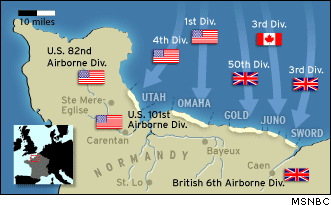
June 6, 1944 D-Day Normandy Invasion Map

It’s June 6th, today, and it’s the anniversary of D-Day: the Allied invasion of northern France – the beginning of the end of World War 2. One of the most pivotal events of that day was the assault on German gun emplacements by members of the Army Rangers at a fortified position called “Pointe du Hoc”.

President Ronald Reagan recognized the soldiers who attacked Pointe du Hoc back in 1984:

You can read the full transcript of that speech here.

Ronald Reagan also made the case for gratitude and vigilance:

Here’s the hymn that starts to play at the end:

The Boys of Pointe du Hoc

Here’s a summary of the Pointe du Hoc mission:

[Lt. Col. James Earl] Rudder took part in the D-Day landings as Commanding Officer of the United States Army’s 2nd Ranger Battalion. His U.S. Army Rangers stormed the beach at Pointe du Hoc and, under constant enemy fire, scaled 100-foot (30 meter) cliffs to reach and destroy German gun batteries. The battalion’s casualty rate for this perilous mission was greater than 50 percent. Rudder himself was wounded twice during the course of the fighting. In spite of this, they dug in and fought off German counter-attacks for two days until relieved. He and his men helped to successfully establish a beachhead for the Allied forces.

You can watch a three-clip documentary on it, too: part 1, part 2, part 3.

Although initially, the Rangers did not find the guns where they had expected them, they did find them further back behind the cliffs and destroyed them there, removing a threat to the forces that would be landing later.

What does D-Day mean to Christians in particular?

A Christian friend asked me what she should be thinking about when I sent her one of the videos above, and so I wrote her this to explain why I sent her the video:

To make you close your eyes and think in a more practical way about what it means for someone to sacrifice their lives to save you, of course. What it means to look up cliffs at machine guns, barbed wire and mortars raining death on you and to take a rope in your hands and to climb up a sheer cliff, under heavy fire, in order to save generations yet unborn and freedom itself.

To think about a concrete example helps us to be able to appreciate what Christ did for us in giving his life for us so that we could be free of sin, as well.

This is the insight that drives my entire interest in war and military history, in fact.

What does this mean: “Greater love has no man than this, that a man lay down his life for his friends.”

The more you know about D-Day, the more fearful what Jesus did appears, and the more you can be grateful.

Bullets and shrapnel are scary… and so are nails and lashes. Why on Earth would anyone endure either for me? And what should my response be to it?

I think it is helpful to explain Christianity to those who are not yet Christian, and for Christians to fully appreciate what Christianity is all about.

We were in peril. And now we have been saved. But at a cost.

I think that it’s important for Christians to look to history, art, poetry and music to help them to reflect and comprehend the sacrifice that Christ made for us in dying on the cross to protect us from peril. What must the cross have looked like to Jesus? It must have been something like what the Omaha beach looked like to the Americans landing in Normandy. Jesus saw whips, thorns and nails, and the heroes of Normandy saw 88 mm AT guns, 81 mm mortars and MG42 machine guns. How should you feel about people who face death on your behalf? Think about it.

Should Christians expect to know God’s will by means of feelings and intuitions?

There are two views on the topic of decision making and the will of God. The view you learn in the church is called “the traditional view”. I call this view the feelings/intuition view. This view that elevates feelings / intuitions to the level of divine communications from God. The more practical view is called “the wisdom view”. I call this view the battlefield commander view. I am a proponent of the wisdom / commander view.

Let’s learn about the two different views:

[The traditional view is] that God has a plan for our lives and that we receive guidance through methods such as “open and closed doors”, “feeling led” and “the still, small, voice”.

[The wisdom view] holds that God does not have an “individual will” for our lives, but rather that all of God’s will can be summed up within two categories, God’s sovereign will and God’s moral will. Basically God’s sovereign will is all the things that god decrees will happen. It is hidden (mostly) from us, and does not play an active part in our decision, although some of it is revealed in the bible. God’s moral will is the part that we must concern ourselves with in making decisions. It is fully revealed in the bible and our decisions must be made within it. We may use wisdom in applying god’s moral will to our lives, or we may be in an area not covered by god’s moral will. We must finally submit in advance to God’s sovereign will, being prepared for him to sovereignty intervene and redirect us through whatever means he wills (see James).

Here’s a bit more from someone else:

Regarding the view that God has a personal will for us individually that we have to discern and find, J.I. Packer says, “The first thing to say is that the idea of guidance is actually a novelty among orthodox evangelicals. It does not go back farther than the last century. Second, it has led people to so much foolish action on the one hand, and so much foolish inaction on the other, as well as puzzlement and heartbreak when the ‘hotline’ to God seems to go silent, that it has to be discredited. Third, it must be said that Scripture gives us no more warrant constantly to expect personal ‘hotline,’ ‘voice-from-the-control-tower’ guidance than to expect new authoritative revelations to come our way for the guidance of the whole church.” (Hot Tub Religion, page 118).

As to the point of the question, how do I make decisions, I attempt to make decisions in light of three factors: God’s moral will, wisdom, and my personal desires. If something is opposed to God’s moral will, then I should obviously flee from it. If it’s not opposed, then I consider the wisdom of the choices. For example, would it be wise for me to marry a woman who loves Jesus, though we have nothing else in common? Probably not. If the options pass the criteria of wisdom, then I’m free to choose how I wish. If I’m offered two jobs, and both are honoring to God, and both would be wise to take, then I’m free to choose the job I would like more. I don’t need to put out a fleece or await some other confirmation from God. If it’s moral and wise, then the only question as to whether or not it will honor Him is my attitude.

Some examples of this model used in the Bible (in theological circles referred to as the Wisdom Model) are in Paul’s planning of a mission to Rome in Romans 1:9-15, 15:22-24, the Jerusalem Council (Acts 15:1-29), and Paul’s instructions for legal disputes (1 Cor 6:3-6).

The best book on this topic is Garry Friesen’s “Decision Making and the Will of God”. In it, you’ll find a full assessment about what the Bible teaches on this topic.

When I am trying to decide what will be effective, I look at Christian scholars, at their papers, books, and public debates. That’s effectiveness because it is addressed to a non-Christian audience in public with the force of reason and evidence. It is persuasion and it is addressed to rational minds. I want to change the minds of people who have a large influence on society on the whole. I don’t think that offering Christianity as life-enhancement or self-help is really “having an influence”. I think that offering Christianity as truth, with support, is “having an influence”.

So let me be clear about what I believe:

  • I don’t think that God normally talks to people directly
  • I don’t believe that life is an Easter egg hunt, filled with clues accessible only to emotion and intuition
  • I don’t believe that God expects people to discover a specific will for their lives using non-rational means
  • I think that people make up their own life plan that is consistent with the Bible
  • The goal of the life plan is to be effective, and there are no other considerations
  • I think that there are many good things a person can do, but that some are more effective than others
  • I think that with respect to the goal of serving God effectively, my happiness is expendable
  • I don’t think that the purpose of doing something for the Lord is to feel good about ourselves
  • I don’t think that people should choose ineffective things to do just because they like them
  • I don’t think that people should choose ineffective things to do just because they are good at them
  • I think people should do hard things that they don’t like – as long as it’s more effective
  • I don’t think that any course of action is as effective as any other – some plans accomplish more
  • I don’t think that life is totally unpredictable and irrational and subjective
  • I think that we can know what is or is not effective by studying and learning about the world
  • I think life is like a battlefield that must be surveyed, understood and acted upon deliberately

I think that every person is the commanding officer of his or her own life, and each person must study everything they can, make a plan that is consistent with the Bible’s moral prescriptions, execute the plan and achieve whatever they can achieve for the Lord. And the goal is not comfort or happy feelings, but real achievements. Not for the purpose of being saved, of course, because salvation is a free gift of God because of what Jesus did on the cross. Life is more like a battle than a vacation resort or a buffet or a shopping center. God’s will for us is not have happy feelings, but that we freely choose to sacrifice ourselves out of obedience and service to him. In my case, that means studying hard things, making money, saving money, and giving money away to good scholars, sponsoring good events and being persuasive to non-Christians. None of this necessarily makes me happy, but it does work to bring glory to God. I cried when I had to learn calculus, because it was so hard. But who cares? The main thing is that I have money now to sponsor Christian speakers or to give books to Christians to read, and God is happy with that.

I think that it is very important to realize that God is not impressed by our not being smart and not being effective. If we have the ability to be smart, then we should be smart, whether it makes us happy or not. If we have the ability to make money, then we should make money, whether it makes us happy or not. If we have the ability have a great influence, then we should have a great influence, whether it makes us happy or not. There will be plenty of time for happiness after we’re dead. But this life is a time of serving, and we should try to serve effectively, whether it makes us happy or not. With respect to God’s purposes in the world, my happiness is expendable.

Whenever someone questions my goals and plans by saying that I am asserting my will over God’s will, the first question I want to ask that person is this: “how do you know what God’s will is?” and “what is your basis for thinking that my plan to serve will not be effective?”. I want to know if I have misunderstood something about the way the world is, or miscalculated in some way. I want someone to look at my calculations and show where they are going to produce a less optimal result for the Lord. That’s the only concern I have – effectiveness for the Lord. Usually what I have found is that the other person wants to make the purpose of life their own happiness, and it makes them happier to choose what to do moment by moment, without having to study anything or make plans. It’s not that they have better goals (for God) or better plans (for God). It’s that they want their goals to be above God, and they don’t want to make plans other than to do whatever makes them happy.

This article by Greg Koukl may be helpful.

And I also found this summary of the Friesen book useful:

In nine parts.

What can Winston Churchill teach us about deterring aggression?

Winston Churchill on appeasement

Famous economist Thomas Sowell explains.

He writes:

Despite Churchill’s legendary status today, he was not merely ignored but ridiculed at the time, when he was repeatedly warning in vain. Knowing that his warnings provoked only mocking laughter in some quarters, even among some members of his own party, he said on March 14, 1938 in the House of Commons, “Laugh but listen.”

Just two years later, with Hitler’s planes bombing London, night after night, the laughter was gone. Many at the time thought that Britain itself would soon be gone as well, like other European nations that succumbed to the Nazi blitzkrieg in weeks (like France) or days (like Holland).

How did things get to such a desperate situation, with Britain alone continuing the fight, and struggling to survive, against the massive Nazi war machine that now controlled much of the material resources on the continent of Europe?

Things got that desperate by following policies strikingly similar to the policies being followed by the Western democracies today, including some of the very same notions and catchwords being used today.

Just recently, a State Department official in the Obama administration said that Americans have remained safe in a nuclear age, not because of our own nuclear arsenal but because “we created an intricate and essential system of treaties, laws and agreements.”

If “treaties, laws and agreements” produced peace, there would never have been a Second World War. The years leading up to that monumental catastrophe were filled with international treaties and arms control agreements.

The Treaty of Versailles, which ended the First World War, imposed strong restrictions on Germany’s military forces — on paper. The Washington Naval Agreements of 1922 imposed restrictions on all the major naval powers of the world — on paper. The Kellogg-Briand pact of 1928 created an international renunciation of war — on paper.

The Munich agreement of 1938 produced a paper with Hitler’s signature on it that British Prime Minister Neville Chamberlain waved to the cheering crowds when he returned to England, and said that it meant “Peace for our time.” Less than a year later, World War II began.

Winston Churchill never bought any of this. He understood that military deterrence was what preserved peace. With England playing a leadership role in Europe, “England’s hour of weakness is Europe’s hour of danger,” he said in the House of Commons in 1931.

[…]While Russia and China increased the share of their national output that went to military spending in 2014, the United States reduced its share. Churchill deplored the “inexhaustible gullibility” of disarmament advocates in 1932. That gullibility is still not exhausted in 2015.

“Not one of the lessons of the past has been learned, not one of them has been applied, and the situation is incomparably more dangerous,” Churchill said in 1934. And every one of those words is more urgently true today, in a nuclear age.

Here’s another article by Thomas Sowell that explains it more.

Excerpt:

In France, after the First World War, the teachers’ unions launched a systematic purge of textbooks, in order to promote internationalism and pacifism.

Books that depicted the courage and self-sacrifice of soldiers who had defended France against the German invaders were called “bellicose” books to be banished from the schools.

Textbook publishers caved in to the power of the teachers’ unions, rather than lose a large market for their books. History books were sharply revised to conform to internationalism and pacifism.

The once epic story of the French soldiers’ heroic defense against the German invaders at Verdun, despite the massive casualties suffered by the French, was now transformed into a story of horrible suffering by all soldiers at Verdun— French and German alike.

In short, soldiers once depicted as national heroes were now depicted as victims— and just like victims in other nations’ armies.

[…]France, where pacifism and internationalism were strongest, became a classic example of how much it can matter.

During the First World War, France fought on against the German invaders for four long years, despite having more of its soldiers killed than all the American soldiers killed in all the wars in the history of the United States, put together.

But during the Second World War, France collapsed after just six weeks of fighting and surrendered to Nazi Germany.

At the bitter moment of defeat the head of the French teachers’ union was told, “You are partially responsible for the defeat.”

Charles de Gaulle, Francois Mauriac, and other Frenchmen blamed a lack of national will or general moral decay, for the sudden and humiliating collapse of France in 1940.

Is the same thing happening in our public schools? Are our children taught to think that wars can be prevented by unilaterally disarming?

The lesson we need to learn from history is that the way to stop wars is by making the people who want to start them understand that there will be a price to pay if they start a war. That means that we need a certain amount of military power, and that we should have demonstrated that we are willing to use it. That is counter-intuitive to people on the left who cannot imagine that evil tyrants really are evil tyrants. They want to believe that problems can be solved with talk, but history teaches that talk is cheap.