Tag Archives: Wall Street

New housing bubble: Obama proposes lowering mortgage-lending requirements

I must have blogged a million times about how the Democrats caused the recession by forcing banks to make bad loans to people who couldn’t pay them back. Although the Republicans got blamed for the crisis, they were the ones who tried to regulate Fannie Mae and Freddie Mac, but they were shut down by Democrats. Well, guess what? The Democrats didn’t learn their lesson the first time, and they want to start another housing bubble, just like the first one that gave us the recession.

Take a look at this article in the leftist Washington Post. (H/T ECM)

Excerpt:

The Obama administration is engaged in a broad push to make more home loans available to people with weaker credit, an effort that officials say will help power the economic recovery but that skeptics say could open the door to the risky lending that caused the housing crash in the first place.

[…][A]dministration officials say they are working to get banks to lend to a wider range of borrowers by taking advantage of taxpayer-backed programs — including those offered by the Federal Housing Administration — that insure home loans against default.

Housing officials are urging the Justice Department to provide assurances to banks, which have become increasingly cautious, that they will not face legal or financial recriminations if they make loans to riskier borrowers who meet government standards but later default.

Officials are also encouraging lenders to use more subjective judgment in determining whether to offer a loan and are seeking to make it easier for people who owe more than their properties are worth to refinance at today’s low interest rates, among other steps.

Obama pledged in his State of the Union address to do more to make sure more Americans can enjoy the benefits of the housing recovery, but critics say encouraging banks to lend as broadly as the administration hopes will sow the seeds of another housing disaster and endanger taxpayer dollars.

“If that were to come to pass, that would open the floodgates to highly excessive risk and would send us right back on the same path we were just trying to recover from,” said Ed Pinto, a resident fellow at the American Enterprise Institute and former top executive at mortgage giant Fannie Mae.

And if that was not enough,the Democrats also have another bubble being inflated. They nationalized the student loan industry, and now taxpayers are going to have to bail out those risky unpaid student loans as well.

Excerpt:

America’s now-nationalized student loan industry just reached a value of $1 trillion, according to Citigroup, growing at a 20 percent-per-year pace. Since President Obama nationalized the industry (a tacked-on provision of the Obamacare bill), tuition has gone up 25 percent and the three-year default rate is at a record 13.4 percent.

[…]With many young people unable to pay their loans (average graduating debt is about $29,000), Citigroup and others are speculating that this industry might be ripe for a bailout.

To pay off all the current defaults, Citigroup says it would cost taxpayers $74 billion. However, this number doesn’t include those who will default in the coming years, and, when the government rewards the defaulters, it will encourage more borrowers not to pay their debts.

And liberals in Congress have proposed forgiving all student loans via “The Student Loan Forgiveness Act 2012,” costing taxpayers $1 trillion.

Adding another $1 trillion dollars to the national debt isn’t exactly “forgiveness” for young people—it’s prolonging the payoff. In fact, student loan bailouts are a catch-22 for young people because they’re going to be held accountable for paying off the national debt and interest payments.

At least the young people who voted for Obama are going to be the ones to get the bill for his socialist economic policies.

Related posts

Mitt Romney’s tax returns would make him lose the election to Obama

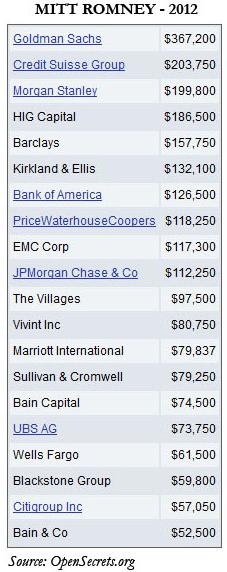
Wall Street Banks contributions to Mitt Romney
Wall Street banks make huge contributions to Mitt Romney

From The Hill. (H/T Riehl Worldview)

Excerpt:

It’s important not to overstate the perils Romney faces. He is still by far the best-funded candidate in the race. He has a state-by-state infrastructure that is the envy of his rivals. Even if he were to lose Saturday’s South Carolina primary, he would  likely remain the overall favorite to clinch the nomination.

But the procession of errors has been striking nonetheless — and it has raised concerns among many in the GOP about his vulnerabilities in a general election contest with President Obama.

Most of Romney’s awkwardness has revolved around questions about his wealth. During a heated exchange during a debate last month, he ill-advisedly offered to bet Perry $10,000 that his own account of what he had written in one of his books was correct. Perry declined, saying he was “not in the betting business,” but the episode heightened perceptions that Romney is out of touch with most Americans.

The same pattern keeps cropping up. Earlier this week, he was asked about the effective tax rate he pays on his income, and managed to injure himself twice in the space of a few sentences. First, he acknowledged that his tax rate was “probably closer to the 15 percent rate than anything.” He then added: “I get speaker’s fees from time to time, but not very much.”

The first claim was almost certainly true. Romney’s income is believed to come chiefly from long-term investments rather than earned income, and that would indeed make him liable for capital gains tax levied at a 15 percent rate. But it still places the multimillionaire in a more lightly taxed band than many voters — something which Newt Gingrich tried to take advantage of with his mocking proposal to introduce a “Mitt Romney 15 percent flat tax.”

Perhaps even worse was Romney’s “not very much” comment. His latest financial disclosure form, which covered the period from February 2010 to February 2011, revealed that he earned $374,327 for speeches. The sum is approximately seven times the median household income in the United States.

Those remarks had been preceded by a televised debate at which he gave a muddled response about whether he would release his tax returns.

Romney flubbed the tax-return question for a second time at a debate last Thursday, eliciting boos from the crowd when he said he would “maybe” follow the example of his late father, former Michigan Gov. George Romney, who released 12 years of tax returns when running for the presidency in 1968.

Romney’s mangled syntax on these occasions seems symptomatic of a wider personal unease in discussing his finances. GOP consultants say he needs to get over that discomfort if he is to prove an effective candidate.

Another concern that I have is that Mitt Romney has $20-100 million dollars in his retirement account.

Excerpt:

Like many Americans, Mitt Romney has an individual retirement account. Unlike most Americans, Mr. Romney has between $20.7 million and $101.6 million in it, a big chunk of his fortune.

Experts on estate planning said it is highly unusual to accumulate such a considerable sum in an IRA, an investment vehicle restricted by annual contribution limits. It appears that Mr. Romney’s grew so large mostly because it holds investments in Bain Capital, the private-equity firm he helped start.

[…]Mr. Romney is one of the richest presidential candidates in decades, and his GOP opponents increasingly are trying to turn wealth into a liability. President Barack Obama is expected to do the same if the former Massachusetts governor wraps up the nomination. Mr. Romney’s tax liability has emerged as a debating point in the GOP nominating contest, a proxy for a bigger argument over who should shoulder the nation’s tax burden.

In recent days, Mr. Romney’s rivals have pressed him to release his tax returns. They have attacked him for his role at Bain Capital, the source of his wealth. When Mr. Romney revealed Tuesday that his effective federal income-tax rate had been about 15% in recent years, both the White House and GOP candidates used the number as a cudgel.

[…]Michael Whitty, a lawyer at Vedder Price in Chicago who advises private-equity executives, said it is impossible to determine from Mr. Romney’s public disclosures how the IRA grew so large. Based on its listed holdings, which include many Bain Capital vehicles, Mr. Whitty theorizes Mr. Romney may have invested in Bain funds through a 401(k)-type plan, or directed some of his Bain holdings into such a plan, which he then rolled into an IRA.

How is he going to explain that? This might be one of the reasons why Romney is not releasing his tax returns. He needs to be pounded on this by Gingrich and Santorum until he drops out – we can’t afford to choose a nominee who has no hope of beating Barack Obama.

Related posts

Obama raised more money from rich bankers than any Republican candidate

From the liberal Washington Post.

Excerpt:

Despite frosty relations with the titans of Wall Street, President Obama has still managed to raise far more money this year from the financial and banking sector than Mitt Romney or any other Republican presidential candidate, according to new fundraising data.

Obama’s key advantage over the GOP field is the ability to collect bigger checks because he raises money for both his own campaign committee and for the Democratic National Committee, which will aid in his reelection effort.

As a result, Obama has brought in more money from employees of banks, hedge funds and other financial service companies than all the other GOP candidates combined, according to a Washington Post analysis of contribution data. The numbers show that Obama retains a persistent reservoir of support among Democratic financiers who have backed him since he was an underdog presidential candidate four years ago.

[…]One top banking executive who raises money for Obama and who requested anonymity to discuss fundraising efforts said reports of disaffection with the president “are exaggerated and overblown.” He said a strong contingent of financiers in New York, Chicago and California remain supportive of Obama and his economic policies, even as some have turned on him.

The Daily Caller explains how Barack Obama has received the most money from Wall Street bankers of all politicians in the last 20 years. (H/T Neil Simpson)

Excerpt: (with links removed)

In fact, the Sunlight Foundation, a nonpartisan watchdog group that tracks lobbyist spending and influence in both parties, found that President Obama has received more money from Bank of America than any other candidate dating back to 1991.An examination of the numbers shows that Obama took in $421,242 in campaign contributions in 2008 from Bank of America’s executives, PACs and employees, which exceeded its prior record contribution of $329,761 to President George W. Bush in 2004.

According to the Center for Responsive Politics, Wall Street firms also contributed more to Obama’s 2008 campaign than they gave to Republican nominee John McCain.

“The securities and investment industry is Obama’s second largest source of bundlers, after lawyers, at least 56 individuals have raised at least $8.9 million for his campaign,” Massie Ritsch wrote in a Sept. 18, 2008 entry on the Center for Responsive Politics’s OpenSecrets blog.

By the end of Barack Obama’s 2008 campaign, executives and others connected with Wall Street firms, such as Goldman Sachs, Bank of America, Citigroup, UBS AG, JPMorgan Chase, and Morgan Stanley, poured nearly $15.8 million into his coffers.

[…]Wall Street’s generosity to Obama didn’t end with his 2008 campaign either. Wall Street donors contributed $4.8 million to underwrite Obama’s inauguration, according to a Jan. 15, 2009 Reuters report.So far Wall Street has raised $7.2 million in the current electoral cycle for President Obama, according to the Center for Responsive Politics. Obama’s 2012 Wall Street bundlers include people like Jon Corzine, former Goldman Sachs CEO and former New Jersey governor; Azita Raji, a former investment banker for JP Morgan; and Charles Myers, an executive with the investment bank Evercore Partners.

It should be no surprise to anyone that Barack Obama voted for the $700 billion Wall Street bailout in 2008. He also supported extending the bailout powers of the federal government in 2010. Those are the facts.