
Tag Archives: Wait Times

We have single-payer health care already in the VA system – is it working?

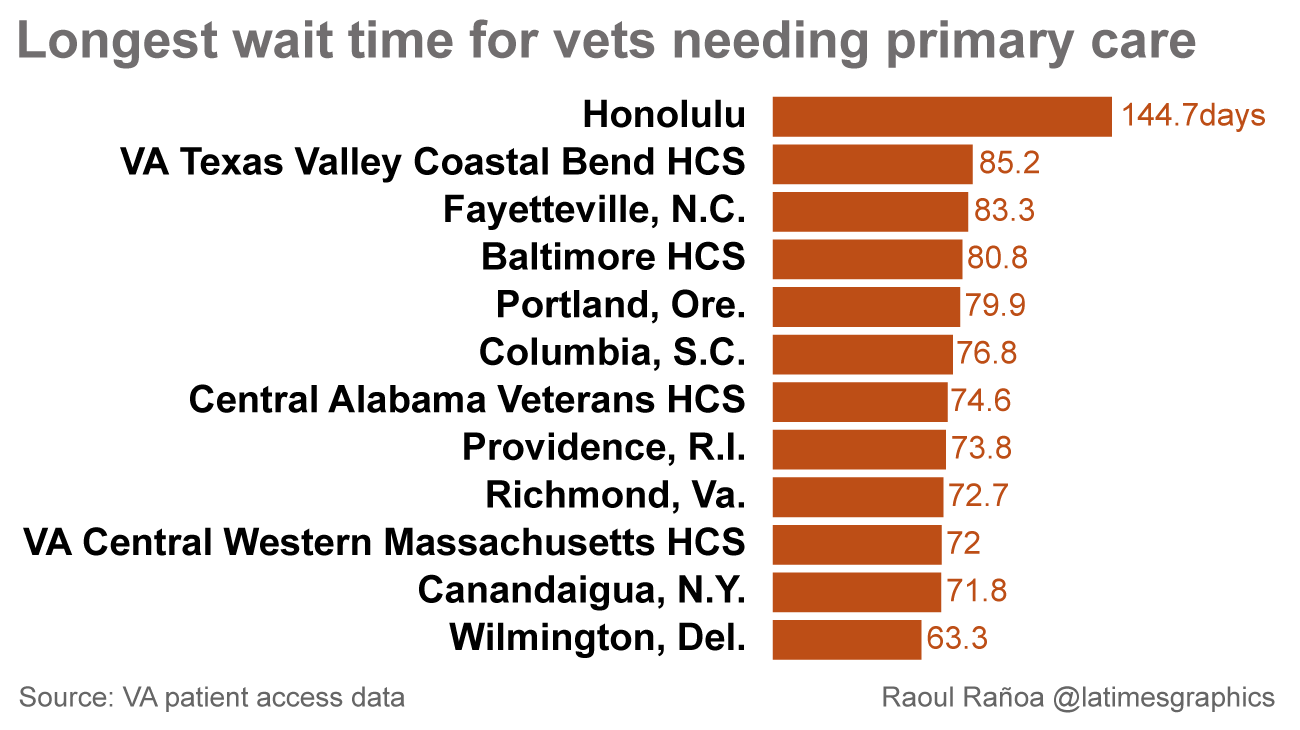
VA health care wait times

This is health care policy expert Sally Pipes, writing in Investors Business Daily.

She writes:

new report from the Government Accountability Office has confirmed that the Department of Veterans Affairs can’t take care of those it’s supposed to serve.

The GAO has placed the VA’s health system on the “high risk” list of federal programs that are vulnerable to “fraud, waste, abuse, and mismanagement.” The agency is still struggling to recover from an 8-month-old internal audit that revealed that returning soldiers had to wait more than 90 days for care. Some patients died while waiting.

The GAO’s findings apply far beyond the VA. The agency’s problems — which include long wait-times and out-of-control costs — demonstrate what happens in any government-run, single-payer health care system.

The VA’s failings ought to give pause to the liberal politicians and policy analysts who would love to introduce single-payer health care for all Americans. But they don’t seem to have heeded the GAO report. Within a week of its release, Rep. John Conyers, D-Mich., called for “Medicare for All.”

Champions of socialized medicine used to point to the VA as proof that single-payer worked. In 2011, economist Paul Krugman called it “a huge policy success story, which offers important lessons for future health reform.” In a 2009 debate with me, Princeton professor Uwe Reinhardt said that there’s an example of a single-payer system in the U.S. that works — the VA.

The VA offers lessons about health reform — just not the ones single-payer’s proponents have in mind.

Defenders of government-run health care claim that it will control costs by cutting out middlemen such as insurance companies. The evidence shows otherwise. According to the GAO, the VA budget more than doubled between 2002 and 2013 even as enrollment increased by less than a third.

Single-payer’s “guarantee” of access to high-quality care is a myth, too.

“Despite these substantial budget increases,” the GAO report says, “for more than a decade there have been numerous reports … of VA facilities failing to provide timely health care.”

Over the last decade, more than 63,000 veterans have been unable to get a doctor’s appointment. At least 40 veterans have died because of long waits.

Things aren’t likely to get better anytime soon. The VA has yet to act on more than 100 GAO recommendations for improving care.

Last summer, lawmakers allocated $10 billion to a program intended to reduce wait times by permitting veterans to see private doctors outside the VA system. So far, the agency has only authorized 31,000 vets to seek private care — out of a possible 8.5 million.

That has to change — 88% of veterans say that they want the ability to choose where they receive their care.

However, there is one military person who is getting health care – convicted traitor Bradley Manning. He’s getting sex-change surgery while he is in jail for leaking national security secrets to our enemies. He won’t have to wait at all for his health care. This is what happens when you take money out of your wallet, give it to the government, and then hope that when you get sick, someone in the government will decide that you are worthy of treatment. Which you aren’t, unless they want your vote.

It’s not just the VA health care system – government-run health care doesn’t work in other places:

The United Kingdom’s National Health Service, for instance, is notorious for denying patients everything from certain cancer medications to hip replacements.

The program is also financially unsustainable. According to its own medical director, Bruce Keogh, “if the NHS continues to function as it does now, it’s going to really struggle to cope because the model of delivery and service that we have at the moment is not fit for the future.”

In Canada’s single-payer system, the average wait time between referral from a general practitioner and the actual receipt of treatment by a specialist was more than four months in 2014. That’s nearly double the wait time of two decades ago.

The Canadian system is the one that Democrats want to emulate – but Canada’s rich left-wing politicians come here when they want care. They don’t want to wait in line. Why should we want to wait in line? We need to prefer consumer-driven health care over government-controlled health care.

Top doctor: NHS is killing off 130,000 elderly patients a year

From the UK Daily Mail:

NHS doctors are prematurely ending the lives of thousands of elderly hospital patients because they are difficult to manage or to free up beds, a senior consultant claimed yesterday.

Professor Patrick Pullicino said doctors had turned the use of a controversial ‘death pathway’ into the equivalent of euthanasia of the elderly.

He claimed there was often a lack of clear evidence for initiating the Liverpool Care Pathway, a method of looking after terminally ill patients that is used in hospitals across the country.

It is designed to come into force when doctors believe it is impossible for a patient to recover and death is imminent.

It can include withdrawal of treatment – including the provision of water and nourishment by tube – and on average brings a patient to death in 33 hours.

There are around 450,000 deaths in Britain each year of people who are in hospital or under NHS care. Around 29 per cent – 130,000 – are of patients who were on the LCP.

Professor Pullicino claimed that far too often elderly patients who could live longer are placed on the LCP and it had now become an ‘assisted death pathway rather than a care pathway’.

He cited ‘pressure on beds and difficulty with nursing confused or difficult-to-manage elderly patients’ as factors.

Professor Pullicino revealed he had personally intervened to take a patient off the LCP who went on to be successfully treated.

[…]Professor Pullicino, a consultant neurologist for East Kent Hospitals and Professor of Clinical Neurosciences at the University of Kent, was speaking to the Royal Society of Medicine in London.

[…]He said: ‘The lack of evidence for initiating the Liverpool Care Pathway makes it an assisted death pathway rather than a care pathway.

‘Very likely many elderly patients who could live substantially longer are being killed by the LCP.

‘Patients are frequently put on the pathway without a proper analysis of their condition.

More from a different UK Daily Mail article:

The health service ‘looks like a supertanker heading for an iceberg’, the head of the NHS Confederation has warned.

His comment came as a survey revealed the squeeze on NHS finances is so serious that almost half of its leaders think it will reduce quality of care for patients over the next year.

The research, carried out before the confederation’s annual conference in Manchester, shows that NHS leaders fear that growing financial pressures will mean treatment rationing and longer waiting times.

Of the 252 chief executives and chairs of NHS organisations questioned, almost half believe the financial burden on the health service is ‘very serious’ and 47 per cent say this means quality of care will reduce over the next 12 months.

Mike Farrar, chief executive of the confederation which represents organisations providing NHS services, said: ‘Despite huge efforts to maintain standards of patient care in the current financial year, healthcare leaders are deeply concerned about the storm clouds that are gathering around the NHS.

‘Our survey shows that many NHS leaders see finances getting worse and that this is already having a growing impact on their patients. In response, they are cutting costs in the short term but they know that much more radical solutions are the only answer in the long run.

[…]Mr Farrar added that politicians had ‘consistently failed’ to put the long-term interests of the population’s health above their short-term electoral interests.

[…]Katherine Murphy, chief executive of the Patients Association said: ‘This survey confirms what everybody inside the health and social care system is already saying – the next decade is likely to be the most challenging one in the history of the NHS.

‘Treatments are being rationed, waiting times for elective procedures are going up and patients continue to be treated poorly on our hospital wards.

In a government-run system, whether you get treatment or not depends on a bureaucrat, whose only desire is to be re-elected. Sometimes, killing you is the best way for them to get re-elected, as seen in the euthanasia numbers. But, in a private health care system, it makes no sense to kill patients, because then the money stops coming in. Doctors actually care about you in a for profit system. They want to help you, and they want you to live.

What could Stephen Harper teach Michele Bachmann about winning elections?

Michele Bachmann should adopt Stephen Harper's plan

Michele Bachmann is soliciting questions for her townhall meeting on her Facebook page. Please “like” her page and then like my question, so that it will be asked.

The post that she is asking for questions in has this text:

Excited to join Tim Scott for Congress for a town hall live on Facebook from Charleston, SC tomorrow at 7PM ET, where we’ll be taking questions from our community of constitutional conservatives. Have a question? Please ask in the comments below:

My question is reproduced below:

Mrs. Bachmann, in the 2011 Canadian federal election, Stephen Harper, a conservative, managed to win a majority in a country that is only one-third conservative. He did this by creating N-point plans that clearly laid out his plans for each term.

The reason I think this is important is because he was able to neutralize the attacks of the media and the three left-leaning political parties because they were not able to accuse him of having a “hidden agenda”. My question for you is, have you considered laying out a clean, specific N-point plan for what you would do as President of the United States? You could even have 3 plans, one for social issues, one for fiscal issues, and one for foreign policy.

If you like my question, please like the “TeamBachmann” Facebook page, and then go to her post asking for questions, and like my question.

Here are the Harper plans:

2006: (won minority)

  • Cleaning up government by passing the Federal Accountability Act
  • Cutting the GST (the national sales tax)
  • Cracking down on crime
  • Increasing financial assistance for parents
  • Working with the provinces to establish a wait-times guarantee for patients

2008: (won minority)

  • The minister of finance and the Bank of Canada will constantly monitor financial markets and the impact of developments in other countries.
  • The global financial crisis will be discussed at the Canada-European Union Summit, which Harper will attend on Friday.
  • Parliament will be summoned to meet this fall and the minister of finance will table an economic and fiscal update before the end of November.
  • Canada will be represented at the meeting of G-20 finance ministers scheduled for early November in Brazil. Canada has also called for a second meeting of G-7 finance ministers.
  • Government spending will be focused and kept under control as the strategic review of departmental spending — now in the second year of a four year review – continues.
  • Harper will hold a first ministers meeting on the economy to discuss with premiers and territorial leaders a joint approach to the global financial crisis.

2011: (won majority)

  • Creating jobs through training, trade and low taxes.
  • Supporting families through our Family Tax Cut and more support for seniors and caregivers.
  • Eliminating the deficit by 2014-2015 by controlling spending and cutting waste.
  • Making our streets safe through new laws to protect children and the elderly.
  • Standing on guard for Canada by investing in the development of Canada’s North, cracking down on human smuggling and strengthening the Canadian Armed Forces.

Actually, Canadian conservatives are much more liberal than we Republicans are – they are soft on social issues. Harper himself is an evangelical Christian, though, but his hands are tied when it comes to social issues. He tries to support stronger families as a way to reduce abortion and to ensure that children grow up with mothers and fathers. Even Stephen Harper is not able to do anything about same-sex marriage and abortion, which are both legal in Canada.

I think Michele would do well to pretend that she was running for office in Canada, and then create her plans that way. All the conservatives already know that she is a solid evangelical and a Tea party stalwart. What she needs to do is come up with a list of specific smart policies that will win over two-thirds of the independents.

Some things I would like to see: transparency in government, sensible spending cuts, tort reform, cut employer payroll tax to 0%, cut federal funding for abortion/Planned Parenthood, increased tax credits for MARRIED couples, matching grants for states that create voucher programs, etc, a federal right-to-work law, a tax credit, usable at any time in the future, for all salary income earned by young people under the age of 22. Etc.