The House approved a budget reconciliation bill Friday that would repeal portions of Obamacare and cut federal funds to Planned Parenthood for one year.
The legislation, called the Restoring Americans’ Healthcare Freedom Reconciliation Act, was passed in a 240-189 vote.
[…]Rep. Tom Price, R-Ga., chairman of the House Budget Committee, said in a statement the bill “repeals the most coercive components of Obamacare—eliminating onerous taxes, the individual and employer mandates, an Obamacare slush fund, and lifting unnecessary burdens on employers and employees.”
Price noted the legislation would increase funding for community health centers while eliminating government support for Planned Parenthood, which is under investigation after a series of undercover videos related to its role with aborted baby body parts.
Marjorie Dannenfelser, president of the Susan B. Anthony List, a pro-life group, praised the House’s efforts to defund Planned Parenthood, the nation’s largest abortion provider.
Naturally, Democrats voted for Obamacare and for Planned Parenthood. Because they love when people lose their doctors and health care, unless their doctor is an abortionist, and the health care is an abortion.
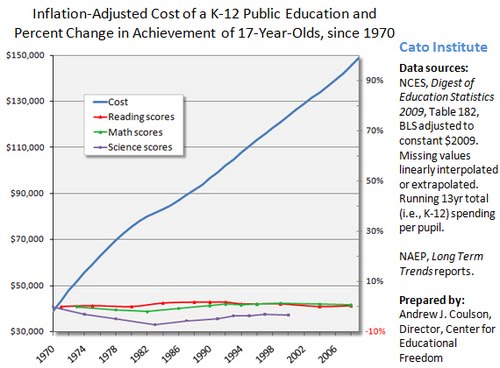
Cato Institute graphs education spending against student achievement
Meanwhile, House Republicans also voted to extend a school voucher program for low-income, minority students in Washington, D.C..
Speaker John Boehner cinched victory Wednesday as House Republicans smoothly extended his linchpin private school voucher program for low-income students through 2021.
The D.C. Opportunity Scholarship Program provides students in Washington’s struggling school districts with federally backed vouchers to attend a private school of choice. The House confirmed its reauthorization Wednesday evening in a near party-line vote of 240 to 191.
[…]Boehner, the product of Catholic school, helped begin the program in 2003 while he served as chairman of the House Education and the Workforce Committee. The program has operated as an alternative for parents who can’t afford to transfer their kids out of a failing school district to a more effective private school.
Over the past 10 years, more than 6,100 inner-city students have used the vouchers to “escape underperforming schools,” Boehner noted.
Proponents boast data finding that among those enrolled, 90 percent graduated from high school, and 88 percent of the class of 2015 moved on to pursue higher education. The average annual household income of the students enrolled falls around $20,575.
Lindsey Burke, a fellow in education policy at The Heritage Foundation, previously told The Daily Signal the program marks a “beacon of education success” that has allowed other states to pursue similar school choice options.
“You’d be hard-pressed to find many other education programs that can deliver those types of outcomes,” Burke said.
The $45-million program has faced Democratic pushback since its inception and will likely surface in the ongoing school choice battle between Republicans and President Barack Obama this fall.
In anticipation of the program’s reauthorization, the White House issued a statement Tuesday reaffirming the administration’s “strong” opposition, but held back a veto threat.
The president has attempted to defund the program every year, aligning with Democrats who argue that the scholarship funnels money out of D.C.’s public schools system.
It still has to make it through the Senate, and then Obama might veto it. But so what if he does, that just means we get a Republican president in 2016, when it comes out where Democrats really stand on providing quality education for poor, minority children. Republicans are all for it. Democrats oppose vouchers because they want to make sure that they have an ample supply of uneducated, dependent voters.
Well, obviously pro-marriage policies will help – encouraging people to get married before they have children, then sticking together to raise the children. That will help.
Economist Stephen Moore has another idea, which I support.
The scenes of Baltimore set ablaze have many Americans thinking: What can be done to rescue families trapped in an inner-city culture of violence, despair and joblessness?
There are no easy answers, but down the road from Baltimore in Washington, D.C., an education program is giving children in poor neighborhoods a big lift up.
The D.C. Opportunity Scholarship Program, which George W. Bush signed into law in 2004, has so far funded private school tuition for nearly 5,000 students, 95 percent of whom are African-American. They attend religious schools, music and arts schools, even elite college-prep schools. Last month at The Heritage Foundation in Washington, I met with about 20 parents and children who participate in the program. I also visited several of these families in their homes—which are located in some of the most beaten-down neighborhoods in the city, places that in many ways resemble the trouble spots in Baltimore.
These families have now pulled together to brace for a David vs. Goliath fight to save the program. For the seventh straight year, President Obama has proposed eliminating this relatively tiny scholarship fund, which at $20 million accounts for a microscopic 0.0005 percent of the $4 trillion federal budget.
Why would Obama want to end the program? Because if children can choose schools that don’t fail them, the teachers are the failing schools might lose their jobs. Since Obama needs the votes and the political support of the teacher unions, he cannot put the interests of the children above the interests of the unionized teachers.
More from the article:
An Education Department-funded study at the University of Arkansas recently found that graduation rates rose 21 percentage points—to 91 percent, from 70 percent—for students awarded the scholarship vouchers through a lottery, compared with a control group of those who applied for but didn’t get the scholarships. For all D.C. public schools, the high school graduation rate is closer to an abysmal 56 percent.
“If you’ve got a program that’s clearly working and helping these kids, why end it?” asks Pamela Battle, whose son Carlos received a voucher and was able to attend the elite Georgetown Day School. He’s now at Northeastern University in Boston. She says Carlos “almost surely wouldn’t have gone to college” without the voucher. “We send all this money overseas for foreign aid,” she adds, “why not save the kids here at home first?”
Well, as I said, the Democrats don’t like the law:
Amazingly, these energized parents are opposed by almost every liberal group, even the NAACP, and nearly every Democrat in Congress—including Eleanor Holmes Norton, who represents the District of Columbia in Congress but opposes a program that benefits her own constituents.
There is little question what stirs this opposition. The teachers union sees the program as taking away union jobs, and it is so powerful that the Democratic establishment falls in line. “It is so sad that our public schools aren’t doing what’s best for the kids,” laments Ford, but instead are looking out for “the adults.”
[…]Obama won’t even meet with these parents. A few years ago the voucher supporters held a rally with 3,000 minority and disadvantaged families in front of the Capitol to protest President Obama’s proposed elimination of the program for all new students. Republicans in Congress, including House Speaker John Boehner, one of the program’s strongest supporters, stood in solidarity with the families, while Nancy Pelosi and her Democratic colleagues were nowhere to be seen.
So, the next time someone accuses conservatives of not caring about children, be sure and tell them the story of the D.C. voucher program. We conservatives are very much in favor of helping poor children. It’s the people on the left who are not. Don’t let your conversations with leftists be about vague things like racism and “the rich”. Bring it down to the level of details – “I support voucher programs for poor children to get out of failing schools. Do you? Why don’t your Democrat leaders support them?” Go on the attack with the facts.
By the way, read the whole post by Moore – it’s chock full of parents giving their opinion about the program, and telling stories of how vouchers worked for them. Children first, adults second. That has to be our rule.
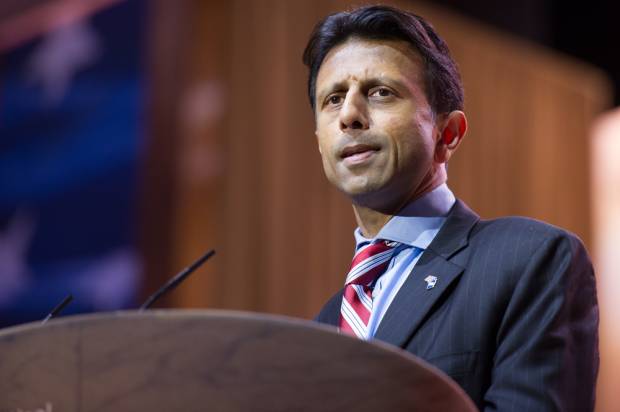
This is an editorial from the Washington Examiner, authored by school choice champion Bobby Jindal.
What is school choice?
On the most basic level, school choice represents the freedom to choose — empowering parents to select the best educational options for their sons and daughters. That could be a charter school, a private school, a religious school, home schooling, or even online learning. Governments should provide parents with the personalized and individualized tools they need to help their children excel academically.
That freedom to choose in turn will provide children with the freedom to succeed. With the right educational environment, teachers and academic training; students from all locations, income brackets and demographic groups will have better tools to compete in the global economy. We need to develop the talents of every American — no matter where he or she is from, and no matter the color of his or her skin — to maximize our country’s potential.
School choice also serves another important purpose — freeing low-income children from failing schools. No child should see his God-given talents go to waste because he is stuck in a failing school — and no parent should face the disempowerment that comes from knowing her son or daughter remains trapped in a poor school, and she lacks the financial means to move that child elsewhere. We can do better — and, by allowing parents dissatisfied with their school to move with their feet, school choice gives both high-performing and low-performing schools more incentive and motivation to improve their offerings.
Finally, school choice provides parents with freedom from the status quo — an educational-industrial complex that thinks bureaucrats, not parents, can best make decisions about the lives and futures of America’s children. It’s about pushing back when the then-head of Louisiana’s largest teachers’ union said low-income parents had “no clue” how to choose the right school for their children. And it’s even about standing up to the Attorney General of the United States, when the Department of Justice asked a court to block Louisiana’s school scholarship program on civil rights grounds — even though 90 percent of the program’s participants come from racial minority groups.
I don’t like people who talk conservative but govern liberal. I want to see the achievements.
The numbers:
For here in Louisiana, we’ve put those principles to practice. Since we removed the cap on charters in 2009, we’ve authorized almost 200 charter schools throughout the state — that’s 70,000 kids who now have a choice about where they go to school. This last year, our Recovery School District became the nation’s first school district with 100 percent charter school enrollment. And the results are dramatic: The graduation rate in New Orleans has increased from 54.4 percent before Hurricane Katrina in 2004 to 72.8 percent; the percentage of New Orleans students scoring basic and above has increased from 35 percent to 63 percent; and the percentage of failing schools in New Orleans has dropped from 67 percent in 2005 to 17 percent.
We expanded our school choice scholarship program, which was initially confined to New Orleans, statewide. Parental satisfaction with the statewide scholarship program stands at a whopping 91.9 percent. We went even further though and created a dollar for dollar rebate for donations used to fund nonpublic school scholarships low-income students through our “school tuition organizations.” Between 2008 and 2013, the percentage of students in the scholarship program who are proficient in third grade English language arts has grown by 20 percentage points and in math by 28 percentage points. Again and again, we’ve proven that giving more choice to parents is not only vital, but it gets results.
We also expanded access to online and dual enrollment courses for students across the state. This year, we’ve had over 19,000 students take advantage of our Course Choice program enrolling in advanced placement courses and career and technical courses that they otherwise wouldn’t have access to.
He’s in my top 2 for the 2016 presidential race, along with Scott Walker.
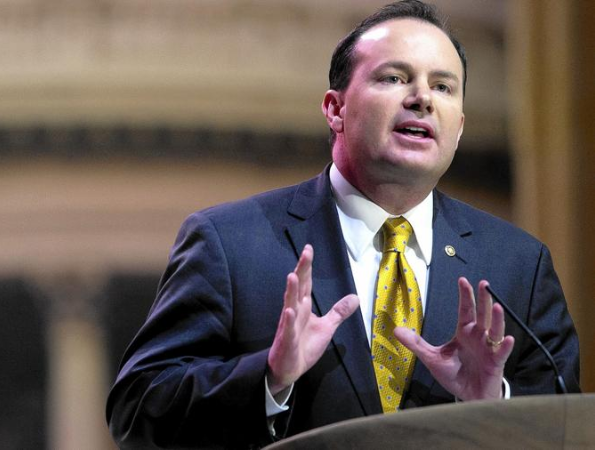
I’d like to see school choice enacted at the federal level, and fortunately, Utah Senator Mike Lee has the same idea.
I recently introduced in the Senate a bill that would empower the people most acutely committed to the quality of our education system: America’s moms and dads. My colleague on the other side of the Capitol, Rep. Luke Messer, R-Ind., has introduced a companion bill in the House.
By giving parents more power to invest in their child’s education and to choose what school best meets their needs, the Enhancing Educational Opportunities for All Act takes an important step toward restoring accountability to our public education system—something that has been missing for far too long.
Under our current system—which has remained essentially unchanged since President Lyndon B. Johnson signed the 1965 Elementary and Secondary Education Act—most parents are powerless to influence the quality of their child’s education.
What occurs in public school classrooms around the country—what teachers teach and how they teach it—is the result of a long, convoluted, bureaucratic chain of command that zigzags its way from Washington to local school districts, but never includes parents.
First, Congress passes legislation authorizing federal bureaucrats to establish rules, regulations, and standards with which states must comply in order to receive federal education funds.
Next, state officials refine—or in some cases distort—these Washington directives, writing narrower rules for their school districts, which then establish the specific policies for individual schools.
At no point in this decision-making process are parents consulted.
Instead, they are left with a “take it or leave it” choice: either accept the education offered at the local public school—no matter how bad it may be—or buy a better alternative, by moving closer to a better school or paying private school tuition.
For America’s most affluent families, this is no big deal—they can afford private schools and so have the power to choose the school that is best for their children. For everyone else, it precludes parents from making choices about their children’s education.
So our bill would expand school choice to all parents, regardless of socio-economic status or zip code, by allowing federal “Title I” K-12 support funds to follow low-income students to any public or private school of their choice.
It would also remove the contribution limits on Coverdell education savings accounts and allow “529” account funds to cover K-12 education expenses.
Our bill would give working parents more opportunities to invest in a variety of learning services and products outside the classroom, such as tutoring, online courses and textbooks.
The problem facing our public school system today is not about a lack of money—we have nearly tripled our investments in elementary and secondary students since 1970. The problem is dysfunctional government policy—however well intentioned—and a lack of accountability.
And that’s exactly what we should expect when Washington bureaucrats have more control than parents over a child’s education. We have a moral and economic obligation to flip this equation and put parents back in the driver’s seat.
For when we tolerate a system in which the quality of a child’s education depends on her parents’ zip code, we fail to live up to the ideals at the heart of American exceptionalism.
And when millions of children learn from a young age not to dream big, but to surrender to the hopelessness of low expectations, we will live in a society where upward mobility is no longer rule but the exception.
We can and we must do better.
If a school is failing – and they often are, especially in poorer areas – then shouldn’t parents have the ability to send their kids to a better school? When I want to buy something online, I know I can always do better by comparing prices and reviews. Competition between suppliers drives prices down, and raises quality up. The customer is king in the free market. It can work in education, too.

 WINTERY KNIGHT