
Tag Archives: Vision

Can a Christian marry an atheist or a Jew or a Muslim or a Hindu?

I think that the best way to answer the question, “should I marry a non-Christian?”, is to ask whether it makes any difference if your spouse is on board with your plans for your ministry and with your marriage. So let’s take a look at a case where someone famous who chose a Christian wife, and we’ll see how much that decision affected his ministry and his marriage.

I want to draw your attention to a talk on “Vision in Life” given by Dr. William Lane Craig. Dr. Craig is the ablest defender of the Christian faith operating today. He has done formal academic debates with all of the best known atheists on major university campuses in front of thousands of university students. This list of atheists and agnostics includes people like Christopher Hitchens and Victor Stenger. The Hitchens debate took place in an auditorium filled with 5000 students, and many thousands more were watching at churches all over the world. How did Dr. Craig get these opportunities to evangelize on secular university campuses?

Well, he owes a lot of his success to his amazing wife Jan, as we shall see in the summary of his talk on that topic.

The MP3 file is here. (32 minutes)

This talk was Dr. Craig’s chapel address to Biola University students, and he is introduced by his son, John, a Biola University grad.

In the talk, it becomes clear that Bill’s wife Jan plays an enormous role in his success. Indeed, you will see that if it were not for her, he never would have gotten either of his doctorates, or even his second Masters degree. Why was she so supportive of his plans? Because she had the same broad goal of evangelism through scholarship. Let’s see how she encouraged him.

Here is a quotation that occurs about 11 minutes into the talk, as Bill describes the completion of his Bachelor’s degree at Wheaton:

And it was at Wheaton that my vision began to focus on presenting the gospel in the context of giving an intellectual defense of the faith, to appeal not only to the heart but also to the head, as well. And so I determined that I would go on to seminary for further training.

But, my senior year, in chapel, we heard a speaker who challenged us, before going on to further education, to take a couple of years out, and to wring out the sponge, so to speak, that had been soaking up all that knowledge, and to work with university students while we were still about the same age.

And so I joined the staff of Campus Crusade for Christ for 2 years, and was assigned to Northern Illinois University. And that was where I met my wife Jan. She was a graduate of the University of North Dakota where she had come to faith in Christ. And she had a similar vision for her life of evangelism and discipleship.

And as we worked at NIU together, she with gals and I with the guys, leading students to Christ and discipling them to walk with the Lord, we fell in love. And we decided that we would be more effective if we joined forces and became a team.

It is at this point in the talk where Bill begins to explain just how Jan molded him into the lean, mean debating machine that travels the world striking terror into the hearts of atheists.

Bill’s first story about Jan occurs early after their marriage while he is working on his first Masters degree at Trinity:

And it was also at that time that I began to see what an invaluable asset the Lord had given me in Jan. I remember I came home from classes one day, and found her at the kitchen table with all the catalogs and schedules and papers spread out in front of her and she said, “look! I’ve figured out how you can get two Masters degrees at the same time that it would normally take to get one! All you have to do is take overloads every semester, go to all full-time summer school and do all these other things, and you can do two MAs in the time it takes to do one!”

And I thought, whoa! Are you sure you really want to make the commitment it takes to do this kind of thing? And she said, “Yeah! Go for it!” And it was then I began to see that God had given me a very special woman who was my supporter – my cheerleader – and who really believed in me. And as long as she believed in me, that gave me the confidence to dream bigger dreams, and to take on challenges that I had never thought of before.

In an article on his web site, he talks about how Jan encouraged him to do his first Ph.D:

As graduation from Trinity neared, Jan and I were sitting one evening at the supper table in our little campus apartment, talking about what to do after graduation. Neither of us had any clear leading or inclination of what we should do next.

So Jan said to me, “Well, if money were no object, what would you really like to do next?”

I replied, “If money were no object, what I’d really like to do is go to England and do a doctorate under John Hick.”

“Who’s he?” she asked.

“Oh, he’s this famous British philosopher who’s written extensively on arguments for the existence of God,” I explained. “If I could study with him, I could develop a cosmological argument for God’s existence.”

But it hardly seemed a realistic idea.

The next evening at supper Jan handed me a slip of paper with John Hick’s address on it. “I went to the library today and found out that he’s at the University of Birmingham in England,” she said. “Why don’t you write him a letter and ask him if you can do a doctoral thesis under him on the cosmological argument?”

What a woman! So I did, and to our amazement and delight Professor Hick wrote back saying he’d be very pleased to supervise my doctoral work on that subject. So it was an open door!

And in the same article, he explains how Jan encouraged him to get his second Ph.D:

As Jan and I neared the completion of my doctoral studies in Birmingham, our future path was again unclear to us. I had sent out a number of applications for teaching positions in philosophy at American universities but had received no bites. We didn’t know what to do.

I remember it like yesterday. We were sitting at the supper table in our little house outside Birmingham, and Jan suddenly said to me, “Well, if money were no object, what would you really like to do next?”

I laughed because I remembered how the Lord had used her question to guide us in the past. I had no trouble answering the question. “If money were no object, what I’d really like to do is go to Germany and study under Wolfhart Pannenberg.”

“Who’s he?”

“Oh, he’s this famous German theologian who’s defended the resurrection of Christ historically,” I explained. “If I could study with him, I could develop a historical apologetic for the resurrection of Jesus.”

Our conversation drifted to other subjects, but Jan later told me that my remark had just lit a fire under her. The next day while I was at the university, she slipped away to the library and began to research grants-in-aid for study at German universities. Most of the leads proved to be defunct or otherwise inapplicable to our situation. But there were two grants she found that were possibilities. You can imagine how surprised I was when she sprung them on me!

Both of these Ph.D experiences are also described in the talk. And the talk concludes as follows:

I am so thankful to be married to a woman who is tremendously resourceful, tremendously talented and energetic, who could have pursued an independent career in any number of areas, but instead, she has chose to wed her aspirations to mine, and to make it her goal to make me the most effective person I can be, for Christ. And she has been like my right arm in ministry over these many years. And it is a tremendous privilege to be a team with a person like that.

And you young men, I would encourage you, if you marry, to find a gal who shares your vision, not some independent vision, but who is interested in aligning herself with you, and pursuing together a common vision and goal that will draw you [together], so that you will avoid the growing separateness that so often creeps into marriages.

And now you know the rest of Bill’s story. The person you marry will have an enormous influence on the impact you will have for Christ and his Kingdom. It is up to you to decide whether that influence is going to be positive or negative, by deciding if you will marry, and if you do marry, by deciding whom you will marry. If you marry a non-Christian, you cannot expect to achieve the same things for God as you can with someone who accepts your core convictions and is willing to sacrifice their happiness so that God can be made happier.

You may also be interested in this talk given by William Lane Craig, entitled “Healthy Relationships” (National Faculty Leadership Conf. 2008) (audio here) In that talk, he offers advice to Christians who want to have a marriage that is consistent with their Christian faith.
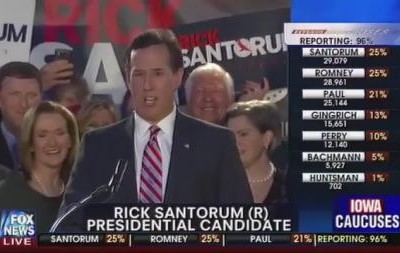
150 evangelical leaders agree to endorse Rick Santorum after two-day conference

Rick Santorum Iowa Caucuses

From Life News.

Excerpt:

After a Friday-Saturday meeting with more than 150 leaders and representatives of evangelical, pro-family and pro-life groups, the organizations have declared consensus support for Rick Santorum’s Republican presidential campaign.

Tony Perkins, the president of the Family Research Council and a participant in last night’s private meeting, addressed a press conference call today to provide additional information about the decision and expected endorsements from some of those attending.

Perkins said the leaders of the evangelical groups came to the meeting each supporting the various different GOP candidates seeking to replace pro-abortion President Barack Obama. Participants engaged in a question and answer session with representatives of each of the campaigns, except for former Utah Governor Jon Huntsman, who did not send a spokesman to the event.

After the session, the leaders discussed the presidential race amongst themselves and then undertook a three-round ballot process. Perkins said the discussion culminated in an agreement that the groups and leaders each have “an overriding passion and desire to defeat Barack Obama” this November. Although the leaders of the various organizations strongly support various candidates, they eventually decided to support Santorum.

“I think it was vigorous discussion of who they felt best represented the conservative movement and who they think had the best chance of succeeding,” he said, but adding that there would not be a “coordinated effort” amongst the groups and leaders to endorse Santorum.

“There is a hope and expectation that those represented by the constituency will make a difference in South Carolina,” he said, adding that some in attendance threw their support behind Santorum to avoid having a repeat of 2008 where conservative candidates split the vote.

Perkins indicated Santorum, Newt Gingrich and Rick Perry but only Gingrich and Santorum made the final ballot. There were 114 votes on the final ballot, as some leaders had to catch returning flights home, and Santorum emerged with a majority (85) of those voting, the FRC president said.

[…]The names and groups participating were not released, but Perkins mentioned former Republican presidential candidate Gary Bauer as another organizer of the private meeting. He said the names of organizations and leaders participating will become public as they begin making endorsements.

[…]Last week, the pro-life group CatholicVote issued an endorsement for Santorum.

Bauer has already endorsed Santorum. I agree that Gingrich is definitely the runner-up, and would be a fine choice for conservatives, but Santorum really is the best overall. My biggest concern about this is how younger evangelicals are so apathetic when it comes to politics and have no idea how to think carefully about things like free market capitalism, abortion, marriage and peace through strength. The young evangelicals are largely illiterate, making their decisions based on emotions and intuitions, because they think that Christianity is about being “nice” so that more people like them. Oh well.

What I find interesting is when even moderate conservative bloggers – ones who are not evangelical – are beginning to notice that there is an integrity argument for Rick Santorum.

Look at this comment from Jeff Goldstein – he’s replying to some Ron Paul person, I guess:

BMoe –

We’ve talked at length about this here, so if you haven’t already done so, I’d say go back and look at the various riffs on how Santorum’s ideas of family as the unit of individual autonomy is tied to his Catholicism / Thomism. Also, how family communitarianism is not at all like collectivism.

My own belief — and James Pethokoukis took this up, as well (I believe I did a post on it), is that Santorum is reacting in the excerpt on individualism you cite, to the Objectivists — those whose ideological foundation is Rand. That is, the libertarians. You may disagree with Santorum — and there’s plenty of room to do so — but it does no good to caricature the belief. Santorum is not a collectivist. And his ideas about the family — and government’s role in nurturing that unit — amount to things like increased tax credits for producing new citizens, or increased credit for charitable giving, so that charity is taken away from the state.

And he tries to balance his own views with the constraints placed on elected officials by the Constitution, which for Santorum includes the 9th and 10th Amendments.

These are often difficult waters to traverse. But with Santorum, he tells you what he thinks and believes. For me, that’s a net positive.

Romney mouths platitudes about limited government, and yet it’s clear he doesn’t believe a word of it. Santorum believes in a social safety net for the truly disadvantaged and indigent, but he tempers that with an animus toward those who would game the system — and toward programs that have the net impact of institutionalizing dependence on government.

What I liked about Cain — he didn’t have all the answers, because he hasn’t studied every question — I like about Santorum. You can see his thinking. He shows his work.

And a bit later, same guy:

Also, BMoe, I think it pretty obvious by now I’m not a social conservative. I’m just far less bothered by them then I used to be back when I was given to accepting the caricature of such creatures.

Nowadays I see that it is the “liberal” secularists who are far more dangerous, because their God is the State, and they therefore serve their God by granting that ever more power comes from the State.

The religious folk simply want the state to leave them the f**k alone, often times. And me and my spaghetti bulbs tend to commiserate.

I think that’s right. I am not thrilled with Santorum’s blue-collar worker economic plan. I’m an investor and a white collar software engineer. I’m chaste and have no children and no plans to marry, so Santorum’s tripling of the tax deduction for children won’t help me. But what is appealing about the man is his vision: he wants more working families and he wants them to face less financial pressure if they have more children, and more choice in education. I get that. It’s not applicable to me, but I get it. I get what his vision is.

Rick Santorum at the Values Voters Summit

Here’s a 3-part speech by Rick Santorum at the Family Research Council:

Part 1:

Part 2:

Part 3:

The Family Research Council is my third favorite think tank, behind the Heritage Foundation and the American Enterprise Institute.

Here’s something to read if you can’t see the speech.

Related posts

Can a Christian date a non-Christian? Can a Christian marry a non-Christian?

I think that the best way to answer the question, “should I marry a non-Christian?”, is to ask whether it makes any difference if your spouse is on board with your plans for your ministry and with your marriage. So let’s take a look at a case where someone chose a Christian wife, and we’ll see how much that affected his ministry and his marriage.

I want to draw your attention to a talk on “Vision in Life” given by William Lane Craig. Bill is the ablest defender of the Christian faith operating today, having defeated all of the best known atheists in formal academic debates, in front of thousands of university students. This list includes people like Christopher Hitchens and Victor Stenger. The Hitchens debate took place in an auditorium filled with 5000 students, and many thousands more were watching at churches all over the world. No one has done more to defend Christianity on university campuses. So how did Bill do it? Well, he owes a lot of his success to his amazing wife Jan, as we shall see below.

The MP3 file is here. (32 minutes)

This was Bill’s chapel address to Biola University students, and he is introduced by his son, John, a Biola grad.

In the talk, it becomes clear that Bill’s wife Jan plays an enormous role in his success. Indeed, you will see that if it were not for her, he never would have gotten either of his doctorates, or even his second Masters degree. Why was she so supportive of his plans? Because she had the same broad goal of evangelism through scholarship. Let’s see how she encouraged him.

Here is a quotation that occurs about 11 minutes into the talk, as Bill describes the completion of his Bachelor’s degree at Wheaton:

And it was at Wheaton that my vision began to focus on presenting the gospel in the context of giving an intellectual defense of the faith, to appeal not only to the heart but also to the head, as well. And so I determined that I would go on to seminary for further training.

But, my senior year, in chapel, we heard a speaker who challenged us, before going on to further education, to take a couple of years out, and to wring out the sponge, so to speak, that had been soaking up all that knowledge, and to work with university students while we were still about the same age.

And so I joined the staff of Campus Crusade for Christ for 2 years, and was assigned to Northern Illinois University. And that was where I met my wife Jan. She was a graduate of the University of North Dakota where she had come to faith in Christ. And she had a similar vision for her life of evangelism and discipleship.

And as we worked at NIU together, she with gals and I with the guys, leading students to Christ and discipling them to walk with the Lord, we fell in love. And we decided that we would be more effective if we joined forces and became a team.

It is at this point in the talk where Bill begins to explain just how Jan molded him into the lean, mean debating machine that travels the world striking terror into the hearts of atheists.

Bill’s first story about Jan occurs early after their marriage while he is working on his first Masters degree at Trinity:

And it was also at that time that I began to see what an invaluable asset the Lord had given me in Jan. I remember I came home from classes one day, and found her at the kitchen table with all the catalogs and schedules and papers spread out in front of her and she said, “look! I’ve figured out how you can get two Masters degrees at the same time that it would normally take to get one! All you have to do is take overloads every semester, go to all full-time summer school and do all these other things, and you can do two MAs in the time it takes to do one!”

And I thought, whoa! Are you sure you really want to make the commitment it takes to do this kind of thing? And she said, “Yeah! Go for it!” And it was then I began to see that God had given me a very special woman who was my supporter – my cheerleader – and who really believed in me. And as long as she believed in me, that gave me the confidence to dream bigger dreams, and to take on challenges that I had never thought of before.

In an article on his web site, he talks about how Jan encouraged him to do his first PhD:

As graduation from Trinity neared, Jan and I were sitting one evening at the supper table in our little campus apartment, talking about what to do after graduation. Neither of us had any clear leading or inclination of what we should do next.

So Jan said to me, “Well, if money were no object, what would you really like to do next?”

I replied, “If money were no object, what I’d really like to do is go to England and do a doctorate under John Hick.”

“Who’s he?” she asked.

“Oh, he’s this famous British philosopher who’s written extensively on arguments for the existence of God,” I explained. “If I could study with him, I could develop a cosmological argument for God’s existence.”

But it hardly seemed a realistic idea.

The next evening at supper Jan handed me a slip of paper with John Hick’s address on it. “I went to the library today and found out that he’s at the University of Birmingham in England,” she said. “Why don’t you write him a letter and ask him if you can do a doctoral thesis under him on the cosmological argument?”

What a woman! So I did, and to our amazement and delight Professor Hick wrote back saying he’d be very pleased to supervise my doctoral work on that subject. So it was an open door!

And in the same article, he explains how Jan encouraged him to get his second Ph.D:

As Jan and I neared the completion of my doctoral studies in Birmingham, our future path was again unclear to us. I had sent out a number of applications for teaching positions in philosophy at American universities but had received no bites. We didn’t know what to do.

I remember it like yesterday. We were sitting at the supper table in our little house outside Birmingham, and Jan suddenly said to me, “Well, if money were no object, what would you really like to do next?”

I laughed because I remembered how the Lord had used her question to guide us in the past. I had no trouble answering the question. “If money were no object, what I’d really like to do is go to Germany and study under Wolfhart Pannenberg.”

“Who’s he?”

“Oh, he’s this famous German theologian who’s defended the resurrection of Christ historically,” I explained. “If I could study with him, I could develop a historical apologetic for the resurrection of Jesus.”

Our conversation drifted to other subjects, but Jan later told me that my remark had just lit a fire under her. The next day while I was at the university, she slipped away to the library and began to research grants-in-aid for study at German universities. Most of the leads proved to be defunct or otherwise inapplicable to our situation. But there were two grants she found that were possibilities. You can imagine how surprised I was when she sprung them on me!

Both of these Ph.D experiences are also described in the talk. And the talk concludes as follows:

I am so thankful to be married to a woman who is tremendously resourceful, tremendously talented and energetic, who could have pursued an independent career in any number of areas, but instead, she has chose to wed her aspirations to mine, and to make it her goal to make me the most effective person I can be, for Christ. And she has been like my right arm in ministry over these many years. And it is a tremendous privilege to be a team with a person like that.

And you young men, I would encourage you, if you marry, to find a gal who shares your vision, not some independent vision, but who is interested in aligning herself with you, and pursuing together a common vision and goal that will draw you [together], so that you will avoid the growing separateness that so often creeps into marriages.

And now you know the rest of Bill’s story. The person you marry will have an enormous influence on the impact you will have for Christ and his Kingdom. It is up to you to decide whether that influence is going to be positive or negative, by deciding if you will marry, and if you do marry, by deciding whom you will marry. If you marry a non-Christian, you cannot expect to achieve the same things for God as you can with someone who accepts your core convictions and is willing to sacrifice their happiness so that God can be made happier.

You may also be interested in this talk given by William Lane Craig, entitled “Healthy Relationships” (National Faculty Leadership Conf. 2008) (audio here)

Conclusion

The level of influence of a significant other in a non-platonic relationship greatly impacts your ability to achieve the vocational task that the Lord has set for you. My recommendation is to avoid engaging in any romantic relationship in which self-sacrificial service to the Lord is not the main focus.

Since I am male, I decided to prepare a set of questions that a man can use to test a woman to see if she is a marriage-ready Christian. You can use those, if you like.