
Tag Archives: Venezuela

Should Barack Obama get credit for killing Osama Bin Laden?

I’ve written before about how George W. Bush deserves credit for the termination of that terrorist vermin.

But there are a couple of other data points to add that recently emerged, as well.

First, the decision on the Bin Laden raid was made by the American Armed Forces, not by Barack Obama, as a newly released memo reveals.

Second, Obama had already drafted a memo to blame the military if the operation failed.

In fact, Obama has weakening our counter-terrorism and defense capabilities from the day he took office.

Excerpt:

Sen. Jim Inhofe, R-Okla., a senior member of the Senate Armed Services Committee, called the president’s victory lap in Afghanistan on the anniversary of the death of Osama bin Laden at the hands of the Navy SEALs “an attempt to shore up his national security credentials, because he has spent the past three years gutting our military.”

Indeed he has. “He cut the F-22, future combat system, C-17 and our ground-based interceptor in Poland, to name a few,” Inhofe noted.

[…]President Obama’s defense policies fulfill a campaign pledge he made to the far-left group Caucus for Priorities a month before the January 2008 Iowa caucuses. Caucus for Priorities is an offshoot of a bigger group, Priorities Action Fund, created by Ben Cohen, the peace activist and co-founder of Ben & Jerry’s ice cream.

In a video made for the group, Obama called for a further deterioration in our military strength.

“I will cut investments in unproven missile defense systems. I will not weaponize space. I will slow our development of future combat systems,” he said.

So far, he has kept his word.

In the video, he also vowed, “I will set a goal of a world without nuclear weapons. To seek that goal, I will not develop new nuclear weapons, I will seek a global ban on the production of fissile material and I will negotiate with Russia to take our ICBMs off hair-trigger alert, and to achieve deep cuts in our nuclear arsenals.”

He has kept that promise as well.

As the Heritage Foundation notes, since Obama took office, over 50 major weapons programs of more than $300 billion have been cut or delayed.

Obama, who betrayed Poland and Czechoslovakia on missile defense and shut down key weapon systems like the F-22 Raptor, has vowed to veto any changes to the mandated cuts, including $650 billion from defense as called for by the Budget Control Act over the next decade.

That comes on top of $460 billion in defense cuts already agreed to — a total of $1.1 trillion in defense cuts our commander in chief is OK with.

A 14-page analysis by the Republican majority staff of the House Armed Services Committee says the cumulative cuts will result in Army and Marine Corps losing 200,000 troops.

The Navy will shrink from 300 ships to 238 vessels and would lose two carrier battle groups needed to project American power and influence. Strategic bombers will fall from 153 to 101. Air Force fighters would drop by more than half, from 3,602 aircraft to 1,512 planes. These are real cuts, both in spending and in military capability.

In fact, the main priority of the Obama administration seems to be redirecting the U.S. military to fight global warming intervening in favor of South American socialist dictators, dismantling our nuclear arsenal, allowing Iranian Islamists to rig elections and shoot pro-democracy protesters, giving drone technology to the Iranians,  setting up the the Muslim Brotherhood in Egypt and Libya, and handing over the keys to our European missile defense system to the Russians.

This is not the full list of how this man has been a disaster for world peace and national security. And it is a list that is ignored by hist supporters who think with their emotions and who have their hands out for more of their share of their neighbor’s earnings.
FARC terrorist leader Alfonso Cano killed by Colombian armed forces

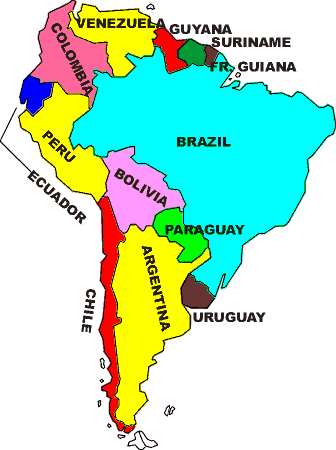
Map of South America

From the Heritage Foundation.

Excerpt:

The armed forces of Colombia have scored a major battlefield victory. They finally hunted down, confronted, and killed the leader of the narco-terrorist Revolutionary Armed Forces of Colombia (FARC), Guillermo Leon Saenz, widely known by his alias Alfonso Cano.

A guerrilla for decades, Cano assumed the top leadership of the FARC following the natural death of founder Manuel Marulanda (2008) and the elimination of senior figures Raul Reyes (2008) and Jorge Briceno (aka Mono Jojoy, 2010).

Seen by some as a modern-day version of the “good revolutionary,” Cano—a life-long advocate of armed violence and terrorism—fell in combat with the Colombian armed forces as they rappelled their way into his secret jungle hideout. Cano was also indicted in a U.S. court for drug trafficking along with dozens of other FARC leaders and had a $5 million price on his head.

FARC is a Marxist terrorist group.

The Economist reports that the Colombian economy is also doing well.

Excerpt:

WHEN the figures are finally tallied, Colombia may prove to have weathered the world recession better than any other of the larger Latin American countries. After a slight contraction at the end of 2008, the economy has been growing modestly this year. This resilience stems from continued foreign investment, an increase in government spending on public works and easier money: since December the central bank has cut interest rates by six percentage points, to 4%, a steeper drop than anywhere in the region outside Chile.

[…]President Álvaro Uribe’s security policies have helped to restore confidence. Investment soared, from 15% of GDP in 2002 to 26% last year, says Mr Zuluaga. Private business has retooled. After many delays, the government has issued licences to expand several ports; this month it hopes to award a contract for the first of four big road schemes, costing a total of $7.5 billion over four years. It hopes for investment of up to $50 billion in mining and oil over the next decade.

And liberal MSNBC has more on the booming Colombian economy.

Excerpt:

…Colombia’s revival is benefiting U.S. economic and political rivals as much as or more than the U.S. itself.

The long delay in signing the treaty allowed Latin America’s fourth-largest economy to strengthen ties with China. It also damaged U.S. credibility in the region, says Eric Farnsworth, vice-president of the Council of the Americas in Washington. “The delay in passing this called into question the United States’ reliability as a partner,” Farnsworth says. “There’s a strategic component to this. It’s not just about economics and trade.”

[…]As talks between the U.S. and Colombia dragged on, Colombia and China forged plans for a rail link between the Pacific and Caribbean that could draw freight away from the Panama Canal. Colombian President Juan Manuel Santos aims for a trade deal with South Korea. To tighten his connections to high-growth Asia, he’s also seeking membership in the Asia-Pacific Economic Cooperation group. “While Washington was debating whether the accord with Colombia was opportune, we advanced in our foreign policy strategy,” says Trade Minister Sergio Diaz-Granados.

Santos has cooperated more with his South American neighbors, organizing a meeting of finance ministers to discuss ways to protect their currencies and economies from the debt crisis in the U.S. and Europe. He supports a stock trading platform with Colombia, Chile, and Peru and wants to bring Mexico and Panama on board. Exports to Brazil have surged tenfold. While the U.S. remains Colombia’s biggest export market, with $16.8 billion in 2010 sales, up 30 percent from a year earlier, sales to China more than doubled last year, to $1.2 billion. Sales to the European Union are also rising, to $5.4 billion this year through August, more than in all of 2010. An EU trade accord could come next year.

The government has reduced cocaine cultivation 37 percent and halved the number of insurgents to about 8,000. Improved security has spurred enough growth to win an investment-grade credit rating from Standard & Poor’s as well as investment from billionaires. Colombia’s victories over the guerrillas opened up swathes of countryside to exploration for oil, gold, and coal. Mexican billionaire Carlos Slim’s push into crude has helped fuel foreign investment that the government says may reach a record $12 billion this year. The economy grew 5.2 percent in the second quarter.

The U.S. faces more competition from Colombia’s neighbors and Canada. In 2010, U.S. agricultural exports to Colombia fell more than 50 percent from 2008, to $827 million, as Argentina’s more than doubled, to $1 billion, according to a report by Senator Richard Lugar’s staff. Diaz-Granados attributes the U.S. setback to the delay in the free-trade agreement.

An August accord reduces or ends Colombian tariffs on Canadian wheat, paper, and machinery. Bank of Nova Scotia, Canada’s third-largest lender, agreed in October to buy 51 percent of Banco Colpatria Red Multibanca Colpatria for about $1 billion—Scotiabank’s largest international takeover. “This is not the Colombia of old,” says Brian J. Porter, group head of international banking for Scotiabank. “The more we looked at Colombia, the more excited we got about the economic potential.”

We really should have signed that trade deal 3 years ago – it would have helped out economy a lot.  But unions got Obama elected, and the unions decided that the trade deal needed to be held up for 3 years. And that’s one of the reasons why we’ve had over 9% unemployment. Our economic policy is being set by unions, not by economists. But in Colombia, economic policy is set by economists, not unions.

Socialist Hugo Chavez begins to use his new dictatorial powers

Are Barack Obama and Hugo Chavez very different?

In Venezuela, Obama’s buddy Chavez is enjoying his new decree powers.

Excerpt:

Venezuelan President Hugo Chavez made his first use of new decree powers on Sunday to create a $2.3 billion fund for reconstruction after widespread flooding that left more than 130,000 people homeless.

The South American OPEC member nation’s socialist leader has infuriated opposition parties and been criticized as a dictator for assuming fast-track powers for the next 18 months that will enable him to rule by decree and bypass parliament.

Chavez has justified the measure as necessary to enable the government to respond to recent torrential rains that swept away houses, smashed bridges and roads, and also killed around 40 people in the nation of 29 million.

But critics say the president has cynically exploited the disaster as an excuse to outwit opposition parties who were due to take a larger share of seats — 40 percent — in the incoming National Assembly which convenes on January 5.

The problem with socialists is that they think that the people who actually make money will just keep on making money even though the government keeps confiscating a larger and larger share of it. Think about it. People on the left in academia, in government, or in the voluntary poor (single mothers, drug addicts) are basically subsisting by confiscating the wealth produced by others in business who have to start and run businesses or work in those businesses. They actually have contempt for people who take risks and take responsibility, because they think that those people are “stupid”.

What you have is one group of people with a tenuous grasp on reality who are acting as parasites on an increasingly over-taxed and over-regulated host. Eventually, the host gives up working – why work if you are constantly being abused by taxes and regulations? And that is why the policies of Obama and Chavez lead to catastrophes like North Korea and Zimbabwe. They don’t understand that their ability to spend money depends on the very people they hate the most, and understand the least.

I actually had one woman in academia recently telling me how she deserved to receive more money from businesses and workers to support her Ph.D studies in a non-engineering and non-scientific field. She also thought that the Comedy Channel was more reliable than Fox News. I produced two studies from UCLA and Harvard showing that Fox News was dead center in terms of news bias. I produced a survey showing that mainstream journalists donate almost exclusively to Democrats. She produced no evidence, but urged me to show more “critical thinking”. “Critical thinking” is the word that people on the left use to mean uncritical acceptance of whatever counter-factual assertions their inexperienced professors tell them about the world. They have to believe in these high-minded delusions – otherwise they cannot get research money, scholarships, or degrees. That is called “critical thinking”. And they want you to pay more to support them in their “critical thinking” so that they can have money to research how up is down, left is right, and hot is cold.