
Tag Archives: Unions

Scott Walker’s plan to reform public sector unions

Political contributions to public sector unions
Political contributions to public sector unions (click for larger image)

(Source: OpenSecrets.org)

I am not sure if I really explained the importance of Scott Walker’s plan to rein in public sector unions in my last post.

Basically, public sector unions generate a lot of money from forced collection of union dues, and they turn around and use that money to donate to politicians who are in favor of growing government. Unions want bigger government, because they make more money if government grows.

This Wall Street Journal article explains that unions donate mostly to Democrats.

Excerpt:

Corporations and their employees… tend to spread their donations fairly evenly between the two major parties, unlike unions, which overwhelmingly assist Democrats. In 2008, Democrats received 55% of the $2 billion contributed by corporate PACs and company employees, according to the Center for Responsive Politics. Labor unions were responsible for $75 million in political donations, with 92% going to Democrats.

So how much money are we talking about?
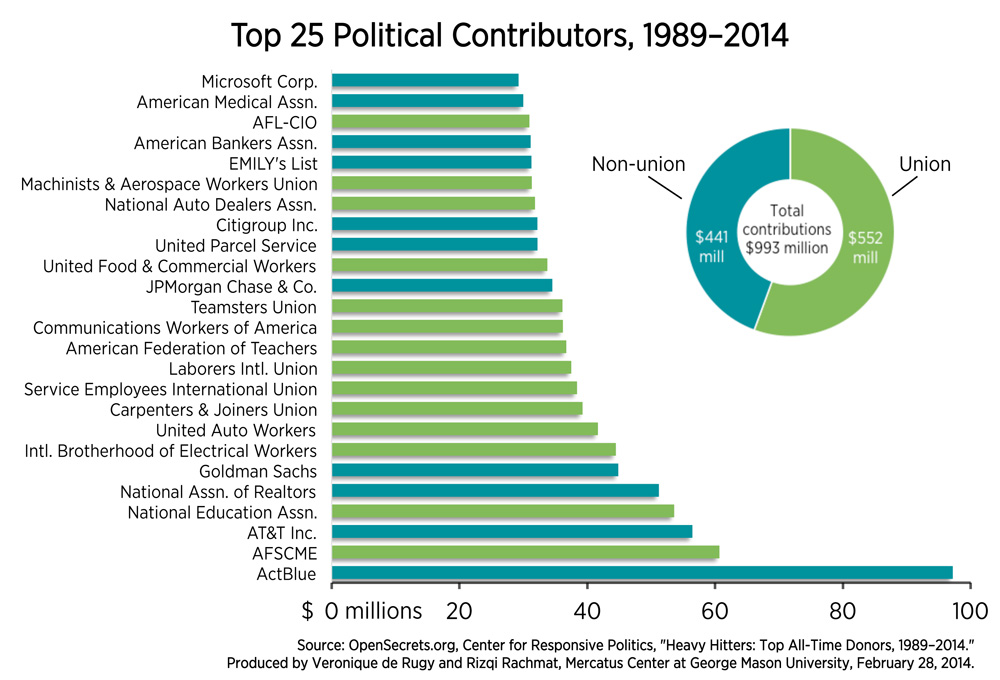
Total political contributions in 2014 election cycle
Total political contributions in 2014 election cycle (click for larger image)

To see how much unions control government, take a look at this story from National Review, written by economist Veronique to Rugy.

It says:

  • The top campaign donor of the last 25 years is ActBlue, an online political-action committee dedicated to raising funds for Democrats. ActBlue’s political contributions, which total close to $100 million, are even more impressive when one realizes that it was only launched in 2004. That’s $100 million in ten years.
  • Fourteen labor unions were among the top 25 political campaign contributors.
  • Three public-sector unions were among the 14 labor groups: the American Federation of State, County, and Municipal Employees; the National Education Association; and the American Federation of Teachers. Their combined contributions amount to $150 million, or 15 percent of the top 25’s approximately $1 billion in donations since 1989.
  • Public- and private-sector unions contributed 55.6 percent — $552 million — of the top 25’s contributions.

Where does the money go? The Daily Caller notes:

“Nearly all of labor’s 2012 donations to candidates and parties – 90 percent – went to Democrats,” the report from CRP concluded. “Public sector unions, which include employees at all levels of government, donated $14.7 million to Democrats in 2014.”

But someone has a plan to do something about this: Scott Walker.

This Investors Business Daily article by economist Veronique de Rugy explains what he would do to the unions if elected President in 2016.

She writes:

Wisconsin Gov. Scott Walker just proposed a plan to overhaul the country’s labor laws, called “My Plan to Give Power to the People, Not the Union Bosses.”

It would do that by expanding employee choice and holding unions accountable to their members.

One of the main underlying themes of the Republican presidential hopeful’s private-sector reforms is transferring power and decision-making from unions to their members.

For instance, the plan would guarantee employees’ rights by strengthening secret-ballot elections. Under current law, unions have ways to work around the protections, making such elections less than secret. The change would protect workers from retaliation by not disclosing their choices to unions during workplace elections.

Though federal laws outlaw extortion, the Supreme Court has ruled that they usually do not apply to unions. Walker’s plan would change that to protect workers from threats, violence and extortion from unions.

Similarly, his reforms would protect whistleblowers who report wrongdoing on the part of a union from being fired or discriminated against.

[…][Public sector unions]… also make the government less effective and more expensive.

That’s why a President Walker would work with Congress to prohibit public employee unions altogether. Meanwhile, he would implement taxpayer and paycheck protections.

As Heritage Foundation labor economist James Sherk explained for National Review, “Walker proposes cracking down on the use of ‘union time’ — that is, allowing federal employees to work for their unions at taxpayer expense.

“He also wants to stop unions from using federal resources to collect the portion of dues that they spend on political causes and lobbying.”

Walker’s plan also would establish a nationwide right-to-work law, making voluntary union dues the default option for all private- and public-sector workers. It would give workers the freedom to choose whether they want to be in a union or not.

States that want to take this freedom away from their workers would have to affirmatively vote to opt out of right-to-work status.

[…]The Walker plan includes many more reforms, such as a repeal of the Davis-Bacon wage controls, which alone could save taxpayers nearly $13 billion over the next 10 years. If implemented, it would be a giant step toward freeing businesses, employers, workers and taxpayers from the incredible burden imposed on them by federal labor laws and union bosses.

Why should we believe that he’ll really do it? Well, unlike some of the talker candidates, Walker has already done it in his state. And it worked – a $3.6 billion dollar deficit was erased.

If you are concerned about the growth of government, and all that that entails, e.g. – higher taxes, massive spending, bloated welfare state, huge levels of corruption, government waste, abortion, gay marriage, etc – then you should know that all of that is driven by the political donations of unions.

And I don’t want anyone to think that union workers are the same as union bosses. In Wisconsin, as soon as the union workers got the right to work without having the pay union dues, the vast majority of them chose not to pay union dues.

Obama administration to push for more government control in 2015

Here’s a rundown on some of the planned regulations, courtesy of Fox News. (H/T Dad)

Excerpt:

The Obama administration is trying to get fossil-fuel fired power plants to reduce carbon dioxide emissions by 30 percent from 2005 levels by 2030.

The EPA proposed the rules last year and is set to finalize them by summer 2015.

[…]Among them is a controversial EPA proposal to expand regulatory power over streams and wetlands. The agency, set to finalize the rule in April, estimates it could impose costs of between $162 million to $278 million per year…

[…][D]etractors claim it is an opening for the EPA to claim authority over countless waterways, including streams that only show up during heavy rainfall. Critics warn this could create more red tape for property owners and businesses if they happen to have even small streams on their land.

Rep. Lamar Smith, R-Texas, chairman of the House Science, Space, and Technology Committee, has called it an effort to “control a huge amount of private property across the country.”

In another EPA initiative, the agency is looking to October to finalize sweeping ozone regulations.

In proposing the limits on smog-forming pollution linked to asthma and respiratory illness in November, EPA Administrator Gina McCarthy argued that the public health benefits far outweigh the costs and that most of the U.S. can meet the tougher standards without doing anything new.

“We need to be smart — as we always have — in trying to find the best benefits in a way that will continue to grow the economy,” McCarthy said. Of reducing ozone, she added: “We’ve done it before, and we’re on track to do it again.”

But business groups panned the proposal as unnecessary and the costliest in history, warning it could jeopardize a resurgence in American manufacturing.

[…]The rules are estimated to cost industry anywhere between $3.9 billion and $15 billion by 2025. That price tag would exceed that of any previous environmental regulation in the U.S. Environmental groups are pushing for stricter limits still.

On other fronts, the Federal Communications Commission could move in a matter of months to propose new “net neutrality” rules. Obama weighed in on that debate late last year, urging the FCC to regulate the Internet like other utilities.

The White House is calling for an “explicit ban” on deals between broadband Internet providers and online services like Netflix, Amazon or YouTube to move their content faster, a potential new source of revenue for cable companies.

[…]Meanwhile, the National Labor Relations Board has issued new rules for so-called “ambush” union elections — speeding up elections and requiring employers to give unions contact information for workers. The rules take effect in April.

These regulations will have nasty effects on job-creating companies and that will work its way down to consumers, who will have to eat the costs. But at least the social engineers will feel really good about themselves, and without having to do the hard work of creating products and services that people will actually pay their own money for of their own free choice.

The very funny thing about this is how unionized blue-collar Democrats complain that they cannot compete with countries abroad, then vote in the very people that make them uncompetitive. You can bet that leaders in other low-cost countries do not pass laws to make them less competitive. And that’s why everything is manufactured abroad. Democrat voters bring these problems on themselves by electing socialists who hamstring American industry.

Federal court reinstates anti-voter-fraud law in Wisconsin, Democrats hardest hit

If it’s not close, they can’t cheat. And in Wisconsin, they can’t cheat anyway.

National Review reports:

Voter-ID opponents have suffered another stunning blow.

On Friday, the Seventh Circuit Court of Appeals dissolved the injunction that had been issued against Wisconsin’s voter-ID law by a federal district court in April. The court told Wisconsin that it “may, if it wishes (and if it is appropriate under rules of state law), enforce the photo ID requirement in this November’s elections.” In reaction, Kevin Kennedy, the state’s top election official, said that Wisconsin would take all steps necessary “to fully implement the voter photo ID law for the November general election.” The appeals court issued its one-page opinion within hours of hearing oral arguments in the appeal.

As I explained in an NRO article in May, the district court judge, Lynn Adelman, a Clinton appointee and former Democratic state senator, had issued an injunction claiming the Wisconsin ID law violated the Voting Rights Act as well as the Fourteenth Amendment. Adelman made the startling claim in his opinion that the U.S. Supreme Court’s decision in 2008 upholding Indiana’s voter-ID law as constitutional was “not binding precedent,” so Adelman could essentially ignore it.

However, that was too much for the Seventh Circuit. It pointed out, in what most lawyers would consider a rebuke, that Adelman had held Wisconsin’s law invalid “even though it is materially identical to Indiana’s photo ID statute, which the Supreme Court held valid in Crawford v. Marion County Election Board, 553 U.S. 181 (2008).”

It was also obviously significant to the Seventh Circuit that the Wisconsin state supreme court had upheld the state’s voter-ID law in July, since the three-judge panel cited that decision, Milwaukee Branch of NAACP v. Walker, too. In fact, the appeals court said the state court decision had changed the “balance of equities and thus the propriety of federal injunctive relief.”

In other words, there was no justification for striking down a state voter-ID law that was identical to one that had been previously upheld by both the Supreme Court of the United States and that state’s highest court.

[…]This is also another big defeat for Attorney General Eric Holder, who announced in July that the Justice Department would be intervening in this lawsuit. The Department lost a lawsuit that claimed South Carolina’s voter-ID law was discriminatory in 2012, and a federal judge recently refused to issue an injunction against North Carolina’s voter-ID law in another lawsuit filed by Justice.

This is a big win for Wisconsin Governor Scott Walker, who faces a tough Democrat challenger backed by powerful unions in November.