A federal stimulus grant of nearly $500,000 to grow trees and stimulate the economy in Nevada yielded a whopping 1.72 jobs, according to government statistics.
In 2009, the U.S. Forest Service awarded $490,000 of stimulus money to Nevada’s Clark County Urban Forestry Revitalization Project, aimed at revitalizing urban neighborhoods in the county with trees, plants, and green-industry training.
According to Recovery.gov, the U.S. government’s official website related to Recovery Act spending, the project created 1.72 permanent jobs. In addition, the Nevada state Division of Forestry reported the federal grant generated one full-time temporary job and 11 short-term project-oriented jobs.
[…]Repeated calls by FoxNews.com to the U.S. Forest Service were not returned.
[…]”Looking at the failure of the stimulus to live up to its promises, not just in Nevada, but throughout America, I think the question becomes ‘is there any good use of stimulus money?'” said Douglas Kellogg, communications manager for National Taxpayers Union, in an email to FoxNews.com.
[…]”The president may well propose new stimulus efforts when Congress returns from recess,” said Kellogg, “and those who learn from past stimulus debacles will not be fooled again.”
Indeed, President Obama’s stimulus bill failed by its own standards. In a January 2009 report, White House economists predicted that the stimulus bill would create (not merely save) 3.3 million net jobs by 2010. Since then, 3.5 million more net jobs have been lost, pushing the unemployment rate above 10 percent.[1] The fact that government failed to spend its way to prosperity is not an isolated incident:
During the 1930s, New Deal lawmakers doubled federal spending–yet unemployment remained above 20 percent until World War II.
Japan responded to a 1990 recession by passing 10 stimulus spending bills over 8 years (building the largest national debt in the industrialized world)–yet its economy remained stagnant.
In 2001, President Bush responded to a recession by “injecting” tax rebates into the economy. The economy did not respond until two years later, when tax rate reductions were implemented.
In 2008, President Bush tried to head off the current recession with another round of tax rebates. The recession continued to worsen.
Now, the most recent $787 billion stimulus bill was intended to keep the unemployment rate from exceeding 8 percent. In November, it topped 10 percent.[2]
Why is this? It’s because the government never spends money as efficiently as the private sector. Private sector firms have to stay lean and mean in order to stay afloat – because they have competitors who are always trying to sell better goods and services for less money. In a capitalist economy, the consumer is king – all the businesses fight to earn the customers’ money. But the government has no competitors, and so they neither care about efficiency, nor pleasing their customers.
CBS News reports:
ABC News reports:
And this one features a real economist:
We shouldn’t let the government take money out of the private sector and let the public sector spend it on “stimulus”. Stimulus means taking money away from your boss, or your possible bosses, and spending it on trees. It’s how you lose jobs – and that’s what we have today.
From the Boston Herald, a look at what happens when the government redistributes wealth based on political correctness.
Excerpt:
Evergreen Solar Inc., the Massachusetts clean-energy company that received millions in state subsidies from the Patrick administration for an ill-fated Bay State factory, has filed for bankruptcy, listing $485.6 million in debt.
Evergreen, which closed its taxpayer-supported Devens factory in March and cut 800 jobs, has been trying to rework its debt for months. The cash-strapped company announced today has sought a reorganization in U.S. Bankruptcy Court in Delaware and reached a deal with certain note holders to restructure its debt and auction off assets.
The Massachusetts Republican Party called the Patrick administration’s $58 million financial aid package, which supported Evergreen’s $450 million factory, a “waste” of money.
“The bankruptcy of Evergreen Solar is another sad event for the Massachusetts company and highlights the folly of the Patrick-Murray Administration which has put government subsidies into their pet projects instead of offering broad based relief to all Bay State employers,” said Jennifer Nassour, head of the state GOP.
Here’s a previous story about another solar-power boondoggle, from the Daily Caller.
Excerpt:
Solyndra, Inc. was supposed to have showcased the effectiveness of the Obama administration’s stimulus and green jobs initiatives, but instead it has become the center of congressional attention for waste, fraud and abuse of such programs.
According to a Feb. 17 letter signed by Energy and Commerce Committee Chairman Fred Upton, Michigan Republican, and Oversight Subcommittee Chairman Cliff Stearns, Florida Republican, to Energy Secretary Steven Chu, the Fremont, Calif.-based solar panel manufacturer should never have received a $535 million loan guarantee from the stimulus.*
The company became the first recipient of an Energy Department loan guarantee under the stimulus in March 2009, which was intended to “finance construction of the first phase of the company’s new manufacturing facility” for photovoltaic solar panels.
The Energy Department estimated in a March 20, 2009 press release that the loan guarantee would create 3,000 construction jobs and a further 1,000 jobs after the plant opened.
And President Barack Obama and Vice President Joseph Biden each personally showcased Solyndra as an example of how stimulus dollars were at work creating jobs, during appearances at the company over the course of the following year.
Biden personally announced the closure of Solyndra’s $535 million loan guarantee in a Sept. 9, 2009 speech, delivered via closed-circuit television, on the occasion of the groundbreaking of the plant.
The vice president justified the federal government’s investment in Solyndra in front of employees and other dignitaries, including Secretary Chu and former Calif. Gov. Arnold Schwartzenegger, saying the jobs the company intended to create would “serve as a foundation for a stronger American economy.”
“These jobs are the jobs that are going to define the 21st century that will allow America to compete and to lead like we did in the 20th century,” Biden said.
According to Biden’s speech, the $535 million loan guarantee was a smaller part of the $30 billion of stimulus money the administration planned to spend as part of its Green Jobs Initiative.
Obama made similar claims in a May 26, 2010 speech at the plant, but the 1,000 jobs he and Biden touted in their respective speeches failed to materialize.
Instead, Solyndra announced on Nov. 3 it planned to postpone expanding the plant, which put the taxpayers on the hook to the tune of $390.5 million taxpayers**, or 73 percent of the total loan guarantee, according to the Wall Street Journal.
It also announced that it no longer planned to hire the 1,000 workers that Obama and Biden had touted in their speeches and that it planned to close one of its older factories and planned to lay-off 135 temporary or contract workers and 40 full-time employees.
A closer look at the company shows it has never turned a profit since it was founded in 2005, according to its Securities and Exchange Commission (SEC) filings.
And Solyndra’s auditor declared that “the company has suffered recurring losses, negative cash flows since inception and has a net stockholders’ deficit that, among other factors, [that] raise substantial doubt about its ability to continue as a growing concern” in a March 2010 amendment to its SEC registration statement.
“While we understand the purpose of the Loan Guarantee Program is to help private companies engaging in clean energy products to obtain financing by providing loan guarantees, subsequent events raise questions about Solyndra was the right candidate to receive a loan guarantee in excess of half a billion dollars,” Upton and Stearns wrote.
A June 2010 Wall Street Journal report indicating that Solyndra’s majority owner, Oklahoma billionaire George Kaiser, was a major fundraiser for the 2008 Obama-Biden campaign has stimulus opponents such as Citizens Against Government Waste crying foul.
Even the radically left-wing Huffington Post is getting the picture, in this article entitled “The Party’s Over for Big Wind“.
Excerpt:
Here’s the reality: the backlash against industrial wind is real, it’s global, and it’s growing. The U.S. has about 170 anti-wind groups. AWEA doesn’t want you to know that a number of towns in New York state have prohibited the construction of industrial wind turbines. In April, the town of Falmouth, Massachusetts enacted a year-long moratorium on construction of new wind turbines. And earlier this month, a pair of environmental groups in Massachusetts called for a ban on new turbines in the state until more work is done on the health effects of wind turbine noise.
The wind lobby is desperate to downplay the problem of infrasound from wind turbines. But this month, in a peer-reviewed article in the Bulletin of Science, Technology & Society, Carl V. Phillips, a Harvard-trained PhD, concludes that there is “overwhelming evidence that wind turbines cause serious health problems in nearby residents, usually stress-disorder type diseases, at a nontrivial rate.”
The subsidies for wind energy are in peril. A recent report from the Energy Information Administration shows that in 2010, the wind energy sector got more federal subsidies than any other energy sector other than biofuels. The report found that wind energy got a total of $4.986 billion in subsidies, or nearly twice as much as was given to the oil and gas sector, which got $2.82 billion. The majority of the wind energy money came from the federal stimulus package passed in 2009. But much of that stimulus money has been spent.
Last December, AWEA cheered after Congress approved a tax bill that included a one-year extension of the investment tax credit for renewable energy. But another high-profile renewable energy subsidy, the tax credit for the corn ethanol scam, is due to expire at the end of this year. And given that Republicans in Washington are eager to cut all types of federal spending, the investment tax credit is likely to, once again, be in legislators’ cross hairs.
Bode was right a year ago when she said the wind industry is in distress. Her industry’s still in peril today because it cannot survive without mandates and taxpayer subsidies. And unless or until it can, she cannot expect any sympathy from cash-strapped voters.
Why are we wasting money on unproven technologies? Do we have money to waste on old-time religion?
PAUL KRUGMAN, NEW YORK TIMES: Think about World War II, right? That was actually negative social product spending, and yet it brought us out.
I mean, probably because you want to put these things together, if we say, “Look, we could use some inflation.” Ken and I are both saying that, which is, of course, anathema to a lot of people in Washington but is, in fact, what fhe basic logic says.
It’s very hard to get inflation in a depressed economy. But if you had a program of government spending plus an expansionary policy by the Fed, you could get that. So, if you think about using all of these things together, you could accomplish, you know, a great deal.
If we discovered that, you know, space aliens were planning to attack and we needed a massive buildup to counter the space alien threat and really inflation and budget deficits took secondary place to that, this slump would be over in 18 months. And then if we discovered, oops, we made a mistake, there aren’t any aliens, we’d be better –
ROGOFF: And we need Orson Welles, is what you’re saying.
KRUGMAN: No, there was a “Twilight Zone” episode like this in which scientists fake an alien threat in order to achieve world peace. Well, this time, we don’t need it, we need it in order to get some fiscal stimulus.
It’s important to note that Paul Krugman’s plan is actually better than Obama’s plan, because Obama doesn’t have a plan.
The Newsbusters piece explains what’s wrong with stimulating the economy with an alien invasion, as seen on the Twilight Zone TV show.
Excerpt:
But more importantly, let’s look at the numbers involved to really get a sense of what Krugman advocated here.
The money unsuccessfully thrown at the Depression prior to World War II was staggering. From 1929 to 1939, government spending tripled from $3 billion a year to $9 billion.
And yet unemployment at the end of 1939 was still 17.2 percent.
Not a very good advertisement for Keynesian economics, is it?
Now imagine that kind of “stimulus” today. That would mean the current $3.8 trillion budget would have to rise to $11.4 trillion which would generate about $9 trillion of debt a year.
What do you think would happen to our credit rating and our dollar then? Wouldn’t be pretty, would it?
Yet that didn’t work in the ’30s – a fact that most liberals other than Krugman still contest – so the Nobel laureate is advocating that we spend like we’re being attacked by space aliens in order to get to the level of outlays during World War II.
Total federal spending in 1940 was $9.5 billion. By 1945, this had risen almost tenfold to $93 billion.
Such an increase in today’s budget would create a deficit greater than $30 trillion per year making our dollar and our Treasuries totally worthless.
[…]Consider too that the lasting stimulative quality of even the World War II spending is up for debate.
The National Bureau of Economic lists a recession that began in February 1945 that lasted until October of that year. This recession happened despite the federal government spending almost tens times as much as it had only five years prior and 30 times more than in 1929.
Once again, not a very good advertisement for Keynesian economics.
But let’s take this a step further, for NBER’s recession numbers might be too conservative. According to the Bureau of Economic Analysis, the Gross Domestic Product shrank by 1.1 percent in 1945, a staggering 10.9 percent in 1946, and 0.9 percent in 1947.
Again, this was after the largest explosion in federal spending in our nation’s history, and this is what Krugman is advocating we repeat.
So what is stimulus spending? Stimulus spending is when you take money OUT of the hands of people who create jobs, and put it into the hand of people who the government thinks deserves that money more. Let’s see who the government thinks deserves the money more than employers.
CBS News reports:
ABC News reports:
And this one features a real economist:
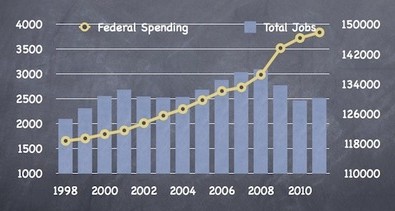
Obama promised that if we let him redirect $864 billion dollars from taxpayers to other people he chose, then that would make unemployment stay below 8%. So did all that “stimulus” keep unemployment below 8%?
The stimulus was worse than doing NOTHING AT ALL
(Click for larger image)
Let’s learn some economics and find out why that happened.
Economics in One Lesson
Perhaps it is time to review Henry Hazlitt’s book on basic economics “Economics in One Lesson”. Let’s look in chapter 4, which is entitled “Public Works Mean Taxes”.
Excerpt from that chapter:
Therefore, for every public job created by the bridge project a private job has been destroyed somewhere else. We can see the men employed on the bridge. We can watch them at work. The employment argument of the government spenders becomes vivid, and probably for most people convincing. But there are other things that we do not see, because, alas, they have never been permitted to come into existence. They are the jobs destroyed by the $10 million taken from the taxpayers. All that has happened, at best, is that there has been a diversion of jobs because of the project. More bridge builders; fewer automobile workers, television technicians, clothing workers, farmers.
And consider Chapter 5 as well, entitled “Taxes Discourage Production”.
In our modern world there is never the same percentage of income tax levied on everybody. The great burden of income taxes is imposed on a minor percentage of the nation’s income; and these income taxes have to be supplemented by taxes of other kinds. These taxes inevitably affect the actions and incentives of those from whom they are taken. When a corporation loses a hundred cents of every dollar it loses, and is permitted to keep only fifty-two cents of every dollar it gains, and when it cannot adequately offset its years of losses against its years of gains, its policies are affected. It does not expand its operations, or it expands only those attended with a minimum of risk. People who recognize this situation are deterred from starting new enterprises. Thus old employers do not give more employment, or not as much more as they might have; and others decide not to become employers at all. Improved machinery and better-equipped factories come into existence much more slowly than they otherwise would. The result in the long run is that consumers are prevented from getting better and cheaper products to the extent that they otherwise would, and that real wages are held down, compared with what they might have been.
There is a similar effect when personal incomes are taxed 50, 60 or 70 percent. People begin to ask themselves why they should work six, eight or nine months of the entire year for the government, and only six, four or three months for themselves and their families. If they lose the whole dollar when they lose, but can keep only a fraction of it when they win, they decide that it is foolish to take risks with their capital. In addition, the capital available for risk-taking itself shrinks enormously. It is being taxed away before it can be accumulated. In brief, capital to provide new private jobs is first prevented from coming into existence, and the part that does come into existence is then discouraged from starting new enterprises. The government spenders create the very problem of unemployment that they profess to solve.
And the results we see today are consistent with the predictions of basic economic theory.
George W. Bush cut taxes in his first term and created 1 million NEW JOBS. On the other hand, Obama transfered BILLIONS from the private sector to the public sector, where government waste is rampant. Government spending is a job killer. Obama might be a nice man, but he is just wrong on economics and business. What we should have done is elected someone who doesn’t repeat the mistakes made in other countries, like in Japan where massive government spending failed to stimulate the economy. We just need to look at where the ideas of Paul Krugman, Fareed Zakaria and Barack Obama have been tried – like in Spain and Greece – and see whether all of this government spending led to economic prosperity and a low unemployment rate. I know that it makes them feel good to think that they are responsible for punishing those who work, and rewarding those who don’t work. But maybe we should look at the results of their policies and decide that we just can’t afford to sacrifice the entire economy to make three people feel good about themselves. As far as I can tell, Keynesian economics has never created jobs whenever it’s been tried – although it does make the liberal elite feel superior to job creators. It works to do that.


 WINTERY KNIGHT