May’s weak jobs report further confirms the president’s policies are failing to help the economy. This is, indeed, the worst recovery since the Depression.
Negative superlatives associated with this presidency keep piling up. The toll so far:
The share of Americans who’ve been out of work a long time — now at 42% of the unemployed — is the highest since the Great Depression (source: Labor Department).
The proportion of the civilian working-age population actually working, at 58%, is the smallest since the Carter era (Labor Department).
Growth in nonfarm payroll jobs since the recovery began in June 2009 is the slowest of any comparable recovery since World War II (Hoover Institution).
The rate of new business startups — the engine of job growth — has plunged to an all-time low of 7.87% of all businesses (Census Bureau).
3 in 10 young adults can’t find jobs and live with their parents, highest since the 1950s (Pew Research).
54% of bachelor’s degree-holders under the age of 25 are jobless or underemployed, the highest share in decades (Northeastern University).
Black teen unemployment, now at 37%, is near Depression-era highs (Labor Department).
Almost 1 in 6 Americans are now poor — the highest ratio in 30 years — and the total number of poor, at 49.1 million, is the largest on record (Census).
The share of Hispanics in poverty has topped that of blacks for the first time, 28.2% to 25.4% (Census).
The number of Americans on food stamps — 45 million recipients, or 1 in 7 residents — also is the highest on record (Congressional Budget Office).
Total government dependency — defined as the share of Americans receiving one or more federal benefit payments — is now at 47%, highest ever (Hoover).
The share of Americans paying no income tax, at 49.5%, is the highest ever (Heritage Foundation, IRS).
The national homeownership rate, now at 65.4%, is the lowest in 15 years (Census).
The 30-point gap between black and white Americans who own their own homes is the widest in two decades and one of the widest on record (Census).
Federal spending, now at 23.4% of GDP, is the highest since WWII (CBO).
Excluding defense and interest payments, spending is the highest in American history, at 17.6% of the economy (First Trust Economics).
The federal debt, at 69% of GDP, is the highest since just after WWII (CBO).
The U.S. budget deficit, now at 9.5% of the economy, is the highest since WWII (CBO).
U.S. Treasury debt has been downgraded for the first time in history, meaning the U.S. government no longer ranks among risk-free borrowers (S&P).
This is what Obamanomics has wrought. Fiscal promiscuity. Trickle-up poverty. Shared misery.
Here’s the Obama legacy in two charts:
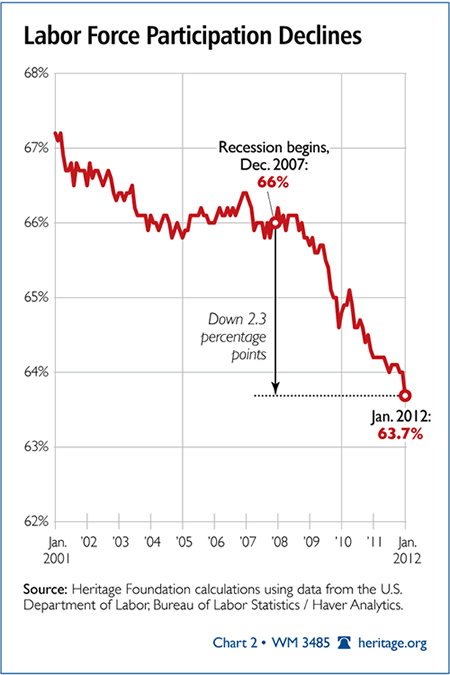
US Labor Force Participation down 4.9 million people
The updated labor force participation is actually lower now than in January.
And:
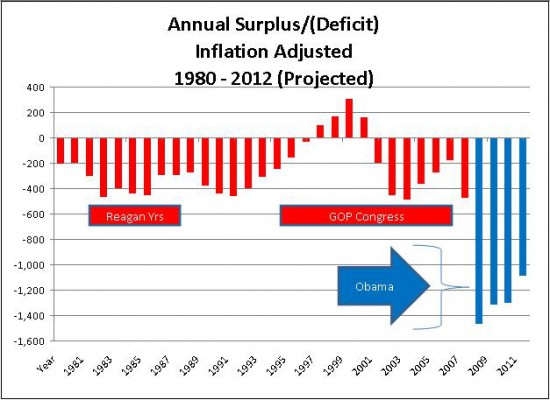
Barack Obama: Budget Deficits
What I find alarming is that Obama is still polling competitively with his Republican rival.
The May jobs report was a complete and utter disaster for the economy and, perhaps, President Obama’s chances for reelection.
Employers created just 69,000 jobs last month, the Labor Department said on Friday. That’s the fewest since May of last year. Economists had been expecting nonfarm payrolls to increase by 150,000. (In fact, the result was lower than what any economist polled by Reuters had predicted.)
Moreover, companies added 49,000 fewer jobs than previously estimated in March and April. Talk about a slowdown. The average monthly gain was 226,000 in first quarter vs. an average of just 73,000 in April and May.
Oh, and the U-3 unemployment rate rose to 8.2% from 8.1%. The broader U-6 gauge, which also measures underemployment, rose to 14.8% from 14.5%. The labor force participation rate did, finally, tick up to a still-low 63.8%, lending credence to the idea that the shrinking workforce reflects discouraged workers and not just demographics.
And here’s the forecast: WE’RE DOOMED.
So what is the true state of the labor market?
– If the size of the U.S. labor force as a share of the total population was the same as it was when Barack Obama took office—65.7% then vs. 63.8% today—the U-3 unemployment rate would be 10.9%. (Now, this doesn’t take into account the aging of the Baby Boomers, which should lower the participation rate due to rising retirements. But is that still a valid assumption given the drop in wealth since 2006?)
– If you take into account the aging of the Baby Boomers, the participation rate should be trending lower. Indeed, it has been doing just that since 2000. Before the Great Recession, the Congressional Budget Office predicted what the participation rate would be in 2012, assuming such demographic changes. Using that number, the real unemployment rate would be 10.5%.
– Of course, the participation rate usually falls during recessions. Yet even if you discount for that and the aging issue, the real unemployment rate would be 9.5%.
– We continue to be stuck in the longest period of 8% unemployment or higher since the Great Depression, 40 consecutive months.
– And, as the above chart shows — originally from Obama economists Christina Romer and Jared Bernstein in January 2009 –the current 8.2% unemployment rate is 2.5 percentage points above where Team Obama predicted it would be right now if Congress passed his trillion-dollar stimulus plan.
– The median duration of unemployment rebounded to 20.1 weeks in May, and 42.8% were unemployed for longer than a half year.
– Total hours worked fell 0.2% on weakness in the work week.
– Average hourly earnings rose just 0.1%. Coupled with a very stable overall inflation rate, real wages were likely flat in May.
The big question now:Does this report suggest the U.S economy is heading into recession, especially given the sharp slowdown in global economic activity from Europe to India to, perhaps most worrisome, China?
Consider this: Last year, the U.S. grew at just a 1.7% pace. Research from the Federal Reserve finds that that since 1947 when year-over-year real GDP growth falls below 2 percent, recession follows within a year 70 percent of the time. We are firmly within the Recession Red Zone.
Facebook friend WGB pointed me to this story in CNS News:
The number of American women who are unemployed was 766,000 individuals greater in May 2012 than in January 2009, when President Barack Obama took office, according to data released today by the Bureau of Labor Statistics.
In January 2009, there were approximately 5,005,000 unemployed women in the United States,according to BLS. In May 2012, there were 5,771,000.
[…]The number of women employed in the United States peaked at 68,102,000 in April 2008, according to BLS. The number of women employed in the United States today is 1,216,000 less than that.
Remember, the Democrats got control of Congress in January 2007, and had control of spending in the 2008 fiscal year. My take is that the hiring is still going on in places like Canada and Chile and Sweden, where government isn’t taxing and regulating job creators into oblivion. Companies are still hiring and expanding and drilling for oil – just not here.
Election 2011: Conservatives in Blue, Socialists in Red, Communists in Orange
I found two examples of policies that promote the redistribution of wealth from producers to non-producers in Canada. I think it’s worth taking a look at their policies so that we understand more about our own redistribution policies.
The first example of redistribution has to do with unemployment insurance, where productive taxpayers who choose low-risk, high-pay jobs must subsidize other citizens who get high-risk, low-pay jobs. Their program is called “Employment Insurance”. Canadians who work have to pay into the system, and when any of them loses their jobs, then they get to take money out of it. Those who work more pay more, those who work less pay less. Those with safe jobs collect nothing, and those with risky jobs collect more.
Is this program fair? In this article from Brian Lilley’s Lilley Pad blog, Canadian columnist Lorne Gunter explains what’s wrong with this program.
Excerpt:
Employment Insurance is a lot of things, but an insurance plan to encourage employment it is not.
For one thing, the premiums aren’t based on the risk of making a claim.
Young drivers pay higher auto insurance premiums because they are much more likely to get in an accident. Yet Canadians in high-unemployment industries and high-unemployment regions make no higher EI contributions than those who live where they are never likely to be without work.
Indeed, those most likely to make EI claims will make far lower lifetime contributions than those who are unlikely ever to claim. That makes EI a welfare program underwritten by a tax on employment, rather than an insurance plan.
In the 1990s, I interviewed a Statistics Canada researcher who had made the study of EI his life’s work. He told me that he had discovered one New Brunswick town of 3,000 people where every adult had made at least one EI claim. Most had claimed three or more times.
In some areas, EI is an accepted part of the culture. It’s that entitlement mentality the Tories’ changes are aimed at breaking.
In the CBC’s fawning 1994 biography of Pierre Trudeau, St. Pierre admitted that one of the goals of his government’s ’70s-era reforms to Unemployment Insurance (as it was more accurately known then) was to enable Canadians to stay in their home regions if they wanted to, even if they were never likely to find steady work there.
So the scheme is also an interregional transfer of wealth — from have to have-not provinces.
Of course, every year thousands of Canadians move from have-not regions to more prosperous areas in search of better jobs and higher pay. So it is not as though everyone who could collects EI to stay put.
But the question is why should hard-working Canadians be compelled to subsidize anyone who refuses to move or turns down locally available work?
It’s very similar to their health care programs, which transfers wealth from producers to health care users – and remember that not all health care is from stuff like car accidents. Abortions, IVF and sex changes are entirely voluntary – based on lifestyle choices.
But this is not the only program that transfers wealth from workers to non-workers. It turns out that there is an entire province of Canada that has a majority of secular socialist slackers who can’t pay their own way, but must instead depend on the rest of Canada to support them.
Eric Duhaime explains in this article on the Lilley Pad.
Excerpt:
Although we live in the same house, we certainly don’t sleep in the same room anymore. Our romantic days are long gone. Quebec and the rest of Canada have grown apart. Young Quebecers have no appetite for constitutional quarrels, although they define themselves more and more as Quebecois and less and less as Canadians. They have even invented the word “decanadianization.”
Conversely, English-Canadians are becoming more and more fed up with paying for Quebec, which receives more than half the money given through the so-called equalization program, the equivalent of $8 billion a year.
The solution might not be to ask Quebec to become an independent nation but to become less dependent on its neighbours and more fiscally autonomous. To calm English Canada down, the equalization formula — which will be reviewed before 2014 anyway — could be modernized.
Canada has evolved over the years. The need for interprovincial welfare is not as necessary as it used to be. The principle of redistribution is part of our Constitution but could focus exclusively on funding very essential social programs, which wouldn’t include $7-a-day daycare or a fully subsidized year of parental leave after the birth of each child.
I think it would be an excellent idea to cut Quebec loose. Whatever goods and services they produce could still be bought by the rest of Canada – if there are any such things. Let them pay for their own exorbitant abortion and day care costs, for a start.
Why am I posting about Canada? I think it’s important for us to look at other countries so that we understand how public policies that are sold to us as “compassionate” actually punish hard work, thrift and risk-taking while at the same time rewarding ignorance, wastefulness and sloth. In fact, one could argue that Obamacare itself is nothing more than a way to transfer wealth from those who are take care of their health and work hard for their money, to those who are unemployed and want free contraceptives, abortions and sex changes. You can get all three of those things in the Canadian province of Ontario, and in the UK as well. But the UK goes even further and provides taxpayer-funded IVF and breast implants. This is what liberal compassion really means: pillaging those who sacrifice their leisure to work, in order to buy votes from unproductive, reckless and lazy special interest groups.


 WINTERY KNIGHT