
Tag Archives: Unemployment

Basic economics: what’s wrong with raising minimum wage rates?

Economist Thomas Sowell

From Investors Business Daily, an article by famous economist Thomas Sowell.

Excerpt:

Political crusades for raising the minimum wage are back again. Advocates of minimum-wage laws often give themselves credit for being more “compassionate” towards “the poor.”

But they seldom bother to check what are the actual consequences of such laws.

One of the simplest and most fundamental economic principles is that people tend to buy more when the price is lower and less when the price is higher.

Yet advocates of minimum-wage laws seem to think that the government can raise the price of labor without reducing the amount of labor that will be hired.

[…]Switzerland is one of the few modern nations without a minimum-wage law. In 2003, the Economist magazine reported: “Switzerland’s unemployment neared a five-year high of 3.9% in February.”

In February of this year, Switzerland’s unemployment rate was 3.1%. A recent issue of the Economist showed Switzerland’s unemployment rate as 2.1%.

Most Americans today have never seen unemployment rates that low. However, there was a time when there was no federal minimum-wage law in the United States.

The last time was during the Coolidge administration, when the annual unemployment rate went as low as 1.8%. When Hong Kong was a British colony, it had no minimum-wage law. In 1991 its unemployment rate was under 2%.

[…]Most people in the lower income brackets are not an enduring class. Most working people in the bottom 20% in income at a given time do not stay there over time. More of them end up in the top 20% than remain behind in the bottom 20%.

There is nothing mysterious about the fact that most people start off in entry-level jobs that pay much less than they will earn after they get some work experience.

But when minimum-wage levels are set without regard to their initial productivity, young people are disproportionately unemployed — priced out of jobs.

In European welfare states where minimum wages, and mandated job benefits to be paid for by employers, are more generous than in the United States, unemployment rates for younger workers are often 20% or higher, even when there is no recession.

Unemployed young people lose not only the pay they could have earned but, at least equally important, the work experience that would enable them to earn higher rates of pay later on.

Minorities, like young people, can also be priced out of jobs. In the United States, the last year in which the black unemployment rate was lower than the white unemployment rate — 1930 — was also the last year when there was no federal minimum-wage law.

Inflation in the 1940s raised the pay of even unskilled workers above the minimum wage set in 1938. Economically, it was the same as if there were no minimum-wage law by the late 1940s.

In 1948 the unemployment rate of black 16-year-old and 17-year-old males was 9.4%. This was a fraction of what it would become in even the most prosperous years from 1958 on, as the minimum wage was raised repeatedly to keep up with inflation.

A survey of American economists found that 90% of them regarded minimum-wage laws as increasing the rate of unemployment among low-skilled workers.

Harvard University economist Greg Mankiw puts the agreement level at 79%. This is not controversial. This is one of the most widely-accepted facts in economics. Generally, if you raise the price of domestic labor, without any increase in worker productivity, then it reduces demand for domestic labor and causes companies to reduce hiring and retention, possibly looking elsewhere for labor. Compassionate-sounding policies actually cause negative results like outsourcing and layoffs. The very people who agitate the most for a “living wage” cause higher unemployment – especially among youth and minorities.

The only sure way to help workers is to give them marketable skills and job experience – that’s what really draws higher salaries and better benefits. And that means advocating for smarter policies: fewer regulations on job creators, lowering the employer portion of payroll taxes, merit pay for teachers, vouchers to encourage competition between schools, making work pay more than collecting welfare for doing nothing. And so on. That would actually solve the problem of people not having work.
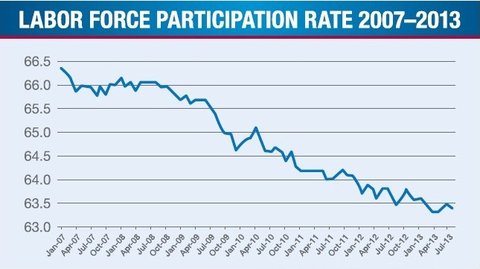
Which policies have caused our low labor force participation rate?

Labor Force Participation Rate from 2007 (Pelosi/Reid) to 2013

Jay Richards tweeted this article from the Wall Street Journal. The article is an interview with a business owner named Bob Funk whose job it is to match job seekers to job creators.

Hiring is down because of increased regulation of employers and fear of interventionism:

Here’s something you don’t often see in Washington: a businessman trying to repeal a law that helps his company. That’s Bob Funk’s latest mission in life. He’s the president and founder of Express Employment Services, the fifth-largest employment agency in America, with annual sales of $2.5 billion and more than 600 franchises across the country. This year he will place nearly half a million workers in jobs.

“ObamaCare has been an absolute boon for my business,” he says as we sit in his new office headquarters near downtown Oklahoma City. “I’m making a lot of money thanks to that law. We’re up 8% this year. But it’s just terrible for the country. I see that firsthand every day.”

Why is the health-care law good for Express but bad for the country? “Firms are just very reluctant to hire full-time workers,” Mr. Funk says. “So they are taking on more temporary help, which is what we do.” ObamaCare imposes new mandates and penalties on companies with more than 50 full-time employees—and even those working 30 hours a week are considered full-time.

He quickly adds: “The problem isn’t just ObamaCare, though. It’s the entire regulatory assault on employers coming out of Washington—everything from the EEOC”—the Equal Employment Opportunity Commission hits companies hard when employees claim age, race or sex discrimination—”to the Dodd-Frank monstrosity. Employers are living in a state of fear.”

So let’s take a look at what is causing a record low labor force participation rate.

The younger generation does not have a good work ethic:

The primary jobs problem today, Mr. Funk says, is that too many workers are functionally unemployable because of attitude, behavior or lack of the most basic work skills. One discouraging statistic is that only about one of six workers who comes to Express seeking employment makes the cut. He recites a company statistic that about one in four applicants can’t even pass a drug test.

“In my 40-some years in this business, the biggest change I’ve witnessed is the erosion of the American work ethic. It just isn’t there today like it used to be,” Mr. Funk says. Asked to define “work ethic,” he replies that it’s fairly simple but vital on-the-job behavior, such as showing up on time, being conscientious and productive in every task, showing a willingness to get your hands dirty and at times working extra hours. These attributes are essential, he says, because if low-level employees show a willingness to work hard, “most employers will gladly train them with the skills to fill higher-paying jobs.”

He fears that too many of the young millennials who come knocking on his door view a paycheck as a kind of entitlement, not something to be earned. He is also concerned that the trendy concept of “life-balancing” is putting work second behind leisure.

Welfare spending discourages people from working:

When pressed to explain what Washington can do to get Americans back on the job, Mr. Funk says the first step would be to start shrinking the “vast social welfare state programs that have become a substitute for work. There’s a prevalent attitude of a lot of this generation of workers that the government will always be there to take care of them. It’s hard to get people to take entry-level jobs when they can get unemployment benefits, health care, food stamps and the rest.”

This week during the food-stamp debate in Congress, Democrats voted unanimously against work requirements and ridiculed Republicans who suggested that the expansion of food stamps to 47 million Americans has discouraged working. The Democrats are living in a fantasy world, according to Mr. Funk. He points to Congress’s decision in 2009 to increase unemployment-insurance benefits to 90 weeks or more as “a policy that held a lot of people out of the workforce until the checks stopped coming. We saw that here very clearly.”

Disability makes people less inclined to get a job:

The most abused government program, he says, is disability insurance and the 14 million Americans who now collect these benefits. Express has found that over half of the disability claims brought by its workers have turned out to be fraudulent. “We win 90% of the disability cases that we challenge in court,” Mr. Funk says.

Skills deficit makes people less employable:

Another big hurdle is the widening skills deficit. At any given time, Mr. Funk says, Express has as many as 20,000 jobs the company can’t fill because workers don’t have the skills required. His advice to young people who are looking for a solid career is to get training in accounting (thanks to Dodd-Frank’s huge expansion of paperwork), information technology, manufacturing-robotics programming, welding and engineering. He’s mystified why Express has so much trouble filling thousands of information-technology jobs when so many young, working-age adults are computer literate.

Public schools and universities don’t prepare people for work:

He blames public schools and universities for the skills mismatch. Young people looking for a financially secure future might want to heed one of his favorite pieces of cautionary advice: “If you’ve got a college degree in psych, poly-sci or sociology, sorry, I can’t help you find a job.” He urges greater emphasis on vocational and practical skills training in schools, universities and junior colleges.

With so many ideas about how to help get the country on track, Mr. Funk might seem ripe to enter politics, but he already made one electoral foray—he was a local school-board member for 11 years—and found it an exercise in pure frustration. Bringing his pay-for-performance values to the board, he spent years futilely trying to get rid of bad teachers and to reward “the 30% that are really good.”

He says “teacher tenure is by far the most corrupt social institution in our time, because it doesn’t reward excellence or weed out bad teachers.” The teachers union had operational control of the school board, and Mr. Funk couldn’t get them to budge. He says the union celebrated when he left the board.

I think that this shows the important of having private sector experience in a President. When you are looking to hire a President, you want to hire someone who has already done what he claims he wants to do, at a smaller level. If you want someone to fix health care, pick someone like Bobby Jindal who has already done it in his state. If you want someone to make schools accountable, pick Scott Walker. If you want someone to cut spending, pick Rick Scott. If you want someone to create jobs, pick Rick Perry. If you want someone to balance the budget, pick John Kasich. Pick a candidate who can do the work. Not someone who passionately speaks about how he wants to do the work. Pick someone who has been fabulously successful at actually doing what he says he wants to do.

Our current President knew nothing about running a business or how jobs are created when he was elected. He was just a community organizer. Never did a thing in the private sector. Maybe he could get lucky at making policies that would create jobs, but “lucky” our best option? Next time, let’s not take chances. Pick someone who has proved that he can do the work based on past performance. Not speeches.

Obama administration effectively bans construction of future coal plants

CNBC explains. (H/T Bad Blue)

Excerpt:

The proposal would help reshape where Americans get electricity, away from a coal-dependent past into a future fired by cleaner sources of energy. It’s also a key step in President Barack Obama’s global warming plans, because it would help end what he called “the limitless dumping of carbon pollution” from power plants.

Although the proposed rule won’t immediately affect plants already operating, it eventually would force the government to limit emissions from the existing power plant fleet, which accounts for a third of all U.S. greenhouse gas emissions.

[…]Despite some tweaks, the rule packs the same punch as one announced last year, which was widely criticized by industry and Republicans as effectively banning any new coal projects in the U.S.

That’s because to meet the standard, new coal-fired power plants would need to install expensive technology to capture carbon dioxide and bury it underground. No coal-fired power plant has done that yet, in large part because of the cost.

[…]”EPA has set a dangerous and far-reaching precedent for the broader economy by failing to base environmental standards on reliable technology,” said Hall Quinn, president and CEO of the National Mining Association. The EPA regulation “effectively bans coal from America’s power portfolio,” he said.

The first effect of this decision will be to put a lot of Americans out of work.

The second effect will be to cause electricity costs to skyrocket, exactly as Obama promised.

Excerpt:

Wind and solar energy are dilute, intermittent, and more costly than traditional hydrocarbon energy sources. After atmospheric absorption and system losses, only a single 100-watt bulb can be powered from a square meter of solar cells, and this only at midday on a cloudless day.  Wind towers must be spaced about 140 meters apart to capture energy from the wind.  As a result, solar requires 75 to 100 times the land and wind requires 150 to 250 times the land of traditional power sources.

Solar systems don’t output energy at night or at low angles of incoming sunlight.  Wind systems provide rated output less than 30% of the time and this output varies chaotically. Traditional gas or coal power plants must be running as an active backup to maintain continuity of electricity supply.  Like a car driving in stop-and-go conditions, installation of a wind farm converts the power system into a stop-and-go electrical system.  In measured real world conditions, combined wind and hydrocarbon systems use more fuel, output more sulfur and nitrogen oxides, and emit more carbon dioxide than hydrocarbon-only electrical systems.

Total cost estimates show that wind and solar systems are significantly more costly than hydrocarbon energy sources.  Since wind requires an active backup hydrocarbon facility, wind can only replace some of the variable cost of a coal or gas plant.  Department of Energy 2011 estimates place the variable cost of coal at 3 cents per kW-hr and gas at 5 cents per kW-hr, compared to 9 cents for on-shore wind and 24 cents for offshore wind.  Solar costs are 20 to 30 cents per kW-hr.

We’re getting what we voted for. We’ve had no significant global warming for 15 years, but that won’t stop the Democrats from saddling private industry with regulatory costs – costs that they will pass on to consumers. I would not be surprised if consumers (who after all mostly voted for Obama) blame the energy companies and never identify the root cause of the rising costs.